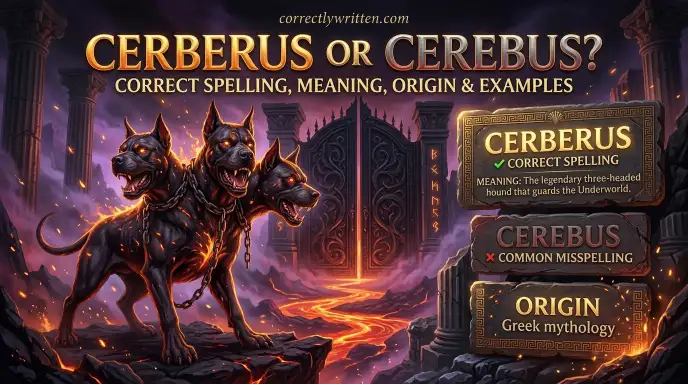
Cerberus is the correct spelling of the mythical three headed dog that guards the entrance to the Underworld in Greek mythology, while Cerebus is a common misspelling of the name. The two words look similar and sound alike in many English accents, which makes them easy to confuse.
However, when referring to the legendary creature associated with Hades and the realm of the dead, the correct name is Cerberus. This creature is one of the best known figures in Greek mythology and appears in stories about heroes who journey into the Underworld. One famous example is Heracles, also known as Hercules in Roman mythology, who captures Cerberus as part of his Twelve Labours.
The spelling Cerebus may appear in other contexts, including fictional names and creative works, but it is not the standard spelling of the Greek mythological guardian. Understanding the difference helps you write accurately when discussing mythology, literature, fantasy stories, and popular culture. This guide explains the meanings, origins, differences, common mistakes, and correct usage of Cerebus and Cerberus.
Cerebus or Cerberus: Quick Answer
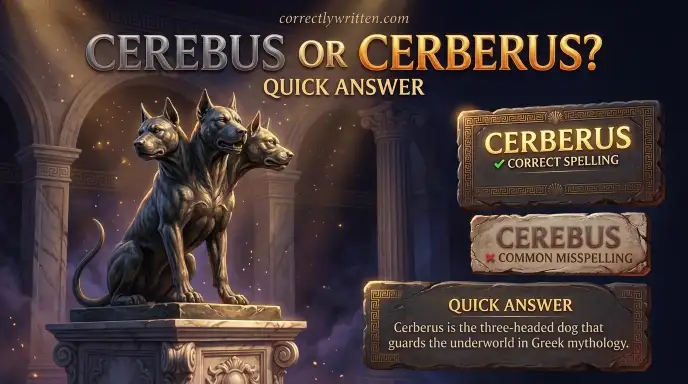
Cerberus is the correct spelling for the legendary guardian dog in Greek mythology.
Cerebus is generally a misspelling when someone intends to refer to this mythological creature. However, it can appear as a proper name in other contexts.
- Cerberus: The mythical multi headed dog that guards the Underworld.
- Cerebus: A spelling often used mistakenly in place of Cerberus, although it may also occur as a name in other works.
- Correct example: “Cerberus guarded the entrance to the Underworld.”
Memory tip: Remember the spelling Cerberus with the letter r after the first e: C E R B E R U S.
Definition and Meaning of Cerberus and Cerebus
What Does Cerberus Mean?
Cerberus is the name of a creature in ancient Greek mythology that guards the entrance to the Underworld, the realm associated with Hades, the god of the dead.
Cerberus is commonly described as a three headed dog. Some ancient and later artistic representations give the creature additional features, such as a serpent like tail or snakes around its body.
In mythology, Cerberus prevents the dead from leaving the Underworld and keeps the living from entering without permission. The creature therefore represents a powerful guardian between the world of the living and the world of the dead.
Examples:
- “Cerberus guarded the gates of the Underworld.”
- “Heracles was ordered to bring Cerberus to the surface.”
- “The artist painted Cerberus as a terrifying three headed dog.”
The name is especially common in discussions of Greek mythology, classical literature, fantasy fiction, and mythology inspired games.
What Does Cerebus Mean?
Cerebus is not the standard spelling of the Greek mythological dog’s name.
People commonly type Cerebus when they mean Cerberus, often because the two spellings look similar and the correct form is unfamiliar.
However, Cerebus can also appear as a proper name in other contexts. For example, Cerebus the Aardvark is the title character of a comic book series created by Canadian cartoonist Dave Sim.
Therefore, it is important to consider the context. If you are writing about the three headed guardian in Greek mythology, use Cerberus. If you are referring to a character or work specifically named Cerebus, retain that spelling.
Examples:
- Incorrect for the mythological creature: “Cerebus guarded the Underworld.”
- Correct for the mythological creature: “Cerberus guarded the Underworld.”
- Correct as a proper name: “Cerebus the Aardvark is a comic book character.”
The Origin of Cerberus
The name Cerberus comes from the Greek name Kerberos (Κέρβερος), which refers to the guardian of the Underworld in Greek mythology.
The creature appears in ancient Greek mythological traditions and is associated with Hades and the realm of the dead. Ancient writers described Cerberus as a formidable guardian whose role was to prevent unauthorized passage between the living world and the Underworld.
One of the most famous stories involving Cerberus concerns Heracles. As the final labour in the traditional account of his Twelve Labours, Heracles was required to bring Cerberus from the Underworld. The story demonstrates the hero’s strength and courage because Cerberus was not an ordinary animal but a supernatural guardian.
The spelling Cerberus became established in English through the Latin form of the Greek name. Although the original Greek form differs in spelling, Cerberus is the familiar English spelling used in mythology books and educational materials.
The spelling Cerebus is often a simple transposition or substitution error when someone tries to remember the mythological name.
Cerebus vs Cerberus: The Main Difference
The main difference is that Cerberus is the standard name of the mythological creature, while Cerebus is usually a spelling error when referring to that creature.
Cerberus
- Correct spelling for the Greek mythological guardian.
- Commonly depicted as a three headed dog.
- Associated with Hades and the Underworld.
- Appears in the story of Heracles and his Twelve Labours.
Example: “Cerberus stood guard at the entrance to the Underworld.”
Cerebus
- A common misspelling of the mythological name.
- May appear as a distinct proper name in other contexts.
- Should not replace Cerberus in ordinary writing about Greek mythology.
Example: “The student accidentally spelled Cerberus as Cerebus in the mythology assignment.”
The distinction matters most when writing educational articles, school assignments, book reviews, and descriptions of mythological characters.
Is Cerberus the Same as the Devil?

No. Cerberus is a creature from Greek mythology, not the Devil in Christian tradition.
Cerberus guards the entrance to the Underworld, which is ruled by Hades in Greek mythology. His role is to prevent the dead from escaping and to guard the boundary between worlds.
The Devil, by contrast, belongs to Christian theological traditions and has a different identity and role.
Because Cerberus is often portrayed as frightening, supernatural, and associated with the realm of the dead, modern fiction sometimes uses the creature as a symbol of evil or danger. However, that artistic interpretation does not make Cerberus the same figure as the Devil.
Example: “The fantasy novel portrayed Cerberus as a demonic looking guardian, but the character originated in Greek mythology.”
British English vs American English Spelling
There is no standard British American spelling difference between Cerberus and Cerebus.
The standard English spelling of the Greek mythological creature is Cerberus in both British and American English.
Examples:
- British English: “Cerberus guarded the entrance to the Underworld.”
- American English: “Cerberus guarded the entrance to the Underworld.”
The spelling remains the same regardless of the English variety. Cerebus is not an alternative British spelling of the mythological name.
If you are writing for an international audience, use Cerberus when discussing Greek mythology. If Cerebus appears as the official name of a fictional character, publication, or other entity, preserve the spelling used by that source.
Which Spelling Should You Use?
Choose Cerberus when referring to the three headed dog from Greek mythology.
Use it in:
- School assignments about Greek mythology
- Articles about ancient myths
- Discussions of Hades and the Underworld
- Literature and fantasy book reviews
- Mythology inspired games and films
- Educational content about Heracles
Examples:
- “Cerberus was known for guarding the Underworld.”
- “The story describes Heracles capturing Cerberus.”
- “Many fantasy games include a creature inspired by Cerberus.”
Use Cerebus only when it is the intended name of a separate character, title, or other proper noun.
For example, Cerebus the Aardvark uses this spelling as the official title and character name. Changing it to Cerberus would alter the proper name.
The simplest rule is to check the meaning before choosing the spelling. If the subject is the legendary guardian dog, write Cerberus.
Common Mistakes with Cerebus and Cerberus
Mistake 1: Writing Cerebus When You Mean the Mythological Dog
Incorrect: “Cerebus guarded the gates of Hades.”
Correct: “Cerberus guarded the gates of Hades.”
Why? The established English spelling of the mythological name is Cerberus.
Mistake 2: Assuming Cerebus Is a British Variant
Incorrect assumption: “Cerebus is the British spelling, while Cerberus is American.”
Correct understanding: Cerberus is the standard spelling in both British and American English.
Mistake 3: Confusing Cerberus with Hades
Cerberus and Hades are connected in Greek mythology, but they are not the same character.
- Hades: The god who rules the Underworld.
- Cerberus: The guardian creature associated with the Underworld.
Example: “Hades ruled the Underworld, while Cerberus guarded its entrance.”
Mistake 4: Assuming Cerberus Always Has Exactly Three Heads in Every Depiction
Cerberus is commonly described and depicted as three headed, but descriptions and artistic representations can vary across ancient sources and later adaptations.
For general writing, calling Cerberus the “three headed dog of Greek mythology” is accurate and widely understood.
Mistake 5: Correcting the Name of a Separate Fictional Character
If a book or comic uses Cerebus as a proper name, do not automatically change it to Cerberus.
The spelling depends on the identity being discussed. Use Cerberus for the mythological creature and preserve Cerebus when it is the official name of another character or work.
Cerberus in Everyday Examples
Mythology
- “Cerberus guarded the entrance to the Underworld.”
- “Heracles captured Cerberus as part of his Twelve Labours.”
- “The ancient story portrays Cerberus as a powerful supernatural guardian.”
- “Hades was associated with Cerberus in Greek mythology.”
Literature
- “The poet used Cerberus as a symbol of danger.”
- “The novel included a three headed creature inspired by Cerberus.”
- “The author compared the guarded entrance to the gates watched by Cerberus.”
Modern Fiction
- “The video game featured a creature modeled after Cerberus.”
- “The film used Cerberus as a reference to Greek mythology.”
- “The fantasy story described a guardian resembling Cerberus.”
Examples Showing the Spelling Mistake
- Incorrect: “Cerebus is the three headed dog in Greek mythology.”
- Correct: “Cerberus is the three headed dog in Greek mythology.”
- Incorrect: “Heracles captured Cerebus.”
- Correct: “Heracles captured Cerberus.”
These examples show how the correct spelling works in different contexts.
Cerebus or Cerberus: Quick Comparison
Cerberus
- Status: Standard spelling of the mythological name.
- Meaning: The guardian dog of the Underworld in Greek mythology.
- Common description: A three headed dog.
- Example: “Cerberus guarded the entrance to the Underworld.”
Cerebus
- Status: Common misspelling when referring to the mythological creature; also used as a proper name elsewhere.
- Meaning: Depends on context when used as a separate name.
- Example: “Cerebus the Aardvark is a comic book character.”
Best choice: Use Cerberus when writing about Greek mythology.
Frequently Asked Questions
Q1. What is the correct pronunciation of Cerberus?
Cerberus is commonly pronounced SUR buh rus in English. It has three syllables, with the stress on the first syllable. Pronunciation can vary slightly between British and American English.
Q2. What is Cerberus’ real name?
In Greek mythology, Cerberus is the creature’s established name, not a nickname with a separate real name. He is the famous three headed dog who guards the entrance to the Underworld, ruled by Hades. His name is also spelled Kerberos when transliterated directly from Greek.
Q3. What does cerebus mean?
Cerebus is generally a misspelling of Cerberus, the three headed dog from Greek mythology. However, Cerebus can also appear as a proper name in other contexts, including the comic book character Cerebus the Aardvark.
Q4. Who or what is cerebus?
If you mean Cerberus, he is a mythical three headed dog in ancient Greek mythology. He guards the Underworld and prevents the dead from escaping. He is often depicted with three heads, a serpent like tail, and snakes around his body.
Q5. Is it Cerebus or Cerberus?
Cerberus is the correct spelling for the guardian dog in Greek mythology. Cerebus is a different spelling used in other contexts, such as the title and main character of the comic series Cerebus the Aardvark. For the mythological creature, use Cerberus.
Q6. Did Hades love Cerberus?
Greek myths portray Hades as the master and keeper of Cerberus, who guards the entrance to his Underworld. Some modern retellings depict Hades as affectionate toward the dog, but ancient sources do not consistently describe their relationship in terms of personal love. Cerberus is primarily known for his loyalty and protective role.
Q7. Who had a crush on Hades?
There is no single universal answer because Greek mythology has many versions and modern adaptations. In the ancient myth, Persephone becomes Hades’ wife after he takes her to the Underworld, but the story is not simply a modern style crush narrative. In modern books, films, games, and fan communities, other characters may be portrayed as having romantic feelings for Hades.
Q8. Who is more evil, Zeus or Hades?
Greek mythology does not give a definitive ranking of Zeus and Hades as more or less evil. Zeus is associated with kingship, thunder, and the authority of the gods, but myths also describe him engaging in deception and exercising power harshly. Hades rules the Underworld and is often stern, but he is not generally portrayed as the embodiment of evil. Their portrayal depends on the particular myth and modern interpretation.
Conclusion
Cerberus is the correct spelling for the legendary guardian dog of the Underworld in Greek mythology. The spelling Cerebus is a common mistake when referring to this creature, although it can be correct as the name of a separate fictional character or work.
Cerberus is closely associated with Hades and is best known for guarding the entrance to the Underworld. His role in the story of Heracles and the Twelve Labours has made him a familiar figure in mythology, literature, films, and video games.
To avoid confusion, remember that the mythological name is spelled C E R B E R U S. Use this form in educational articles, school assignments, and discussions of ancient Greek stories. If you encounter Cerebus as the official name of a particular character or publication, keep that spelling when referring to that specific subject.
Understanding the distinction will help you write accurately and avoid mixing up a mythological name with a similar looking word.
🔤 Discover the Right Words:
Gardener or Gardner: Correct Spelling, Meaning & Usage

Hi, I’m Ava Collins, a writer and English language enthusiast behind CorrectlyWritten. I’m passionate about making grammar simple, clear, and easy to understand. I write about grammar rules, confusing words, spelling, and everyday English usage to help readers write more accurately and confidently.








2 thoughts on “Cerberus or Cerebus: Correct Spelling, Meaning & Origin ”