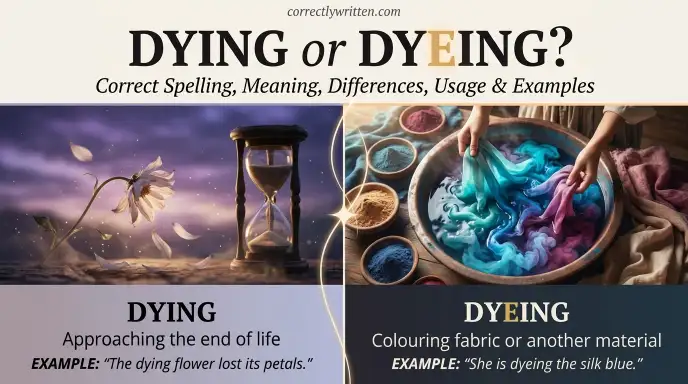
Dying and dyeing are both correct English words, but they have completely different meanings. Dying is the present participle of die and refers to approaching death, fading away, or gradually losing strength. Dyeing is the present participle of dye and means changing the color of something, such as hair, fabric, or clothing.
Although these words look and sound similar, their meanings depend on the context in which they are used. For example, “The flowers are dying” means the flowers are gradually losing life, while “She is dyeing her hair” means she is changing its color.
Understanding the difference between dying and dyeing helps you avoid spelling mistakes in everyday conversations, school assignments, professional writing, and online content. The easiest way to remember the distinction is to connect dying with death and dyeing with adding color.
Dying or Dyeing: Quick Answer
Dying is correct when referring to death, fading, or the gradual loss of life or strength. Dyeing is correct when referring to coloring something with dye.
Use dying when someone, an animal, a plant, or something else is approaching the end of its life or gradually disappearing. Use dyeing when changing the color of hair, fabric, clothing, or another material.
Examples:
- The old tree is dying because it has not received enough water.
- She is dyeing her hair blonde.
- The patient was seriously ill and dying.
- They are dyeing white cotton fabric blue.
The main difference is the base word: dying comes from die, while dyeing comes from dye.
Definition and Meaning of Dying or Dyeing
What Does Dying Mean?
Dying is the present participle of the verb die. It means approaching death or gradually coming to an end. It can describe people, animals, plants, traditions, hopes, and other things that are losing life, strength, or importance.
Examples:
- The dying bird was taken to a wildlife shelter.
- The flowers are dying in the summer heat.
- Interest in the old tradition is slowly dying.
- He was dying to know the answer.
In the final example, dying to know is an informal expression meaning extremely eager to find something out. It does not refer to literal death.
What Does Dyeing Mean?
Dyeing is the present participle of the verb dye. It means applying a coloring substance to change the color of a material or object.
Dyeing is commonly associated with hair, textiles, clothing, leather, and other materials.
Examples:
- She is dyeing her hair red.
- The workers are dyeing cotton fabric.
- He learned the traditional art of dyeing wool.
- They are dyeing their old curtains a darker shade.
The word dyeing is often used in fashion, textile production, beauty treatments, crafts, and manufacturing.
Origin of Dying and Dyeing
Origin of Dying
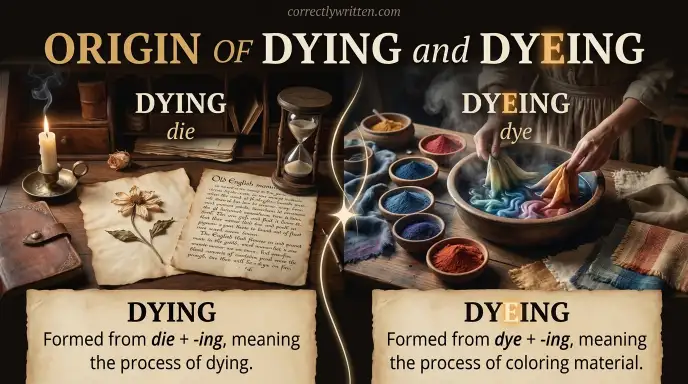
The word dying comes from the verb die, which developed from Old English dēag and related Germanic forms. Over time, the spelling and pronunciation changed into the modern English word die.
When the suffix ing is added to die, the final silent e is removed, producing dying.
Die + ing = Dying
Origin of Dyeing
The word dyeing comes from the verb dye, meaning to color a material using a coloring substance. The verb has historical roots in older Germanic and Old English vocabulary associated with coloring or staining.
When ing is added to dye, the final e is retained to distinguish the spelling from dying.
Dye + ing = Dyeing
This spelling distinction helps readers recognize the intended meaning.
Dying vs Dyeing: The Main Difference
The key difference between dying and dyeing is their meaning and the verb from which each word comes.
Dying relates to death, fading, or the end of something. Dyeing relates to changing the color of an object or material.
Comparison Table
| Feature | Dying | Dyeing |
| Base word | Die | Dye |
| Part of speech | Verb form | Verb form |
| Main meaning | Approaching death or fading | Coloring something |
| Common contexts | Health, nature, emotions, figurative expressions | Hair, clothing, fabric, crafts |
| Example | The plant is dying. | She is dyeing the fabric. |
| Memory clue | Death or decline | Adding color |
Both words are pronounced the same in most English accents. This makes context especially important when choosing the correct spelling.
British English vs American English Spelling
The spellings dying and dyeing are the same in British English and American English. Neither word has a separate British or American spelling.
| British English | American English |
| Dying | Dying |
| Dyeing | Dyeing |
| The flowers are dying. | The flowers are dying. |
| She is dyeing her hair. | She is dyeing her hair. |
Writers should use these spellings consistently regardless of if they are writing for a British, American, or international audience.
Which Spelling Should You Use?
Choose the spelling according to the meaning of your sentence.
When to Use Dying
Use dying when describing someone or something approaching death, losing strength, or gradually disappearing.
Examples:
- The dying plant needs immediate care.
- The injured animal was dying.
- The old custom is slowly dying out.
- I am dying to see the new movie.
Remember that dying out means gradually disappearing, while dying to do something can mean being very eager to do it.
When to Use Dyeing
Use dyeing when describing the process of changing color by applying dye.
Examples:
- She is dyeing her hair at home.
- The company specializes in dyeing textiles.
- They are dyeing the fabric green.
- Dyeing clothes can give old garments a fresh appearance.
If your sentence involves coloring, hair treatments, fabric, or textiles, dyeing is usually the correct choice.
Common Mistakes with Dying and Dyeing
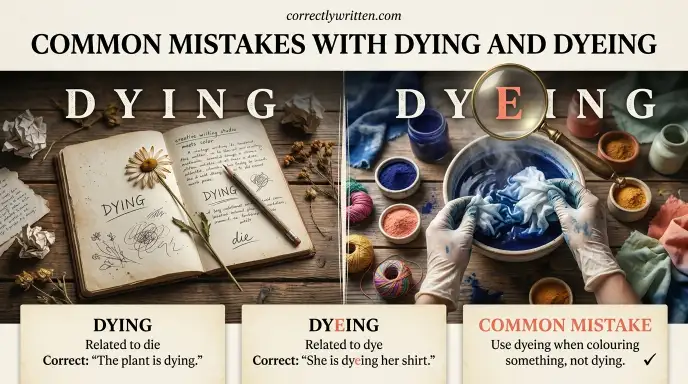
Mistake 1: Using Dying for Coloring Hair
Incorrect: She is dying her hair brown.
Correct: She is dyeing her hair brown.
The intended meaning is changing hair color, so the correct word is dyeing.
Mistake 2: Using Dyeing for Loss of Life
Incorrect: The flowers are dyeing without water.
Correct: The flowers are dying without water.
The sentence describes the flowers losing life, not receiving a new color.
Mistake 3: Confusing the Base Words
Incorrect: I am dyeing to know what happened.
Correct: I am dying to know what happened.
The expression dying to know means being extremely eager to learn something.
Mistake 4: Assuming the Words Sound Different
Dying and dyeing are generally pronounced identically. Their spelling must therefore be chosen according to the meaning of the sentence rather than the sound.
Dying or Dyeing in Everyday Examples
Examples of Dying
- The flowers are dying because the soil is too dry.
- The doctors worked hard to save the dying patient.
- The candle flame was dying in the wind.
- Interest in the old television show is dying.
- I am dying to hear your good news.
- The tree began dying after its roots were damaged.
Examples of Dyeing
- She is dyeing her hair a lighter shade.
- The artist is dyeing the fabric with natural colors.
- They are dyeing their old clothes instead of replacing them.
- The textile factory is dyeing cotton for a new collection.
- He watched a tutorial about dyeing leather.
- Dyeing the curtains made the room look brighter.
These examples show that the surrounding words usually make the intended meaning clear.
Easy Ways to Remember Dying vs Dyeing
Remember Dying
Connect dying with die. Both relate to death, fading, or coming to an end.
Example: The dying flower needs water.
Remember Dyeing
Connect dyeing with dye, the substance used to change color.
Example: She is dyeing a white shirt blue.
A simple memory trick is: Die → Dying; Dye → Dyeing.
The additional letter e in dyeing helps preserve the spelling of the original word dye.
Frequently Asked Questions
Q1. Is it spelled dying or dyeing?
Both dying and dyeing are correct English spellings, but they have different meanings. Dying means approaching death or gradually fading away, while dyeing means changing the color of something by applying dye. For example, “The plant is dying” and “She is dyeing her hair.”
Q2. Is it die or dye your hair?
Dye your hair is correct when you mean changing its color. Dye means to color something using a coloring substance, while die means to stop living. For example, “I want to dye my hair brown.”
Q3. What does “dyeing” mean?
Dyeing is the process of coloring something by applying dye. It is commonly used when talking about hair, fabric, clothing, wool, and other materials. For example, “She is dyeing a white shirt blue.”
Q4. Is dying grammatically correct?
Yes, dying is grammatically correct. It is the present participle of die and can be used in continuous verb forms, such as “The flowers are dying.” It also appears in expressions such as “I am dying to know,” meaning that someone is extremely eager to find out something.
Q5. Is it dying or dying?
Both options are spelled identically as dying, so there is no difference between them. If you meant to compare dying and dyeing, use dying for death or fading and dyeing for changing color.
Q6. What does “dying” mean?
Dying means approaching death or gradually losing life, strength, or activity. It can also be used figuratively to express a strong desire or feeling. For example, “The tree is dying” describes a tree losing life, while “I am dying to see the movie” means being very eager to watch it.
Q7. How do you say dying?
Dying is pronounced DYE ing, with two syllables. The first syllable rhymes with buy, and the second sounds like ing in singing. It is generally pronounced the same as dyeing.
Q8. Is dying a real word?
Yes, dying is a standard English word. It is the present participle and gerund form of die. It can describe approaching death, fading away, or experiencing a strong feeling, as in “dying of laughter” or “dying to know.”
Conclusion
Dying and dyeing are both correct, but they are not interchangeable. Dying refers to death, fading, or a strong figurative feeling, while dyeing means changing the color of something with dye. Remember the base words to choose the correct spelling: die becomes dying, and dye becomes dyeing. This simple distinction will help you write clearly and avoid a common English spelling mistake.
🔍 Find the Perfect Word:
Feel or Feal: Correct Spelling, Meaning & Usage

Hi, I’m Ava Collins, a writer and English language enthusiast behind CorrectlyWritten. I’m passionate about making grammar simple, clear, and easy to understand. I write about grammar rules, confusing words, spelling, and everyday English usage to help readers write more accurately and confidently.







