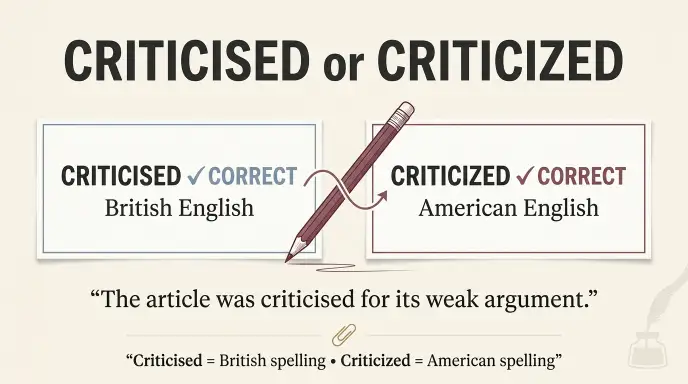
Both “criticised” and “criticized” are correct. “Criticised” is British English. “Criticized” is American English. The word itself has just one meaning: to judge someone or something in a negative way.
People search for this because the two spellings look almost the same, but one letter changes: an “s” or a “z.” This small difference confuses many writers, students, and professionals. They worry about picking the “wrong” one, especially in emails, essays, or articles that need to look polished.
The confusion grows because spell checkers often flag one version as wrong, even when it is correct in another form of English. A UK writer using “criticized” might get an error message. A US writer using “criticised” might see the same thing. Neither is actually making a mistake they are just using a different English variant.
This guide gives you a clear answer. It explains where the difference comes from, when to use each spelling, and how to stay consistent no matter who reads your writing.
Criticised or Criticized : Quick Answer
Use “criticised” if you write in British English. Use “criticized” if you write in American English. Both spellings mean the same thing.
Example 1 (British):
“The teacher criticised the report for being too short.”
Example 2 (American):
“The teacher criticized the report for being too short.”
Pick one spelling and stay consistent through your writing.
Definition and Meaning of Criticised/Criticized
Definition: To criticise (or criticize) means to point out faults or give a negative judgment about someone or something.
Simple meaning: You say something is wrong, weak, or bad about a person, idea, or piece of work.
Context and usage: The word is used in reviews, feedback, news reports, and everyday conversation. For example:
- “The film was criticised for its slow pace.”
- “She criticized his plan during the meeting.”
Different meanings: The word has no separate meanings. It always means to judge something negatively. The only difference between the two versions is spelling, based on British or American English.
The Origin of Criticised/Criticized
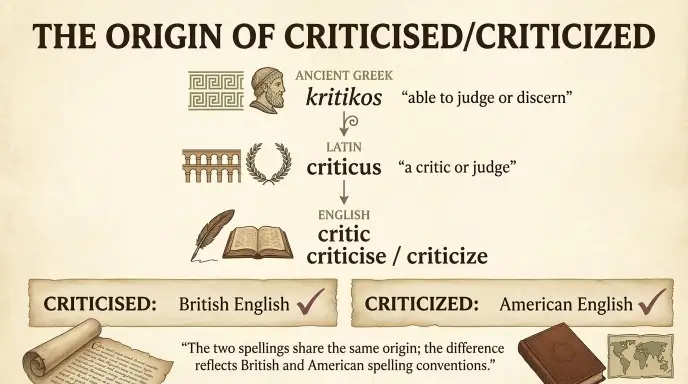
The word comes from the Greek word “kritikos,” meaning “able to judge.” It passed through Latin and French before entering English as “criticize” or “criticise.”
The spelling split happened because of two different paths English took. British English kept closer ties to French spelling patterns, which often use ” ise.” American English, shaped in part by lexicographer Noah Webster in the early 1800s, simplified many spellings and moved toward ” ize,” a form also found in Greek.
Interestingly, ” ize” is actually the older and more traditional English ending. Many British style guides, including Oxford, still allow ” ize” for this reason. But most UK writers today use ” ise” out of habit and convention.
British English vs American English Spelling
British English usually adds “s” in words like this. American English usually adds “z.” This pattern applies to many similar verbs, not just “criticise/criticize.”
| Word Type | British English | American English |
| Base verb | criticise | criticize |
| Past tense | criticised | criticized |
| Present participle | criticising | criticizing |
| Noun form | criticism | criticism |
| Similar word | organise | organize |
| Similar word | recognise | recognize |
Notice that “criticism” stays the same in both versions. Only the verb form changes.
Which Spelling Should You Use?
| Your audience | Recommended spelling |
| US readers or American company | criticized |
| UK readers or British company | criticised |
| Canada | criticized (US style is common) |
| Australia, New Zealand | criticised |
| Global or mixed audience | Either just stay consistent |
| Academic writing | Follow your style guide (APA = US, most UK unis = British) |
If you are unsure, check who reads your work most. Match your spelling to that audience.
Common Mistakes with Criticised/Criticized
- Mixing both spellings in one document. This looks careless. Pick one and stick with it.
- Assuming “criticize” is always wrong outside the US. It is standard in American English and accepted in many global style guides.
- Forgetting the noun stays the same. “Criticism” does not change, even though the verb does.
- Auto correct switching mid document. Some tools quietly change spelling based on default settings. Always check the final draft.
- Using the wrong tense. “Criticised” and “criticized” are past tense. The present form is “criticise/criticize,” and the ing form is “criticising/criticizing.”
Criticised or Criticized in Everyday Examples
Criticised or Criticized in Everyday Examples
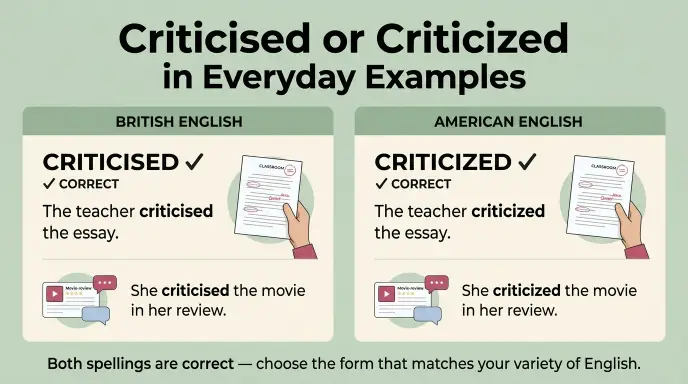
The words criticised and criticized are used in many everyday situations. They have the same meaning, but the spelling changes between British and American English. Criticized is the usual American spelling, while criticised is common in British English.
You can use either form when talking about someone pointing out a mistake, problem, or weakness.
For example,
an American writer may say, “The teacher criticized my essay.”
A British writer may write, “The teacher criticised my essay.” Both sentences mean that the teacher pointed out problems in the essay.
The word can also describe comments about a decision or action.
For example,
“The manager was criticized for changing the work schedule.”
In British English, this can be written as “The manager was criticised for changing the work schedule.” You may also use the word when talking about products, services, or ideas.
For example,
“Many customers criticized the poor service.” Another example is, “The new plan was criticised by several employees.”
In each case, the meaning stays the same. Only the spelling changes. When writing for an American audience, choose criticized. When writing for a British audience, choose criticised. Staying consistent with one spelling style will make your writing clear and professional.
Criticised or Criticized : Google Trends & Usage Data
“Criticized” has higher overall search volume worldwide, mainly because the US has more English speakers online than the UK. “Criticised” ranks higher in the UK, Ireland, Australia, and New Zealand.
Both spellings trend during news cycles, especially when a public figure, company, or policy faces backlash. Search interest often rises alongside terms like “backlash,” “response,” or “controversy.”
Keyword Variation Comparison Table
| Search phrase | Likely spelling preference |
| criticised or criticized | Mixed, often UK based confusion |
| criticized meaning | Usually US search |
| criticised spelling | Usually UK search |
| how to spell criticized | US learner or writer |
| criticise vs criticize | General comparison, global |
| criticism spelling | Both regions, same spelling either way |
FAQs
Q1. What is the difference between “criticized” and “criticised”?
Both words have the same meaning. “Criticized” is the standard American spelling, while “criticised” is the British spelling.
Q2. How do you spell “criticized” or “criticised”?
Both spellings are correct. Use “criticized” in American English and “criticised” in British English.
Q3. What does “criticized” mean?
Criticized means someone pointed out faults, problems, or weaknesses in a person or thing. It can also mean giving a negative opinion.
Q4. Is it correct to say “criticizing” or “criticising”?
Both are correct spellings. “Criticizing” is American English, while “criticising” is British English.
Q5. What is a person who criticizes called?
A person who criticizes can be called a critic. Depending on the context, they may also be described as a reviewer or commentator.
Q6. How to use criticize in a sentence?
You can say, “It is easy to criticize someone without knowing the full story.” Here, “criticize” means to point out faults or express disapproval.
Q7. What is another word for “criticized”?
Depending on the context, synonyms include condemned, blamed, judged, questioned, reviewed, and disapproved of.
Q8. How to use criticism in a sentence?
You can say, “She accepted the criticism and used it to improve her work.” Here, “criticism” means comments that point out faults or suggest improvement.
Q9. What is criticizing a person?
Criticizing a person means pointing out their faults, mistakes, or weaknesses. It can be helpful when done respectfully, but harsh criticism can be hurtful.
Conclusion
“Criticised” and “criticized” mean exactly the same thing. The only difference is regional spelling. British English, along with Australia and New Zealand, uses “criticised.” American English, along with most of Canada, uses “criticized.”
The key rule is consistency. Once you pick a spelling, use it throughout your document, email, or article. Mixing both looks like an error, even though each one is correct on its own.
If you write for a specific audience, match their spelling convention. If you write for a global audience, either spelling works just don’t switch between them halfway through. Remember that the noun form, “criticism,” never changes, no matter which spelling of the verb you choose.
Meta description: Criticised or criticized? Learn the British vs American spelling difference, when to use each, and common mistakes to avoid.
More Spelling Differences:
Biannual or Biennial: Understanding the Difference With Examples
Cava or Chipotle: What’s the Difference? Menu, Prices, Examples
Bracelets or Rose Gold: Meaning, Types, Styles & How to Choose

Hi, I’m Ava Collins, a writer and English language enthusiast behind CorrectlyWritten. I’m passionate about making grammar simple, clear, and easy to understand. I write about grammar rules, confusing words, spelling, and everyday English usage to help readers write more accurately and confidently.








1 thought on “Criticised or Criticized: British vs. American Spelling Explained ”