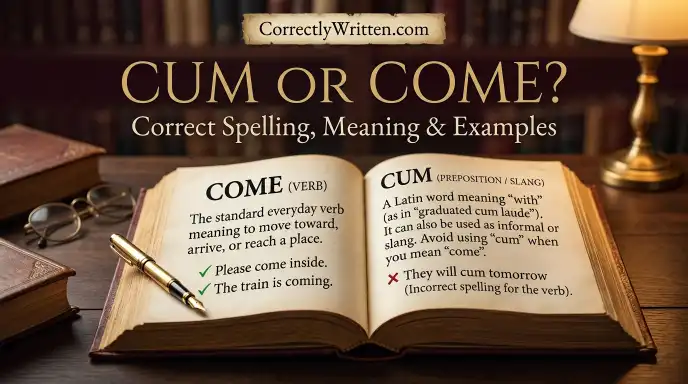
Cum or come confuse many learners. They look close and sound the same. Come is the everyday verb for arrival, and cum is a formal Latin word that means with.
Come appears in daily speech and writing. You ask a friend to come to your house, and you say a new season has come. Cum is rare, and it shows up in formal writing, book titles, and place names.
Learners mix them up because the spelling is close. One letter changes the whole meaning. A wrong choice can make a normal sentence look strange, so the fix matters.
This guide gives you the full difference. You will learn the forms of come, the compound pattern of cum, and the honour phrases. You will also get wrong and correct examples, a short decision guide, and a practice test.
Short Answer
| Word | Meaning | Part of Speech |
| Come | Move toward a place, arrive | Verb |
| Cum | With, joins two nouns | Latin linker |
Use come when someone or something arrives or moves. Use cum when one person or thing has two roles, like a bedroom cum study. Note: cum also has a vulgar slang sense in informal English, so in formal writing use it only for the Latin compound and honour phrase senses in this guide.
What Does Come Mean?
Come is a standard English verb. It means to move toward a place or a person. It also means to arrive, to happen, or to reach a state.
| Form | Example |
| Base form | come |
| Past simple | came |
| Past participle | come |
| Present participle | coming |
- “Please come here.” This means move toward a place.
- “Spring came early.” This means spring happened early.
- “They have come.” This means they have arrived.
- “The train is coming.” This means the train will arrive soon.
- “Can I come too?” This means join a person.
- “She came first in the race.” This means she reached first place.
Notice the past form. The past of come is came, and the past participle is come again. Many learners write “comed”, and that form is wrong.
What Does Cum Mean?
Cum is a Latin word. It means with. In English it links two nouns to show one person or thing has two roles or two purposes.
You write it with hyphens. The pattern is noun cum noun. Each noun names one role, and cum joins them.
| Compound | First Role | Second Role |
| bedroom cum study | bedroom | study |
| actor cum diplomat | actor | diplomat |
| wife cum business partner | wife | business partner |
| bookstore cum coffeehouse | bookstore | coffeehouse |
| gardener cum odd job man | gardener | odd job man |
Read bedroom cum study as a room that is both a bedroom and a study. Read actor cum diplomat as a person who is both an actor and a diplomat. The word cum does the work of the word with.
Cum or Come: Side by Side Difference
| Point | Come | Cum |
| Meaning | Move, arrive, happen | With, joins two roles |
| Part of speech | Verb | Latin linker |
| Used in | Daily speech and writing | Formal writing |
| Example | “Please come here.” | “A bedroom cum study.” |
| Past form | came | No past form |
Come changes its form. Cum never changes its form. Come works in a sentence as the main verb, and cum works inside a compound noun.
When to Use Cum and When to Use Come
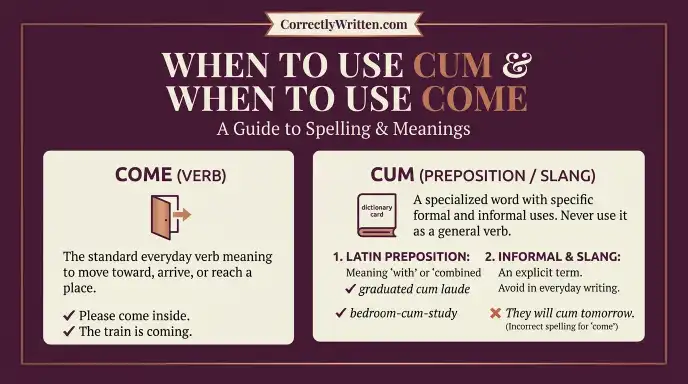
Follow these three steps in order:
- Ask what the sentence needs. If it needs arrival or movement, use come.
- Ask if one thing has two roles. If the answer is yes, use cum in a hyphenated compound.
- Try a swap test. If you can replace the word with “arrive”, use come. If you can replace it with “combined with”, use cum.
Test your sentence with the swap. “Please come here” becomes “Please arrive here”, so come is correct. “A bedroom cum study” becomes “a bedroom combined with a study”, so cum is correct.
Wrong vs Correct Examples
| Wrong | Correct | Why |
| I will cum to your house. | I will come to your house. | Arrival needs the verb come. |
| A bedroom come study. | A bedroom cum study. | Two roles need the Latin linker cum. |
| She cummed late. | She came late. | The past of come is came. |
| He graduated cum laude. | He graduated cum laude. | Already correct. Cum laude is a Latin honour phrase. |
| An actor come singer. | An actor cum singer. | Two roles need cum. |
Read each pair aloud. The wrong form looks close to the right form, and that is why learners slip. The swap test from the last section catches each error.
Cum Laude Phrases Explained
Cum laude phrases come from Latin. They are academic honours, and they are not English compounds. The word cum still means with in these phrases.
- cum laude means with praise.
- magna cum laude means with great praise.
- summa cum laude means with highest praise.
You see these phrases on degree certificates and in graduation lists. Do not split them, and do not replace cum with come in them.
Place Names With Cum

Some English place names use cum to join two old villages or parishes. The pattern is the same as the compound pattern.
Chorlton cum Hardy is the well known example. Attercliffe cum Darnall and Upton cum Chalvey follow the same pattern.
Common Mistakes Learners Make
- Using cum as a verb. Cum is not a verb, so “I will cum” is wrong.
- Using come inside a dual role compound. “Actor come singer” is wrong.
- Dropping the hyphens. “Bedroom cum study” without hyphens looks loose, so keep the hyphens.
- Using cum in casual chat. Cum is formal, so in a quick chat it can look odd. Use a plain phrase like “a room that is both” instead.
Each mistake comes from one root cause. Learners treat the two words as one word. Keep their jobs apart, and the errors stop.
British vs American Use
Come is identical in British and American English. The spelling and the forms are the same on both sides.
Cum compounds and cum laude phrases are also the same in both. Formal writing in British and American English uses them with no spelling difference.
| Point | British English | American English |
| Come | come, came, come | come, came, come |
| Cum compounds | bedroom cum study | bedroom cum study |
| Cum laude phrases | cum laude | cum laude |
Memory Hooks
- Cum means combined. If the word means combined with, write cum.
- Come means come to a place. If the word means arrive, write come.
- Cum laude means with praise. The Latin word still means with.
Say the swap test in your head. Arrive means come, and combined with means cum. Two quick tests beat long rules.
FAQs
1. Is cum a real word?
Yes, cum is a real word from Latin, and it means with. In English it appears in formal compounds like bedroom cum study, where it joins two nouns to show two roles, and in Latin honour phrases like cum laude. It is not a made up spelling, and it is not a short form of come.
2. Is it “come to my house” or “cum to my house”?
It is “come to my house”. The sentence needs the verb for arrival, and that verb is come, because cum is a linker, not a verb. Cum joins two nouns in a compound, and it cannot show movement, so use come for every sentence about arrival or movement.
3. What does bedroom cum study mean?
Bedroom cum study means a room that is both a bedroom and a study. The word cum joins the two nouns, and it does the work of the word with, so you read it as a bedroom combined with a study. The hyphens hold the compound together, and they show that the two roles belong to one room.
4. What does cum laude mean?
Cum laude means with praise. It is a Latin phrase used for academic honours, and it appears on degree certificates, while magna cum laude means with great praise and summa cum laude means with highest praise. These phrases are Latin, not English compounds, and you should never replace cum with come in them.
5. Can cum be a verb?
No, cum cannot be a verb. It is a Latin linker that joins two nouns in a compound, like actor cum diplomat, while the verb for arrival is come, with the past form came and the past participle come. If your sentence needs an action word, use come, and keep cum for dual role compounds only.
6. What is the past tense of come?
The past tense of come is came, as in “She came home late” and “They came to the party”. The past participle is come again, as in “They have come”, and you should not write “comed” or “cummed”, because neither form exists. Learn the pair come and came together, and the error goes away.
7. Is cum formal or informal?
Cum is formal. It belongs in formal writing, book titles, degree lists, and place names, but in a quick casual chat it can look odd, so use a plain phrase there instead, like “a room that is both”. Come is the everyday word, and it fits speech, chat, and writing at every level.
8. Is there a British vs American difference?
No, there is no British vs American difference for these words. Come has the same spelling and the same forms in both, and cum compounds and cum laude phrases are also spelled the same in both. Formal writers on both sides use them in the same way, so you do not need a separate rule for each region.
9. How can I remember cum vs come?
Use two swap tests. If you can replace the word with “arrive”, write come, as in “Please come here”, and if you can replace it with “combined with”, write cum, as in “a bedroom cum study”. Say the test in your head before you write, because it takes two seconds and it catches the error each time.
Conclusion
Come is the verb for arrival, movement, and happening, with the forms come, came, come, and coming. Cum is the Latin word for with, and it joins two nouns to show two roles in one person or thing. Cum laude phrases are Latin honours, and place names like Chorlton cum Hardy use the same joining pattern.
Keep the swap tests close. Arrive means come, and combined with means cum. With that one habit, you will pick the right word each time, and the confusion will end.
✍️ Write with Confidence:
Faze or Phase: Difference, Meaning and Correct Use

Hi, I’m Ava Collins, a writer and English language enthusiast behind CorrectlyWritten. I’m passionate about making grammar simple, clear, and easy to understand. I write about grammar rules, confusing words, spelling, and everyday English usage to help readers write more accurately and confidently.








2 thoughts on “Cum or Come: Difference, Meaning and Correct Use”