
Faze or phase confuse many learners. They sound the same. Faze means to disturb someone, and phase means a stage in a process of change.
The mix up is easy to understand. Both words are short, and both are said as FAYZ. But one talks about a person and their calm, while the other talks about steps in a process.
This guide clears the confusion for good. You will learn the meaning of each word, with forms, examples, and common errors. You will also get quick tests to check your own use.
By the end, you will pick the right word in seconds. The trick is simple: ask what you mean, disturb or stage.
Short Answer
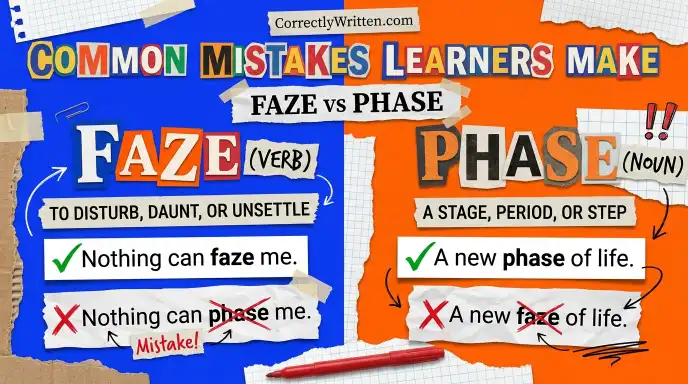
Faze means disturb. Phase means stage. That one line settles most cases.
| Word | Meaning | Part of Speech |
| Faze | To disturb or unsettle someone | Verb only |
| Phase | A stage or period in a process | Noun, also verb |
Use two quick substitution tests:
- If “disturb” fits your sentence, use faze.
- If “stage” fits your sentence, use phase.
“The noise did not faze her.” Disturb fits, so faze is right.
“She is in a new phase of life.” Stage fits, so phase is right.
What Does Faze Mean?
Faze is a verb. It means to disturb, disconcert, or daunt someone. It talks about a person’s calm being shaken.
When something fazes you, it throws you off balance for a moment.
| Form | Example |
| Base form | faze |
| Third person singular | fazes |
| Past tense | fazed |
| Present participle | fazing |
Faze shows up most in negative sentences. People say “did not faze” or “was not fazed”.
It also shows up in questions. “Did the crowd faze you?” is a normal question.
Here are everyday examples:
- The loud noise did not faze the baby.
- Nothing fazes her before a big test.
- He was not fazed by the hard questions.
- The long delay fazed the whole team.
What Does Unfazed Mean?
Unfazed is the adjective form. It means not disturbed or not bothered.
“She stayed unfazed” means she stayed calm. Do not write “unphased” for this meaning. Unphased is not the right word here.
What Does Phase Mean?
Phase is a noun first. It means a distinct stage or period in a process of change.
Life has phases, and projects have phases. The moon has phases too. Each phase is one part of a longer story.
| Form | Use | Example |
| Phase (noun, singular) | One stage | A new phase of life |
| Phases (noun, plural) | More than one stage | The phases of the moon |
| Phase (verb) | To introduce step by step | They will phase in the new rules |
| Phased (verb, past) | Introduced step by step | The old system was phased out |
| Phasing (verb, present participle) | In the process of changing | They are phasing out paper forms |
Phase In and Phase Out
it means to introduce something bit by bit. Phase out means to remove something bit by bit. Both are about slow change.
“The school will phase in the new timetable” means the change will happen in steps.
“The firm will phase out plastic bags” means plastic bags will go away in steps.
Here are everyday examples:
- The project is in its final phase.
- Teen years are just a phase of life.
- The moon is in a new phase tonight.
- The company phased out the old software last year.
Faze or Phase: Side by Side Difference
| Point | Faze | Phase |
| Meaning | To disturb or unsettle | A stage in a process |
| Part of speech | Verb only | Noun, and also verb |
| Talks about | A person and their calm | A process and its steps |
| Common partner words | Did not faze, was not fazed, nothing fazes | Phase of life, phase in, phase out |
| Example | The news did not faze him. | He is in a new phase of life. |
The key split is simple. Faze acts on a person. Phase marks a step in a process.
Keep that split in mind and most errors go away.
When to Use Faze and When to Use Phase

Follow this 3 step decision guide:
- Find the core idea of your sentence. Is it about a person being shaken, or about a step in a process?
- Try the substitution test. Put “disturb” in the blank for faze, and “stage” in the blank for phase.
- Check the grammar. Faze is always a verb that acts on someone, while phase as a noun often follows “a” or “the”, and phase as a verb pairs with “in” or “out”.
Wrong vs Correct Examples
| Wrong | Correct | Why |
| She is going through a faze. | She is going through a phase. | A life stage is a phase, not faze. |
| The news did not phase him. | The news did not faze him. | Not being disturbed calls for faze. |
| They will faze out the old system. | They will phase out the old system. | Slow removal is phase out. |
| He was not phased by the crowd. | He was not fazed by the crowd. | Not being shaken calls for fazed. |
Read each pair out loud. The wrong version sounds fine.
That is why this pair traps so many learners. The meaning test is the only safe check.
Common Mistakes Learners Make
Writing Unphased Instead of Unfazed
“Unphased” looks right because phase is the more common word.
But the adjective for “not disturbed” is unfazed. Write “She remained unfazed”. Do not write “She remained unphased”.
Writing Faze Out Instead of Phase Out
Faze out is a common error. Faze means disturb, and disturb out makes no sense.
Phase out is the set phrase for slow removal. Always use phase out.
Using Phase for a Person
Phase does not disturb people. “The crowd phased him” is wrong.
Crowds can faze people. Crowds cannot phase people.
Using Faze for a Process
Faze does not mark steps. “The project is in a faze” is wrong.
Projects move through phases. Use phase for steps in a process.
The “Going Through a Phase” Idiom
“Going through a phase” means passing through a short period of behavior or mood.
Parents say it about teens. Friends say it about new hobbies.
It is always phase, never faze. The idea is a stage of life, not a disturbance.
Examples: “He is going through a quiet phase.” “This is just a phase, and it will pass.”
British vs American Use
There is no spelling split here. Faze and phase are spelled the same in British English and American English. The meanings are also the same in both.
Learners sometimes expect a difference because other word pairs do split across regions. This pair does not. Use the same forms on both sides of the Atlantic.
Faze vs Daze and Phase vs Stage
Faze vs Daze
Daze means to stun someone into confusion. A loud blast can daze you.
Faze means to disturb your calm. A rude comment can faze you.
Daze is about shock and confusion. Faze is about being thrown off balance.
Phase vs Stage
Phase and stage are near synonyms. A stage is a general step in a process.
A phase stresses one part of a changing process. “A phase of the project” points to a period of change.
“A stage of the project” is the plainer word for a step. In most sentences, both work, but phase fits change better.
Memory Hooks
Hook 1: Faze rhymes with daze. Both words are about being shaken.
If you can rhyme it with daze, it is about a person being unsettled. Think: faze, daze, both shake your calm.
Hook 2: Phase means stage. Say the sentence with “stage” in the blank.
If it still works, write phase. “A new stage of life” works, so “a new phase of life” is right.
Frequently Asked Questions
1. Is faze a real word?
Yes, faze is a real verb that means to disturb or unsettle someone, and it is common in spoken and written English. Most style guides accept it, and it is not slang, so use it when you mean that something shook someone’s calm. The past form is fazed, and the adjective form is unfazed.
2. Is it “didn’t faze me” or “didn’t phase me”?
“Didn’t faze me” is correct, because faze means disturb, and the sentence says the thing did not disturb you. “Didn’t phase me” is wrong, because phase means stage, and a stage cannot disturb you. Use the disturb test: if disturb fits, write faze, since this error is easy to make with this pair.
3. Is it “going through a phase” or “faze”?
“Going through a phase” is correct, because a phase is a stage of life, and the idiom talks about a short period of behavior. Faze is about disturbance, so it does not fit here, since the person is passing through a stage, not being disturbed. Always write phase in this idiom, as in a quiet phase or a sporty phase.
4. What does unfazed mean?
Unfazed means not disturbed or not bothered, and it describes a person who stays calm under pressure. “She stayed unfazed during the interview” means the interview did not shake her, since unfazed comes from faze plus the prefix un. Do not write unphased for this meaning, because unphased is an error in this sense.
5. What does phase out mean?
Phase out means to remove something bit by bit, as firms phase out old products and schools phase out old rules. The change happens in steps, not all at once, and phase out is a verb phrase that pairs phase with out. Do not write faze out, because faze means disturb, and disturb out makes no sense.
6. Can phase be a verb?
Yes, phase can be a verb as well as a noun, and as a verb it means to carry out or introduce something step by step. The common forms are phase in and phase out, so “They phased in the new rules” means the rules came in slowly. “They phased out the old system” means the system went away slowly.
7. What is the difference between faze and daze?
Faze means to disturb someone’s calm, while daze means to stun someone into confusion, so a rude remark can faze you and a hard blow can daze you. Faze is about being thrown off balance, and daze is about shock and a foggy mind. The two words rhyme, and both shake a person, but their meanings stay apart: use faze for calm, and daze for shock.
8. Is there a British vs American difference?
No, faze and phase are spelled the same in British English and American English, and their meanings are the same in both. Some word pairs do split across regions, but this pair does not, so you can use the same spelling in London and New York. Teachers in both regions teach the same rule: disturb is faze, and stage is phase.
9. How can I remember faze vs phase?
Use two quick tests: first, try disturb in the blank, and if it fits, write faze, and second, try stage in the blank, and if it fits, write phase. Faze also rhymes with daze, and both are about being shaken, while phase means stage, and both are about steps. Run one test before you write, since it takes two seconds and stops most errors.
Conclusion
Faze and phase sound the same but do different jobs. Faze disturbs a person, and phase marks a stage in a process. The disturb test and the stage test settle almost every case, so keep unfazed for calm, phase out for slow removal, and phase for every life stage.
Next time you write the pair, pause for two seconds and ask what you mean. If the answer is disturb, write faze, and if the answer is stage, write phase. That small pause will keep your writing clean and correct.
📖 Your Next Read:
Sempai or Senpai: Correct Spelling, Meaning, and Examples

Hi, I’m Ava Collins, a writer and English language enthusiast behind CorrectlyWritten. I’m passionate about making grammar simple, clear, and easy to understand. I write about grammar rules, confusing words, spelling, and everyday English usage to help readers write more accurately and confidently.








1 thought on “Faze or Phase: Difference, Meaning and Correct Use”