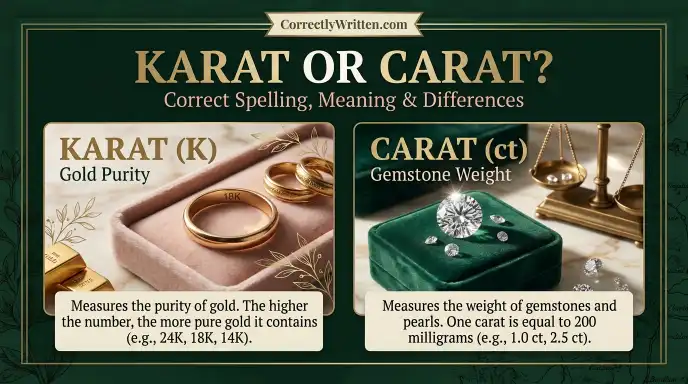
Karat and carat are both correct English words, but they have different meanings. In American English, karat usually measures the purity of gold, while carat measures the weight of gemstones, such as diamonds. For example, a 24 karat gold ring refers to gold purity, while a 2 carat diamond refers to the diamond’s weight.
These words sound alike, so it is easy to mix them up. Both often appear in jewelry descriptions, engagement ring advertisements, and discussions about gold and diamonds. However, using the wrong word can change the meaning of a sentence.
The difference becomes easier to understand when you remember what each word measures. Karat tells you how much pure gold an item contains. Carat tells you how much a gemstone weighs. A piece of jewelry can have both a karat rating for its gold and a carat weight for its diamond.
In this guide, you will learn the meanings, origins, spelling differences, and correct uses of karat and carat. You will also find practical examples, common mistakes, and answers to frequently asked questions.
Karat or Carat: Quick Answer
The main difference between karat and carat is what each word measures.
- Karat: A measure of gold purity, especially in American English.
- Carat: A measure of the weight of a diamond or another gemstone.
Here are three examples:
- My necklace is made of 18 karat gold.
- Her engagement ring has a 2 carat diamond.
- The jeweler explained the gold’s karat rating and the diamond’s carat weight.
In British English, carat is also commonly used for gold purity. In American English, karat is the usual spelling for gold purity. The gemstone weight term is carat in both varieties.
What Does Karat Mean?
Karat describes the purity of gold. It tells you how much of the metal is pure gold compared with other metals in an alloy.
Pure gold is soft, so jewelers often mix it with metals such as copper, silver, or zinc. These mixtures can make gold jewelry harder and more suitable for everyday use.
How Is Gold Purity Measured?
Gold purity uses a scale of 24 parts.
- 24 karat: Almost pure gold, generally described as 99.9% pure when marked 999.
- 22 karat: About 91.7% gold.
- 18 karat: 75% gold.
- 14 karat: About 58.3% gold.
- 10 karat: About 41.7% gold.
The exact purity of a piece depends on its composition and applicable standards. The figures above show the usual mathematical proportions.
Examples of Karat in Sentences
- My mother wears a 22 karat gold bracelet.
- The jeweler recommended 18 karat gold for the ring.
- This necklace has a 14 karat gold setting.
- The buyer asked if the chain was 24 karat gold.
In American English, karat is the standard choice when describing gold purity.
Does a Higher Karat Mean Better Gold?
A higher karat rating means a greater proportion of gold. However, it does not always mean that the jewelry is the best choice for every person.
Higher purity gold is generally softer than many lower karat gold alloys. Lower karat jewelry contains more other metals, which can improve hardness and durability.
Your best choice depends on the item’s purpose, your budget, and how often you plan to wear it.
What Does Carat Mean?
Carat is a unit used to measure the weight of diamonds and other gemstones. One metric carat equals exactly 200 milligrams, or 0.2 grams.
Carat weight does not directly measure a gemstone’s size, quality, or value. Two diamonds with the same carat weight can look different because of their cut, shape, and proportions.
How Is Carat Weight Measured?
Gemstone weight is measured in metric carats. Each carat is divided into 100 points.
- 0.25 carat: 25 points, or 50 milligrams.
- 0.50 carat: 50 points, or 100 milligrams.
- 1 carat: 100 points, or 200 milligrams.
- 2 carats: 200 points, or 400 milligrams.
These measurements describe weight, not the exact visible size of a stone.
Examples of Carat in Sentences
- Her engagement ring has a 1 carat diamond.
- The jeweler showed us a 2 carat sapphire.
- This pendant features a 0.5 carat gemstone.
- The buyer compared diamonds by carat weight.
Does a Higher Carat Mean a Better Diamond?
Not necessarily. A higher carat weight means a heavier gemstone, but weight alone does not determine quality.
When comparing diamonds, buyers also consider the cut, color, and clarity. These features affect a diamond’s appearance and value.
A well cut diamond with a lower carat weight may look more attractive than a heavier stone with a poor cut. The best choice depends on your preferences and budget.
The Origin of Karat and Carat
The words karat and carat have a shared historical background. Both are linked to the word carob, the name of a tree whose seeds were once associated with weighing small objects.
The history of the terms developed through several languages, including Greek, Arabic, and European languages. Over time, English adopted different spellings for related uses.
The Origin of Carat
Carat developed as a term for measuring the weight of gemstones. Today, the metric carat is standardized at exactly 200 milligrams.
This standard gives jewelers and buyers a consistent way to compare gemstone weights around the world.
The Origin of Karat
Karat became the common American English spelling for the purity of gold. It distinguishes gold purity from the carat used for gemstone weight.
In British English, carat can be used for both gemstone weight and gold purity. This is one reason the two words can cause confusion in international writing.
Although their spelling and use differ, both words remain important in jewelry terminology.
British English vs American English
The main regional difference concerns gold purity. American English usually uses karat, while British English commonly uses carat for both gold purity and gemstone weight.
| British English | American English | Example |
| 18 carat gold | 18 karat gold | The ring is made of 18 carat/18 karat gold. |
| 1 carat diamond | 1 carat diamond | She bought a 1 carat diamond. |
| 22 carat gold | 22 karat gold | The necklace is made of 22 carat/22 karat gold. |
| 2 carat sapphire | 2 carat sapphire | The ring contains a 2 carat sapphire. |
Which Spelling Should You Use in the United States?
Use karat for gold purity and carat for gemstone weight.
Examples:
- 14 karat gold
- 18 karat gold
- 1 carat diamond
- 3 carat emerald
This distinction is standard in American jewelry writing.
Which Spelling Should You Use in the United Kingdom?
British English commonly uses carat for both gold purity and gemstone weight.
Examples:
- 18 carat gold
- 22 carat gold
- 1 carat diamond
Follow the spelling used by your publisher or style guide if you are writing for a specific British audience.
What About International Writing?
For international readers, make the meaning clear. In American English, the distinction between karat and carat is especially useful. In British English, carat can serve both purposes.
If you are writing for a global audience, explain if the number refers to gold purity or gemstone weight.
Which Version Should You Use?
The best spelling depends on your audience and what you are describing.
- United States: Use karat for gold purity and carat for gemstone weight.
- United Kingdom: Carat is commonly used for both gold purity and gemstone weight.
- Canada: Usage can vary by publication and context. Follow the relevant local style guide, and make the meaning clear.
- Australia: Carat is commonly used for gold purity and gemstone weight, following British style usage.
- International writing: Use the form your target audience expects. Explain the measurement if confusion is possible.
- Academic writing: Define the terms clearly and use them consistently. Include the appropriate unit when discussing measurements.
- Business writing: In jewelry listings, state the gold purity and gemstone weight separately. For example, “18 karat gold ring with a 1 carat diamond.”
Remember that gold purity and gemstone weight describe different properties. They should never be treated as interchangeable measurements.
Common Mistakes with Karat and Carat
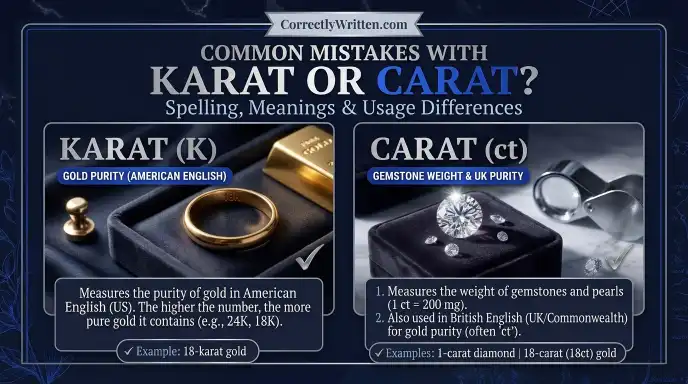
Writers often confuse these words because they sound alike and appear in the same jewelry descriptions. The easiest way to avoid mistakes is to identify what the number measures.
Mistake 1: Using Carat for Gold Purity in American English
Incorrect: This ring is made of 18 carat gold.
Preferred in American English: This ring is made of 18 karat gold.
Explanation: American English usually uses karat for gold purity. The original sentence is common in British English, where carat is also used for gold purity.
Mistake 2: Using Karat for Diamond Weight
Incorrect: She bought a 2 karat diamond.
Correct: She bought a 2 carat diamond.
Explanation: The weight of a diamond is measured in carats, regardless of if you use British or American English.
Mistake 3: Assuming Carat Measures Diamond Quality
Incorrect: This 3 carat diamond must be better than that 1 carat diamond.
Correct: This 3 carat diamond weighs more than the 1 carat diamond.
Explanation: Carat measures weight. It does not tell you everything about a diamond’s cut, color, clarity, or value.
Mistake 4: Assuming Higher Karat Gold Is Always Better
Incorrect: 24 karat gold is always the best choice for every ring.
Correct: 24 karat gold has a higher gold content, but a lower karat alloy may be more suitable for some jewelry.
Explanation: Gold purity is only one factor. Hardness, durability, design, and intended use also matter.
Mistake 5: Mixing the Two Measurements in One Description
Incorrect: The ring has 18 carats of gold and a 1 karat diamond.
Clearer American English: The ring is made of 18 karat gold and has a 1 carat diamond.
Explanation: Use karat for the gold’s purity and carat for the diamond’s weight.
A Simple Memory Tip
Remember these two rules:
- Karat = gold purity in American English.
- Carat = gemstone weight in both American and British English.
Think of the K in karat as the spelling used for the gold’s quality rating. This is a memory aid, not the word’s historical origin.
Everyday Examples of Karat and Carat
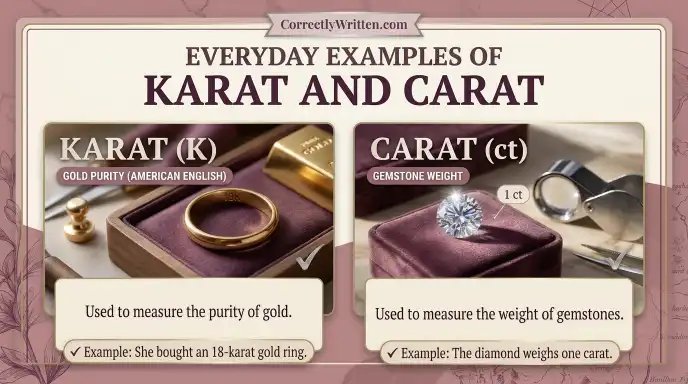
These examples show how to use both words naturally in different situations.
Ten Sentence Examples
- My mother wears an 18 karat gold necklace.
- The jeweler tested the ring to confirm its gold purity.
- He chose a 14 karat gold chain for everyday wear.
- The shop sells bracelets made from 22 karat gold.
- Her engagement ring features a 1 carat diamond.
- The jeweler displayed a 2 carat emerald in the glass case.
- They compared two diamonds with the same carat weight.
- The buyer wanted an 18 karat gold ring with a 0.5 carat diamond.
- The certificate listed the diamond’s weight as 1.25 carats.
- The customer asked if the ring’s 18 karat gold setting would suit the gemstone.
Emails
- “Could you confirm if the bracelet is made of 18 karat gold?”
- “Please include the diamond’s carat weight in the product details.”
Business Writing
- “This necklace features a 14 karat gold chain.”
- “The collection includes diamonds ranging from 0.5 to 2 carats.”
News Headlines
- “Jeweler Unveils Rare 10 Carat Diamond”
- “Buyers Compare 18 Karat Gold Prices”
Blogs
- “How to Choose the Right Gold Karat for Everyday Jewelry”
- “Does Diamond Carat Weight Affect Its Appearance?”
Social Media
- “A timeless 18 karat gold bracelet for your jewelry collection.”
- “Discover how carat weight affects a diamond’s appearance.”
Academic Writing
- “The gold alloy contained 75% gold by mass, corresponding to 18 karat purity.”
- “The gemstone had a mass of 1 carat, equivalent to 200 milligrams.”
Daily Conversation
- “Is your ring made of 18 karat gold?”
- “How many carats is the diamond?”
These examples show that both terms can appear in the same sentence, but each describes a different measurement.
Google Trends and Modern Usage
People search for “karat or carat” because they want to understand jewelry labels, compare gold products, or learn the difference between gold purity and gemstone weight.
Why Is Carat Common in Jewelry Searches?
The word carat often appears in diamond descriptions, engagement ring listings, and gemstone certificates. Buyers use it to compare the weight of different stones.
The word karat is especially important in American jewelry listings because it identifies gold purity. People may search for terms such as 14 karat gold, 18 karat gold, or 24 karat gold before buying jewelry.
Which Word Is More Popular?
The popularity of either word depends on the country, the topic, and the search phrase. A search for diamond weight may favor carat, while a search for American gold purity may use karat.
These are general observations about how the words are used. No exact Google Trends figures are claimed here.
How Should Writers Use These Keywords?
For a comparison article, include both terms naturally and answer the difference early.
For a gold jewelry article aimed at American readers, use phrases such as 18 karat gold and gold purity.
If you want to compare actual search interest, check Google Trends for the target country and date range. Do not invent search volume figures or treat a popular search term as proof of its definition.
Karat vs Carat: Quick Comparison Table
| Version | Meaning | Correct? | Common Usage | Example |
| Karat | Gold purity | Yes | Mainly American English | 18 karat gold |
| Carat | Gemstone weight | Yes | British and American English | 1 carat diamond |
| Carat | Gold purity | Yes | Common in British English | 18 carat gold |
| Karat | Diamond weight | Not the standard term | Avoid in standard jewelry writing | 2 karat diamond |
| 24 karat gold | Very high gold purity | Yes | Gold jewelry descriptions | A 24 karat gold coin |
| 2 carat diamond | Gemstone weight | Yes | Diamond descriptions | A 2 carat diamond |
Key Takeaways
- Karat measures gold purity in American English.
- Carat measures the weight of diamonds and other gemstones.
- One metric carat equals exactly 200 milligrams.
- Pure gold is measured on a 24 part scale.
- British English commonly uses carat for both gold purity and gemstone weight.
- American English usually distinguishes karat for gold from carat for gemstones.
- A higher carat weight does not automatically mean a better quality diamond.
- Always state gold purity and gemstone weight clearly when describing jewelry.
Frequently Asked Questions
Q1. Is it 24 karat or carat?
Both spellings are correct. Karat is commonly used in American English to measure gold purity, while carat is widely used in British English and other regions.
Q2. Is it 18 carat or 18 karat?
Both are correct. 18 karat gold and 18 carat gold contain 75% pure gold, with the remaining 25% made up of other metals.
Q3. What is better, 10 carat or 14 karat?
14 karat gold contains more pure gold and offers a good balance of purity and durability. 10 karat gold is generally harder and more affordable.
Q4. What is 24 carat called?
24 carat gold is commonly called pure gold or fine gold. It is typically about 99.9% pure, depending on the product.
Q5. What is 18 karat gold called?
18 karat gold is often called 75% gold because 18 of its 24 parts are pure gold. The remaining 25% consists of other metals.
Q6. What is 9K gold?
9K gold, also written as 9 karat or 9 carat gold, contains 37.5% pure gold. The remaining 62.5% consists of other metals.
Q7. Is 18K or 9K better?
18K gold offers higher gold purity and is often preferred for its rich gold content. 9K gold is generally more affordable and harder, making it a practical choice for everyday jewelry.
Q8. What karat is 90% pure gold?
Gold that is 90% pure is 21.6 karat, calculated by multiplying 24 by 0.90. By comparison, 22 karat gold contains about 91.7% pure gold.
Conclusion
The difference between karat and carat is easy to remember once you know what each word measures. In American English, karat describes gold purity, while carat measures the weight of a diamond or another gemstone. One metric carat equals 200 milligrams, while gold purity is measured on a 24 part scale.
British English commonly uses carat for both gold purity and gemstone weight. This regional difference explains why you may see 18 karat gold in an American jewelry store and 18 carat gold in a British one.
When writing about jewelry, always make the measurement clear. Use karat for gold purity when following American conventions and carat for gemstone weight in either variety of English. Remember that a diamond’s carat weight does not determine its quality on its own.
📖 Your Next Read:
Cum or Come: Difference, Meaning and Correct Use

Hi, I’m Ava Collins, a writer and English language enthusiast behind CorrectlyWritten. I’m passionate about making grammar simple, clear, and easy to understand. I write about grammar rules, confusing words, spelling, and everyday English usage to help readers write more accurately and confidently.







2 thoughts on “Karat or Carat: Meaning, Differences & Correct Usage ”