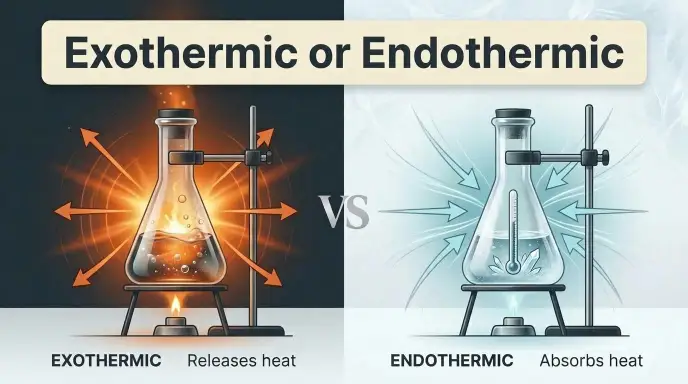
Exothermic reactions release heat into the surroundings, while endothermic reactions absorb heat from the surroundings. This is the main difference between these two types of chemical reactions. Both terms describe how energy moves during a reaction or physical change.
The words exothermic and endothermic are common in chemistry, but they can be confusing at first. One process gives out heat. The other takes in heat. Understanding this difference makes many science topics easier, including combustion, melting, freezing, photosynthesis, and instant cold packs.
In this guide, you will learn what exothermic and endothermic mean, how they differ, how to identify each process, and how to use both terms correctly in science assignments and everyday examples.
Exothermic or Endothermic: Quick Answer
An exothermic reaction releases energy, usually as heat. It makes the surroundings warmer.
An endothermic reaction absorbs energy from the surroundings. It often makes the surroundings cooler.
Feature
Exothermic
Endothermic
Energy movement
Releases energy
Absorbs energy
Effect on surroundings
Usually becomes warmer
Usually becomes cooler
Heat flow
Out of the system
Into the system
Negative
Positive
Common example
Burning wood
Melting ice
The easiest way to remember the difference is:
- Exothermic = heat exits
- Endothermic = heat enters
What Does Exothermic Mean?
Exothermic describes a process that releases energy into its surroundings.
This energy often leaves the system as heat. As a result, the area around the reaction may become warmer.
The word exothermic comes from two parts:
- Exo means “outside.”
- Thermic relates to heat.
So, exothermic refers to heat moving outward.
Examples of exothermic reactions
Common examples include:
- Burning wood
- Burning fuel
- Many acid base neutralization reactions
- Freezing water
- Condensation of steam
- Cellular respiration
For example, when wood burns, it releases heat and light. The surroundings become warmer because energy moves out of the burning material.
Exothermic reaction in a sentence
Burning gasoline is an exothermic reaction because it releases energy as heat.
What Does Endothermic Mean?
Endothermic describes a process that absorbs energy from its surroundings.
The system takes in heat to make the process happen. Because heat leaves the surroundings and enters the system, the nearby area may become cooler.
The word endothermic also has two parts:
- Endo means “inside.”
- Thermic relates to heat.
So, endothermic refers to heat moving inward.
Examples of endothermic processes
Common examples include:
- Melting ice
- Boiling water
- Evaporation
- Photosynthesis
- Thermal decomposition
- Some reactions between chemicals
For example, ice absorbs heat from its surroundings as it melts. The ice needs this energy to change from a solid into a liquid.
Endothermic reaction in a sentence
Melting ice is an endothermic process because it absorbs heat from the surroundings.
Exothermic vs Endothermic: Main Differences
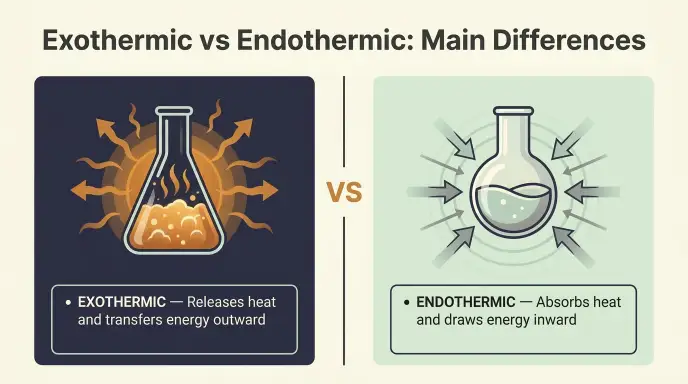
The key difference is the direction of heat transfer.
In an exothermic process, heat moves from the system to the surroundings.
In an endothermic process, heat moves from the surroundings to the system.
Point of Difference
Exothermic
Endothermic
Meaning
Releases heat
Absorbs heat
Heat direction
System : surroundings
Surroundings: system
Surroundings
Usually become warmer
Usually become cooler
Energy change
Energy enters the system
Enthalpy value
ΔH is less than zero
ΔH is greater than zero
Example
Burning fuel
Melting ice
A simple way to understand the difference
Imagine that the system is holding heat.
- In an exothermic process, the system gives some heat away.
- In an endothermic process, the system takes heat in.
This simple idea can help you identify the correct term in many chemistry questions.
Exothermic and Endothermic Energy Diagrams
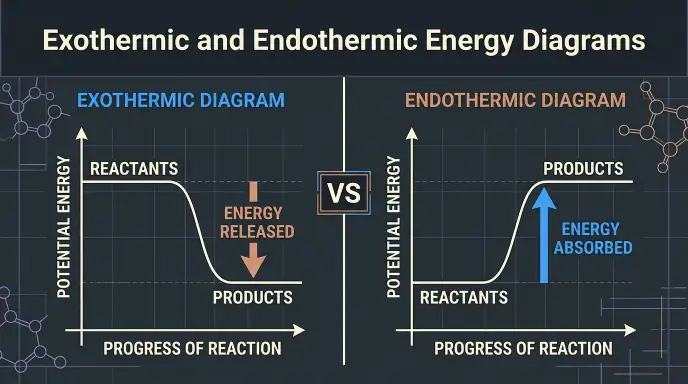
Energy diagrams show how the energy of a system changes during a reaction.
Exothermic energy diagram
In an exothermic reaction, the products have less energy than the reactants.
The extra energy is released into the surroundings.
Basic pattern:
Reactants : Products + Energy
Endothermic energy diagram
In an endothermic reaction, the products have more energy than the reactants.
The system absorbs energy during the process.
Basic pattern:
Reactants + Energy : Products
The energy difference helps explain why the two processes have opposite heat changes.
What Is Enthalpy Change?
Enthalpy change describes the heat absorbed or released by a system under constant pressure.
It is represented by the symbol ΔH.
Exothermic enthalpy change
An exothermic reaction releases heat.
Therefore:
ΔH is negative.
For example:
ΔH = −100 kJ
The negative sign shows that the system has lost energy.
Endothermic enthalpy change
An endothermic reaction absorbs heat.
Therefore:
ΔH is positive.
For example:
ΔH = +100 kJ
The positive sign shows that the system has gained energy.
Easy memory tip
Remember:
- Exothermic = energy exits = negative ΔH
- Endothermic = energy enters = positive ΔH
Everyday Examples of Exothermic Processes
Exothermic processes happen in many parts of daily life.
1. Burning wood
When wood burns, it releases heat and light.
Burning wood is an exothermic reaction.
2. Burning a candle
A candle releases heat as its wax burns.
A burning candle gives off heat through an exothermic reaction.
3. Freezing water
When water freezes, it releases heat into its surroundings.
Freezing water is an exothermic phase change.
4. Hand warmers
Some disposable hand warmers release heat through chemical reactions.
A hand warmer uses an exothermic process to produce warmth.
5. Cellular respiration
Cells release usable energy when they break down glucose during cellular respiration.
Cellular respiration is an overall exothermic process.
Everyday Examples of Endothermic Processes
Endothermic processes also occur around us.
1. Melting ice
Ice absorbs heat as it changes into liquid water.
Melting ice is an endothermic process.
2. Boiling water
Water needs energy to change from a liquid into a gas.
Boiling water is an endothermic phase change.
3. Evaporation
When sweat evaporates, it absorbs heat from your skin.
This helps your body cool down.
Evaporation is an endothermic process.
4. Cold packs
Some instant cold packs become cold when their chemicals dissolve in water.
The process absorbs heat from the surroundings.
5. Photosynthesis
Plants absorb energy from sunlight during photosynthesis.
Photosynthesis is an overall endothermic process because it requires energy.
Common Mistakes
Mistake 1: Thinking exothermic means “takes in heat”
Incorrect idea: Exothermic reactions absorb heat.
Correct idea: Exothermic reactions release heat.
Memory tip: Exo means outside, so heat moves outward.
Mistake 2: Thinking endothermic always means a chemical reaction
Incorrect idea: Endothermic processes must involve new chemicals.
Correct idea: A physical change, such as melting ice, can also be endothermic.
Mistake 3: Confusing system and surroundings
The system is the part being studied. The surroundings include everything around it.
An exothermic system releases heat to its surroundings. An endothermic system absorbs heat from its surroundings.
Mistake 4: Forgetting the sign of ΔH
- Exothermic reactions have a negative ΔH.
- Endothermic reactions have a positive ΔH.
The sign shows the direction of energy change in the system.
Exothermic or Endothermic in Science Class
Both terms are common in chemistry, physics, and biology.
They help explain how energy moves during a reaction or physical change. The spelling and meaning stay the same in British and American English.
English Variety
Correct Term
Example
American English
Exothermic
Combustion is an exothermic reaction.
British English
Exothermic
The reaction releases heat.
American English
Endothermic
Melting ice is an endothermic process.
British English
Endothermic
The process absorbs heat.
There is no difference in spelling between the two varieties of English.
How to Identify an Exothermic Reaction
You can look for several clues when identifying an exothermic reaction.
1. The surroundings become warmer
If a reaction releases heat, the temperature around it may rise.
For example, a burning fuel produces heat that you can feel.
2. Energy leaves the system
An exothermic reaction transfers energy from the system to the surroundings.
3. The enthalpy change is negative
An exothermic reaction has a negative value for ΔH.
4. The products have less energy
In a basic energy diagram, the products have less stored energy than the reactants.
Remember that a reaction may still need some starting energy. Releasing energy overall does not mean that the reaction starts without an energy input.
How to Identify an Endothermic Reaction
You can also use simple clues to identify an endothermic process.
1. The surroundings become cooler
If a process absorbs heat from nearby materials, those materials may cool down.
2. Energy enters the system
An endothermic process takes in energy from the surroundings.
3. The enthalpy change is positive
An endothermic process has a positive value for ΔH.
4. The products have more energy
In a basic energy diagram, the products have more stored energy than the reactants.
An endothermic reaction may still release some energy during individual steps. The overall energy change is what determines if the reaction is endothermic.
Are Melting and Freezing Opposites?
Yes. Melting and freezing show how opposite processes can have opposite heat changes.
Melting
When ice melts, it absorbs heat from its surroundings.
Therefore, melting is endothermic.
Freezing
When liquid water freezes, it releases heat into its surroundings.
Therefore, freezing is exothermic.
Change
Energy Movement
Type
Melting
Absorbs heat
Endothermic
Freezing
Releases heat
Exothermic
Boiling
Absorbs heat
Endothermic
Condensation
Releases heat
Exothermic
Evaporation
Absorbs heat
Endothermic
This pattern also applies to other changes of state.
Are Exothermic and Endothermic Reactions Always Fast?
No. Energy change and reaction speed are different ideas.
An exothermic reaction can happen quickly or slowly.
For example, an explosion releases energy very quickly, while the slow oxidation of iron can also release energy over time.
An endothermic reaction can also be fast or slow, depending on the process and conditions.
The terms exothermic and endothermic tell us about heat transfer. They do not tell us how fast a reaction occurs.
Common Examples in Chemistry
| Process or Reaction | Type | Reason |
|---|---|---|
| Burning methane | Exothermic | Releases heat |
| Burning wood | Exothermic | Releases heat and light |
| Acid–base neutralization | Usually exothermic | Commonly releases heat |
| Freezing water | Exothermic | Releases heat as water freezes |
| Melting ice | Endothermic | Absorbs heat to melt |
| Boiling water | Endothermic | Absorbs heat to change into vapor |
| Photosynthesis | Endothermic overall | Absorbs energy from sunlight |
| Thermal decomposition | Often endothermic | Usually requires heat input |
The energy change can vary depending on the substances and reaction conditions.
Exothermic or Endothermic: Quick Practice
Use these examples to test your understanding.
Test yourself
1. A candle burns and releases heat. What type of process is this?
Exothermic
Endothermic
2. Ice absorbs heat while it melts. What type of process is this?
Exothermic
Endothermic
3. Water releases heat as it freezes. What type of process is this?
Exothermic
Endothermic
Key Takeaways
- Exothermic means that a system releases heat.
- Endothermic means that a system absorbs heat.
- Exothermic processes usually warm the surroundings.
- Endothermic processes often cool the surroundings.
- Exothermic reactions have a negative ΔH.
- Endothermic reactions have a positive ΔH.
- Melting and boiling are endothermic changes.
- Freezing and condensation are exothermic changes.
- Reaction speed is different from heat transfer.
- The prefixes can help you remember the meanings: exo = out and endo = in.
Frequently Asked Questions
Q1. What are exothermic and endothermic reactions? Give an example.
An exothermic reaction releases heat into the surroundings. For example, burning wood produces heat. An endothermic reaction absorbs heat from the surroundings. For example, photosynthesis absorbs energy from sunlight.
Q2. How can you tell if a reaction is endothermic or exothermic?
A reaction is exothermic if it releases heat and the surroundings become warmer. It is endothermic if it absorbs heat and the surroundings become cooler. You can also check the enthalpy change: exothermic reactions have a negative value, while endothermic reactions have a positive value.
Q3. Why is an exothermic reaction negative?
An exothermic reaction has a negative enthalpy change (ΔH) because it releases more energy than it absorbs. As a result, the products contain less energy than the reactants.
Q4. What is an exothermic reaction?
An exothermic reaction is a chemical reaction that releases energy, usually as heat, into the surroundings. Common examples include combustion, acid–base neutralization, and cellular respiration.
Q5. What is an endothermic reaction?
An endothermic reaction is a chemical reaction that absorbs energy from its surroundings. This energy is needed for the reaction to occur. Photosynthesis and the thermal decomposition of calcium carbonate are examples.
Q6. What are five examples of exothermic reactions?
Five examples of exothermic reactions include:
- Burning wood or coal.
- Combustion of natural gas.
- Cellular respiration.
- Acid base neutralization.
- Freezing water into ice.
Q7. What are ten examples of endothermic reactions?
Ten examples of endothermic reactions or processes include:
- Photosynthesis.
- Thermal decomposition of calcium carbonate.
- Decomposition of baking soda when heated.
- Electrolysis of water.
- Melting ice.
- Evaporation of water.
- Sublimation of dry ice.
- Dissolving ammonium nitrate in water.
- Dissolving potassium nitrate in water.
- The reaction between barium hydroxide and ammonium chloride.
Note: Some examples are physical changes or energy absorbing processes rather than chemical reactions.
Q8. Which reaction is exothermic?
A reaction that releases heat is exothermic. For example, the combustion of methane releases energy:
CH₄ + 2O₂ : CO₂ + 2H₂O + energy
Q9. What are ten examples of chemical reactions?
Ten common examples of chemical reactions include:
- Burning paper.
- Rusting iron.
- Cooking an egg.
- Photosynthesis in plants.
- Cellular respiration.
- Burning natural gas.
- Neutralization of an acid and a base.
- Formation of a precipitate.
- Fermentation of sugar.
- Decomposition of hydrogen peroxide.
Conclusion
Exothermic and endothermic describe two opposite patterns of energy transfer.
An exothermic process releases heat, while an endothermic process absorbs heat. This difference helps explain many reactions and physical changes in science.
Burning wood, freezing water, and many combustion reactions are exothermic. Melting ice, boiling water, and photosynthesis are common examples of endothermic processes.
You can identify these processes by looking at the direction of heat transfer. A negative ΔH usually indicates an exothermic change, while a positive ΔH indicates an endothermic change.
The easiest way to remember the terms is to focus on their prefixes. Exo suggests that energy moves out, while endo suggests that energy moves in.
Once you understand this simple idea, it becomes much easier to recognize and explain exothermic and endothermic processes in exams, assignments, and everyday science.
More Word Choices:
Arctic or Artic: Correct Spelling, Meaning & Examples
Shuttlecock or Birdie: A Simple Guide to the Difference
Criticised or Criticized: British vs. American Spelling Explained

Hi, I’m Ava Collins, a writer and English language enthusiast behind CorrectlyWritten. I’m passionate about making grammar simple, clear, and easy to understand. I write about grammar rules, confusing words, spelling, and everyday English usage to help readers write more accurately and confidently.








1 thought on “Exothermic or Endothermic: Heat Transfer Explain with Examples ”