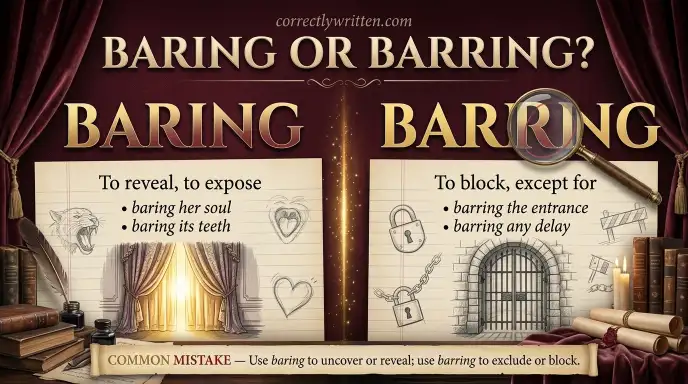
Baring and barring are both correct English words, but they have different meanings. Baring means uncovering or exposing something, while barring usually means excluding something, excepting something, or preventing someone from entering or doing something.
For example, “He was baring his teeth” means he was showing his teeth. In contrast, “Barring any delays, we will arrive by noon” means we expect to arrive by noon unless something causes a delay. The extra r changes the spelling and meaning, so choosing the right word matters.
Both forms come from the verb bar or bare, depending on the word. This guide explains the difference between baring and barring, their definitions, grammar rules, origins, common mistakes, and everyday examples. By the end, you will know when to use each word confidently.
Baring or Barring: Quick Answer
Baring and barring are both correct, but you cannot use them interchangeably.
- Baring: The present participle of bare, meaning to uncover or expose something.
- Barring: The present participle of bar, meaning to block or prevent. It can also mean “except for” or “unless.”
- Correct: The dog was baring its teeth.
- Correct: Barring any unexpected problems, the event will start on time.
Easy memory tip: Baring comes from bare, while barring comes from bar.
Definition and Meaning of Baring
Baring means exposing, uncovering, or revealing something that was previously covered or hidden. It is the present participle of the verb bare.
People often use it when describing physical actions, emotions, or the revelation of information.
Baring as Exposing Something
Use baring when someone removes a covering or reveals something.
Examples:
- She was baring her arms in the summer heat.
- The man stood there, baring his chest.
- The dog growled, baring its teeth.
- The artist created a sculpture baring the figure’s shoulders.
In each sentence, baring describes exposing something.
Baring as Revealing Feelings or Truth
The word can also describe revealing something that was hidden or private.
Examples:
- The interview involved baring his deepest fears.
- She spoke honestly, baring her feelings.
- The investigation succeeded in baring the truth.
- His diary revealed years of private thoughts, baring his emotional struggles.
In these examples, baring means revealing rather than physically uncovering something.
Baring in Common Expressions
You may encounter phrases such as:
- Baring one’s teeth: Showing one’s teeth, often as a threat or warning.
- Baring one’s soul: Revealing deep personal feelings.
- Baring all: Revealing everything or making oneself completely exposed.
Example: She was baring her soul when she shared her personal story.
Definition and Meaning of Barring
Barring has two common meanings. It can mean blocking or preventing something, and it can mean “except for” or “unless.”
It is the present participle of the verb bar.
Barring as Blocking or Preventing
Use barring when someone or something stops access or prevents an action.
Examples:
- The security guard is barring visitors from entering the restricted area.
- The school is barring students from using the damaged playground.
- The new rule is barring unauthorized users from accessing the system.
- The fence is barring animals from entering the garden.
Here, barring describes an action that blocks or restricts access.
Barring as Except for or Unless
Barring also appears as a preposition meaning “except for” or “if something does not happen.”
Examples:
- Barring bad weather, the match will take place tomorrow.
- Barring any delays, we should reach the airport by six.
- Barring an unexpected emergency, the shop will open as usual.
- Barring a last-minute change, the meeting will begin at noon.
In these sentences, barring introduces an exception or possible obstacle.
Why Are Baring and Barring Spelled Differently?
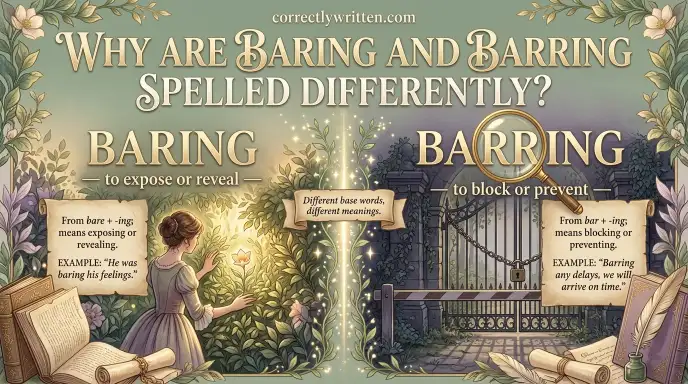
The difference comes from their base verbs.
- Bare : Baring
- Bar : Barring
The verb bare means to uncover or expose something. When you add -ing, you remove the final silent e. This produces baring.
The verb bar means to block, prohibit, or prevent. When you add -ing to a short verb ending in a consonant-vowel-consonant pattern, you usually double the final consonant. This produces barring.
Other examples follow similar patterns:
- Bake : Baking
- Hide : Hiding
- Run : Running
- Stop : Stopping
The spelling rule helps explain why baring has one r, while barring has two.
Baring vs Barring: Main Differences
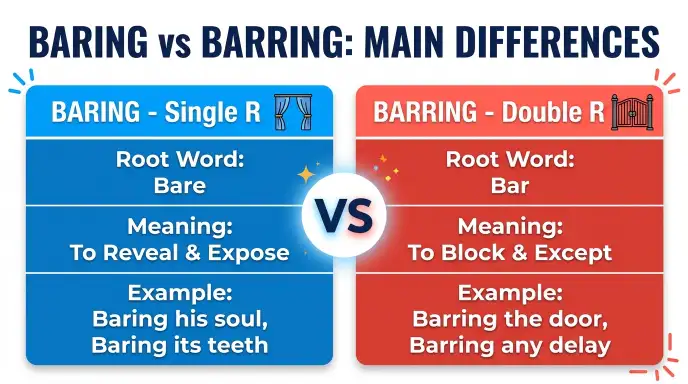
Baring
- Comes from the verb bare.
- Means uncovering, exposing, or revealing.
- Often describes physical exposure or emotional openness.
- Uses one r after the letter a.
Examples:
- He was baring his arms.
- She was baring her soul.
- The dog was baring its teeth.
Barring
- Comes from the verb bar.
- Means blocking, preventing, or prohibiting.
- Can mean “except for” or “unless.”
- Uses two r letters.
Examples:
- The guard was barring the entrance.
- Barring rain, the picnic will continue.
- The policy is barring access to restricted files.
The easiest way to choose is to identify the intended meaning. If you mean exposure, use baring. If you mean prevention or an exception, use barring.
Baring or Barring in Everyday English
Both words appear in everyday conversations, news articles, stories, and professional writing.
When to Use Baring
Choose baring when someone exposes or reveals something.
Examples:
- The athlete was baring his shoulders in the heat.
- The animal snarled, baring its teeth.
- She told her story, baring her emotions.
- The report succeeded in baring the hidden facts.
When to Use Barring
Choose barring when someone blocks access or when you want to express an exception.
Examples:
- The staff are barring entry to unauthorized visitors.
- Barring traffic, we will arrive early.
- The new policy is barring access to the building.
- Barring any changes, the ceremony will begin at ten.
These examples show how the meaning determines the spelling.
Common Mistakes with Baring or Barring
Mistake 1: Using Baring for an Exception
Incorrect: Baring any delays, the train will arrive on time.
Correct: Barring any delays, the train will arrive on time.
Use barring to mean “except for” or “unless.”
Mistake 2: Using Barring for Exposing Something
Incorrect: The dog was barring its teeth.
Correct: The dog was baring its teeth.
The dog is exposing its teeth, so baring is correct.
Mistake 3: Forgetting to Double the R
Incorrect: The guard was baring visitors from entering.
Correct: The guard was barring visitors from entering.
The verb bar forms barring with a double r.
Mistake 4: Assuming Baring Is Always Physical
Baring can describe revealing emotions, secrets, or personal truths. For example, “He was baring his soul” means he was sharing his deepest feelings.
Mistake 5: Ignoring the Meaning of the Sentence
Both words are valid, so a spell-checker may not identify the wrong choice. Read the sentence carefully. Ask if it describes exposure, prevention, or an exception.
Sentence Examples: Baring or Barring
Here are ten natural examples using both words in different contexts.
- The dog growled while baring its teeth at the stranger.
- She was baring her arms to enjoy the warm sunshine.
- The honest conversation involved baring their deepest fears.
- The actor stood on stage, baring his chest for the dramatic scene.
- The documentary succeeded in baring the truth behind the scandal.
- Barring heavy traffic, we should reach the airport by seven.
- The security team is barring unauthorized visitors from entering the building.
- Barring any unexpected problems, the project will finish this week.
- The new restrictions are barring customers from accessing the closed area.
- Barring a last-minute change, the wedding ceremony will begin at noon.
Notice that baring describes exposure or revelation, while barring describes prevention or an exception.
Baring and Barring in British and American English
The spellings and meanings of baring and barring are the same in British and American English.
British English examples:
- The dog was baring its teeth.
- Barring bad weather, the match will continue.
American English examples:
- She was baring her feelings during the interview.
- Barring any delays, the flight should arrive on time.
Neither word is a regional spelling variant of the other. Choose the spelling according to its meaning, not the country where you are writing.
Frequently Asked Questions
Q1. Is it bearing or baring something?
Both bearing and baring are correct words, but they have different meanings. Bearing can mean carrying, supporting, or having an influence, while baring means uncovering or exposing something. For example, “She is bearing the weight” and “He is baring his teeth.”
Q2. What does barring mean?
Barring means excluding something or someone, or unless a particular event happens. For example, “Barring any delays, we will arrive by noon.” It can also mean preventing someone from entering a place, as in “The guard is barring visitors from entering.”
Q3. What is called baring?
Baring is the -ing form of the verb bare, meaning to uncover, expose, or reveal something. For example, “Baring his arms, he prepared for the task.” It can also describe revealing emotions, feelings, or the truth.
Q4. Is “baring in mind” correct?
No, “bearing in mind” is the correct expression. It means remembering or considering something when making a decision. For example, “Bearing in mind the weather forecast, we decided to stay home.” Baring in mind is a common spelling mistake.
Q5. Which is correct: “baring” or “bearing” gifts?
Bearing gifts is correct. It means bringing or presenting gifts to someone. For example, “The visitors arrived bearing gifts for the children.” Baring gifts would suggest uncovering or exposing the gifts rather than bringing them.
Q6. What does “bare” mean?
Bare means uncovered, exposed, or without the usual covering. It can describe a physical object or a lack of something. For example, “He walked across the bare floor” or “She told me the bare facts.” It can also mean to reveal something, as in “bare your soul.”
Q7. Can I say “bare with me”?
The correct expression is “bear with me,” meaning please be patient with me or give me a little time. For example, “Please bear with me while I check the information.” Bare with me has a different, potentially suggestive meaning because bare means to uncover or remove clothing.
Q8. What does “bare girls” mean?
“Bare girls” generally refers to girls or young women who are uncovered, minimally clothed, or showing bare skin. The exact meaning depends on the context. In ordinary writing, use a more specific phrase, such as “girls with bare arms,” if you mean that a particular part of the body is uncovered.
Conclusion
Baring and barring are both correct, but their meanings differ. Use baring when someone uncovers or reveals something. Use barring when someone blocks or prevents access, or when you mean “except for” or “unless.”
Remember the base verbs: bare becomes baring, while bar becomes barring. This simple spelling rule will help you choose the right word in everyday writing, professional communication, and articles.
🔍 Find the Perfect Word!
Rein or Reign: Meaning, Differences & Correct Usage
Site or Sight: Correct Spelling, Meaning, Differences & Examples

Hi, I’m Ava Collins, a writer and English language enthusiast behind CorrectlyWritten. I’m passionate about making grammar simple, clear, and easy to understand. I write about grammar rules, confusing words, spelling, and everyday English usage to help readers write more accurately and confidently.








2 thoughts on “Baring or Barring? Meaning, Differences & Correct Usage ”