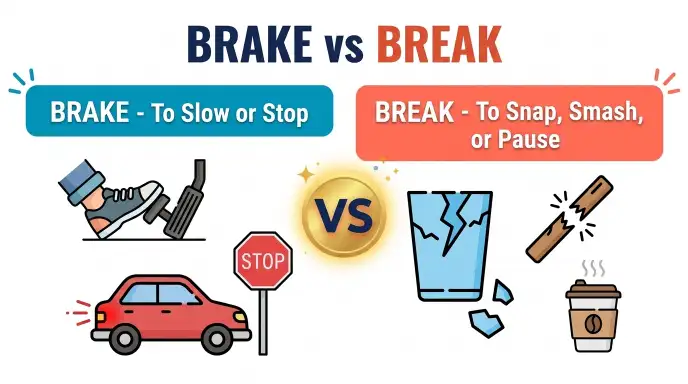
A brake is the part of a car or bike that slows it down or stops it. To break means to snap, damage, or split something into pieces, and a break is also a short pause or rest. One word stops a vehicle, and the other one breaks things apart, so swapping them changes your whole sentence.
The mix up is easy to understand. Brake and break sound exactly the same when you say them out loud. They share the same letters too, just in a new order, so your eyes can slide right past the error.
Writers, students, and drivers search for brake vs break every day because spell check accepts both words. This guide clears the doubt for good.
You will learn the brake meaning, the break meaning, the past forms, and the common mistakes to avoid. You will also get one simple trick that makes the right word easy to pick, plus clear examples from cars, classrooms, offices, and daily talk, so the lesson sticks long after you close the page.
Brake vs Break: The Short Answer
The Quick Difference in Plain Words
Brake is a device that slows or stops a moving vehicle or machine, and to brake means to use that device. Break means to separate into pieces, to damage, or to interrupt something, and as a noun it means a short pause or rest.
Brake belongs to cars and stopping. Break belongs to splitting, pausing, and stopping an activity for a while.
Brake vs Break: Quick Answer
Think Stop the Car, or Split the Thing
Picture two scenes. In the first, a driver presses a pedal and the car slows down. That is brake.
In the second, a glass falls and cracks, and a worker rests. That is break.
- Brake means a device that slows or stops a vehicle or machine, or the act of using it.
- Break means to snap or damage something, to interrupt it, or a short rest from work.
- Brake past form is braked. Break past forms are broke and broken.
Two Fast Examples
The driver had to brake hard when a dog ran onto the road. The car had to stop, so brake is right.
Please take a break and rest your eyes for ten minutes. It means a pause, so break is right.
What Does Brake vs Break Mean?
What Brake Means
Brake is a noun first. It names the part of a car, bike, bus, or train that makes it slow down or stop.
Brake is also a verb. To brake means to press that device and slow the vehicle. A careful driver brakes early on a wet road.
What Break Means
Break is a verb with a wide reach. It means to separate something into pieces, often by force. A child can break a toy, and a fall can break a bone.
Break also means to interrupt something. A loud noise can break the silence, and a team can break a record. As a noun, a break is a short rest.
The Past Forms Give You a Clue
The past forms split the pair apart in a helpful way. Brake is a regular verb, so its past form is braked. The driver braked at the red light.
Break is an irregular verb. Its past form is broke, and its past participle is broken. She broke the stick in two.
The Origin of Brake and Break
Where Break Comes From
Break is a very old English word. It comes from Old English brecan, which meant to break or shatter. The core idea never changed: one whole thing becomes pieces.
That root explains why break covers so much ground today. Rules can be broken, and news can break. Each use carries the idea of a sudden split.
Where Brake Comes From
Brake had a slower road into English. In early use, it named tools and parts that gripped or held things in place. On a cart, the brake was the lever that pressed the wheel and held the cart back.
When cars arrived, the name moved with the job.
Why the Two Words Sound the Same
English often gives one sound to two spellings. Brake and break share a sound but not a history or a meaning. Sound is a poor guide here.
The spelling is the real signal. Tie each spelling to its scene, car or crack, and the trap is gone.
British English vs American English
Same Spelling on Both Sides
Good news first: British and American English spell both words the same way. Brake is brake in London and in Texas. Break is break in both places too.
The small gap is habit. British workers take a tea break. American workers say coffee break or lunch break more often.
| Feature | British English | American English | Example |
| Spelling of the car word | Brake | Brake | Check the brake pads. |
| Spelling of the pause word | Break | Break | We need a short break. |
| Common rest phrase | Tea break | Coffee break | The team took a tea break. |
| Past forms | Braked, broke, broken | Braked, broke, broken | He braked. She broke it. |
What the Dictionaries Say
Merriam Webster, Cambridge Dictionary, and the Oxford English Dictionary all draw the same line. Each ties brake to slowing a vehicle, and break to splitting and pausing.
So region never changes the answer. The scene does. A moving car takes brake, and a pause or a crack takes break.
Which Version Should You Use?
Use Brake in These Cases
Use brake for anything that slows or stops movement. Cars, bikes, and machines all take brake.
- Press the brake gently on ice, never in a hard stamp.
- The cyclist braked at the corner and waved us past.
- A loud screech came from the worn car brake.
Use Break in These Cases
Use break when something splits, gets damaged, or pauses. Objects, rules, records, and work all take break.
- Do not drop that vase, or it will break.
- Let us break for lunch and meet again at two.
- She hopes to break the school record this spring.
Advice by Place and Setting
In the United States, the United Kingdom, Canada, and Australia, the rules stay the same. Only the scene in your sentence decides the word.
For school and exam writing, test each sentence with the car question. For business writing, break suits pauses and schedules, and brake suits vehicle safety notes.
Common Mistakes with Brake and Break
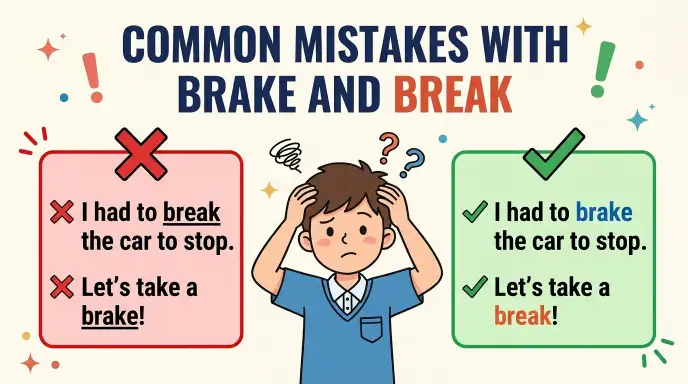
Mistake 1: The Break Pedal
Incorrect: He pressed the break hard, but the car kept rolling.
Correct: He pressed the brake hard, but the car kept rolling.
A car pedal is a brake, with the A spelling. Break would mean he snapped the pedal instead.
Mistake 2: Brake the Glass
Incorrect: Be careful with that jug, or you will brake it.
Correct: Be careful with that jug, or you will break it.
A jug can split and shatter, so break is right. Brake only slows movement, and glass has no wheels.
Mistake 3: The Wrong Past Form
Incorrect: The van broke sharply at the gate to let the kids cross.
Correct: The van braked sharply at the gate to let the kids cross.
The van slowed down, so the past form must be braked. Broke would say the van fell apart.
An Easy Memory Tip
Look at the A inside brake. Let it stand for automobile. The word with the A is the car word.
Break is the word for cracks, pauses, and interruptions.
Everyday Examples of Brake and Break
In Emails
Please service the van, as the brake pedal feels soft. Let us break at noon and finish the report after lunch.
In Business Writing
Safety rules require a brake test before each trip. The staff room stays open during the lunch break.
In News Headlines
Driver brakes in time to save a child at a crossing. Wild cheers break out as the home team breaks the record.
In Blogs
A good car brake should feel firm under your foot. My post on study habits explains why a short break helps your brain.
On Social Media
Brake early, drive safe, and keep your distance in the rain. Taking a break from my phone this week, see you on Monday.
In Academic Writing
The lab report measured how heat changes brake power. The class will break into groups for one case each.
In Daily Conversation
Mind the step, or you will fall and break a leg. Easy on the brake, dad, the baby is asleep.
Google Trends and Modern Usage
Why People Search for This Pair
This section is based on general usage patterns, not on exact chart data. People meet brake in driving lessons and car manuals. They meet break at school, at work, and in chats about rest.
Both words pass spell check, so the tools stay silent and a quick search follows.
Where Each Word Shows Up Today
Brake lives in the motoring world. It shows up in car reviews, repair guides, and safety posts. Phrases like brake pads and emergency brake keep it busy.
Break lives almost everywhere else. It fills office talk about lunch breaks and sports talk about records: break the news, break a habit, take a break.
Why the Mix Up Will Stay Common
The pair sounds the same, and busy writers type by sound. As long as cars need brakes and people need breaks, the same question will keep coming back.
Brake vs Break: Quick Comparison Table
Read the Table, Pick the Word
Use this table as your final check. Match the scene, then take the word beside it.
| Version | Meaning | Correct? | Region | Example |
| Brake | Device that slows or stops a vehicle | Yes, for cars and machines | UK, US, and worldwide | Press the brake now. |
| Brake | To slow a vehicle by using the device | Yes, as a verb | UK, US, and worldwide | She braked at the light. |
| Break | To snap, damage, or split into pieces | Yes, for objects and rules | UK, US, and worldwide | Do not break the cup. |
| Break | A short pause or rest | Yes, as a noun | UK, US, and worldwide | We took a tea break. |
| Break | Device that stops a car | No | None | Wrong: the car break failed. |
| Brake | A short rest from work | No | None | Wrong: a lunch brake at noon. |
Key Takeaways on Brake vs Break
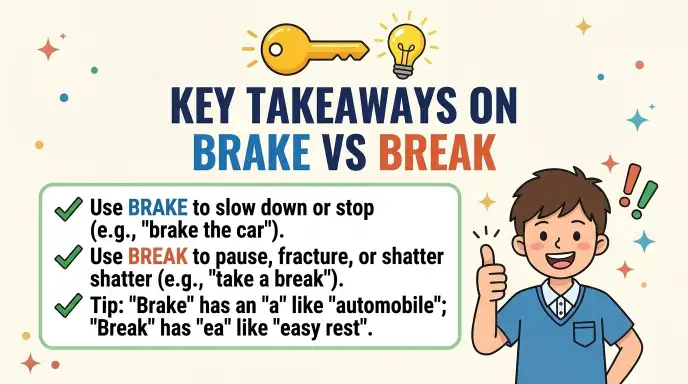
The Points to Keep
- Brake is the device that slows or stops a vehicle or machine.
- To brake means to use that device and cut the speed.
- Break means to snap, damage, split, or interrupt something.
- A break is also a short pause or rest, like a tea break.
- Past forms split cleanly: braked, and broke or broken.
- British and American English spell both words the same way.
- Memory trick: the A in brake stands for automobile.
- Test the scene: car takes brake, crack or pause takes break.
FAQs About Brake vs Break
1. What is the main difference between brake and break?
Brake is the part of a vehicle that slows it down or stops it, and to brake means to use that part. Break means to snap or damage something, or to pause for a short rest.
Cars and stopping take brake. Cracks, rules, records, and rests take break.
2. Is it car brake or car break?
The correct form is car brake. A car stops with a device, and that device is spelled brake. The A in brake can remind you of automobile.
A car break is not a part at all. That spelling only fits a pause on a trip.
3. What does take a break mean?
Take a break means to stop an activity for a short time and rest. Workers take a lunch break, and students take a study break.
The pause helps the body and mind recover. It has no link to pedals, so the spelling is always break here.
4. What is the past tense of brake and break?
The past tense of brake is braked, because brake is a regular verb. The driver braked at the crossing. Break is irregular, so its past tense is broke, and its past participle is broken.
She broke the plate today. Test the scene first, then pick the matching past form.
5. Is it break a leg or brake a leg?
The correct phrase is break a leg. In the theatre, people say it to wish a performer good luck. The phrase uses break in its splitting sense, though no one wants a real injury.
Brake a leg has no such idiom behind it. Brake only slows vehicles, so it never fits this wish.
6. Can break be a noun and a verb?
Yes, break works as both a verb and a noun. As a verb, it means to split, damage, or interrupt: do not break the vase.
As a noun, it means a pause or a gap: a tea break or a lucky break. Brake can also be a noun and a verb, but only for vehicles.
7. Why do brake and break sound the same?
Brake and break are homophones, words that share a sound but not a spelling or a meaning. English has many such pairs, grown from different roots with the same spoken form.
Since sound gives no clue, spelling and scene must do the work. Picture the scene, and the right word will stand out.
8. Is it emergency brake or emergency break?
The correct term is emergency brake. It names the backup device that stops a vehicle when the main brake fails. Some people call it the hand brake or parking brake.
An emergency break is not a car term. That spelling would mean a sudden rest.
9. How can I stop mixing up brake and break?
Use two quick tests. First, ask if a car or stopping movement sits in your sentence. If yes, choose brake, and let the A remind you of automobile.
Second, ask if something splits, ends, or pauses. If yes, choose break. With practice, the right choice becomes fast.
Conclusion: Brake vs Break Made Simple
The Final Word
Brake and break look close, sound the same, and trouble writers of every level. Yet their jobs are far apart.
One word slows a car and keeps people safe. The other splits things, ends things, and gives workers a well earned rest.
Brake belongs to pedals, wheels, pads, and careful drivers. Its past form is braked, neat and regular.
Break belongs to cracks, rules, records, silence, and pauses. Its past forms are broke and broken, and its phrases fill daily speech.
Region will not rescue you here. Britain and America spell the pair the same way.
The scene is the only guide. Run the car test, and the spelling falls into place.
Remember: the A in brake stands for automobile, and everything else takes break. Now scan the last page you wrote, fix any slips, and share this guide with a friend who mixes the pair up too.
💡 Unlock Better Writing:
Baring or Barring? Meaning, Differences & Correct Usage
Rein or Reign: Meaning, Differences & Correct Usage
Site or Sight: Correct Spelling, Meaning, Differences & Examples

Hi, I’m Ava Collins, a writer and English language enthusiast behind CorrectlyWritten. I’m passionate about making grammar simple, clear, and easy to understand. I write about grammar rules, confusing words, spelling, and everyday English usage to help readers write more accurately and confidently.







2 thoughts on “Brake vs Break: Main Differences, Meaning and Examples”