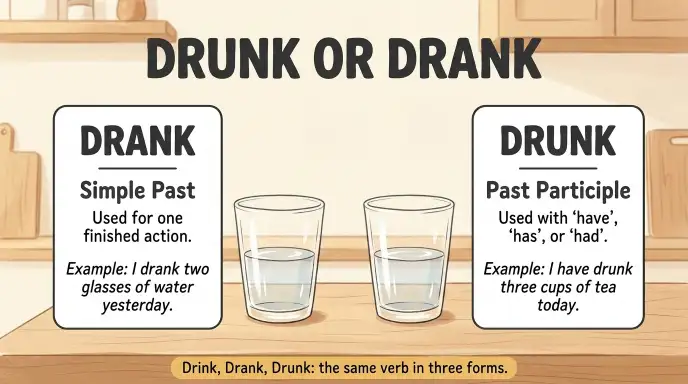
Drank is the simple past tense of drink, and drunk is the past participle. Use drank for one finished past action with no helper verb, as in “I drank a glass of water.” Use drunk with have, has, or had, as in “I have drunk two cups of tea.”
This small pair causes big confusion. Many learners write “I drunk it” or “I have drank it,” and both forms sound wrong to careful readers. The good news is that the rule behind drunk or drank is short, fixed, and easy to learn.
In this guide, you will learn the meaning of each form, the full verb table, and the one simple test that picks the right word every time. You will also see the common mistakes, clear examples from daily life, and the small difference between British and American habits.
You will also meet the adjective sense of drunk and the older partner word drunken. A short practice set near the end will help you test the rule yourself.
Drunk or Drank: The Short Answer
Drank is the simple past tense of drink. It stands alone for a finished past action: “She drank the juice.” Drunk is the past participle. It needs a helper verb like have, has, or had: “She has drunk the juice.” Drunk is also an adjective that means affected by alcohol: “He was drunk.”
Drunk or Drank: Quick Answer
Here is the whole rule in three lines:
- Drank = simple past tense. No helper verb. Example: “We drank lemonade at lunch.”
- Drunk = past participle. It works with have, has, or had. Example: “We have drunk all the lemonade.”
- Drunk = adjective for a person affected by alcohol. Example: “The driver was drunk.”
Keep one memory tip in mind from the start. Drank works alone, but drunk always needs a helper friend. If a helper verb is in the sentence, the answer is almost always drunk.
Drink, Drank, Drunk: The Three Forms
The verb drink is an irregular verb. Its three main forms do not follow the usual “add ed” pattern, so you must learn them as a set.
| Base Form | Simple Past | Past Participle | Example |
| drink | drank | drunk | I drink tea. I drank tea. I have drunk tea. |
Read the three forms aloud a few times: drink, drank, drunk. The vowel sound steps down each time, from “i” to “a” to “u.” This same song appears in sing, sang, sung and swim, swam, swum.
What Does Drank Mean?
Drank is the simple past tense of drink. It tells about one action that started and ended in the past. The action is complete, and the sentence needs no helper verb.
Drank Stands Alone
A sentence with drank works on its own. The verb carries the full past meaning by itself.
- “He drank a bottle of water after the game.”
- “We drank hot milk before bed last night.”
- “The cat drank from its bowl this morning.”
Drank With Time Words
Drank often sits next to clear past time words. Words like yesterday, last night, and ago point to a finished time, and drank fits that finished time well.
- “I drank two glasses of juice yesterday.”
- “They drank coffee together an hour ago.”
What Does Drunk Mean?
Drunk has two jobs in English. Its first job is the past participle of drink. Its second job is an adjective that describes a person affected by alcohol.
Drunk as the Past Participle
As the past participle, drunk never stands alone as the main verb of a past action. It always works with a helper verb: have, has, had, or a form of be in passive sentences.
- “I have drunk three cups of tea today.”
- “She had drunk the juice before lunch.”
- “The water was drunk by the thirsty hikers.”
Drunk as an Adjective
As an adjective, drunk means affected by alcohol. In this job it follows verbs like be, get, feel, and seem. It describes a person, not an action with a glass.
- “He was drunk and could not walk straight.”
- “Do not drive when you are drunk.”
- “She felt drunk after one strong drink.”
A Note on Drunken
Drunken is a close partner of drunk. It works mostly as an adjective placed before a noun, as in “a drunken sailor” or “a drunken song.” In daily speech, drunk is far more common in most spots.
The Origin of Drunk and Drank
Drink is a very old verb. It comes from the Old English word “drincan,” which had a similar sound and the same basic meaning. English speakers have used this verb for well over a thousand years.
In older English, the past participle was drunken. Over the centuries, the shorter form drunk took over that job in normal grammar. Drunken stayed alive in one small corner, as the adjective placed before a noun.
British English vs American English
The core rule is the same on both sides of the ocean. Drank is the simple past, and drunk is the past participle, in British English and American English alike. The differences are only habits of speech and a few fixed terms.
| Point | British English | American English |
| Core rule | drank = past, drunk = participle | drank = past, drunk = participle |
| “Have drank” in speech | Heard in casual talk, marked wrong in tests | Heard more often in casual talk, still marked wrong in tests |
| Road safety term | drink driving | drunk driving |
| With “got” | got drunk | gotten drunk |
So a learner is safe with one plan for both regions. Learn drank for the simple past and drunk after have, has, or had. That plan passes in London, New York, and everywhere else.
Which One Should You Use?
Run this quick three step test before you write the word. It takes two seconds and settles almost every sentence.
Step 1: Look for a Helper Verb
Does the sentence have have, has, or had before the verb? If yes, use drunk. “I have drunk enough water today” is correct, and “I have drank” is not.
Step 2: Check for One Past Action
Is it one finished past action with no helper verb? If yes, use drank. “I drank enough water yesterday” is correct, and “I drunk” is not.
Step 3: Check if It Describes a Person
Are you describing a person after be, get, feel, or seem? If yes, use the adjective drunk. “He got drunk at the party” is correct usage.
Common Mistakes With Drunk and Drank
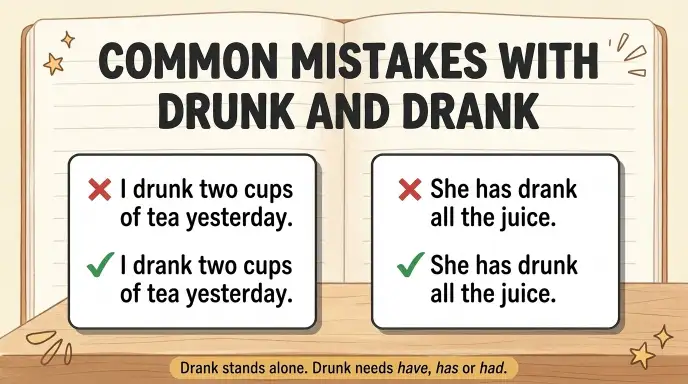
Most errors with this pair fall into four clear groups. Learn to spot each one, and your writing will sound clean and correct.
Mistake 1: Using “I Drunk”
- Wrong: “I drunk a glass of milk.”
- Correct: “I drank a glass of milk.”
Drunk cannot act as the simple past tense. A past action with no helper verb always takes drank.
Mistake 2: Using “I Have Drank”
- Wrong: “I have drank my tea.”
- Correct: “I have drunk my tea.”
This is the most common error of all. The helper have calls for the past participle, and the participle of drink is drunk. You may hear “have drank” in casual speech in some places, but exams, formal writing, and standard guides all mark it wrong.
Mistake 3: Mixing Drank With “Had”
- Wrong: “She had drank the soup before we came.”
- Correct: “She had drunk the soup before we came.”
The word had works like have and has here. Any helper from the have family must pair with drunk, never with drank.
Mistake 4: Using Drunk as the Simple Past in Exams
- Wrong: “He drunk the medicine and slept.”
- Correct: “He drank the medicine and slept.”
In tests and formal writing, drunk alone as a past verb loses marks every time. Keep the simple past slot saved for drank only.
Everyday Examples of Drunk and Drank
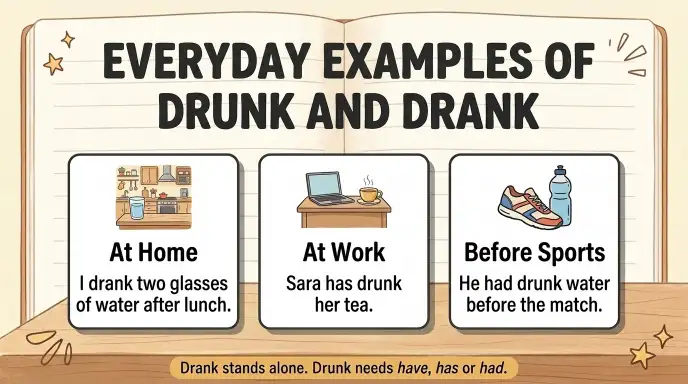
Seeing the forms in real settings makes the rule stick. Notice how drank stands alone, and how drunk always has a helper or describes a person.
At Home
- “Dad drank his tea in silence.”
- “We have drunk the last of the milk, so please buy more.”
- “The baby drank from her cup all by herself today.”
At School and Work
- “The students drank water during the break.”
- “Our team has drunk a lot of coffee this week.”
- “He had drunk two energy drinks before the exam ended.”
Health and Safety
- “You should rest if you feel drunk or dizzy.”
- “She drank plenty of water to stay safe in the heat.”
- “A drunk driver is a danger to everyone on the road.”
Modern Usage: How People Use These Forms Today
Short messages and social posts spread “have drank” far and wide. It pops up in chats, comments, and song lines, so learners hear it often and copy it. Standard guides, teachers, and exam boards still mark it wrong, and careful writers avoid it.
The adjective drunk stays strong in news and safety writing. You will see it in road rules, health advice, and police reports in both Britain and America. The old form drunken now sounds a bit formal or old style, and it mostly survives in fixed phrases and stories.
Drunk vs Drank: Quick Comparison Table
| Point | Drank | Drunk |
| Job | Simple past tense | Past participle and adjective |
| Helper verb | Never takes one | Needs have, has, had, or be |
| Example | I drank water yesterday. | I have drunk water today. |
| Adjective use | No | Yes, means affected by alcohol |
| Common error | “Have drank” is wrong | “I drunk” is wrong |
Key Takeaways
- Drank is the simple past tense of drink, and it stands alone.
- Drunk is the past participle, and it needs have, has, or had.
- “I drunk” is always wrong in standard English.
- “I have drank” is a common speech habit but wrong in tests and formal writing.
- Drunk is also an adjective that means affected by alcohol.
- Drunken works mostly before a noun, as in “a drunken sailor.”
- The core rule is the same in British and American English.
- Memory song: drink, drank, drunk, like sing, sang, sung.
Frequently Asked Questions
1. Is it “I drank” or “I drunk”?
The correct form is “I drank.” Drank is the simple past tense of drink, so it carries a finished past action on its own. “I drunk” is always wrong because drunk is the past participle, and a participle cannot act as the main past verb. Say “I drank a glass of water,” never “I drunk a glass of water.”
2. Is “have drank” correct?
No, not in standard English. The correct form is “have drunk,” because have takes the past participle, and the participle of drink is drunk. You may hear “have drank” in casual speech, songs, and online comments, but teachers, exams, and style guides treat it as an error. In any careful writing, always write “have drunk” or “has drunk.”
3. What is the past tense of drink?
The past tense of drink is drank, and it serves one finished action in the past with no helper verb. For example, “She drank a cup of coffee this morning,” and time words like yesterday, last night, and ago often appear beside it. Remember the set as a group: drink for the present, drank for the simple past.
4. What is the past participle of drink?
The past participle of drink is drunk. It joins helper verbs to build perfect tenses, as in “I have drunk,” “She has drunk,” and “They had drunk.” It can also appear in passive sentences, such as “The juice was drunk quickly.” If have, has, or had stands before the verb, drunk is the form you need.
5. Should I use drunk or drank after “had”?
Use drunk after had, because had works just like have and has and pairs with the past participle. Write “He had drunk his soup before the guests arrived,” and treat “had drank” as a common slip that is wrong in standard English. A quick check helps: had plus drunk, always.
6. Can drunk be an adjective?
Yes, drunk is a common adjective. It means affected by alcohol, and it follows verbs like be, get, feel, and seem. For example, “He was drunk,” “She got drunk,” and “They felt drunk.” In this job, drunk describes a person and says nothing about a glass or a drink. It is the sense used in safety lines like “Never drive drunk.”
7. What is the difference between drunk and drunken?
Drunk is the everyday word, working as the past participle and as an adjective after verbs like be and get. Drunken is an adjective that sits mostly before a noun, as in “a drunken sailor” or “a drunken party,” and it can sound a little old style or formal today. For most sentences, plain drunk is the safe and natural pick.
8. Is drunk or drank used differently in British English?
No, the core rule is the same in British and American English, with drank as the simple past and drunk as the past participle in both. Only small habits differ: the British road term is “drink driving” while Americans say “drunk driving,” and Americans also say “gotten drunk” while British speakers prefer “got drunk.” The forms drank and drunk never swap jobs.
9. Which is correct: “I never drank” or “I have never drank”?
The first sentence is correct: “I never drank.” It uses drank as the simple past with no helper, which is right. The second sentence is wrong because have needs the participle. Fix it to “I have never drunk.” Use this pair as a model: never with drank alone, and never with have plus drunk.
Conclusion
The drunk or drank puzzle has one simple heart. Drank is the simple past tense, and it handles finished past actions all by itself. Drunk is the past participle that works with have, has, or had, and it also serves as an adjective for a person affected by alcohol.
Run the two second test each time you write: a helper verb in the sentence means drunk, and one past action with no helper means drank. Say the sentence in your head before you type the word. With a little practice, the right form will come to mind at once.
Errors like “I drunk” and “have drank” will leave your writing for good, and your readers will trust your English more. Keep the memory song close: drink, drank, drunk, A in the past and U with the helper.
Say it once, and you will never mix this pair again. Now write your next sentence with full care and full trust in the rule.
🔤 Discover the Right Words!
Brake vs Break: Main Differences, Meaning and Examples

Hi, I’m Ava Collins, a writer and English language enthusiast behind CorrectlyWritten. I’m passionate about making grammar simple, clear, and easy to understand. I write about grammar rules, confusing words, spelling, and everyday English usage to help readers write more accurately and confidently.






2 thoughts on “Drunk or Drank: Correct Forms, Rules and Examples”