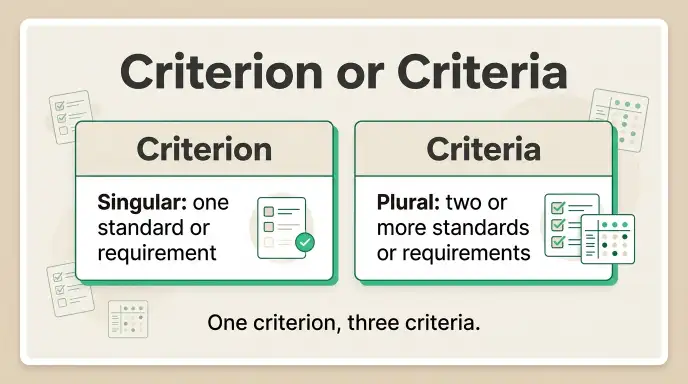
Criterion is the singular form, while criteria is the plural form. Use criterion when you are talking about one standard used to judge or evaluate something, and use criteria when you are talking about two or more standards.
This difference often causes confusion because the two words look and sound similar, but they do not have the same grammatical function. For example, “Cost is an important criterion” is correct when referring to one standard, while “Cost and quality are important criteria” is correct when referring to more than one.
Both words are common in academic writing, business, research, education, hiring, and everyday discussions about decisions and evaluations. Understanding the difference between criterion and criteria helps you choose the correct verb, article, and sentence structure. In this guide, you will learn what each word means, where it comes from, how to use it correctly, common mistakes to avoid, and plenty of real examples.
Criterion or Criteria: Quick Answer
Criterion is singular, and criteria is plural.
Use criterion for one standard, rule, or condition used to make a judgment.
Example:
“Experience is an important criterion for the position.”
Use criteria for two or more standards, rules, or conditions.
Example:
“Experience and education are important criteria for the position.”
The easiest rule to remember is:
One = criterion
More than one = criteria
Definition and Meaning of Criterion and Criteria
What Does Criterion Mean?
A criterion is a standard, rule, or condition used to judge, evaluate, compare, or make a decision about something.
For example:
- “Price is one criterion for choosing a hotel.”
- “Accuracy is an important criterion for this test.”
- “The main criterion is customer satisfaction.”
Because criterion is singular, it can be used with a or one.
Example:
“Safety is a key criterion.”
What Does Criteria Mean?
Criteria is the plural form of criterion. It refers to two or more standards, rules, or conditions used for evaluation or decision:making.
For example:
- “The selection criteria are clearly explained.”
- “The job has several important criteria.”
- “Price and quality are the main criteria.”
Since criteria is plural in formal standard English, it normally takes plural verbs such as are, were, and have.
Example:
“The criteria are difficult to meet.”
Criterion and Criteria in Simple English
Think of the words this way:
Criterion = one standard
Criteria = several standards
For example, imagine you are choosing a new laptop.
If price is the only standard you are considering, price is one criterion.
If you consider price, battery life, screen quality, and performance, these are several criteria.
The Origin of Criterion and Criteria
The word criterion comes from Greek. It is related to a Greek word meaning a means or standard for judging something.
English adopted criterion as a singular noun, while criteria comes from the Greek plural form.
This explains why the two words do not follow the usual English pattern of simply adding :s.
For example:
- one criterion
- two criteria
You would not normally write criterions when you mean the plural of criterion in standard English.
Criterion vs Criteria: Singular and Plural
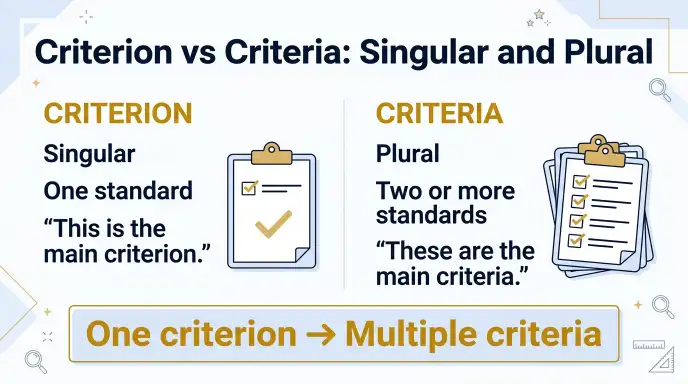
The main difference is grammatical number.
Criterion refers to one standard.
Example:
“Attendance is one criterion for passing the course.”
Criteria refers to multiple standards.
Example:
“Attendance, participation, and exam results are the main criteria.”
Notice the verb changes as well:
The criterion is important.
The criteria are important.
This singular and plural distinction is especially important in formal writing.
British English vs American English Usage
British and American English generally use criterion and criteria in the same way.
In both varieties:
- criterion = singular
- criteria = plural
British English
“Cost is an important criterion.”
“The criteria are clearly stated.”
American English
“Cost is an important criterion.”
“The criteria are clearly stated.”
There is no major spelling difference between British and American English for these words. The important distinction is number, not regional spelling.
Which Form Should You Use?
Use criterion when you are discussing one standard.
Correct:
“Quality is an important criterion.”
Use criteria when discussing multiple standards.
Correct:
“Quality, price, and durability are important criteria.”
For formal, academic, professional, and business writing, keeping this distinction clear is the safest choice.
Although criteria is sometimes used as a singular noun in informal modern English, traditional standard usage treats it as plural. In careful writing, use criterion for one and criteria for more than one.
Common Mistakes with Criterion and Criteria
Mistake 1: Using Criteria for One Standard
Incorrect:
“This is the most important criteria.”
Correct:
“This is the most important criterion.”
There is only one standard in this sentence, so criterion is required.
Mistake 2: Using Criterion for Multiple Standards
Incorrect:
“These are the main criterion for selection.”
Correct:
“These are the main criteria for selection.”
The sentence refers to several standards, so criteria is correct.
Mistake 3: Using a with Criteria
Incorrect:
“A criteria for admission is academic performance.”
Correct:
“A criterion for admission is academic performance.”
Because criterion is singular, it can follow a.
Mistake 4: Using a Plural Verb with Criterio
Incorrect:
“The main criterion are cost and quality.”
Correct:
“The main criterion is cost.”
If several standards are mentioned, you can say:
“The main criteria are cost and quality.”
Mistake 5: Using a Singular Verb with Criteria
Incorrect:
“The selection criteria is simple.”
Correct:
“The selection criteria are simple.”
In formal standard English, criteria is plural, so it normally takes are.
Important Rule: “One of the Criteria”
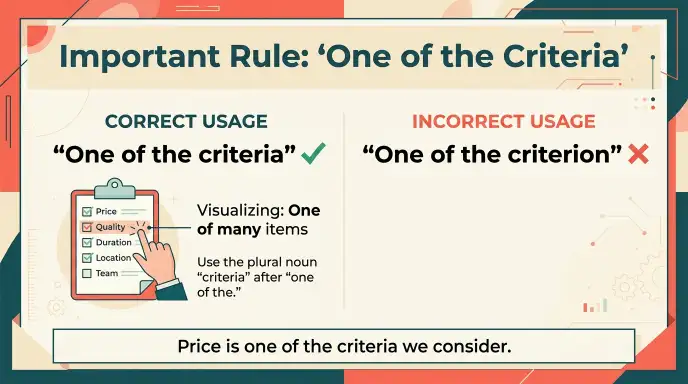
A particularly useful construction is:
“One of the criteria is…”
This is correct because criteria is plural, but the subject of the verb is one, which is singular.
For example:
- “One of the criteria is affordability.”
- “One of the criteria is previous experience.”
- “One of the criteria is customer satisfaction.”
Do not write:
“*One of the criteria are affordability.”
The correct sentence is:
“One of the criteria is affordability.”
Criterion and Criteria in Everyday Examples
In Education
“Attendance is an important criterion for passing the course.”
“The grading criteria include accuracy, organization, and originality.”
In Job Applications
“Relevant experience is an important criterion for this position.”
“The hiring criteria include experience, education, and communication skills.”
In Business
“Profitability is one criterion used to evaluate the project.”
“The company has several criteria for selecting suppliers.”
In Research
“Accuracy is a key criterion for evaluating the results.”
“The researchers established several criteria before collecting the data.”
In Everyday Conversation
“Price is my main criterion when buying clothes.”
“Comfort and quality are my main criteria when choosing shoes.”
In Formal Writing
“The proposal must meet every criterion listed in the guidelines.”
“The applications were reviewed according to several criteria.”
Criterion or Criteria: Easy Way to Remember
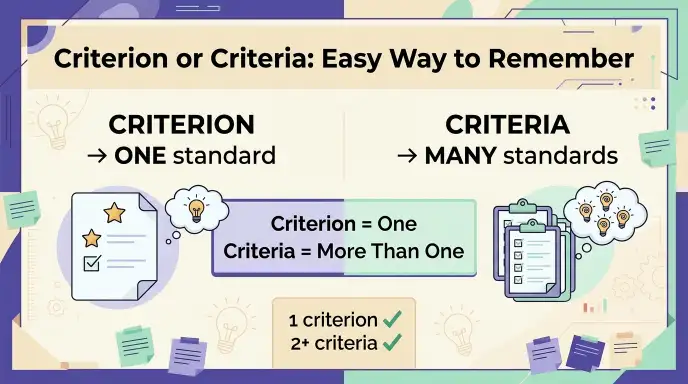
A simple memory trick can help:
Criterion = one
Criteria = many
Think of criterion as a single measuring stick.
If you have several measuring sticks, you have criteria.
You can also remember these sentence patterns:
One criterion is…
Several criteria are…
This makes it easier to choose the correct word and verb at the same time.
Criterion or Criteria: Quick Comparison
Criterion
Meaning: One standard used for judging or evaluating something.
Number: Singular
Example: “Price is an important criterion.”
Common verb: is
Can use “a”: a criterion
Criteria
Meaning: Two or more standards used for judging or evaluating something.
Number: Plural
Example: “Price and quality are important criteria.”
Common verb: are
Can use “a”: Not in formal standard usage.
Criterion or Criteria: Google Trends & Usage Data
Both criterion and criteria are established English words and appear frequently in academic, professional, educational, business, and research contexts.
Searches for these words often come from people trying to understand the singular and plural forms. The confusion is understandable because criteria does not look like the usual English plural formed by adding :s.
In actual writing, criteria is often encountered more frequently because people commonly discuss several requirements or standards at once. However, the frequency of a word does not change its grammatical role.
The key distinction remains simple:
Criterion = singular
Criteria = plural
Frequently Asked Questions
Q1. What is a criterion example?
A criterion is a standard or rule used to make a judgment or decision. For example, “Experience is an important criterion for hiring a manager.”
Q2. Is criterion the same as criteria?
Criterion and criteria have the same basic meaning, but they differ in number. Criterion is singular, referring to one standard, while criteria is plural, referring to two or more standards.
Q3. What does criterion mean?
Criterion means a standard, requirement, or principle used to evaluate, judge, or make a decision about something. For example, price can be a key criterion when choosing a product.
Q4. Is it correct to say “three criteria” or “three criterion”?
Three criteria is correct because criteria is the plural form of criterion. For example, “The committee evaluated the applications using three criteria.”
Q5. Do I say criteria or criterion?
Use criterion when referring to one standard and criteria when referring to multiple standards. For example, “Cost is one criterion,” but “Cost and quality are two criteria.”
Q6. How do you use criterion in a sentence?
Use criterion as a singular noun when describing a standard for evaluation or selection. For example, “Accuracy is the main criterion for judging the results.”
Q7. What is another word for “criterion”?
Depending on the context, synonyms for criterion include standard, requirement, benchmark, measure, guideline, and test. Each word has slightly different uses.
Q8. What is a good sentence for criteria?
A good example is: “The school uses several criteria to select students for its scholarship program.” Here, criteria refers to the multiple standards used in the selection process.
Conclusion
The difference between criterion and criteria is mainly a matter of singular and plural usage. Criterion refers to one standard, rule, or condition used to evaluate something, while criteria refers to two or more standards. For example, “Experience is an important criterion” is correct when discussing one standard, while “Experience and education are important criteria” is correct when discussing multiple standards.
The most useful rule is simple: one criterion, several criteria. Remembering this also helps you choose the correct verb. Say “the criterion is” for one and “the criteria are” for several. This distinction is especially important in academic, professional, business, and formal writing. Once you understand the singular and plural relationship, criterion and criteria become much easier to use correctly.
📚 Explore More:
Grayson or Greyson? Meaning, Origin & Spelling Differences

Hi, I’m Ava Collins, a writer and English language enthusiast behind CorrectlyWritten. I’m passionate about making grammar simple, clear, and easy to understand. I write about grammar rules, confusing words, spelling, and everyday English usage to help readers write more accurately and confidently.








2 thoughts on “Criterion or Criteria? Meaning, Correct Usage & Differences ”