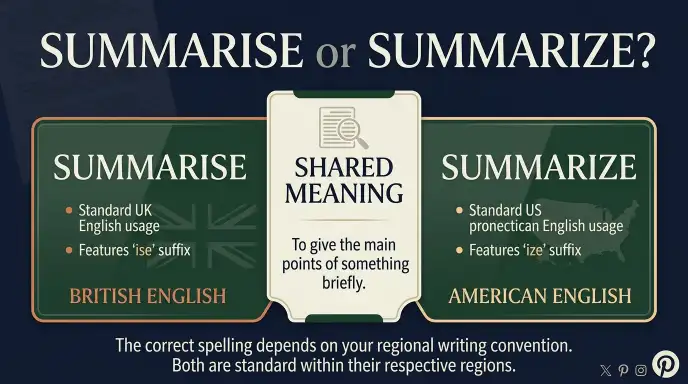
Summarise and summarize are both correct spellings of the same verb, but they belong to different varieties of English. Summarise is the standard spelling in British English, while summarize is the standard and more widely preferred spelling in American English.
Both words mean to give the main points of something briefly and clearly, without including every detail. The difference comes from the spelling conventions used in British and American English, not from a difference in meaning or pronunciation. This can be confusing for students, writers, editors, and English learners because both forms appear frequently online and in professional writing.
The distinction is especially useful when writing for a specific audience, following a style guide, or preparing academic and professional documents. In this guide, you will learn the meaning, pronunciation, origin, British and American spelling differences, correct usage, common mistakes, everyday examples, and an easy way to remember when to use summarise and summarize.
Summarise or Summarize: Quick Answer
Both summarise and summarize are correct.
- Summarise is commonly used in British English.
- Summarize is the standard spelling in American English.
Both mean to give the main points of something in a shorter form.
Examples:
- British English: Please summarise the article.
- American English: Please summarize the article.
The pronunciation and meaning are essentially the same. The main difference is the spelling of the ending:
British English: summarise
American English: summarize
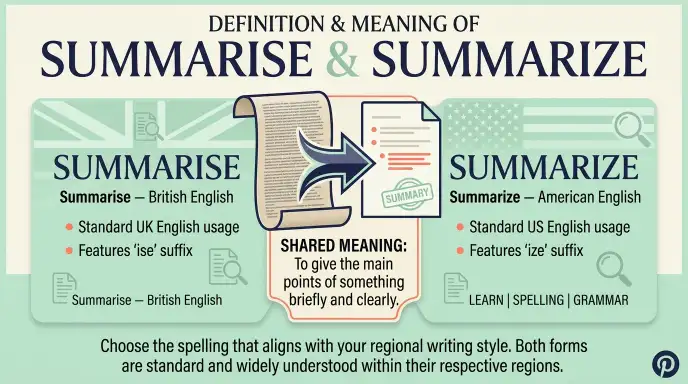
Definition and Meaning of Summarise and Summarize
What Does Summarise Mean?
Summarise means to present the main ideas or important points of something briefly.
For example:
Please summarise the chapter in three paragraphs.
This means to explain the important information without repeating every detail.
What Does Summarize Mean?
Summarize has exactly the same meaning.
For example:
Please summarize the chapter in three paragraphs.
The meaning does not change simply because the spelling changes.
Simple Meaning
The easiest meaning of both words is:
To give the main points in a shorter form.
For example:
- summarise a book
- summarize an article
- summarise a meeting
- summarize a report
- summarise a conversation
The goal is to make information shorter while keeping its most important ideas.
Summarise vs Summarize: The Main Difference
The main difference is regional spelling.
Summarise is associated primarily with British English.
Summarize is the standard form in American English.
However, the distinction in British English is slightly more flexible than many people realize. British English commonly uses ise, but ize is also an established British spelling in many style systems.
For example, both summarise and summarize can be encountered in British English. The ise form is very common in British usage, while the ize form is preferred by some British publishers and style guides.
This means the simple rule is useful:
US English : summarize
UK English : summarise is common
If you are following a particular organization’s style guide, use the spelling that guide specifies.
The Origin of Summarise and Summarize
The verb comes from summary, which ultimately traces back to Latin summarius, meaning related to a sum or summary.
English developed the verb summarize from summary with the suffix ize. British English later developed widespread usage of the ise spelling as well.
This explains why the two forms have the same meaning and pronunciation. They are not separate words with different histories or definitions. They are spelling variants of the same verb.
The related noun is:
summary
Examples:
- Write a summary of the article.
- Please summarize the article.
- Please summarise the article.
British English vs American English Spelling
The most noticeable difference is the final three letters.
| Variety of English | Preferred/Common Spelling | Example |
| British English | summarise | Please summarise the report. |
| American English | summarize | Please summarize the report. |
| Meaning | Same | Give the main points briefly. |
| Pronunciation | Same | No major difference |
| Past form | summarised | British usage |
| Past form | summarized | American usage |
In British English, summarise is very common.
In American English, summarize is the normal spelling.
What About Summarize in British English?
Summarize is not necessarily wrong in British English.
The ize spelling is accepted by some British dictionaries, publishers, and style guides. The Oxford spelling tradition, for example, has historically favored ize in many words of this type.
Therefore, it is better to think of the difference as a preference and style convention, rather than saying that summarize is always incorrect in Britain.
Which Spelling Should You Use?
Your audience should guide your choice.
For American English
Use:
summarize
Examples:
- Please summarize the findings.
- Can you summarize this article?
- Students must summarize the chapter.
For British English
Use:
summarise
Examples:
- Please summarise the findings.
- Can you summarise this article?
- Students must summarise the chapter.
For International Writing
Either spelling may be understood internationally, but consistency matters.
If the rest of your writing follows American spelling, use summarize.
If your writing follows British spelling, use summarise.
Avoid switching between the two forms within the same document unless a quotation or source requires it.
Common Mistakes with Summarise and Summarize
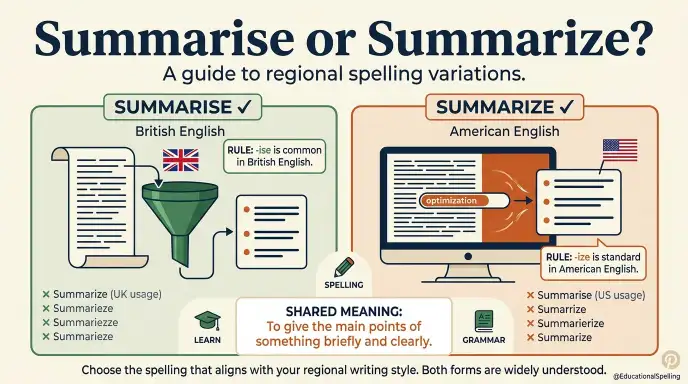
Mistake 1: Mixing Spelling Systems
A writer may use British spelling in one paragraph and American spelling in another.
For example:
Please summarise the report and analyze the results.
This mixes summarise with analyze.
A consistent British style could use:
Please summarise the report and analyse the results.
An American style could use:
Please summarize the report and analyze the results.
Consistency is especially important in academic and professional writing.
Mistake 2: Assuming One Form Is Always Wrong
It is incorrect to assume that summarise is simply a misspelling of summarize, or that summarize is always wrong in British English.
Both forms exist.
The appropriate choice depends largely on the variety of English and the style guide being followed.
Mistake 3: Changing the Meaning
Some writers think summarise and summarize have slightly different meanings.
They do not.
Both mean to present the main points of something briefly.
Summarise and Summarize in Everyday Examples
In Academic Writing
British:
Students should summarise the main arguments.
American:
Students should summarize the main arguments.
In Emails
British:
Could you please summarise the meeting?
American:
Could you please summarize the meeting?
In Business Writing
British:
The report summarises the company’s performance.
American:
The report summarizes the company’s performance.
In News Writing
British:
The article summarises the latest developments.
American:
The article summarizes the latest developments.
In Everyday Conversation
British:
Can you summarise what happened?
American:
Can you summarize what happened?
Summarise or Summarize: Other Forms
The spelling difference continues when the verb changes form.
British English
- summarise
- summarises
- summarised
- summarising
American English
- summarize
- summarizes
- summarized
- summarizing
Examples:
British:
She is summarising the article.
American:
She is summarizing the article.
The meaning remains the same.
Summarise or Summarize: Easy Way to Remember
A simple memory trick is to connect the spelling with the variety of English you are using.
British English: summarise
Think:
ise = common British style
American English : summarize
Think:
ize = standard American style
Another useful trick is to look at related words.
British English often uses forms such as:
- organise
- recognise
- realise
- summarise
American English commonly uses:
- organize
- recognize
- realize
- summarize
Remember that British ise is not a universal rule, because some British style systems prefer ize. Always follow the required style guide when one is specified.
Summarise or Summarize: Usage Comparison
| Feature | Summarise | Summarize |
| Main usage | British English | American English |
| Meaning | Give the main points briefly | Give the main points briefly |
| Pronunciation | Same | Same |
| Present form | summarise | summarize |
| Thirdperson form | summarises | summarizes |
| Past form | summarised | summarized |
| ing form | summarising | summarizing |
| Correct? | Yes | Yes |
Summarise or Summarize: Google Trends & Usage Data
Both forms are widely used online, but their popularity is strongly connected with regional English conventions.
Summarize is especially common in content written for American audiences, including American education, business communication, and software instructions.
Summarise is common in British English and appears frequently in British educational, governmental, and professional writing.
Search results can also vary depending on the country, publisher, and writing style. Because both forms are correct, a difference in search frequency does not mean that one spelling is universally correct.
For writers, the more useful rule is to match the spelling to the audience and remain consistent throughout the document.
Frequently Asked Questions
Q1. What does summarise mean?
Summarise means to give the main points of something in a shorter form. It is the British English spelling of summarize.
Q2. Is it summarize or summarise?
Both spellings are correct. Summarize is the standard spelling in American English, while summarise is commonly used in British English and other varieties of English.
Q3. What does it mean to summarize?
To summarize means to present the most important points of something briefly, without including every detail. For example, you can summarize a long article in a few sentences.
Q4. Is it summarise or summarize in R?
In R, both summarise() and summarize() are supported by dplyr. They perform the same operation, with summarise() commonly used in current dplyr documentation.
Q5. How do you spell “summarize” in the UK?
In British English, summarise is the traditional spelling. Summarize is also found in British English, particularly in styles that use ize spellings.
Q6. What does mutate() mean in R?
In dplyr, mutate() creates new columns or modifies existing columns in a data frame. It generally keeps the original number of rows while adding or changing variables.
Q7. What does %>% mean in R?
The %>% symbol is known as the pipe operator from the magrittr package. It passes the result of one operation into the next, making sequences of datamanipulation steps easier to read.
Q8. What is the difference between summarise() and mutate() in dplyr?
summarise() reduces data to summary results, often producing one row per group, while mutate() adds or changes columns while generally keeping the existing rows.
Conclusion
Summarise and summarize are both correct spellings of the same English verb. The main difference is regional and stylistic rather than semantic. Summarise is commonly associated with British English, while summarize is the standard spelling in American English. Both mean to present the main points of something clearly and briefly.
The spelling difference continues in other forms of the verb. British English commonly uses summarises, summarised, and summarising, while American English uses summarizes, summarized, and summarizing. British English can also use the ize form in some style systems, so summarize should not automatically be treated as incorrect in British writing.
For everyday writing, the simplest approach is to follow your intended variety of English. If you are writing for an American audience, summarize is the natural choice. If you are following common British English conventions, summarise is appropriate. Most importantly, keep your spelling consistent throughout the same document. Both forms communicate exactly the same idea: reducing information to its most important points.
🚀 Take Your words to the Next Level:
Porsche or Porsha? Correct Spelling, Pronunciation, & Usage

Hi, I’m Ava Collins, a writer and English language enthusiast behind CorrectlyWritten. I’m passionate about making grammar simple, clear, and easy to understand. I write about grammar rules, confusing words, spelling, and everyday English usage to help readers write more accurately and confidently.








2 thoughts on “Summarise or Summarize? Correct Spelling, Meaning & Usage ”