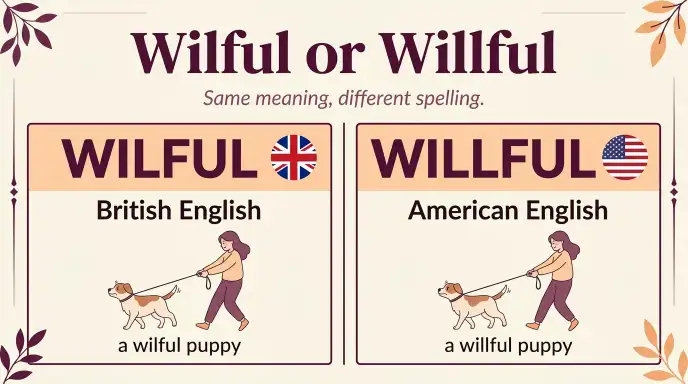
Wilful and willful are both correct spellings, but the preferred form depends on the variety of English you are using. Wilful is the traditional British spelling, while willful is the standard American spelling.
Both words describe something done deliberately, intentionally, or stubbornly, often despite knowing that it is wrong or against a rule. For example, “His wilful refusal to cooperate caused problems” is standard British English, while “His willful refusal to cooperate caused problems” is standard American English.
The main difference is the spelling of the word, not its meaning. This distinction can be confusing because many British words ending in ful keep a single l, while American English often uses willful with two l’s. In this guide, you will learn the meaning, origin, British and American spellings, common mistakes, everyday examples, and the best form to use in different types of writing.
Wilful vs Willful: Quick Answer
Both wilful and willful are correct.
- Wilful is the preferred spelling in British English.
- Willful is the preferred spelling in American English.
Both mean deliberate, intentional, or done knowingly, often with an implication of stubbornness or refusal to follow rules.
British English:
“His wilful disregard of the rules was unacceptable.”
American English:
“His willful disregard of the rules was unacceptable.”
The difference is mainly spelling.
Wilful = British English
Willful = American English
Definition and Meaning of Wilful and Willful
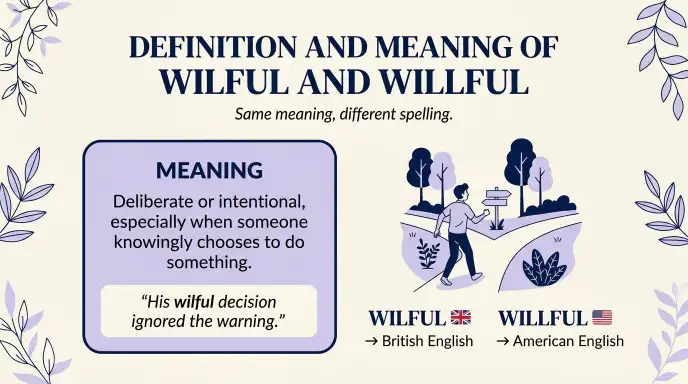
What Does Wilful or Willful Mean?
Wilful or willful describes something that is done intentionally or deliberately. It can also describe someone who stubbornly refuses to obey, cooperate, or change their behavior.
The word can have a neutral meaning when it simply means intentional, but it often carries a negative sense.
For example:
- “The damage was wilful.”
- “His wilful disobedience led to disciplinary action.”
- “She made a willful decision to ignore the warning.”
The exact tone depends on the context.
Simple Meaning of Wilful orWillful
In simple English, wilful/willful means:
done deliberately
or
intentionally refusing to do what is expected
For example:
“He ignored the warning on purpose.”
This could be described as:
“His action was wilful.”
The word is especially common in formal, legal, professional, and serious contexts.
Wilful or Willful as a Description of a Person
The word can also describe a person who is determined to do what they want, even when others advise against it.
For example:
“She is a wilful child.”
This can mean that she is stubborn, independent, or difficult to control.
The tone depends on context. In some situations, wilful can suggest strong determination, while in others it suggests stubborn disobedience.
The Origin of Wilful and Willful
Wilful and willful come from the English word will, referring to intention, desire, or determination.
The suffix ful means “full of” or “characterized by.”
The word has been used in English for centuries to describe actions or behavior guided by conscious intention or personal determination.
The spelling later developed differently in British and American English.
British English generally retained:
wilful
American English commonly adopted:
willful
The difference is therefore connected to spelling conventions rather than two different meanings.
British English vs American English Spelling
The main spelling difference is the number of l’s.
British English
The preferred British spelling is:
wilful
Example:
“His wilful disobedience was clearly documented.”
American English
The preferred American spelling is:
willful
Example:
“His willful disobedience was clearly documented.”
The meaning remains the same.
This is similar to other British and American spelling differences, where the same word may appear in slightly different forms depending on the variety of English being used.
Why Does British English Use “Wilful”?
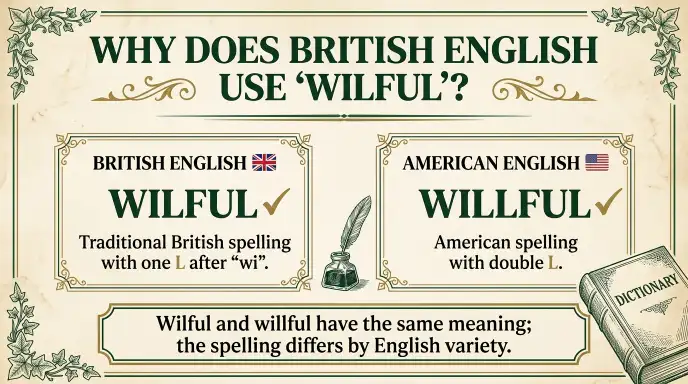
British English traditionally spells the word as wilful, with one l before ful.
This follows the common British spelling of many words formed with the suffix ful.
Examples include:
- useful
- careful
- hopeful
- meaningful
- wilful
The spelling wilful is well established in British English and is especially common in British legal, academic, and formal writing.
Why Does American English Use “Willful”?
American English commonly uses willful, with two l’s.
The spelling emphasizes the connection with the word will.
For example:
will + ful = willful
This spelling is standard in American dictionaries and is common in American legal, business, academic, and everyday writing.
The important point is that willful is not a spelling mistake simply because British English uses wilful.
Both forms are legitimate.
Which Spelling Should You Use?
Choose the spelling based on your audience and the variety of English you are following.
For British English
Use:
wilful
Example:
“The court found that the damage was wilful.”
For American English
Use:
willful
Example:
“The court found that the damage was willful.”
For International Writing
If your audience includes readers from different English speaking regions, either spelling can be understood.
However, consistency is important. If your document follows British English, use wilful throughout. If it follows American English, use willful throughout.
Do not switch between the two forms randomly in the same piece of writing.
Common Mistakes with Wilful vs Willful
Mistake 1: Calling Wilful Incorrect
Some writers assume wilful is a spelling mistake because willful has two l’s.
That is incorrect.
Wilful is a standard British English spelling.
Mistake 2: Calling Willful Incorrect
Similarly, willful is not incorrect simply because British English uses wilful.
It is the standard American spelling.
Mistake 3: Mixing Both Spellings
Using wilful in one paragraph and willful in another can make your writing look inconsistent.
Choose one spelling according to your preferred variety of English and use it consistently.
Mistake 4: Confusing Wilful with Willing
Wilful does not simply mean “willing.”
Willing means ready or prepared to do something.
Wilful/willful usually means deliberate or intentional and can suggest stubbornness or wrongdoing.
For example:
“She was willing to help.”
“She showed wilful disregard for the rules.”
These sentences express very different ideas.
Wilful and Willful in Everyday Examples
In Formal Writing
“His wilful disregard for the regulations resulted in a penalty.”
American version:
“His willful disregard for the regulations resulted in a penalty.”
In Legal Contexts
“The defendant was accused of wilful misconduct.”
American spelling:
“The defendant was accused of willful misconduct.”
In Workplace Writing
“Management considered the employee’s repeated refusal to follow instructions wilful.”
American spelling:
“Management considered the employee’s repeated refusal to follow instructions willful.”
In Everyday Conversation
“That was a wilful decision to ignore the warning.”
American version:
“That was a willful decision to ignore the warning.”
Describing Behavior
“His wilful behavior made the situation more difficult.”
American version:
“His willful behavior made the situation more difficult.”
Wilful vs Willful: Meaning and Spelling
The two forms have the same basic meaning.
Wilful
Spelling: One l before ful
Preferred in: British English
Meaning: Deliberate, intentional, or stubbornly determined
Example: “It was a wilful act.”
Willful
Spelling: Two l’s
Preferred in: American English
Meaning: Deliberate, intentional, or stubbornly determined
Example: “It was a willful act.”
The important difference is regional spelling, not definition.
Wilful or Willful in Legal and Formal English
Both spellings are particularly common in serious or formal contexts.
The word can appear in expressions such as:
- wilful misconduct
- wilful disobedience
- wilful neglect
- wilful damage
- wilful refusal
- willful misconduct
- willful disobedience
- willful neglect
- willful damage
- willful refusal
In legal writing, the preferred spelling often follows the jurisdiction’s established language conventions.
For example, British legal writing generally uses wilful, while American legal writing generally uses willful.
If you are preparing an official document, it is best to follow the spelling conventions used by the relevant institution or jurisdiction.
Wilful or Willful: Easy Way to Remember
A simple trick is:
British English = wilful
American English = willful
Remember:
UK : one L
US : two L’s
The meaning stays the same.
You can also connect willful with the word will, which helps explain why American English commonly writes it with two l’s.
Wilful or Willful: Google Trends & Usage Data
Both wilful and willful continue to appear in English language searches and written content, but their popularity depends strongly on the region.
Wilful is more closely associated with British English and is therefore more common in British oriented writing and sources.
Willful is more common in American English and appears frequently in American legal, professional, and general writing.
Searches for the two spellings often happen because writers want to know which version is correct. The answer depends on the variety of English being used.
For British English, choose wilful.
For American English, choose willful.
Neither spelling should automatically be treated as a mistake.
Frequently Asked Questions
Q1. What does wilful mean?
Wilful means intentional, deliberate, or done knowingly. It can describe someone who deliberately chooses to do something, especially when that action is considered wrong or unreasonable.
Q2. How do you spell “willful” in the UK?
In British English, wilful is the traditional spelling, with one l in the middle. Willful, with two l’s, is the standard American English spelling.
Q3. Who is a willful person?
A willful person is someone who is determined to do what they want, sometimes despite advice, rules, or other people’s wishes. The word can suggest stubborn or deliberate behavior depending on the context.
Q4. Is willful a positive word?
Willful can be positive or negative depending on the context. It can suggest strong determination, but it can also imply stubbornness or deliberate disobedience.
Q5. Which is correct, wilful or willful?
Both are correct, but they are used in different varieties of English. Wilful is commonly used in British English, while willful is the standard American English spelling.
Q6. What is another way to say “very willing”?
Depending on the context, alternatives include eager, enthusiastic, keen, ready, and more than willing. For example, “She was eager to help” sounds more natural than “She was very willing to help.”
Q7. What is a nicer word for “willing”?
Some warmer alternatives to willing include eager, enthusiastic, cooperative, agreeable, and open. The best choice depends on if you want to emphasize enthusiasm, cooperation, or readiness.
Q8. What is a fancy way of saying “very”?
Depending on the sentence, you can replace very with stronger words such as extremely, exceptionally, remarkably, highly, or particularly. Often, choosing a stronger adjective is even more natural.
Conclusion
Wilful and willful are both correct spellings of the same word. The main difference is regional. Wilful is the preferred spelling in British English, while willful is the standard spelling in American English. Both words describe something deliberate, intentional, or sometimes stubbornly determined.
For British English writing, use wilful, as in “wilful misconduct” or “wilful disobedience.” For American English writing, use willful, as in “willful misconduct” or “willful disobedience.” The meaning does not change when the spelling changes.
The easiest rule to remember is UK: wilful, US: willful. Neither form is automatically wrong. Your choice should depend on the English variety you are following and the audience you are writing for. Once you remember the British and American spelling difference, choosing between wilful and willful becomes straightforward.
🔤 Discover the Right Words!
Gopher or Gofer? Correct Spelling, Meaning & Usage

Hi, I’m Ava Collins, a writer and English language enthusiast behind CorrectlyWritten. I’m passionate about making grammar simple, clear, and easy to understand. I write about grammar rules, confusing words, spelling, and everyday English usage to help readers write more accurately and confidently.








2 thoughts on “Wilful or Willful? Correct Spelling, Meaning & Usage ”