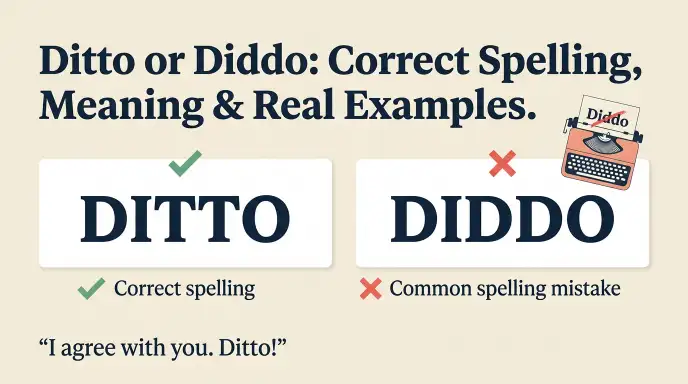
Have you ever heard someone say “ditto” and wondered if it should be spelled ditto or diddo? This is a common spelling confusion, especially among English learners and people who hear the word before seeing it in writing.
Ditto is the correct spelling. Diddo is a misspelling when you mean “the same” or “I agree.” The word ditto is used in everyday conversations, text messages, and informal writing. It can show that you share someone’s opinion, feeling, or experience.
For example, if someone says, “I love this song,” you can reply, “Ditto!” This means “I love it too” or “I feel the same way.”
But what exactly does ditto mean? Where did the word come from? Is it appropriate for formal writing? And why do so many people spell it as diddo?
In this guide, you will learn the correct spelling, meaning, origin, pronunciation, common mistakes, and practical examples of ditto. You will also discover how to use it naturally in different situations.
Let’s begin by settling the spelling question.
Ditto or Diddo: Quick Answer
Ditto is the correct spelling. Diddo is incorrect when you want to express “the same,” “me too,” or “I agree.”
The word ditto has two common uses:
- It means “the same” when referring to repeated information.
- It means “I agree” or “me too” in casual conversations.
Examples:
- “I am tired today.” “Ditto!”
- “She bought a blue notebook, and I bought ditto.”
- “I love your new hairstyle.” “Ditto!”
The main rule is simple: Use ditto, not diddo, in standard English.
What Does Ditto Mean?
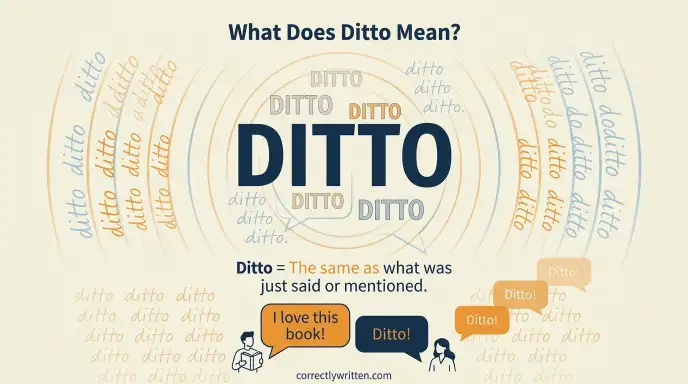
Ditto is an English word that means “the same” or “the same thing as mentioned before.” It can also be used as a short response to show agreement.
The meaning depends on the situation.
1. Ditto Means “The Same”
When you use ditto to refer to something repeated, you are saying that the same information applies again.
Example:
The first box contains ten books. The second box contains ditto.
In this example, ditto means that the second box also contains ten books.
A more natural modern version would be:
The second box also contains ten books.
2. Ditto Means “I Agree”
In informal conversations, ditto can mean “I agree,” “me too,” or “I feel the same way.”
Example:
“I really enjoyed the movie.”
“Ditto!”
The second speaker is saying that they also enjoyed the movie.
3. Ditto as a Repetition Mark
A ditto mark is a symbol used to show that information is repeated from above. The symbol is often written as two small quotation marks or represented by a double prime like mark.
For example, an old record might use ditto marks to repeat a name or a category in a list.
Today, many documents repeat the information directly because it is easier to read.
4. Ditto as a Verb
Ditto can also be used as a verb, meaning to repeat or do the same thing.
Example:
“Please ditto the instructions from the previous page.”
This use is less common than the conversational meaning.
The Origin of Ditto
The word ditto entered English from Italian. It is connected to the Italian word detto, which means “said” or “the said.”
The word became popular in English record keeping and commercial documents. People used it to indicate that information was the same as something written above.
Over time, ditto developed a wider meaning. It began to refer to anything repeated or identical.
Eventually, people started using ditto in everyday speech as a short way to agree with someone. This conversational use is still familiar today.
Why Do People Spell Ditto as Diddo?
The spelling diddo usually comes from a pronunciation based mistake.
When people hear ditto, they may not know how to spell it. Because the word is pronounced quickly in conversation, some people write diddo instead.
However, diddo is not the standard spelling of the word meaning “the same” or “I agree.”
How Do You Pronounce Ditto?
Ditto is usually pronounced DIT oh.
- Dit sounds like the beginning of the word difficult.
- Oh sounds like the letter O.
The pronunciation does not change the spelling. Remember the two T’s in ditto.
British English vs American English
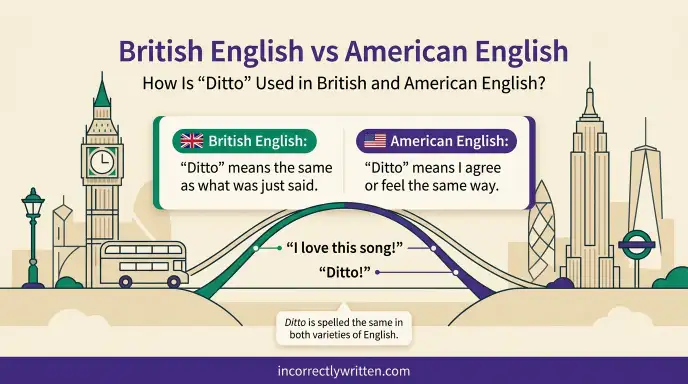
There is no spelling difference between British English and American English for the word ditto. Both varieties use the same spelling.
The word may appear in casual conversations, historical documents, and informal writing in both regions.
Does Ditto Change in British English?
No. The spelling remains ditto in British, American, Canadian, and Australian English.
Regional differences may affect how often people use the word, but the spelling stays the same.
Is Ditto Suitable for Formal Writing?
Ditto is a standard English word, but it is often more natural in informal communication.
In academic, legal, or professional writing, repeating the information may be clearer than using ditto.
For example:
Less clear:
The same rule applies to the second section. Ditto for the third.
Clearer:
The same rule applies to the second and third sections.
The best choice depends on your audience and the context.
Which Version Should You Use?
Always use ditto when you mean “the same,” “me too,” or “I agree.”
Here is a practical guide for different regions and writing situations.
In Casual Conversations
Ditto is a natural way to agree with a friend.
“I cannot wait for the weekend.”
“Ditto!”
This sounds friendly and relaxed.
In Academic Writing
Academic writing usually requires clear explanations. Instead of using ditto, repeat the information or use a specific reference.
Example:
The first experiment produced positive results. The second experiment produced similar results.
This is clearer than using ditto without explaining what it refers to.
In Business Writing
You may use ditto in informal workplace messages when everyone understands the reference.
Example:
“The same deadline applies to the second project. Ditto for the third.”
For important instructions, it is better to state the details clearly.
Common Mistakes
People often confuse ditto and diddo because the two spellings sound similar. Here are some common mistakes and their corrections.
Memory Tip
Remember this simple rule:
Ditto has two T’s.
You can connect it with the phrase “the same thing.”
Whenever you want to say “the same” or “I agree,” remember to write ditto.
Ditto = The same.
Ditto in Everyday Examples
The word ditto is useful in casual conversations and informal writing. Here are examples from different situations.
1. Emails
Example:
“I really enjoyed the training session.”
“Ditto! It was very helpful.”
This is suitable for a friendly, informal email.
For a formal email, you could write:
“I agree. I also found the training session very helpful.”
2. Business Writing
Example:
“The same deadline applies to the marketing team. Ditto for the sales team.”
This means that both teams have the same deadline.
For important business documents, repeat the deadline to avoid confusion.
3. News Headlines
Ditto may appear in informal headlines, opinion articles, or commentary.
Example:
“Higher costs affect small businesses. Ditto for independent retailers.”
Here, ditto means that independent retailers face the same problem.
4. Blogs
Blog writers may use ditto to avoid repeating an idea.
Example:
“The first recipe is simple and affordable. Ditto for the second recipe.”
This means that the second recipe has the same qualities.
5. Social Media
Ditto is common in short online replies.
Example:
“I need a long holiday!”
“Ditto!”
The response means, “I need one too.”
6. Academic Writing
In academic writing, clarity is important.
Less precise:
“The first study found similar results. Ditto for the second study.”
Clearer:
“The second study found similar results.”
The second version is more direct.
7. Daily Conversation
Example 1:
“I love chocolate ice cream.”
“Ditto!”
Example 2:
“I think we should leave early.”
“Ditto. Traffic could be heavy.”
Example 3:
“You look great today.”
“Ditto!”
In the third example, the speaker may mean, “You look great too.”
Google Trends & Modern Usage
People search for “ditto or diddo” because the two spellings sound similar, and many people want to confirm the correct spelling before using the word in writing.
Why Do People Search for Ditto or Diddo?
Common reasons include:
- They heard the word in a conversation or video.
- They are unsure how to spell it.
- They have seen diddo written online.
- They want to know if ditto means “I agree.”
- They want to use the word correctly in a message or article.
Is Ditto Still Used Today?
Yes. Ditto remains a familiar English word, especially in informal conversations, text messages, and online discussions.
Its conversational meaning is easy to understand in many situations. However, some speakers may prefer expressions such as “me too,” “same here,” or “I agree.”
Regional Popularity
The spelling ditto is used across major varieties of English. There is no standard regional spelling called diddo for this meaning.
Exact Google Trends data is not included in this article. Therefore, no specific search volume or regional popularity claims can be made here.
Quick Comparison Table
| Word | Correct or Incorrect | Meaning | Example |
| Ditto | Correct spelling | Same; I agree; me too | “I love this song.” “Ditto!” |
| Diddo | Incorrect spelling | No standard English meaning | “Diddo” is a common spelling mistake. |
Key Takeaways
- Ditto is the correct spelling.
- Diddo is a misspelling when you mean “the same” or “I agree.”
- Ditto can mean “the same thing,” “me too,” or “I agree.”
- The word comes from Italian and entered English through record keeping.
- British and American English use the same spelling.
- Ditto is especially common in informal conversations.
- Clearer wording is often better in academic and formal writing.
- Remember: Ditto means the same.
Frequently Asked Questions
Q1. What does diddo mean in slang?
“Diddo” is a common misspelling of ditto, which means “same here” or “I agree.” It is not a standard slang word.
Q2. What does ditto mean in slang?
In slang, ditto means “me too,” “same,” or “I feel the same way.” It is used to show agreement with someone’s statement.
Q3. What does dido mean in slang?
“Dido” is usually a misspelling of ditto when used to mean “same here.” However, Dido is also the name of a British singer.
Q4. What is the definition of diddo?
“Diddo” is generally considered an incorrect spelling of ditto. Ditto means something that has been said or mentioned before, or “the same.”
Q5. Is it diddo or ditto?
The correct spelling is ditto, not diddo. Ditto means “same here” or “I agree” and is used in casual conversations.
Q6. Does ditto mean “I love you”?
Yes, ditto can mean “I love you” when someone uses it to return the same feelings. However, its meaning depends on the context of the conversation.
Q7. When a woman says Ditto?
When a woman says “ditto,” she usually means “I agree,” “same here,” or “I feel the same way.” If someone says “I love you,” she may use it to express the same feelings.
Q8. Is saying Ditto disrespectful?
No, saying ditto is not disrespectful in most situations. It is a casual way to express agreement, although it may sound too informal in certain professional settings.
Q9. How do you use Ditto?
You can use ditto to agree with someone’s statement or repeat the same idea. For example: “I love this movie.” “Ditto!”
Conclusion
When choosing between ditto or diddo, the correct spelling is ditto. It is the standard English word for expressing “the same,” referring to repeated information, or showing agreement.
The spelling diddo is a common mistake caused by pronunciation. Although you may see it in informal online messages, it is not the accepted spelling for this meaning.
Ditto is particularly useful in casual conversations, text messages, social media, and friendly emails. You can use it to agree with an opinion, share a feeling, or indicate that something is the same as something mentioned earlier.
In academic and professional writing, clear language is often the better choice. Instead of using ditto, repeat the information or explain the connection directly.
For English learners, remembering this spelling is simple. The word has two T’s, and it means “the same.”
if you are writing an email, replying to a friend, or creating content for your website, using the correct spelling helps you communicate more clearly.
Remember this simple rule: When you mean “the same,” write ditto, not diddo.
If you enjoy learning about confusing English words, explore more spelling and meaning guides on correctlywritten.com.
Explore More:
Skis or Skiis: The Correct Plural of “Ski” With Usage Examples
Exothermic or Endothermic: Heat Transfer Explain with Examples

Hi, I’m Ava Collins, a writer and English language enthusiast behind CorrectlyWritten. I’m passionate about making grammar simple, clear, and easy to understand. I write about grammar rules, confusing words, spelling, and everyday English usage to help readers write more accurately and confidently.








2 thoughts on “Ditto or Diddo? Correct Spelling, Meaning, Usage & Real Examples ”