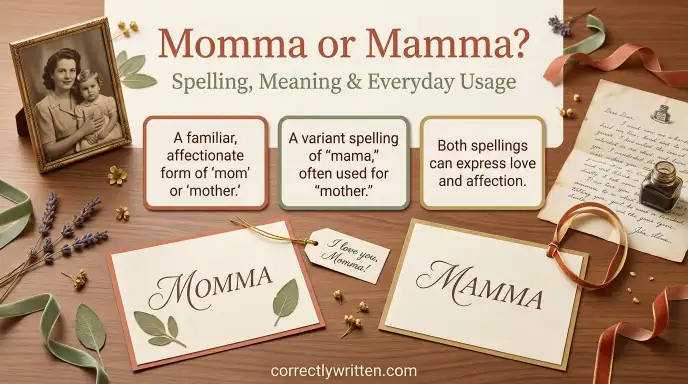
Choosing between momma or mamma comes down to if you prefer modern American informal English or traditional, literary, and international linguistic variations.
People search for “momma or mamma” when checking spelling rules, writing character dialogue, drafting personal notes, or analyzing regional dialects. This comprehensive 1,500 word guide solves the confusion by breaking down regional usage, etymological origins, grammatical structures, and practical writing applications.
Momma or Mamma : Quick Answer
Momma is predominantly used in American English as a casual variation of “mom,” while mamma is an older, classic spelling widely used in British English, historical literature, Southern regional dialects, and Latin based European languages.
- Momma: Popular in the United States, modern informal speech, pop culture, and country or hip hop lyrics.
- Mamma: Common in classic English literature, British history, and European languages like Italian, Spanish, and Scandinavian tongues.
Definition and Meaning of Momma or Mamma
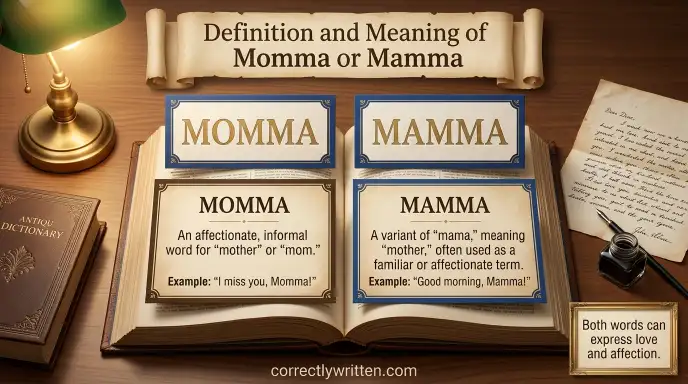
Clear Definition
The phrase “momma or mamma” refers to informal nouns used as affectionate titles, forms of address, or general vocabulary for a mother or maternal figure.
Simple Meaning
In simple terms, both terms mean “mother,” “mom,” or “mum.” They function as tender, colloquial alternatives to formal parental designations.
Context and Usage
You will find these words used in informal family communications, creative writing, song lyrics, poetry, social media captions, and regional storytelling. They express emotional warmth, familiarity, and maternal bonding.
Different Meanings and Distinctions
While both words share a primary definition referring to a parent, distinct nuances exist across linguistic contexts:
- Momma (Colloquial Noun): An informal American variant representing a mother. In certain Southern and urban American dialects, it can also refer affectionately to a matriarch or grandmother (“Big Momma”).
- Mamma (Colloquial & Literary Noun): The traditional spelling used historically in English and widely preserved in Romance languages.
- Mamma (Anatomical / Biological Noun): In biology and medicine, mamma (plural: mammae) is the official scientific term for the milk secreting organ or mammary gland of female mammals.
The Origin of Momma or Mamma
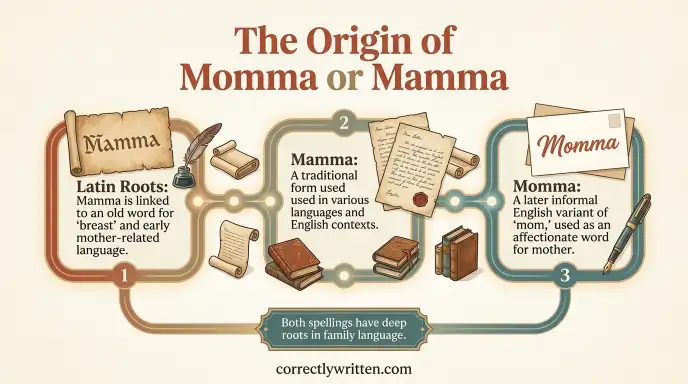
Word History and Etymology
Both forms originate from early infant vocalizations. When human babies begin developing speech, bilabial nasal sounds (specifically the “m” sound produced by pressing the lips together) are the easiest speech sounds to articulate.
- Origin of Mamma: The word derives directly from the Late Latin mamma, which meant “breast” or “mother.” This Latin root gave birth to words across the Indo European language tree, including the scientific category Mammalia (mammals). It was integrated into Early Modern English as a natural nursery word.
- Origin of Momma: The spelling “momma” developed much later, specifically in 19th century American English. As the word “mom” emerged as a distinctly American abbreviation for “mother” (replacing the British “mum”), the double m variation “momma” followed phonetically to reflect how Americans pronounced the open vowel sound.
Spelling and Naming Variations
The structural split between the two spellings aligns with broader sound shifts between British and American English. While British speakers gravitated toward “mum” and “mummy,” Americans developed “mom” and “momma.” Meanwhile, “mamma” remained popular in literary English up through the Victorian era before gradually yielding to “mama” or “momma” in everyday American print.
British English vs American English Spelling
Understanding regional preferences prevents awkward phrasing when writing for specific international audiences. The table below compares how terms for mothers align across major dialects:
| Context / Term | American English | British English / International |
| Primary Informal Term | Mom / Momma | Mum / Mamma / Mummy |
| Traditional / Literary Form | Mama / Momma | Mamma / Mama |
| Plural Forms | Mommas | Mammas |
| Anatomical Term | Mammary gland / Mamma | Mammary gland / Mamma |
| Common Slang Idiom | “Yo momma” | “Mamma mia” (Italian usage) |
Which Spelling Should You Use?
Choosing the correct form depends on your target audience, geographic setting, and narrative voice.
Choose “Momma” If:
- You write for an American audience: American readers naturally associate “momma” with warmth, Southern hospitality, or modern urban dialogue.
- You write song lyrics or dialogue: If your text represents contemporary American speech, “momma” accurately captures the spoken cadence.
- You create casual digital content: Blog posts, lifestyle content, and casual emails in North America lean toward “momma.”
Choose “Mamma” If:
- You write historical fiction or poetry: Period pieces set in the 18th, 19th, or early 20th centuries sound more authentic using “mamma.”
- You target European or British readers: UK and international audiences accustomed to traditional spellings will recognize “mamma” more readily.
- You reference non English cultural contexts: When writing characters of Italian, Nordic, or Eastern European heritage, “mamma” fits their native linguistic roots.
Common Mistakes with Momma or Mamma
1: Using Informal Variants in Professional Documents
- Incorrect: “Employees must submit a emergency contact form signed by their momma.”
- Correct: “Employees must submit an emergency contact form signed by their mother or guardian.”
2: Confusing Anatomical Terms with Casual Terms
- Incorrect: “The veterinary surgeon examined the dog’s momma.”
- Correct: “The veterinary surgeon examined the dog’s mammae (or mammary glands).”
3: Dropping the Double ‘M’ in Dialogue
- Incorrect: “She called out to her moma across the yard.”
- Correct: “She called out to her momma across the yard.” (Or: “She called out to her mama across the yard.”)
4: Inconsistent Spelling in Creative Writing
- Incorrect: “Momma brought us breakfast, and then Mamma read us a story.”
- Correct: Pick one spelling style and maintain consistency throughout your manuscript.
Momma or Mamma in Everyday Examples
1. Informal Business or Casual Email
“Good morning team, just a quick reminder that our office Mother’s Day drive is happening this Friday. Feel free to share a photo of your momma on the company bulletin board!”
2. Journalism and Feature Articles
“Local community leaders organized a weekend fundraiser to support low income mothers, ensuring every momma in the neighborhood received essential supplies.”
3. Creative Writing and Literature
“Little Ellen sat quietly on the front porch steps, waiting patiently for her mamma to return from the market before sunset.”
4. Social Media Captions
“Wishing a very Happy Mother’s Day to my incredible momma! Thank you for your endless love, patience, and support. ❤️”
Momma or Mamma : Google Trends & Usage Data
Regional Distribution and Popularity Analysis
Search trends reflect distinct geographic preferences for these terms across global regions:
- United States & Canada: “Momma” holds dominant search volume across North America. It displays particularly high density in the Southern United States and Midwest, where regional speech patterns favor soft phonetic endings.
- United Kingdom & Commonwealth Nations: “Mamma” retains steady historical search interest, though it often shares space with “mum” and “mummy.”
- Continental Europe: Search queries for “mamma” spike significantly across Italy, Scandinavia, and Germany, where local spellings mirror the Latin root.
| Feature | Momma | Mamma |
| Dominant Region | United States, Canada | United Kingdom, Italy, Europe |
| Primary Tone | Warm, casual, American regional | Classic, literary, traditional |
| Scientific Usage | None | Yes (Biological term for milk glands) |
| Neutral Universal Alternative | Mama | Mama |
Comparison of Keywords and Variations
Understanding related keyword variations clarifies search intent and usage scope:
| Keyword Variation | Primary Search Intent | Best Context |
| Momma or mamma | Spelling comparison | Language guides and style decision making |
| Momma meaning | Definition search | Explaining American colloquial terms |
| Mamma definition | Multipurpose definition | Checking literary or biological meanings |
| Mama vs momma | Phonetic comparison | Choosing between single m and double m forms |
Frequently Asked Questions
Q1. Is it mamma, mama or momma?
All three spellings are correct, but mama is the most common. “Momma” and “mamma” are informal or regional variations of the word.
Q2. What does “momma” mean?
“Momma” is an informal word for mother or mom. It is often used affectionately by children and adults.
Q3. Can I say momma?
Yes, you can say momma in casual conversations. It is a familiar and affectionate way to refer to your mother.
Q4. Can I call my girlfriend momma?
Yes, if your girlfriend is comfortable with it. “Momma” can be a playful or affectionate nickname, depending on your relationship.
Q5. Is mamas a flirty word?
“Mamas” can be a flirty or affectionate term in some contexts, especially when addressing a woman. Its meaning depends on the speaker and situation.
Q6. Can I call a female mama?
Yes, you can call a woman “mama” as a nickname if she is comfortable with it. In some cultures, it is also used as a friendly or affectionate expression.
Q7. Is mama a romantic word?
“Mama” is not normally a romantic word, but couples may use it as a personal nickname. Its meaning depends on the relationship and context.
Q8. What if my bf calls me mommy?
If your boyfriend calls you “mommy,” it may be a playful, affectionate, or flirtatious nickname. Ask him what he means if you feel unsure or uncomfortable.
Q9. What is the male version of momma?
The male equivalent of “momma” is generally daddy, when referring to a father. In some romantic contexts, “daddy” may also be used as a nickname.
Conclusion
Determining if to write momma or mamma depends on your target audience, geographical setting, and narrative style. Use momma when crafting modern American dialogue, writing casual digital content, or capturing Southern regional speech. Choose mamma when writing historical prose, targeting European readers, or utilizing terms grounded in Latin heritage. If you want a globally recognized term that avoids regional bias altogether, the simplified spelling mama provides an ideal alternative. Selecting the right option ensures your writing remains authentic, clear, and engaging for your readers.
Deciding between momma or mamma? Discover the spelling rules, regional origins, and dialect differences in this complete language guide.
Discover the Right Words:
Snowboarding vs Skiing: Key Difference, Skills, Beginner Tips
Ditto or Diddo? Correct Spelling, Meaning, Usage & Real Examples
Skis or Skiis: The Correct Plural of “Ski” With Usage Examples

Hi, I’m Ava Collins, a writer and English language enthusiast behind CorrectlyWritten. I’m passionate about making grammar simple, clear, and easy to understand. I write about grammar rules, confusing words, spelling, and everyday English usage to help readers write more accurately and confidently.








3 thoughts on “Momma or Mamma: Meaning, Spelling Differences ,Everyday Uses”