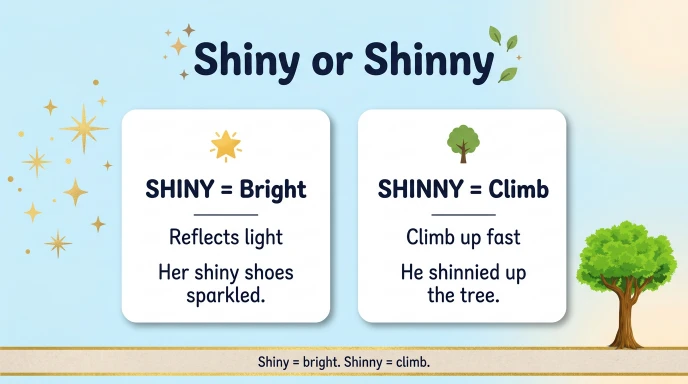
The correct word for something bright, glossy, or reflective is shiny. However, shinny is also a real English word with a different meaning. It can refer to an informal hockey like game or the act of climbing by gripping a surface with the hands and legs.
Many people search for “shinny or shiny” because the two words look almost identical. The extra letter n can cause confusion, especially when writing about shiny shoes, shiny hair, polished cars, or reflective surfaces. Although both spellings exist, they cannot be used interchangeably.
Understanding the difference helps you avoid spelling mistakes in school assignments, emails, blog posts, product descriptions, and everyday conversations. In this guide, you will learn the definitions, origins, and correct uses of both words. You will also find practical sentence examples, common mistakes, regional spelling guidance, and answers to frequently asked questions.
The main rule is simple: use shiny when describing something that reflects light. Use shinny only when its specific meaning fits the sentence.
Shinny or Shiny: Quick Answer
The correct choice depends on what you want to say.
- Shiny: An adjective meaning bright, glossy, or reflective.
- Shinny: A noun for an informal game or a verb meaning to climb by gripping a surface.
Examples:
- The car looks shiny after washing.
- She has beautiful, shiny hair.
- The children played shinny on the ice.
If you are describing an object that reflects light, choose shiny. If you are talking about a game or climbing, shinny may be correct.
What Does Shiny Mean?
Shiny is an adjective that describes something that reflects light or has a smooth, glossy appearance.
Definition of Shiny
Shiny means bright, glossy, or reflecting light. A surface may look shiny because of its material, natural properties, or a process such as cleaning or polishing.
For example:
- The silver necklace looks shiny.
- He bought a shiny black car.
- The polished table has a shiny surface.
Simple Meaning of Shiny
In simple English, shiny means something looks bright or glossy.
Think of a clean mirror, polished shoes, or a new metal watch. These objects can reflect light and appear shiny.
The word can also describe hair, fabric, jewelry, and other things with a glossy appearance.
How to Use Shiny in a Sentence
Use shiny before a noun or after a linking verb.
- Before a noun: She wore shiny shoes.
- After a linking verb: The floor looks shiny.
- In a comparison: This ring is shinier than that one.
The comparative form is shinier, and the superlative form is shiniest.
What Does Shinny Mean?
Shinny is a real English word, but it does not mean bright or glossy.
Shinny as a Noun
As a noun, shinny can refer to an informal game played with sticks and a ball or puck. The game may resemble hockey, although its rules and equipment can vary.
Examples:
- The children played shinny after school.
- We organized a friendly game of shinny.
- The neighborhood team enjoys playing shinny in winter.
Shinny as a Verb
As a verb, shinny means to climb by gripping a surface with the hands and legs.
Examples:
- The boy tried to shinny up the tree.
- The climber began to shinny up the pole.
- The monkey seemed to shinny along the branch.
This meaning is less common in everyday writing than shiny.
Is Shinny a Misspelling of Shiny?
Not always. Shinny is a valid word, but it is incorrect when you want to describe something glossy or reflective.
Incorrect: My shoes look shinny.
Correct: My shoes look shiny.
The meaning of the sentence determines which spelling you should use.
The Origin of Shinny and Shiny
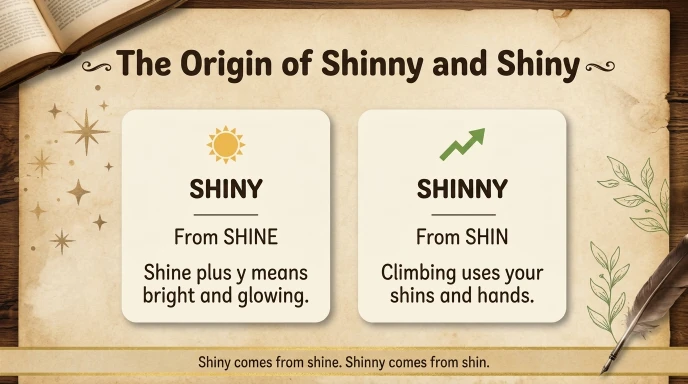
Although the two words look similar, their meanings and histories differ.
The Origin of Shiny
Shiny comes from the verb shine, which means to give off or reflect light. The verb has roots in older Germanic languages and has been used in English for centuries.
The ending y often helps form adjectives. In shiny, it describes something that shines or has a bright appearance.
Examples include shiny shoes, shiny metal, and shiny hair.
The Origin of Shinny
Shinny has a separate history connected with informal games and climbing. Its use for a hockey like game is associated with recreational play using simple equipment.
As a verb, it describes climbing by gripping a surface with the hands and legs.
The words may look alike, but you should not assume that shinny is an alternative spelling of shiny. Their modern meanings are different.
British English vs American English
Both British and American English use shiny to describe something glossy or reflective. Neither variety uses shinny as a standard alternative spelling for this meaning.
| British English | American English | Example |
| Shiny | Shiny | Her shoes are shiny. |
| Shinny | Shinny | They played shinny. |
| Shinier | Shinier | This surface is shinier. |
| Shiniest | Shiniest | It is the shiniest ring. |
Regional Differences
The spelling shiny remains the same in both countries. The word shinny may be more familiar in places where informal hockey like games are played.
This is a difference in familiarity and context, not a spelling difference between British and American English.
Publishing and Style Guides
For academic papers, business documents, blog posts, and product descriptions, use shiny when describing appearance.
Use shinny only when discussing the game or climbing action. If readers may not know the word, explain its meaning in the sentence.
Which Version Should You Use?
The correct spelling depends on meaning rather than location.
United States: Use shiny for glossy objects, polished shoes, reflective surfaces, and bright looking materials.
United Kingdom: Use shiny for the same meaning. There is no British spelling variation that adds another n.
Canada: Use shiny for appearance. You may encounter shinny when reading about informal hockey.
Australia: Use shiny to describe something glossy or reflective. Do not treat shinny as an alternative spelling.
International writing: Choose shiny when you mean bright or glossy. Use shinny only when its specific meaning applies.
Academic writing: Use the word that accurately describes the subject. Define shinny if its meaning may be unfamiliar to readers.
Business writing: Use shiny in product descriptions, catalogs, and marketing content when describing a glossy finish.
Common Mistakes with Shinny and Shiny
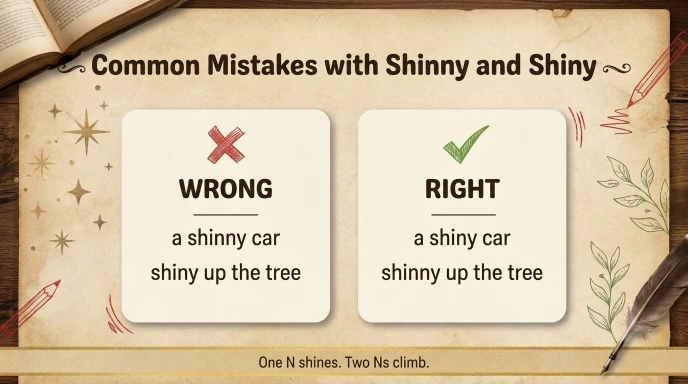
The most common error is adding an extra n to shiny. Since shinny is also a real word, it is important to check the meaning rather than rely only on spellcheck.
Mistake 1: Describing a Glossy Object
Incorrect: She bought a shinny handbag.
Correct: She bought a shiny handbag.
Explanation: The sentence describes the handbag’s appearance, so shiny is correct.
Mistake 2: Describing Hair
Incorrect: Her hair looks shinny in the sunlight.
Correct: Her hair looks shiny in the sunlight.
Explanation: Use shiny for hair that reflects light or looks glossy.
Mistake 3: Writing a Product Description
Incorrect: These shinny shoes are perfect for the party.
Correct: These shiny shoes are perfect for the party.
Explanation: The shoes have a glossy appearance, so the adjective shiny fits.
Mistake 4: Claiming Shinny Is Always Wrong
Incorrect: Shinny is not a real English word.
Correct: Shinny is a real word with different meanings from shiny.
Explanation: Shinny is correct when referring to the game or climbing action.
Memory Tip
Remember the connection between shine and shiny.
If something shines, it can be shiny. Save shinny for the game or the climbing action.
Everyday Examples of Shinny and Shiny
These ten examples show how to use both words naturally.
- The little girl wore shiny red shoes to the party.
- My new phone has a shiny silver back.
- The cleaner left the kitchen floor looking shiny.
- He bought a shiny watch for his father’s birthday.
- Sunlight reflected off the shiny surface of the lake.
- Her shiny hair caught everyone’s attention.
- The artist used shiny paint to finish the model.
- The shop displayed shiny jewelry in its front window.
- The children gathered outside to play shinny on the ice.
- The boy tried to shinny up the tree.
Emails
- “The new display looks shiny and clean.”
- “Please polish the shiny metal parts before the meeting.”
- “The children are planning a game of shinny this weekend.”
Business Writing
- “This shiny finish gives the product a modern look.”
- “The collection includes shiny gold accessories.”
News Headlines
- “Shiny New Exhibition Opens in the City”
- “Local Children Enjoy a Game of Shinny”
Blogs and Social Media
- “Three easy ways to keep your shoes shiny.”
- “My favorite shiny accessories for a night out.”
- “A fun afternoon of shinny with friends.”
Academic Writing
- “The shiny surface reflected the laboratory light.”
- “The researchers examined how light behaved on the material.”
Daily Conversation
- “Your car looks so shiny!”
- “How did you get your shoes that shiny?”
- “We used to play shinny outside during winter.”
Google Trends and Modern Usage
People search for “shinny or shiny” because they want to confirm the correct spelling before publishing content, completing schoolwork, or writing a message.
Which Word Is More Common?
Shiny is more familiar in general English because it describes everyday objects and surfaces. People use it when talking about hair, shoes, cars, jewelry, furniture, and clothing.
Shinny is less common in general writing. It usually appears in discussions of informal hockey like games or climbing.
These are general observations about English usage, not measured Google Trends statistics.
Why Do People Confuse These Words?
Three factors explain the confusion:
- Similar spelling: The words differ by only one letter.
- Typing errors: Writers may accidentally add an extra n.
- Unfamiliar vocabulary: Some people do not know that shinny is a real word.
How Does This Affect Writing?
If you are writing about glossy products or reflective surfaces, use shiny naturally in your title and content.
If you are writing a comparison article, include both spellings and explain their distinct meanings. Avoid claiming that they are interchangeable.
For actual search interest data, compare the terms in Google Trends using a clear country and time range. Do not invent search volumes or use popularity as proof of correct spelling.
Shinny vs Shiny: Quick Comparison Table
| Version | Meaning | Correct? | Region | Example |
| Shiny | Bright or glossy | Yes, for appearance | All major English varieties | The table is shiny. |
| Shinny | An informal game | Yes, for this meaning | Usage varies by region | They played shinny. |
| Shinny | To climb by gripping | Yes, for this meaning | Usage varies by region | He tried to shinny up the tree. |
| Shinny | Bright or glossy | No, for this meaning | Not a standard spelling variant | The shoes are shinny. |
| Shinier | More shiny | Yes | All major English varieties | This surface is shinier. |
| Shiniest | Most shiny | Yes | All major English varieties | It is the shiniest ring. |
Key Takeaways
- Shiny is the correct adjective for something bright, glossy, or reflective.
- Shinny is a real English word with different meanings.
- Use shiny to describe hair, shoes, cars, jewelry, and polished surfaces.
- Use shinny for an informal game or climbing by gripping a surface.
- British and American English both use shiny for a glossy appearance.
- Shinny is not an alternative regional spelling of shiny.
- Remember the connection between shine and shiny to avoid mistakes.
Frequently Asked Questions
Q1. What is the meaning of shinny?
Shinny means to climb or move along a surface by gripping it with your hands and feet. It can also refer to an informal game played with a stick and a ball.
Q2. Why is it called shinny?
The word shinny is associated with an informal stick and ball game. Its exact origin is uncertain, but the term has been used for this game for centuries.
Q3. What is the meaning of shinies?
Shinies is the plural of shiny when used as a noun to describe shiny objects or things. It can also refer to shiny collectibles in gaming, depending on the context.
Q4. Is “shiny” spelled correctly?
Yes, shiny is spelled correctly. It is an adjective that describes something bright, glossy, or reflective, such as shiny shoes or shiny hair.
Q5. How do you spell shiny or shinny?
Both shiny and shinny are correct words, but they have different meanings. Use shiny for something glossy or bright and shinny for climbing by gripping a surface or referring to the game.
Q6. What does “shiny girl” mean?
“Shiny girl” is not a fixed English expression. Depending on the context, it may describe a girl with shiny hair, glowing skin, or a bright appearance. It can also have a specific meaning in a particular online community.
Q7. What is “shiny” slang for?
In slang, shiny can describe something attractive, impressive, new, or exciting. Its meaning depends on the context and the community using it.
Q8. What does glitter girl mean?
“Glitter girl” can describe a girl associated with glitter, sparkle, or a glamorous, colorful style. It may also be a nickname or a phrase with a specific meaning in a song, social media post, or community.
Conclusion
The difference between shinny and shiny comes down to meaning. Shiny is the standard adjective for something bright, glossy, or reflective. You can use it to describe shoes, hair, cars, jewelry, furniture, and many other objects.
Shinny is also a correct English word, but it serves a different purpose. It can refer to an informal hockey like game or describe climbing by gripping a surface. It is not a regional spelling of shiny, and the distinction applies in both British and American English.
When writing an article, email, school assignment, product description, or social media post, consider what you want to describe. If you mean something reflects light, choose shiny. If you mean the game or climbing action, shinny may be correct.
🌸 Explore More:
Resell or Resale: Difference, Meaning and Correct Use

Hi, I’m Ava Collins, a writer and English language enthusiast behind CorrectlyWritten. I’m passionate about making grammar simple, clear, and easy to understand. I write about grammar rules, confusing words, spelling, and everyday English usage to help readers write more accurately and confidently.








2 thoughts on “Shiny or Shinny: Correct Spelling, Meaning,& Examples ”