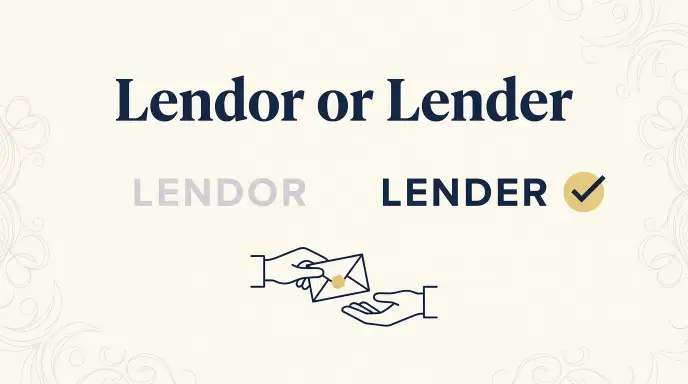
Lendor or lender the correct spelling is lender. A lender is a person, bank, or organization that lends money to someone else. “Lendor” is a common misspelling and should generally be avoided in standard English. For example: The lender approved my loan application.
If you are writing about a person or company that provides a loan, one spelling is clearly the standard choice: lender. The spelling lendor often appears because the word is formed from the verb lend, and some writers expect the ending to follow a pattern that feels natural. However, standard English dictionaries list lender as the correct noun for someone or an organization that lends money.
This spelling confusion is common in emails, loan documents, business writing, financial articles, and everyday searches. It can be especially confusing for ESL learners because lend, loan, borrow, lender, and borrower are closely related words.
In this guide, you will learn if to use lendor or lender, what lender means, where the word comes from, how it is used in different types of writing, and how to avoid the most common spelling mistake. By the end, you will have a simple rule you can remember whenever you need this word.
Lendor or Lender: The Quick Answer
Lender is the standard and correct spelling when you mean a person, bank, company, or organization that lends money or something to another person. Lendor is not the standard spelling of this common English noun. Major dictionaries such as Cambridge, Oxford, and Merriam:Webster list lender.
For example:
- Correct: The lender approved my loan.
- Correct: We contacted the bank lender about the mortgage.
- Incorrect in standard English: The lendor approved my loan.
If you are writing for school, work, business, finance, or general English, choose lender.
What Does Lender Mean?
Lender is a noun. It refers to a person, business, bank, or other organization that lends something to another party.
In financial contexts, a lender usually provides money that the borrower agrees to repay, often with interest. Cambridge specifically notes that a lender may be a person or business such as a bank.
Lender in finance
In banking and finance, the word is very common:
- mortgage lender
- private lender
- payday lender
- commercial lender
- online lender
- direct lender
For example:
The lender reviewed the borrower’s application.
Here, lender means the person or organization providing the money.
Lender vs. borrower
These two words describe opposite sides of a loan:
- Lender: gives or provides the money.
- Borrower: receives the money and agrees to repay it.
A useful way to remember this is:
Lender gives. Borrower receives.
Lender outside finance
Although lender is strongly associated with money, the word can have a broader meaning.
For example:
The museum was the main lender of the paintings.
Here, the museum temporarily provided artwork for an exhibition. The meaning still comes from the verb lend. The lender is the party providing something for temporary use.
The Origin of Lender
The spelling lender has a long history in English. Merriam:Webster traces the noun to Middle English lendare, influenced by the verb lenden, and ultimately connects it with Old English lǣnere, from lǣnan, meaning “to lend.”
The modern word follows a familiar English pattern:
lend + :er → lender
The suffix :er commonly forms nouns for people or things that perform an action.
Examples include:
- teach → teacher
- write → writer
- drive → driver
- work → worker
- lend → lender
The important point is that lender is not a modern spelling invention. It has a documented history in English, and dictionaries recognize it as the standard noun.
The confusion with lendor likely comes from pronunciation and from the natural tendency to spell words according to how they sound. However, pronunciation does not change the standard spelling.
British English vs American English
There is no standard British:versus:American spelling difference between lender and lender. Both major varieties of English use lender.
| British English | American English | Example |
| lender | lender | The lender approved the application. |
| mortgage lender | mortgage lender | We contacted the mortgage lender. |
| private lender | private lender | The private lender offered financing. |
| lending institution | lending institution | The lending institution reviewed the documents. |
Cambridge provides both UK and US pronunciations for lender, but the spelling remains lender in both varieties.
Oxford also lists lender in both its standard learner dictionary and American English dictionary.
Does Canada use lender?
Yes. Lender is the appropriate standard spelling in Canadian English as well.
What about Australia?
Australian English also uses lender in standard financial and general writing.
So, unlike words such as colour/color or centre/center, this is not a regional spelling issue.
Which Version Should You Use?

Use lender in almost every standard English context.
United States
Use lender in:
- financial documents
- loan applications
- emails
- business writing
- news articles
- websites
- academic work
United Kingdom
Use lender as well. British English does not require the spelling lendor.
Canada
Use lender for professional, academic, and everyday writing.
Australia
Use lender in standard English.
International writing
For international audiences, lender is the safest and most widely recognized form.
Academic writing
Use lender. Avoid lendor unless it appears as part of a proper name or a quoted source that must be reproduced exactly.
Business writing
Always prefer lender when referring to a person or organization that provides a loan.
Common Mistakes
Mistake 1: Using lendor as the standard spelling
Incorrect:
The lendor rejected the application.
Correct:
The lender rejected the application.
Why?
The standard English noun formed from lend is lender, not lendor.
Memory tip:
Think lend → lender, just as teach → teacher.
Mistake 2: Confusing lender and borrower
Incorrect idea:
The lender is the person receiving the loan.
Correct idea:
The lender provides the loan. The borrower receives it.
Mistake 3: Confusing lender and loan
A loan is the money or item being provided.
A lender is the person or organization providing it.
For example:
The lender gave Maria a loan.
Here, lender identifies the provider, while loan identifies what was provided.
Mistake 4: Assuming lendor is a British or American variant
It is not a standard UK:versus:US spelling difference. Standard dictionaries consistently list lender.
Everyday Examples
In an email
Please contact your lender if you have questions about the repayment schedule.
In business writing
The lender requested additional financial documents before approving the loan.
In a news headline
Major Lender Announces New Mortgage Rates
In a blog
Choosing the right lender can make the borrowing process easier.
On social media
Always compare rates before choosing a lender.
In academic writing
The study examines the relationship between lenders and borrowers.
In daily conversation
I need to speak with my lender about my payment.
These examples show that lender works naturally across formal and informal contexts.
Google Trends & Modern Usage
People often search lendor or lender because the two spellings look and sound similar. The confusion is especially understandable because English contains many nouns ending in :or and :er.
However, current dictionary usage strongly supports lender as the standard English noun. Cambridge, Oxford, and Merriam:Webster all provide entries for lender.
Searches for the misspelling do not necessarily mean that lendor is an accepted spelling. People frequently search for a word precisely because they are unsure how to spell it.
There are also isolated uses of lendor online, including in informal documents and as a proper name. That does not make it the standard spelling of the common English noun.
For example, the State Bank of Pakistan’s online glossary has a document in which lendor appears, but the same entry also uses the standard form lender. This illustrates why isolated real:world usage should not be treated as proof of standard spelling.
Bottom line: Search behavior shows confusion, not necessarily correctness. For standard English, use lender.
Quick Comparison Table
| Version | Meaning | Correct? | Region | Example |
| lender | A person or organization that lends | Yes | US, UK, Canada, Australia, International | The lender approved the loan. |
| lendor | Usually an attempted spelling of lender | No, as the standard common noun | Not a standard regional variant | The lendor approved the loan. |
A separate word can appear as Lendor in proper names, surnames, fictional settings, or business names. In those cases, capitalization and context matter. It should not be confused with the standard English noun lender.
Key Takeaways
- Lender is the standard spelling.
- Lendor is not the standard spelling of the common English noun.
- A lender is someone or an organization that lends money or something else.
- The word comes from the verb lend plus the suffix :er.
- British and American English both use lender.
- Lender and borrower describe opposite sides of a loan.
- Use lender in academic, business, financial, and everyday writing.
- Remember: lend → lender.
FAQs
Q1. What Is a Lender Person?
A lender is a person, bank, or organization that gives money or something valuable to another person with the expectation of repayment.
For example, a bank can be a lender when it provides a loan.
Q2. Who Is a Borrower and Lender?
A borrower receives money or something valuable and agrees to repay it. A lender provides the money or valuable item to the borrower, usually with agreed repayment terms.
Q3. What Is the Role of a Lender?
The role of a lender is to provide money or credit to a borrower under agreed terms.
The lender typically sets repayment conditions and may charge interest on the amount borrowed.
Q4. What Is the Definition of a Lender?
A lender is a person or organization that lends money or other assets to someone else.
The borrower is generally required to repay what was borrowed according to the agreed terms.
Q5. What Is a Lender Used For?
A lender provides funds when someone needs money for purposes such as buying a home, starting a business, or covering personal expenses.
The borrowed amount is usually repaid over an agreed period.
Q6. What Is Another Name for a Lender?
Another name for a lender can be creditor, loan provider, financier, or moneylender.
The exact term depends on the type of loan and the lending arrangement.
Q7. What Are the Three Types of Lenders?
Three common types of lenders are banks, credit unions, and private lenders.
They provide loans under different requirements, interest rates, and repayment terms.
Q8. What Is the Opposite of Lender?
The opposite of a lender is a borrower.
A lender gives money or credit, while a borrower receives it and is responsible for repayment.
Q9. What Is a Money Lender Called?
A person who lends money, especially as a business, may be called a moneylender or private lender.
A bank or financial institution may also act as a lender.
Conclusion
When choosing between lendor or lender, the answer is simple: use lender. It is the standard English noun for a person or organization that lends money or another item. Cambridge, Oxford, and Merriam:Webster all recognize lender, and the word is used across American, British, Canadian, Australian, and international English.
The easiest way to remember the spelling is to connect it directly to the verb lend: lend + er = lender. A lender gives or provides something, while a borrower receives it.
You may occasionally encounter lendor online or in a name, document, or informal source. Such appearances do not make it the standard spelling of the common noun.
So, if you are writing a school assignment, business email, financial article, loan document, or everyday message, choose lender.
Discover More:
Indure or Endure: Which Is Correct? Meaning, Spelling & Examples

Hi, I’m Ava Collins, a writer and English language enthusiast behind CorrectlyWritten. I’m passionate about making grammar simple, clear, and easy to understand. I write about grammar rules, confusing words, spelling, and everyday English usage to help readers write more accurately and confidently.








2 thoughts on “Lendor or Lender: Which Spelling Is Correct? Meaning & Examples”