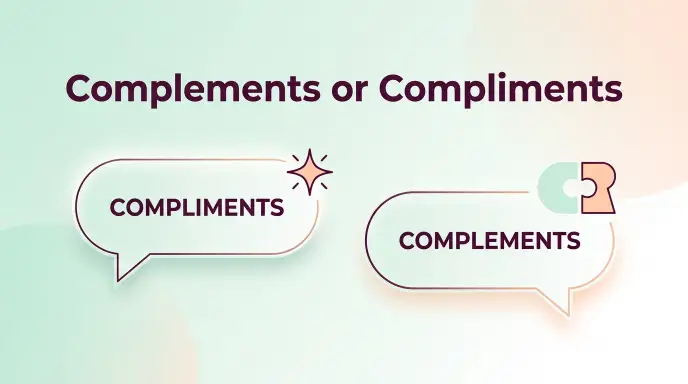
If you mean praise, use compliments; if you mean things that complete or improve each other, use complements. These two words sound almost the same, but they have different meanings. This is why many writers search for “complements or compliments” when they are unsure which spelling belongs in a sentence.
The confusion is common because both words are pronounced similarly and share a long history. However, the letter E in complements and the letter I in compliments can help you remember the difference. A compliment is kind praise, such as “She gave me several compliments.”
A complement is something that completes, matches, or improves another thing, such as “The shoes complement her dress.” Knowing this small difference can make your emails, schoolwork, articles, and professional writing much clearer. In this guide, you will learn the meanings, origins, spelling rules, common mistakes, examples, and simple memory tricks for choosing the right word every time.
Complements or Compliments – Quick Answer
The Simple Rule
Use compliments when you mean praise or kind words.
- She received many compliments on her dress.
- Thank you for the compliments.
- He gave me several compliments.
Use complements when you mean things that complete, match, or improve each other.
- Her shoes complement her dress.
- The sauce complements the meal.
- These colors complement each other.
Cambridge defines compliment as a remark showing approval, admiration, or respect. Complement means to make something else better or more attractive when combined with it.
Easy Memory Trick
Think:
Compliment = I = admiration
Complement = E = complete
If someone says something nice to you, it is a compliment.
If two things work well together, they complement each other.
Definition and Meaning of Complements or Compliments
What Does Compliments Mean?
Compliments is the plural form of compliment.
A compliment is a kind or positive comment about someone or something. It can show praise, approval, or admiration.
Examples:
- She gave me compliments about my writing.
- His speech received many compliments.
- I appreciate your compliments.
The word can also work as a verb.
- She complimented me on my work.
- The manager complimented the team.
Cambridge lists compliment as both a noun and a verb related to praise and admiration.
What Does Complements Mean?
Complements is the plural form of complement.
As a verb, complements means makes something better, more attractive, or more complete when combined with it.
Examples:
- The blue shirt complements his eyes.
- The side dish complements the main course.
- Her skills complement his experience.
As a noun, a complement can be something that completes or adds to something else.
In grammar, a complement is also a word or phrase that adds information needed to complete the meaning of a sentence.
Context and Usage
The two words are used in different situations.
| Word | Main Meaning | Example |
|---|---|---|
| Compliment | Praise | She gave me a compliment. |
| Compliments | More than one praise | He received many compliments. |
| Complement | Something that completes or improves | The colors complement each other. |
| Complements | Completes or improves | This sauce complements the dish. |
The Origin of Complements or Compliments
Origin of Complement
Complement comes from Latin complementum, meaning “that which fills up” or “that which completes.” It entered English through Old French in the late 14th century. Its basic idea has remained linked to completing or making something whole.
This explains why complement is connected to words such as:
- complete
- completion
- complementary
For example, two colors can complement each other because they work well together.
Origin of Compliment
Compliment has a related history. Its spelling and meaning developed from older forms connected to ideas of courtesy and respect. The spelling shifted toward compliment in English after about the mid:17th century. The word later developed its modern meaning of praise or admiration.
This shared history helps explain why the two words look and sound so similar.
Why Are They Confused?
The words were once closer in meaning and spelling than they are today. Over time, English developed separate meanings for them.
Today, the difference is clear:
Complement = complete or improve
Compliment = praise
British English vs American English Spelling
Is the Spelling Different?
No. Complements and compliments are spelled the same in British English and American English.
The difference is not between UK and US spelling. The difference is between meaning.
For example:
- British English: “Her dress complements her shoes.”
- American English: “Her dress complements her shoes.”
Both use complements because the meaning is “matches or improves.”
Likewise:
- British English: “She received many compliments.”
- American English: “She received many compliments.”
Both use compliments because the meaning is praise.
Cambridge provides both British and American entries for the two words and keeps their spellings distinct by meaning, not by regional spelling.
British vs American Comparison
| Meaning | British English | American English |
|---|---|---|
| Praise | compliment | compliment |
| Praise, plural | compliments | compliments |
| Complete or improve | complement | complement |
| Complete or improve, third person | complements | complements |
| Free of charge | complimentary | complimentary |
| Related to completing or matching | complementary | complementary |
Which Spelling Should You Use?
For US English
Use compliments for praise.
Thank you for your kind compliments.
Use complements when two things work well together.
The new design complements the website.
For UK and Commonwealth English
The same rule applies.
She received several compliments.
The furniture complements the room.
There is no British:versus:American spelling choice here.
For Global English
If you write for an international audience, focus on the meaning.
Ask yourself:
Am I talking about praise?
Use compliment.
Am I talking about completing, matching, or improving something?
Use complement.
This simple test works in most English:
speaking contexts.
Common Mistakes with Complements or Compliments
Mistake 1: Using Compliments for Matching Things
Incorrect:
The colors compliment each other.
Correct:
The colors complement each other.
The colors work well together, so complement is correct.
Mistake 2: Using Complements for Praise
Incorrect:
She gave me several complements.
Correct:
She gave me several compliments.
The person is giving praise, so compliments is correct.
Mistake 3: Confusing Complimentary and Complementary
These words are also easy to mix up.
Complimentary can mean:
- expressing praise
- given for free
Example:
The hotel offers complimentary breakfast.
Complementary means things that work well together or complete each other.
Example:
The two colors are complementary.
Mistake 4: Forgetting the Memory Trick
Remember:
Compliment :I : praise
Complement : E : complete
This quick trick can help you avoid the most common spelling error.
Complements or Compliments in Everyday Examples

In Emails
Use compliments when thanking someone for praise.
Thank you for your kind compliments on my presentation.
Use complement when describing how things work together.
The new layout complements the existing design.
In News Writing
News articles may use compliment when someone praises another person.
The director complimented the team on its performance.
They may use complement when two things work together.
The new policy complements the existing program.
On Social Media
A social media post may say:
Thanks for all the compliments!
But if someone is talking about style, they might write:
These colors complement each other perfectly.
In Formal Writing
In academic or professional writing, complement is common when discussing ideas, skills, systems, or methods that work together.
The two methods complement each other.
Compliment is used when someone expresses praise.
The manager complimented the employee on her excellent work.
Complements or Compliments – Google Trends & Usage Data
What Do People Search For?
The search phrase “complements or compliments” usually shows a spelling and word:choice question.
People often want to know:
- Which word means praise?
- Which word means complete?
- Is the spelling different in the US and UK?
- Should I write “compliment” or “complement”?
- What is the difference between complementary and complimentary?
Google Trends measures relative search interest rather than giving a simple exact worldwide search:volume number. Search interest can also change by country, language, season, and search context.
Which Word Is Used in Which Context?
Compliment is common when people talk about:
- praise
- appearance
- skills
- achievements
- manners
- positive feedback
Complement is common when people talk about:
- colors
- clothing
- food
- design
- skills
- systems
- grammar
- ideas
Both words are standard English words. The important issue is choosing the one that matches your intended meaning.
Complements vs Compliments – Comparison Table
Side:by:Side Comparison
| Feature | Complements | Compliments |
|---|---|---|
| Base word | Complement | Compliment |
| Main meaning | Completes, improves, or matches | Praises or expresses admiration |
| Key letter | E | I |
| Common use | Colors, food, design, ideas | People, work, appearance, achievements |
| Example | The colors complement each other. | She gave me many compliments. |
| Memory word | Complete | Admire |
| British spelling | Complements | Compliments |
| American spelling | Complements | Compliments |
FAQs About Complements or Compliments
1. What is the difference between complements and compliments?
Complements means things that complete, improve, or work well with each other. Compliments means words or actions that show praise or admiration.
2. Is it “compliments to the chef” or “complements to the chef”?
The correct phrase is “compliments to the chef.” It means praise for the chef.
3. Is it “colors compliment each other” or “colors complement each other”?
The correct sentence is “colors complement each other.” The colors work well together.
4. Does compliment mean praise?
Yes. A compliment is a positive remark that shows approval, admiration, or respect.
5. Does complement mean complete?
Yes. Complement is connected to the idea of completing or making something whole. It can also mean making something better when combined with it.
6. Is “complimentary” the same as “complementary”?
No. Complimentary often means expressing praise or provided for free. Complementary means completing, matching, or working well with something else.
7. Is the spelling different in British and American English?
No. Both British and American English use compliment for praise and complement for something that completes or improves another thing.
Conclusion: Complements or Compliments?
The Final Rule
Complements and compliments are different words with different meanings. The spelling difference is small, but the meaning can change the whole sentence.
Use compliments when you mean praise, admiration, or kind words. For example, “She received many compliments on her presentation.”
Use complements when you mean something that completes, matches, or improves another thing. For example, “The new colors complement the website design.”
The words are spelled the same way in British and American English. So, this is not a UK:versus:US spelling issue. It is a meaning issue. The easiest memory trick is simple: complement has an E like complete, while compliment has an I for praise and admiration.
Once you learn this rule, the difference becomes much easier to remember. if you are writing an email, article, school assignment, social media post, or professional report, choosing the correct word will make your writing clearer and more polished.
Meta Description: Complements or compliments? Learn the difference, meanings, examples, spelling rules, common mistakes, and simple tips for correct English writing.
Get More INformation:
Lendor or Lender: Which Spelling Is Correct? Meaning & Examples

Hi, I’m Ava Collins, a writer and English language enthusiast behind CorrectlyWritten. I’m passionate about making grammar simple, clear, and easy to understand. I write about grammar rules, confusing words, spelling, and everyday English usage to help readers write more accurately and confidently.








2 thoughts on “Complements or Compliments: Which Word Is Correct?”