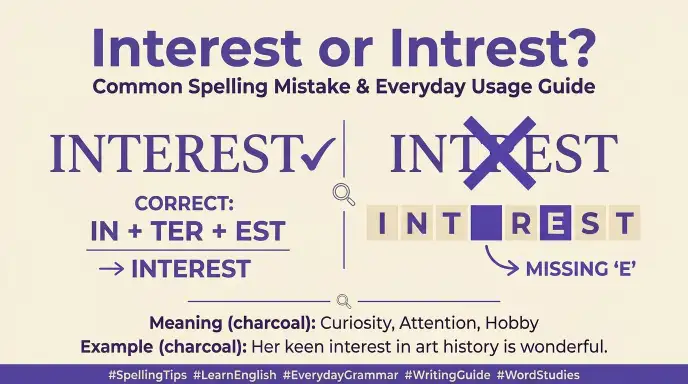
Interest is the correct spelling, while intrest is a common spelling mistake. The word interest can describe curiosity, attention, involvement, or a desire to learn more about something. It can also refer to money earned on savings or charged on a loan.
For example, you can say, “I have an interest in history,” or “The bank charges interest on the loan.” The incorrect form intrest is often written because people may not clearly hear the second vowel when saying the word. The correct spelling contains three vowels in the middle: inte rest.
Learning the correct form is useful because interest is a very common word in school, work, business, finance, and everyday conversation. This guide explains the difference between interest and intrest, the meaning and origin of interest, common spelling mistakes, pronunciation, British and American English usage, and practical examples. By the end, you will know exactly when and how to use interest correctly.
Interest or Intrest: Quick Answer
Interest ✅ is the correct spelling.
Intrest ❌ is an incorrect spelling and should be avoided in standard English.
Examples:
- I have a strong interest in science.
- She developed an interest in painting.
- The bank charges interest on the loan.
- ❌ I have a strong intrest in science.
A simple way to remember the spelling is:
IN + TEREST = INTEREST
The word contains “ter” after “in,” so do not drop the second vowel.
What Does Interest Mean?
Interest has several meanings.
The most common meaning is a feeling of curiosity or attention toward something.
For example:
I have an interest in photography.
This means photography is something that attracts my attention or that I enjoy learning about.
Interest can also mean involvement or concern.
Example:
The company has a financial interest in the project.
Here, interest refers to a connection or stake in something.
In finance, interest means money paid for borrowing money or earned from saving or investing money.
Example:
The bank pays interest on my savings.
Interest as Curiosity or Attention
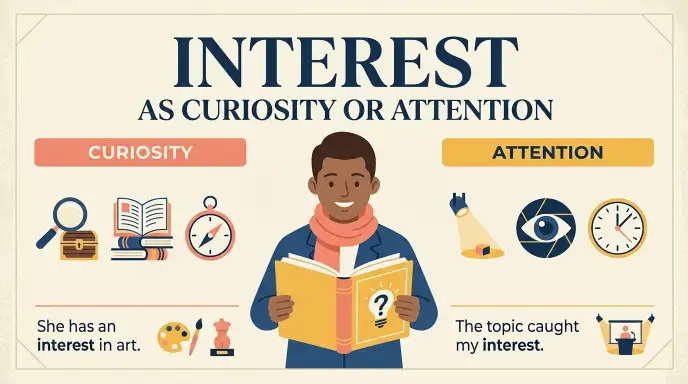
One common meaning of interest is curiosity.
When something interests you, you want to know more about it.
Examples:
- History interests me.
- She has a strong interest in music.
- His interest in science began at school.
- The book caught my interest.
- The topic is of great interest to students.
In this sense, interest is connected with attention, curiosity, and enjoyment.
Interest in Finance
Interest also has an important financial meaning.
When you borrow money, you may have to pay interest to the lender.
When you save or invest money, you may receive interest.
For example:
I paid interest on my bank loan.
Or:
My savings account earns interest.
The amount of interest can depend on factors such as the interest rate, loan amount, and length of time.
This financial meaning is common in banking, loans, credit cards, savings accounts, and investments.
Interest as a Share or Stake
Interest can also mean a legal, financial, or personal stake in something.
For example:
She has a financial interest in the business.
This means she has a financial connection to the business.
Another example is:
The investors have an interest in the company’s success.
Here, interest means that the investors have something to gain from the company’s success.
The Origin of Interest
The word interest has a long history.
It entered English through Old French and Latin.
The Latin root is connected with the idea of something being important or making a difference.
Over time, the word developed several related meanings.
These meanings include attention, concern, benefit, involvement, and financial return.
Today, interest is used in many different areas of English.
It can describe a hobby, curiosity, a financial charge, or a personal stake.
Why Is “Intrest” Incorrect?
Intrest is not the standard spelling of the word.
It is usually a spelling mistake caused by leaving out the second vowel sound in interest.
The correct spelling is:
INTEREST ✅
The incorrect spelling is:
INTREST ❌
The middle part of the word is important.
Correct:
in ter est
Incorrect:
in trest
When writing quickly, people may leave out the e after t. This creates the common error intrest.
How Do You Spell Interest?
The correct spelling is:
I N T E R E S T
There are eight letters in the word.
A useful spelling breakdown is:
IN + TER + EST
The most important point is not to remove the e after the t.
Correct:
interest
Incorrect:
intrest
You can also connect the word with related forms:
- interest
- interested
- interesting
- interestingly
Seeing the full word family can make the spelling easier to remember.
Interest vs Intrest: The Main Difference
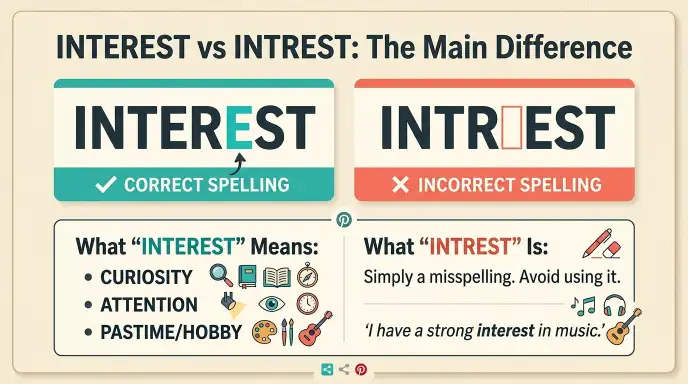
There is no difference in meaning because intrest is not a standard English word.
The correct word is interest.
Interest
Status: Correct
Meaning: Curiosity, attention, involvement, stake, or financial charge
Example:
She has a strong interest in art.
Intrest
Status: Incorrect
Meaning: No standard English meaning
Example:
She has a strong intrest in art. ❌
The main issue is spelling, not meaning.
British English vs American English
Interest is spelled the same way in British and American English.
British English:
I have an interest in history.
American English:
I have an interest in history.
There is no standard British or American spelling difference here.
The incorrect form intrest should be avoided in both varieties.
This makes the rule simple:
Interest is correct in both British and American English.
How to Pronounce Interest
The pronunciation of interest can vary slightly depending on accent and speaking style.
In careful speech, the word may be pronounced with the middle vowel sound clearly present.
In fast or casual speech, some speakers may reduce or soften the middle sounds.
This can make the word sound shorter than it looks.
That pronunciation difference may help explain why some people accidentally spell it intrest.
Even if the spoken form sounds reduced, the standard spelling remains:
interest
Common Mistakes With Interest
Mistake 1: Writing Intrest
Incorrect:
I have an intrest in sports.
Correct:
I have an interest in sports.
Mistake 2: Leaving Out the Second E
The correct spelling contains e after t.
Correct:
interest
Incorrect:
intrest
Mistake 3: Confusing Interest With Interested
Interest can be a noun or a verb.
Interested is an adjective.
Examples:
I have an interest in history.
I am interested in history.
Both are correct, but their grammatical roles are different.
Mistake 4: Confusing Interest With Interesting
Interesting describes something that attracts attention.
Example:
The book is interesting.
Interest can refer to the feeling or attention itself.
Example:
The book caught my interest.
Interest in Everyday Examples
Here are natural examples of interest:
- I have a strong interest in writing.
- She developed an interest in photography.
- His interest in music started at a young age.
- The article caught my interest.
- They share an interest in travel.
- Her main interest is history.
- The students showed great interest in the lesson.
These examples use interest to describe curiosity, attention, or a subject someone enjoys.
Interest in Professional and Academic Writing
Interest is common in professional and academic writing.
Examples:
The study examines public interest in renewable energy.
The researcher developed an interest in language development.
The company has a financial interest in the project.
Students with an interest in science can join the program.
The word works well in both formal and informal writing.
Interest in Questions and Expressions
Several common English expressions use interest.
In the Interest of
This means for the benefit or purpose of something.
Example:
In the interest of safety, the event was postponed.
Of Interest
This means interesting or relevant.
Example:
The report contains several findings of interest.
Take an Interest In
This means to become interested in something.
Example:
She took an interest in gardening.
Lose Interest
This means to stop being interested.
Example:
He lost interest in the project.
Pique Someone’s Interest
This means to make someone curious or interested.
Example:
The headline piqued my interest.
Interest vs Interested vs Interesting
These words are related but have different grammatical uses.
Interest
Usually a noun or verb.
Example:
I have an interest in art.
Interested
An adjective describing a person who feels curiosity or attention.
Example:
I am interested in art.
Interesting
An adjective describing something that attracts attention.
Example:
This book is interesting.
A simple rule is:
Interest = the feeling or action
Interested = how a person feels
Interesting = what causes the feeling
Is Interest a Noun or a Verb?
Interest can be both a noun and a verb.
As a noun:
Her interest in science is growing.
Here, interest means curiosity or attention.
As a verb:
Science interests her.
Here, interest means to attract her attention or curiosity.
The meaning is related, but the grammatical role changes.
Is “Interest” Countable or Uncountable?
Interest can be countable or uncountable depending on its meaning.
When talking about a subject or activity someone likes, it can be countable.
Example:
She has many interests.
Here, interests means different hobbies or subjects.
When talking about attention or curiosity, it is often used as an uncountable noun.
Example:
The topic attracted a lot of interest.
Financial interest is also commonly uncountable.
Example:
The bank charges interest on the loan.
Google Trends and Modern Usage
Interest is a very common English word used across everyday conversation, education, business, media, and finance.
The spelling intrest appears mainly as a spelling mistake.
Search behavior can vary by country and time. Exact Google Trends numbers should be checked for a specific region and date range rather than treated as universal data.
For standard English writing, there is no reason to use intrest.
The correct form is always:
interest
Quick Comparison: Interest vs Intrest
Interest
Correct spelling: Yes
Meaning: Curiosity, attention, involvement, stake, or financial return
Word type: Noun and verb
Example:
I have a strong interest in science.
Intrest
Correct spelling: No
Meaning: Not a standard English word
Word type: Spelling error
Example:
I have a strong intrest in science. ❌
Correct version:
I have a strong interest in science. ✅
Key Takeaways
- Interest is the correct spelling.
- Intrest is a common spelling mistake.
- Interest can be a noun or a verb.
- It can mean curiosity, attention, involvement, or a financial charge.
- Interest is spelled the same way in British and American English.
- The word contains the important middle e: interest.
- Interested describes a person who feels curiosity.
- Interesting describes something that creates curiosity.
- Use interest in both formal and informal writing.
- Never use intrest in standard English.
Frequently Asked Questions
Q1. What is the difference between intrest and interest?
Interest is the correct spelling. Intrest is a common misspelling and is not the standard spelling of the word.
Q2. What is the meaning of intrest?
Intrest is generally a misspelling of interest. The correct word, interest, can mean curiosity, attention, involvement, or money earned from savings or charged on a loan.
Q3. What is an interest of a person?
A person’s interest is something they enjoy, care about, or want to learn more about. For example, “Reading is one of her main interests.”
Q4. Is “I am interested” correct?
Yes, “I am interested” is grammatically correct. It means that you have curiosity, attention, or enthusiasm about something.
Q5. What can I say instead of “I am interested”?
Depending on the context, you can say “I am curious,” “I am keen,” “I would like to know more,” “I am intrigued,” or “I am interested in learning more.”
Q6. How do you use interested?
Use interested to describe someone’s curiosity or attention toward something. For example, “She is interested in photography” or “I am interested in the position.”
Q7. What’s interested?
Interested is an adjective that describes someone who has curiosity, attention, or enthusiasm about something. It is commonly followed by in, as in “He is interested in music.”
Q8. Is “Are you interested in me?” correct?
Yes, “Are you interested in me?” is grammatically correct. Depending on the context, it can ask if someone is interested in you personally, romantically, or as a potential partner.
Conclusion
Interest is the correct spelling, while intrest is a common spelling mistake. The word interest has several meanings. It can describe curiosity, attention, involvement, a financial stake, or money earned or paid through a financial arrangement.
The spelling can be easy to get wrong because the middle sounds may become less noticeable in fast speech. However, the standard written form always includes the e after the t.
Remember the simple rule: interest is correct, and intrest is incorrect. The same spelling is used in both British and American English. Once you remember the middle “ter”, the correct spelling becomes much easier to recognize.
Interest is also part of a useful word family that includes interested and interesting. Learning these related forms can help you use the word correctly in school, work, conversations, emails, and formal writing.
🔍 Find the Perfect Word:
Suing or Sueing? Correct Spelling, Meaning & Usage
Whole or Hole? Correct Spelling, Meaning, Usage & Examples
Acquirer or Acquiror? Correct Spelling, Meaning, Differences

Hi, I’m Ava Collins, a writer and English language enthusiast behind CorrectlyWritten. I’m passionate about making grammar simple, clear, and easy to understand. I write about grammar rules, confusing words, spelling, and everyday English usage to help readers write more accurately and confidently.








2 thoughts on “Interest or Intrest? Correct Spelling, Meaning & Usage ”