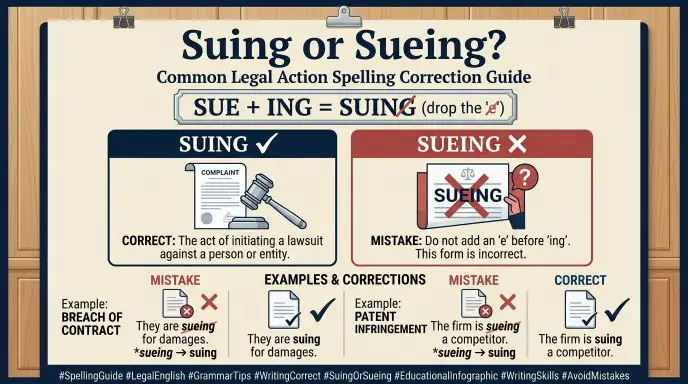
Suing is the correct spelling, while sueing is incorrect in standard English. The word suing is the present participle and gerund form of the verb sue, meaning to take legal action against a person, company, or organization.
The confusion happens because many English verbs add ing by simply keeping the final letters of the original word. However, sue follows a different spelling pattern. When ing is added, the final e is removed, giving us suing, not sueing.
This spelling can be confusing because the pronunciation does not clearly show the difference. Understanding how sue changes to suing is useful for formal writing, legal discussions, news articles, emails, and everyday English. In this guide, you will learn the correct spelling, meaning, pronunciation, grammar rule, common mistakes, usage examples, British and American English differences, and simple ways to remember why suing is correct.
Sueing or Suing: Quick Answer
Suing is correct. Sueing is incorrect.
The correct form is:
sue : suing
Not:
sue : sueing
The verb sue means to take legal action against someone.
Examples:
- She is suing the company.
- He threatened to sue his former employer.
- They are suing for damages.
- The customer is suing the business.
The spelling changes because the final e in sue is dropped before adding ing.
Definition and Meaning of Suing
What Does Suing Mean?
Suing is the present participle and gerund form of sue.
To sue someone means to take legal action against them in court.
For example:
The customer is suing the company.
This means the customer has started or is pursuing a legal case against the company.
Simple Meaning of Suing
The simplest meaning of suing is:
Taking legal action against someone through a court.
Examples:
- suing a company
- suing an employer
- suing a person
- suing for damages
- suing for compensation
What Does Sue Mean?
The verb sue can mean to bring a legal case against someone.
Examples:
- They decided to sue the manufacturer.
- She plans to sue for damages.
- He threatened to sue the newspaper.
The word is commonly associated with civil legal action.
Why Is Suing Spelled Without the E?
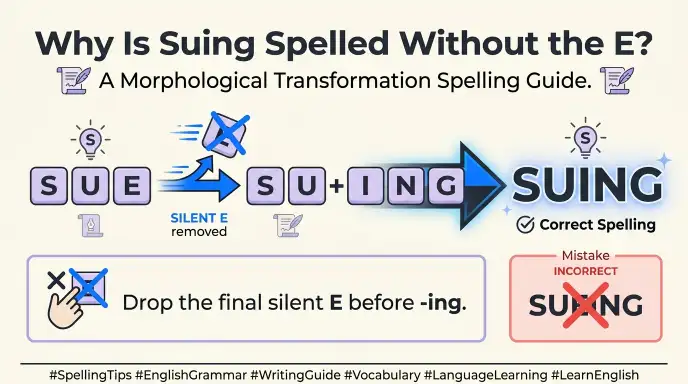
The spelling of suing follows a common English spelling rule.
The base verb is:
sue
When ing is added, the final e is removed:
sue + ing = suing
The same general pattern appears in many English verbs:
- use : using
- make : making
- write : writing
- take : taking
- argue : arguing
So:
sue : suing
The spelling sueing incorrectly keeps the final e.
Why Does Sue Become Suing?
The final e in sue is part of the base word’s spelling. When the verb takes the ing ending, that final e is normally dropped.
Therefore:
❌ sueing
✅ suing
The Origin of Sue and Suing
The verb sue comes from Old French and ultimately traces back to Latin legal vocabulary connected with following or pursuing a matter.
Over time, sue became established in English as a legal verb meaning to bring a case against someone or seek something through legal action.
The form suing developed naturally from the verb sue by adding the ing ending according to English spelling conventions.
Although suing looks unusual to some readers, it is the standard modern spelling.
British English vs American English Spelling
There is no spelling difference between British and American English for sue and suing.
Both varieties use:
sue
suing
Examples in British English:
- The company is suing its former supplier.
- She decided to sue for damages.
Examples in American English:
- The company is suing its former supplier.
- She decided to sue for damages.
The spelling remains the same in both varieties.
British vs American Usage
| Feature | British English | American English |
| Base verb | sue | sue |
| ing form | suing | suing |
| Incorrect form | sueing | sueing |
| Meaning | Take legal action | Take legal action |
| Example | They are suing the company. | They are suing the company. |
Which Spelling Should You Use?
Always use suing when you need the ing form of sue.
Use:
The woman is suing the company.
Do not write:
The woman is sueing the company.
The spelling sueing is considered incorrect in standard English.
This rule applies if you are writing in British English, American English, or most other standard varieties of English.
Common Mistakes with Sueing and Suing
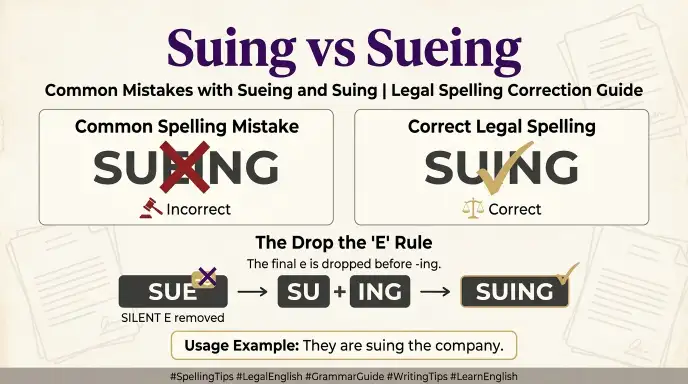
Mistake 1: Writing Sueing
Incorrect:
He is sueing the company.
Correct:
He is suing the company.
The final e is dropped before ing.
Mistake 2: Adding an Extra E
Some writers think the spelling should preserve the entire base verb:
sue + ing = sueing
However, English spelling rules do not normally keep the final silent e before ing.
The correct form is:
sue + ing = suing
Mistake 3: Confusing Suing With Sewing
Suing and sewing are different words.
Suing means taking legal action.
The company is suing the contractor.
Sewing means joining or repairing fabric with thread.
She is sewing a button onto her shirt.
These words can sound similar in some accents, so context is important.
Suing in Everyday Examples
Legal Writing
- The company is suing the contractor for damages.
- The family is suing for compensation.
- The employee is suing the employer.
News Writing
- The actor is suing the newspaper over the published report.
- The customer is suing the company after the dispute.
- Several people are suing the manufacturer.
Formal Emails
- We have been informed that the client is suing the company.
- The organization is considering suing for damages.
Everyday Conversation
- He’s suing his former employer.
- They are talking about suing the company.
- She said she might sue.
With “Is,” “Are,” and “Was”
Suing often appears after forms of be.
- He is suing the company.
- They are suing the manufacturer.
- She was suing for damages.
- We were suing the organization.
Suing vs Sue: What Is the Difference?
Sue is the base form of the verb.
Suing is the ing form.
Examples:
- I plan to sue the company.
- I am suing the company.
After modal or auxiliary structures that require the base form, use sue:
- They may sue.
- She might sue.
- We could sue.
After forms of be in the continuous tense, use suing:
- They are suing.
- She is suing.
- We were suing.
Suing or Sueing: Easy Way to Remember
A simple way to remember the correct spelling is:
Drop the final E before adding ing.
So:
sue : suing
Think of these similar examples:
- use : using
- confuse : confusing
- refuse : refusing
- pursue : pursuing
This makes suing easier to remember.
A useful rule is:
Final silent e + ing = usually remove the e.
Therefore:
❌ sueing
✅ suing
Suing or Sueing: Usage Comparison
| Word | Correct? | Meaning | Example |
| Suing | Yes | Taking legal action | She is suing the company. |
| Sueing | No | Incorrect spelling | Do not write “sueing.” |
| Sue | Yes | To take legal action | They may sue the manufacturer. |
| Sewing | Yes, but different word | Joining fabric with thread | She is sewing a dress. |
Sueing or Suing: Google Trends & Usage Data
Suing is the standard spelling used in modern English, especially in legal, business, news, and everyday contexts involving lawsuits.
Searches for suing are commonly connected with phrases such as:
- suing someone
- suing a company
- suing for damages
- suing for compensation
- suing an employer
The incorrect spelling sueing may appear in searches because people often search for a word they are unsure how to spell. This does not make sueing an accepted standard spelling.
For formal writing, use suing.
Frequently Asked Questions
Q1. Is it suing or sueing?
The correct spelling is suing, not sueing. When sue takes the ending ing, the final e is dropped: sue : suing.
Q2. What is the meaning of sue?
Sue means to take legal action against a person or organization in a court of law. For example, “She decided to sue the company for damages.”
Q3. What does it mean by “I will sue you”?
“I will sue you” means “I will take legal action against you in court.” It usually refers to a person’s intention to bring a legal claim against someone.
Q4. What does suing mean?
Suing means taking someone to court to seek a legal remedy, such as compensation or enforcement of a legal right. It is the ing form of sue.
Q5. How do you spell “I am suing you”?
The correct spelling is “I am suing you.” The word suing is spelled S U I N G, without an e before ing.
Q6. Why do we say “sue for peace”?
Sue for peace is a traditional expression meaning to ask or seek an end to conflict and the restoration of peaceful relations. Here, sue has an older sense related to seeking or requesting something.
Q7. What does “sue” mean in slang?
In informal speech, sue generally keeps its standard meaning of taking legal action. However, people may sometimes use it casually or jokingly when threatening to take someone to court.
Q8. Is it sue or sew?
Both sue and sew are correct words, but they have different meanings. Sue means to take legal action, while sew means to join fabric using a needle and thread.
Conclusion
Suing is the correct spelling, while sueing is incorrect in standard English. The word suing comes from the verb sue, which means to take legal action against someone. When ing is added to sue, the final e is removed, producing suing.
The most important spelling pattern to remember is sue : suing. The same general pattern appears in words such as use : using and refuse : refusing. This makes the spelling easier to recognize and remember.
Use suing in legal writing, news reports, professional communication, academic work, and everyday English. For example, “The customer is suing the company” is correct, while “The customer is sueing the company” is not. Also remember that suing is completely different from sewing, which refers to working with fabric and thread. Once you remember that the final e disappears before ing, choosing suing becomes simple.
Descover More:
Whole or Hole? Correct Spelling, Meaning, Usage & Examples
Acquirer or Acquiror? Correct Spelling, Meaning, Differences
Spiralling or Spiraling? Correct Spelling, Meaning, & Examples

Hi, I’m Ava Collins, a writer and English language enthusiast behind CorrectlyWritten. I’m passionate about making grammar simple, clear, and easy to understand. I write about grammar rules, confusing words, spelling, and everyday English usage to help readers write more accurately and confidently.








2 thoughts on “Suing or Sueing? Correct Spelling, Meaning & Usage ”