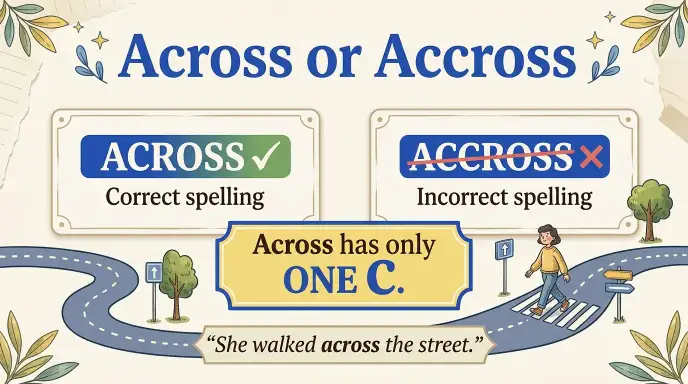
Across is the correct spelling, while accross is incorrect. The word across can describe movement from one side to another, a position on the opposite side, or something that extends over an area.
Many people accidentally write “accross” because they expect the word to contain two c letters. However, English uses only one c in across. This simple spelling difference can cause problems in schoolwork, emails, articles, and professional writing.
If you have ever wondered if to write “across” or “accross,” the answer is clear: always use across. In this guide, you will learn what across means, how to spell it correctly, how to use it in sentences, why “accross” is wrong, and how to remember the correct spelling.
Across or Accross: Quick Answer
Across is the only correct spelling in standard English.
Accross is a common spelling mistake. It does not appear as the standard spelling of the word.
The correct form is:
Across = correct
Accross = incorrect
Examples:
- She walked across the bridge.
- The store is across the street.
- We traveled across the country.
- A smile spread across her face.
A useful way to remember the spelling is simple: across has one c and two s’s.
Definition and Meaning of Across
Across is a preposition and adverb. It describes movement, position, distance, or extension from one side to another.
Across as a Preposition
As a preposition, across often shows movement from one side of something to the other.
For example:
- He ran across the field.
- We walked across the road.
- She swam across the river.
In each sentence, someone or something moves from one side to another.
Across can also show a position on the opposite side.
- The bank is across the street.
- She lives across the river.
- There is a café across the road.
Across as an Adverb
This can also work as an adverb when the sentence does not need a noun after it.
- He walked across.
- She looked across and smiled.
- The child ran across quickly.
The exact meaning depends on the sentence.
Why Is Accross Incorrect?
Accross is incorrect because standard English spells the word with only one c.
The correct spelling is:
A + cross = across
The incorrect version adds an unnecessary second c:
A + ccross = accross ❌
English contains many words with double consonants, so writers sometimes add an extra c to across. However, across does not follow that pattern.
You should always write:
across
not:
accross
Why Do People Spell Across as Accross?
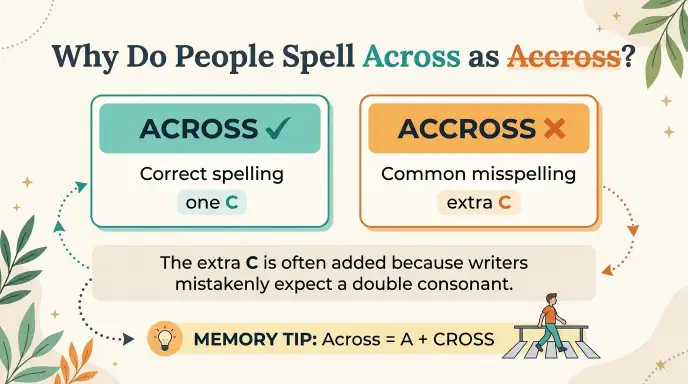
The mistake usually comes from pronunciation and spelling patterns.
When people say across, they may hear a strong k sound followed by an r sound. Some writers then assume that the word needs cc, as in words such as “success” or “access.”
However, spelling does not always follow pronunciation in a simple way.
The safest approach is to remember the correct written form:
across
One c. Two s’s.
Across in American and British English
Across has the same spelling in American English and British English.
There is no standard British spelling such as accross.
For example:
American English:
She walked across the street.
British English:
She walked across the street.
The spelling stays the same.
This makes across easy to use in international English. if you write for readers in the United States, the United Kingdom, Canada, Australia, or elsewhere, use across.
Common Uses of Across
The word across appears in many everyday situations.
1. Movement From One Side to Another
Use across when someone or something moves from one side to another.
- The dog ran across the garden.
- We drove across the bridge.
- She walked across the room.
2. Position on the Opposite Side
Use across to show that something sits on the other side.
- The school is across the road.
- My office is across the hall.
- The pharmacy is across the street.
3. Over an Area
Across can describe something that covers or affects an entire area.
- The news spread across the country.
- Heavy rain fell across the region.
- The campaign reached people across the world.
4. From One End to Another
Across can describe something that stretches from one side or end to another.
- A bridge runs across the river.
- A crack appeared across the wall.
- A path extends across the field.
5. Throughout a Group or Area
Across can also mean throughout.
- The company has offices across Europe.
- The rule applies across all departments.
- The trend became popular across social media.
Across in Everyday Examples
Here are natural examples of across in everyday English.
Casual Conversation
- I’ll meet you across the street.
- She lives across from my house.
- We walked across the park.
- He shouted across the room.
School and Academic Writing
- The study examined students across several schools.
- The researchers collected data across different age groups.
- The results remained consistent across the study.
Work and Business
- The company operates across several countries.
- The manager shared the update across the team.
- The policy applies across all departments.
News and Media
- The story quickly spread across the country.
- The storm moved across the region.
- Protests took place across several cities.
Social Media
- The video went viral across social media.
- Her post reached users across the world.
- The trend spread across different platforms.
Across vs Accross: Common Mistakes
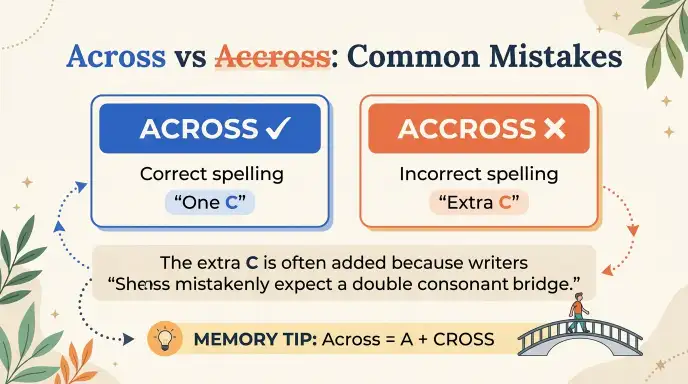
The most common mistake is adding an extra c.
Incorrect
- We walked accross the street.
- The news spread accross the country.
- She looked accross the room.
Correct
- We walked across the street.
- The news spread across the country.
- She looked across the room.
Another common mistake involves changing the word based on how it sounds. Avoid this approach. Memorize the standard spelling instead.
Across = one c + two s’s.
How to Remember the Spelling of Across
A simple memory trick can help.
Think of the word as:
A + CROSS = ACROSS
The word cross already contains one c and two s’s.
When you add a before it, you get:
a + cross = across
You do not need another c.
Easy Memory Rule
Across has one C and two S’s.
If you remember this short rule, you can avoid the common “accross” mistake.
Across in Common Expressions
English uses across in many familiar expressions.
Across the Street
This means on the opposite side of the street.
- The restaurant is across the street.
Across the World
This means in many parts of the world or throughout the world.
- The song became popular across the world.
Across the Country
This means throughout a country or from one part of a country to another.
- People across the country watched the event.
Across the Board
This means applying to everyone or everything in a particular group.
- The company increased salaries across the board.
Across from
This means directly opposite something.
- The hotel is across from the station.
Across or Accross: Comparison
Across
- Correct spelling
- One c
- Two s’s
- Used in standard English
- Works in American and British English
- Can act as a preposition or adverb
Accross
- Incorrect spelling
- Contains an unnecessary second c
- Not the standard spelling
- Should not appear in formal or professional writing
- Often occurs as a spelling mistake
Across vs Through
These can sometimes look similar, but they do not always mean the same thing.
Across usually describes movement from one side to another.
- We walked across the field.
Through usually describes movement into and out of something or within an enclosed area.
- We walked through the forest.
Compare these:
- She ran across the field.
- She ran through the tunnel.
Use across when the idea focuses on crossing from one side to another. Use through when the movement happens within or inside something.
Is Across a Preposition or Adverb?
Across can function as both a preposition and an adverb.
When it comes before a noun or pronoun, it often works as a preposition:
- He walked across the bridge.
Here, “the bridge” follows across.
It can also work as an adverb:
- He walked across.
Here, across stands without a direct noun after it.
The word keeps its basic idea of movement or position from one side to another.
Frequently Asked Questions
Q1. What is the spelling of across?
The correct spelling is across: A C R O S S. It has one c and two s’s.
Q2. What does “across” mean?
Across means from one side to the other side of something. It can also mean on the opposite side or throughout an area, depending on the context.
Q3. Is it correct to say “I came across”?
Yes, “I came across” is correct. It commonly means that you found, encountered, or discovered something by chance, as in “I came across an interesting article.”
Q4. When do you use across?
Use across when talking about movement from one side to another, a position on the other side, or something spread throughout an area. For example, “She walked across the street.”
Q5. What is another word for “across”?
Depending on the context, synonyms for across include over, through, throughout, opposite, and from one side to the other.
Q6. What word type is “across”?
Across can function mainly as a preposition or adverb. For example, “We walked across the bridge” uses it as a preposition, while “The store is just across” uses it as an adverb.
Q7. Does “across” mean opposite?
Sometimes. Across can indicate that something is on the opposite side, as in “The bank is across the street.” However, across and opposite do not always have the same meaning.
Q8. Does across have two Cs?
No. Across has only one C and two S’s. The correct spelling is A C R O S S, not “accross.”
Final Thoughts
Across is the correct spelling, and accross is incorrect. The word appears frequently in everyday English, academic writing, business communication, news, and online content.
Use across when you want to describe movement from one side to another, a position on the opposite side, or something that extends throughout an area.
The spelling becomes easy to remember when you connect it with the word cross:
A + CROSS = ACROSS
So, whenever you are unsure, choose across. Avoid accross in every type of standard English writing.
🌟 Make Every Word Count!
Branzini or Branzino? Meaning, Spelling, Usage & Differences

Hi, I’m Ava Collins, a writer and English language enthusiast behind CorrectlyWritten. I’m passionate about making grammar simple, clear, and easy to understand. I write about grammar rules, confusing words, spelling, and everyday English usage to help readers write more accurately and confidently.








1 thought on “Across or Accross? Correct Spelling, Meaning & Usage ”