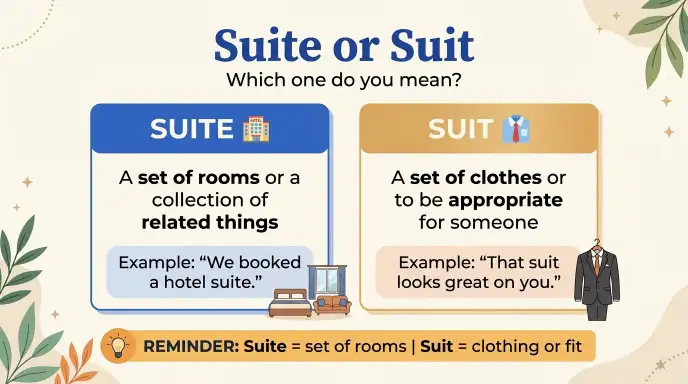
Suite and suit are both correct English words, but they have completely different meanings and uses. A suite can refer to a set of connected rooms, a group of matching furniture, or a collection of related software programs or services.
A suit, on the other hand, can mean a set of matching clothes, a legal action, or something that is appropriate or suitable for a particular purpose. These words are often confused because they are pronounced the same in many varieties of English, even though their spellings and meanings are different.
For example, “We booked a hotel suite” refers to connected rooms, while “He wore a black suit” refers to clothing. Likewise, “This job suits her” means the job is appropriate for her. Knowing the difference between suite and suit helps you avoid spelling mistakes in emails, essays, business writing, travel descriptions, and everyday communication. In this guide, you will learn their meanings, origins, differences, common mistakes, and practical examples.
Suite or Suit: Quick Answer
They are both correct, but they have different meanings.
Suite usually refers to a set or group of connected things, especially rooms.
Example:
“We booked a luxury suite at the hotel.”
Suit can refer to a set of matching clothes, a legal case, or something that is appropriate for someone.
Example:
“He wore a dark business suit.”
So the easiest rule is:
Suite = a set of rooms or related things
Suit = clothing, legal action, or something appropriate
Definition and Meaning of Suite and Suit
What Does Suite Mean?
A suite is a group of related or connected things considered as a unit.
The word is especially common when talking about hotel rooms.
For example:
- “The hotel has several luxury suites.”
- “We stayed in a tworoom suite.”
- “The presidential suite was spacious.”
A suite can also refer to a group of rooms in an office or residential building.
Example:
“She works in an office suite on the third floor.”
Suite in Music
In music, a suite is a collection of musical pieces designed to be performed together.
For example:
“The composer wrote a beautiful orchestral suite.”
The word therefore does not only refer to rooms.
Suite in Technology and Business
Suite can also mean a collection of related software programs, services, or products.
For example:
“A business software suite includes several productivity tools.”
You may also see the word used for groups of related services or products.
The central idea is always similar: a suite is a collection or set of related things.
What Does Suit Mean?
Suit has several common meanings.
The first is a set of matching clothes, usually consisting of a jacket and trousers or a jacket and skirt.
Example:
“She bought a new business suit.”
The word can also be a verb meaning to be appropriate, convenient, or suitable for someone or something.
Example:
“This schedule suits me.”
It can also be a noun referring to a legal case or legal action.
Example:
“The company faced a civil suit.”
The Origin of Suite and Suit
Although suite and suit are different words in modern English, they are historically related.
Suite entered English from French and is connected with the idea of a sequence, following, or group of things that belong together.
This explains its modern meanings involving collections or sets.
Suit also came into English through French and is related to ideas of following, fitting, or being appropriate.
Over time, suit developed several meanings, including clothing, legal action, and something that fits or is appropriate.
Although their histories are connected, modern English uses the two spellings for different meanings.
Suite vs Suit: The Main Difference
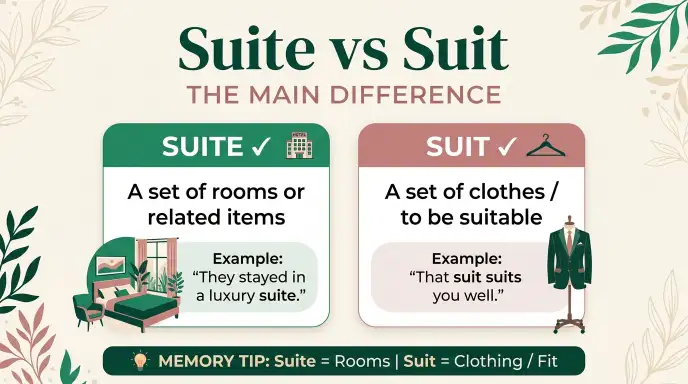
The easiest way to understand the difference is to look at what each word refers to.
Suite usually means a collection or set.
Example:
“We booked a hotel suite.”
Suit can mean clothing.
Example:
“He wore a gray suit.”
Suit can also mean “to be suitable.”
Example:
“Monday suits me.”
And suit can refer to a legal action.
Example:
“The company filed a suit.”
So, while the words sound alike, their meanings depend heavily on context.
British English vs American English Usage
There is no major BritishAmerican spelling difference between suite and suit.
Both British English and American English use:
suite
and
suit
The difference is based on meaning, not region.
For example, British and American speakers can both say:
“We stayed in a hotel suite.”
They can also both say:
“He wore a business suit.”
And:
“Friday suits me.”
The spellings remain the same across the two major varieties of English.
Which Spelling Should You Use?
Choose suite when you mean a collection, group, or set of connected rooms or related things.
Correct:
“We booked a honeymoon suite.”
Choose suit when you mean clothing.
Correct:
“He bought a new suit.”
Use suit when you mean “be suitable.”
Correct:
“Does this time suit you?”
Use suit when referring to a legal case.
Correct:
“The company filed a lawsuit.”
A simple check is to ask yourself what you mean before choosing the spelling.
Common Mistakes with Suite and Suit
Mistake 1: Writing Suit for a Hotel Room
Incorrect:
“We stayed in a luxury suit.”
Correct:
“We stayed in a luxury suite.”
A hotel suite is a group of rooms or a larger accommodation unit.
Mistake 2: Writing Suite for Clothing
Incorrect:
“He bought a new suite for the wedding.”
Correct:
“He bought a new suit for the wedding.”
Clothing is spelled suit.
Mistake 3: Confusing Suit with Suitability
The verb suit means to be appropriate or convenient.
Correct:
“Does this time suit you?”
Here, suit does not refer to clothing.
Mistake 4: Confusing Suite with a Legal Suit
A legal case is a suit, not a suite.
Correct:
“The company filed a civil suit.”
You may also see the related word lawsuit.
Mistake 5: Assuming the Pronunciation Tells You the Spelling
Suite and suit are commonly pronounced the same.
Because of this, listening alone may not tell you which spelling to use.
You need to consider the meaning and context.
Suite and Suit in Everyday Examples
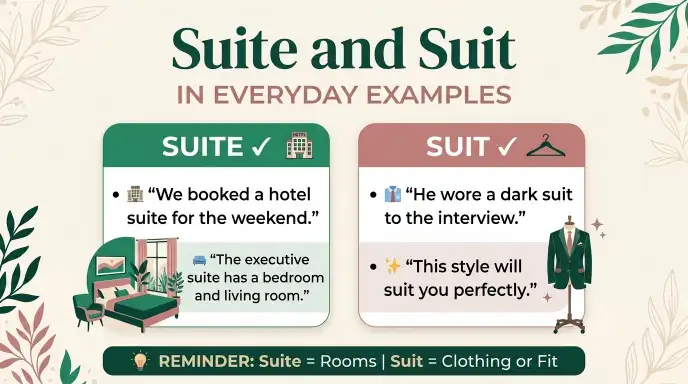
Hotel and Travel
“We booked a family suite.”
“The hotel offers several luxury suites.”
“The presidential suite has a separate living room.”
Clothing
“He wore a navy suit to the interview.”
“She bought a new suit for the wedding.”
“This suit fits him perfectly.”
Being Appropriate
“Tuesday suits me better.”
“That color suits you.”
“This arrangement suits our needs.”
Legal Context
“The company filed a suit against the contractor.”
“The legal suit was settled out of court.”
Music
“The orchestra performed a classical suite.”
“The musical suite contained several connected movements.”
Business and Technology
“The company offers a complete software suite.”
“The design suite includes several professional tools.”
Suite vs Suit in Different Contexts
Hotel
Use suite.
Example:
“We upgraded to a larger suite.”
Clothing
Use suit.
Example:
“He wore a formal suit.”
Appropriateness
Use suit.
Example:
“This option suits me.”
Legal Action
Use suit.
Example:
“The plaintiff filed a suit.”
Music
Use suite.
Example:
“The composer created a new suite.”
Software
Use suite.
Example:
“The company uses an office software suite.”
Suite or Suit: Easy Way to Remember
A useful memory trick is:
Suite = several things together
Think of a hotel suite as several connected spaces.
Suit = clothes or suitability
Think of a business suit or the phrase “This suits me.”
You can remember:
Suite : set
Suit : clothing or suitable
This simple connection makes the spelling easier to choose.
Suite or Suit: Quick Comparison
Suite
Meaning: A group or collection of related things, especially connected rooms.
Common uses: Hotels, offices, music, software.
Example: “We booked a hotel suite.”
Suit
Meaning: Matching clothing, something appropriate, or a legal action.
Common uses: Clothing, suitability, law.
Example: “He wore a black suit.”
Suite or Suit: Google Trends & Usage Data
Both suite and suit are common English words, but their search contexts are quite different.
Searches for suite often relate to hotels, travel, software, business products, music, and accommodation.
Searches for suit commonly relate to clothing, fashion, legal cases, and the verb meaning “to be suitable.”
Because suit has several everyday meanings, it appears in a wide range of conversations and searches. Suite is more strongly connected with the idea of a collection or set.
The key distinction remains simple:
Suite = a set or collection
Suit = clothing, legal action, or suitability
Frequently Asked Questions
Q1. When should you use suit vs suite?
Use suit for clothing, legal actions, or something that is appropriate or suitable. Use suite for a set of matching rooms, furniture, software, or musical pieces.
Q2. Is it “suit yourself” or “suite yourself”?
The correct phrase is “suit yourself.” It means “do what you want” or “choose what you prefer.” Suite yourself is incorrect in this expression.
Q3. Is it “suite or suit your needs”?
The correct phrase is “suit your needs.” Here, suit means to be appropriate or suitable for someone’s requirements.
Q4. Is it suit or suite for clothing?
Use suit for clothing. A suit is a set of clothes, usually including a matching jacket and trousers or a jacket and skirt.
Q5. Which is correct, suit or suite?
Both suit and suite are correct words, but they have different meanings. Suit can refer to clothing or something suitable, while suite usually refers to a set or collection of related things.
Q6. What is a suit in clothing?
A suit is a coordinated set of clothing, typically consisting of a jacket and matching trousers or a skirt. Suits are commonly worn for business, formal events, and other professional occasions.
Q7. Is “a suit of clothes” correct?
Yes, “a suit of clothes” is grammatically correct. It refers to a coordinated set of matching garments, particularly a jacket and trousers or a jacket and skirt.
Q8. Can females wear suits?
Yes. Women can wear suits, and women’s suits are widely worn for professional, formal, and everyday occasions. They may include matching trousers, skirts, jackets, or other coordinated pieces.
Conclusion
Suite and suit are both correct words, but they have different meanings. Use suite when referring to a set or collection, especially a group of connected hotel rooms, an office group, a musical collection, or a software collection. Use suit for matching clothing, a legal case, or something that is appropriate or convenient.
For example, you can book a hotel suite, wear a formal suit, or say “Friday suits me.” A legal case is also a suit, while a collection of musical pieces can be a suite. The two words are commonly pronounced alike, so spelling them correctly depends on understanding the context.
The easiest rule is to connect suite with a set and suit with clothing or suitability. Once you understand these meanings, choosing between suite and suit becomes simple. Both British and American English use the same spellings, so the key issue is meaning rather than regional variation.
Meta Description: Suite or suit explained with correct spelling, meaning, differences, usage, common mistakes, examples, and easy rules for English writers.
🔍 Find the Perfect Word!
Across or Accross? Correct Spelling, Meaning & Usage
Branzini or Branzino? Meaning, Spelling, Usage & Differences

Hi, I’m Ava Collins, a writer and English language enthusiast behind CorrectlyWritten. I’m passionate about making grammar simple, clear, and easy to understand. I write about grammar rules, confusing words, spelling, and everyday English usage to help readers write more accurately and confidently.








2 thoughts on “Suite or Suit? Correct Spelling, Meaning & Usage ”