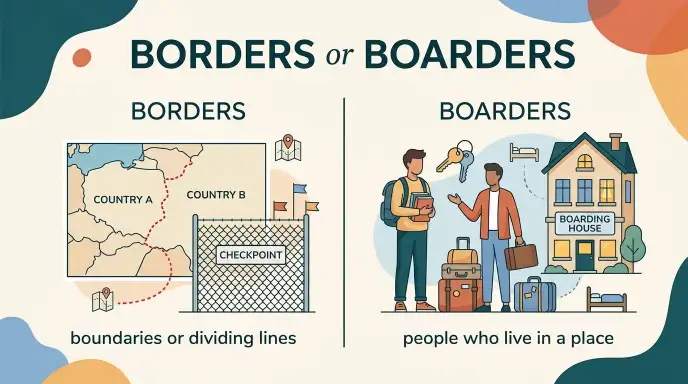
Borders and boarders are both correct English words, but they have completely different meanings. Borders usually refers to boundaries, edges, or dividing lines between places or areas.
Boarders, on the other hand, refers to people who live or stay at a place while receiving accommodation, often at a school or boarding house. For example, “The two countries share a border” uses border, while “The school has twenty boarders” refers to students who live at the school.
The confusion between these words comes from their similar spelling and pronunciation. The only difference is the vowel sequence: border contains “or,” while boarder contains “oa.” Their meanings are different, so choosing the correct word depends on what you are describing.
This guide explains the meaning of borders and boarders, their origins, common uses, spelling differences, everyday examples, and the mistakes people often make.
Quick Answer: Borders or Boarders?
Borders is correct when you mean boundaries, edges, or dividing lines.
Boarders is correct when you mean people who live or stay somewhere while receiving accommodation, especially students at a boarding school.
Correct: The countries share common borders.
Correct: The school has several boarders.
The easiest way to remember the difference is:
Borders = boundaries
Boarders = people who board or stay somewhere
What Does Border Mean?
A border is a line, area, or boundary that separates one place from another.
It can separate:
- Two countries
- Two states or regions
- Two properties
- Two areas
- Different sections of a place
For example:
The border between the two countries is heavily guarded.
Here, border means the boundary separating the countries.
Border can also describe the outer edge of something.
For example:
The picture has a decorative border.
In this sentence, the border is the area around the edge of the picture.
The plural form is borders.
One border
Two borders
What Does Boarder Mean?
A boarder is a person who lives or stays somewhere while receiving meals or accommodation.
The word is especially common when talking about boarding schools.
For example:
The school has more than 100 boarders.
Here, boarders are students who live at the school.
Boarder can also refer to someone who pays to stay in another person’s home while receiving accommodation and sometimes meals.
For example:
The family took in two boarders.
The plural form is boarders.
One boarder
Two boarders
Borders vs Boarders: The Main Difference
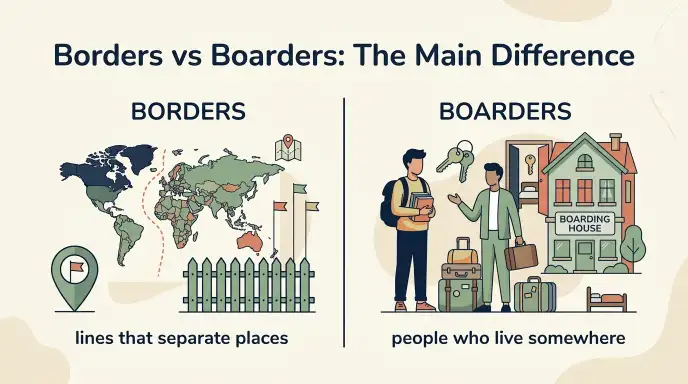
The biggest difference is simple:
Borders are boundaries. Boarders are people.
If you are talking about a line or area that separates places, use border or borders.
If you are talking about people who stay somewhere for accommodation, use boarder or boarders.
Quick Comparison
| Word | Meaning | Example |
| Border | A boundary or edge | The border separates the two countries. |
| Borders | More than one boundary or edge | Several borders were closed. |
| Boarder | A person who stays somewhere for accommodation | The student is a boarder. |
| Boarders | More than one person staying somewhere | The school has many boarders. |
The extra a in boarder changes the meaning completely.
The Origin of Border
The word border has roots in Old French and is related to words connected with the edge or boundary of an area.
Over time, its meaning developed around the idea of a dividing edge or boundary.
Today, border is commonly used for geographical boundaries:
The US Mexico border
The border between France and Germany
It can also describe the edge of an object:
a border around a page
a flower border in a garden
The word therefore has both geographical and general meanings.
British English vs American English
Both border and boarder are standard words in British English and American English.
Their meanings remain essentially the same in both varieties.
Border refers to a boundary or edge.
Boarder refers to someone who receives accommodation or stays at a boarding institution.
The spelling does not change between British and American English.
British and American English Comparison
| Word | British English | American English |
| Border | Boundary or edge | Boundary or edge |
| Borders | More than one boundary or edge | More than one boundary or edge |
| Boarder | Person receiving accommodation | Person receiving accommodation |
| Boarders | More than one person receiving accommodation | More than one person receiving accommodation |
So you can use the same spellings in both varieties of English.
Which Word Should You Use?
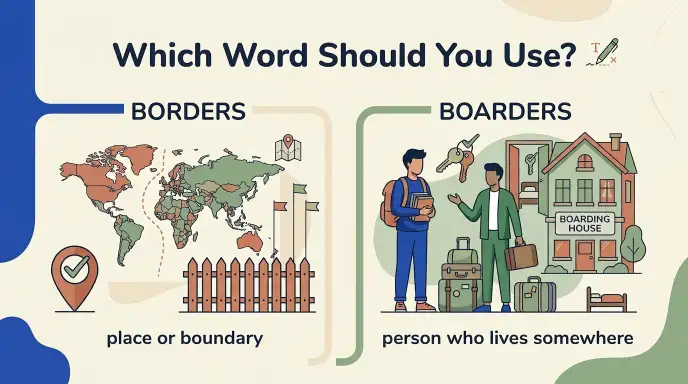
Choose the word according to the meaning you want.
Use borders when you mean:
- Country boundaries
- State or regional boundaries
- Property boundaries
- Edges of objects
- Decorative edges
- Dividing lines
Use boarders when you mean:
- Students living at a boarding school
- People staying in a boarding house
- People receiving accommodation and meals
- More than one person who boards somewhere
A simple question can help:
Am I talking about a boundary or a person?
If it is a boundary, choose border.
If it is a person staying somewhere, choose boarder.
Common Mistakes With Borders or Boarders
Using Boarders for Boundaries
Incorrect: The two countries share common boarders.
Correct: The two countries share common borders.
Countries have borders, not boarders.
Using Borders for People
Incorrect: The school has fifty borders.
Correct: The school has fifty boarders.
Students who live at the school are boarders.
Confusing Border With Boarding
The word boarder is related to boarding.
For example:
She is boarding at the school.
She is a boarder at the school.
The word border has no connection with staying at a school.
Forgetting the “A” in Boarder
The extra a is important.
Border = boundary
Boarder = person staying somewhere
Changing the spelling changes the meaning.
Borders in Everyday Examples
Here are some common examples of borders.
Countries
The two countries share a long border.
Thousands of people crossed the border.
Regions
The river forms the border between the two regions.
The northern border is heavily protected.
Property
A fence marks the border of the property.
They planted trees along the property border.
Decorative Edges
The tablecloth has a colorful border.
She added a floral border to the page.
In all these examples, border refers to an edge or boundary.
Boarders in Everyday Examples
Here are some common examples of boarders.
Boarding Schools
The school provides rooms for its boarders.
The boarders eat dinner together in the dining hall.
Boarding Houses
The house has several boarders.
The landlord provides meals for the boarders.
General Accommodation
The family welcomed two boarders into their home.
The boarders shared the kitchen.
In these examples, boarders refers to people who stay somewhere and receive accommodation.
Border vs Boarder vs Boarding
These three words are easy to mix up.
Border means a boundary or edge.
Boarder means a person who receives accommodation.
Boarding can refer to staying somewhere with accommodation or getting onto a vehicle, depending on the context.
Examples:
The border between the countries is closed.
The student is a boarder at the school.
The passengers are boarding the plane.
Although these words look similar, their meanings are different.
Borders or Boarders in Formal Writing
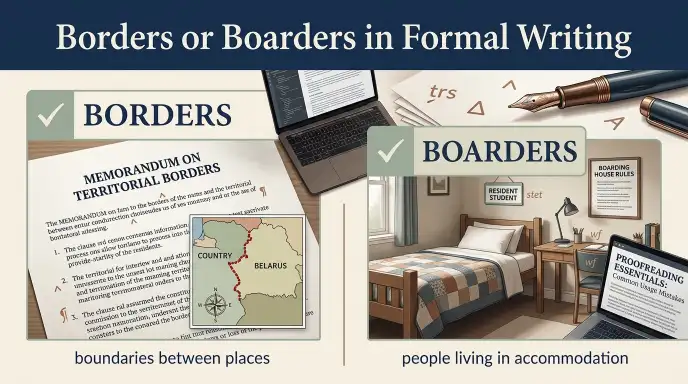
Both words are correct, but they must be used in the right context.
For geographical writing:
The countries agreed to protect their borders.
For education:
The school provides accommodation for its boarders.
For property:
The fence marks the borders of the land.
Using the wrong spelling can change the meaning of the sentence. In formal writing, always check if you are describing a boundary or a person.
Google Trends and Modern Usage
Both borders and boarders are established English words, but they appear in very different contexts.
Borders is commonly used in discussions about countries, regions, properties, maps, design, and physical edges.
Boarders is mainly used when discussing people who stay at boarding schools, boarding houses, or similar accommodation.
Because the words are pronounced similarly in some accents, spelling mistakes can occur. The context of the sentence usually makes the intended meaning clear.
For standard writing, remember:
Borders = boundaries
Boarders = people
Quick Comparison: Borders vs Boarders
| Point | Borders | Boarders |
| Basic meaning | Boundaries or edges | People who stay somewhere |
| Singular form | Border | Boarder |
| Refers to | Places, areas, objects | People |
| Common context | Countries, regions, property, design | Boarding schools, houses, accommodation |
| Example | The countries share borders. | The school has many boarders. |
| Spelling clue | No “a” after bo | Contains “boa” |
Key Takeaways
- Borders means boundaries or edges.
- Boarders means people who stay somewhere while receiving accommodation.
- A country has borders.
- A boarding school has boarders.
- The extra a in boarder changes the meaning.
- Both words are correct English words.
- Their spelling is the same in British and American English.
- Use the context to decide which word you need.
Frequently Asked Questions
Q1. What is the difference between boundaries and borders?
A boundary is a line or limit that separates areas, ideas, or personal space. A border usually refers to an official dividing line between countries, regions, or areas.
Q2. What is the meaning of boarder?
A boarder is a person who receives accommodation and meals in a place, usually by paying for them. For example, a student living at a boarding school can be called a boarder.
Q3. Is it borders or boarders?
Borders and boarders are both correct words, but they have different meanings. Borders refers to dividing lines or edges, while boarders refers to people who receive accommodation and meals.
Q4. What do borders mean?
Borders are dividing lines or edges that separate countries, regions, areas, or objects. The meaning depends on the context in which the word is used.
Q5. What is the difference between “boarder” and “border”?
A border is a dividing line, boundary, or edge. A boarder is a person who pays for and receives accommodation and meals.
Q6. What are borders called?
Borders can also be called boundaries, dividing lines, frontiers, edges, limits, or margins, depending on the context.
Q7. What is another word for “borders”?
Common alternatives for borders include boundaries, edges, limits, margins, frontiers, and dividing lines.
Q8. What does the name Borders mean?
As a surname, Borders is generally associated with the word border, which historically referred to someone who lived near a boundary or border area.
Q9. What are two types of borders?
Two broad types of borders are natural borders, such as rivers and mountains, and artificial or political borders, which are established through laws, agreements, or political decisions.
Conclusion
Borders and boarders are both correct English words, but they describe completely different things. Borders refers to boundaries, dividing lines, or edges. Boarders refers to people who stay somewhere while receiving accommodation.
The easiest way to remember the difference is to focus on the extra a in boarder. A boarder is connected with boarding, such as a student living at a boarding school. A border, without the extra “a,” is a boundary between places or the edge of something.
For example, countries share borders, while boarding schools have boarders. You can also have a decorative border around a page, while a house may have boarders living inside it.
So, when choosing between these words, ask what you are describing. If it is a boundary or edge, use border or borders. If it is a person staying somewhere, use boarder or boarders.
More Spelling Diferences:
Neither or Nither: Correct Spelling, Meaning, Usage & Examples
Techie or Techy: Correct Spelling, Meaning, Usage, Examples
Congratulations or Congratulation? Usage, Meaning & Examples

Hi, I’m Ava Collins, a writer and English language enthusiast behind CorrectlyWritten. I’m passionate about making grammar simple, clear, and easy to understand. I write about grammar rules, confusing words, spelling, and everyday English usage to help readers write more accurately and confidently.








1 thought on “Borders or Boarders? Meaning, Differences & Usage”