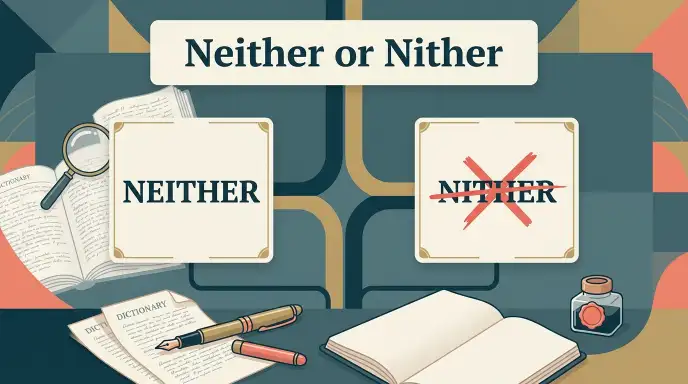
Neither is the correct spelling, while nither is incorrect. Neither means “not one and not the other” when you are talking about two people, things, or choices. For example, “Neither answer is correct” means that both answers are incorrect. The word is also commonly used in the expression neither…nor, as in “Neither John nor Sarah attended the meeting.”
The confusion between neither and nither often comes from pronunciation. Some speakers say NEE :ther, while others say NY :ther. Because the sound can vary, some people may spell the word the way they hear it. However, the standard written form does not change. The correct spelling is always neither.
Understanding this word is useful because neither has several common grammar patterns. It can describe two choices, work as a pronoun, appear with nor, and help you agree with a negative statement. This guide explains its meaning, usage, pronunciation, common mistakes, and everyday examples in simple English.
Quick Answer: Neither or Nither?
Neither is the correct spelling. Nither is a common spelling mistake and is not the standard form of the word.
Neither means not one and not the other of two.
Correct: Neither answer is correct.
Incorrect: Nither answer is correct.
You will often see neither with nor:
Neither Ali nor Ahmed was at home.
This means Ali was not at home and Ahmed was not at home.
What Does Neither Mean?
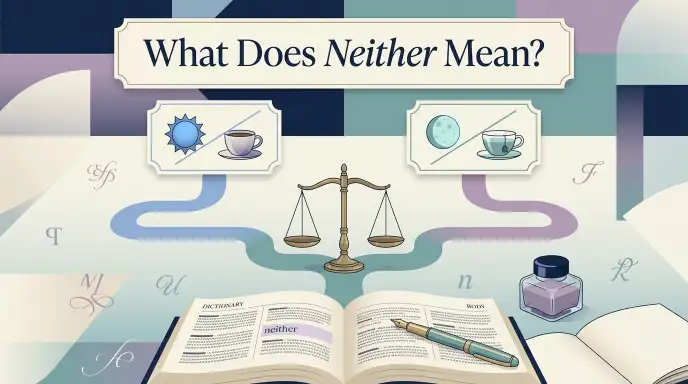
Neither is used when two people, things, or choices are being discussed and both are excluded.
For example:
Neither book is interesting.
This means the first book is not interesting and the second book is not interesting.
Another example is:
Neither student passed the test.
This means both students failed the test.
Neither can also stand alone when the two choices are already clear.
“Do you want tea or coffee?”
“Neither.”
Here, neither means “not tea and not coffee.”
A simple way to remember the meaning is:
Either = one of two
Neither = not one and not the other
Neither…Nor: How to Use It
One of the most common structures with neither is neither…nor.
It connects two people, things, actions, or choices that are both excluded.
Examples:
Neither John nor James was available.
Neither tea nor coffee is on the menu.
She likes neither football nor basketball.
Neither the manager nor the assistant answered the phone.
The basic pattern is:
Neither + first choice + nor + second choice
Do not normally use or after neither.
Incorrect: Neither John or James came.
Correct: Neither John nor James came.
The Origin of Neither
Neither has a long history in the English language. It developed from older forms that expressed the idea of not either.
Its modern meaning still reflects this idea. When you use neither, you are saying that two possible choices are both excluded.
This is closely connected to the word either.
For example:
Either road will take you to the town.
This presents two possible choices.
Neither road is safe.
This rejects both choices.
The word has remained a standard part of English for centuries and is still widely used today.
British English vs American English
The spelling neither is the same in both British English and American English.
The main difference you may notice is pronunciation. Different speakers may pronounce the first part of the word differently.
Common pronunciations include:
NEE :ther
NY :ther
Both are recognized pronunciations. Neither pronunciation changes the spelling.
British English and American English Comparison
| Feature | British English | American English |
| Correct spelling | neither | neither |
| Incorrect spelling | nither | nither |
| Common pronunciation | NEE :ther or NY :ther | NEE :ther or NY :ther |
| Neither…nor | Standard | Standard |
The important point is simple: the pronunciation may vary, but the spelling remains neither.
Which Version Should You Use?
Use neither in all standard English writing.
It is appropriate for:
- School assignments
- University essays
- Business emails
- Reports
- Articles
- Formal letters
- Professional communication
- Social media posts
- Everyday messages
There is no standard situation where nither should replace neither.
If you hear the word pronounced differently, do not change the spelling. Remember:
N :E :I :T :H :E :R
Neither vs Either
Neither and either are closely related, but they do not have the same meaning.
Either usually refers to one of two choices.
Either answer could be correct.
This means one answer or the other could be correct.
Neither rejects both choices.
Neither answer is correct.
This means the first answer is incorrect and the second answer is also incorrect.
Quick Comparison
| Word | Meaning | Example |
| Either | One of two choices | Either answer could be correct. |
| Neither | Not one and not the other | Neither answer is correct. |
| Nither | Incorrect spelling | Nither answer is correct. |
A simple memory trick is:
Either gives a choice. Neither rejects both choices.
Common Mistakes With Neither or Nither
Writing Nither Instead of Neither
This is the most common spelling mistake.
Incorrect: Nither option is suitable.
Correct: Neither option is suitable.
Remember that neither contains ei after the first letter.
Using Neither…Or
The standard paired structure is neither…nor.
Incorrect: Neither Sarah or Emma came.
Correct: Neither Sarah nor Emma came.
Confusing Neither With Either
These words have different meanings.
Either option is acceptable.
This gives two possible choices.
Neither option is acceptable.
This rejects both choices.
Using a Plural Noun After Neither
When neither directly modifies a noun, a singular noun is normally preferred in standard formal English.
Less suitable: Neither students was ready.
Standard: Neither student was ready.
Changing the Spelling Because of Pronunciation
Neither can be pronounced in different ways. That does not create different spellings.
Correct: Neither
Incorrect: Nither
Neither in Everyday Examples
Neither appears naturally in everyday conversation and writing.
At School
Neither student brought a notebook.
Neither answer matches the question.
At Work
Neither manager was available.
Neither proposal meets our needs.
In Conversation
“Would you like tea or coffee?”
“Neither, thank you.”
Talking About Two Things
Neither phone has enough storage.
Neither option seems practical.
Talking About Two People
Neither David nor Mark joined the meeting.
Neither sister wanted to leave early.
Talking About Preferences
I like neither option.
She enjoys neither singing nor dancing.
Neither as a Pronoun
Neither can be used as a pronoun when it replaces two previously mentioned choices.
For example:
“Which of these two bags do you want?”
“Neither.”
The word neither replaces the names of the two bags because the choices are already understood.
Another example:
“Which restaurant should we choose?”
“Neither.”
This means the speaker does not want either of the two restaurants.
Using neither by itself is natural when the context makes the two choices clear.
Neither for Negative Agreement
Neither can also be used to agree with a negative statement.
For example:
“I don’t like spicy food.”
“Neither do I.”
The second speaker means:
“I don’t like spicy food either.”
Another example:
“She wasn’t at the party.”
“Neither was I.”
This means both people were absent.
This use of neither is common in conversation and helps avoid repeating a complete negative sentence.
Neither or Nither in Formal Writing
In formal writing, always use neither.
Examples include:
Neither candidate submitted the required form.
Neither explanation answers the question.
Using nither can make a sentence appear to contain a spelling error. This matters in school assignments, professional documents, applications, reports, and published content.
When proofreading, check the spelling carefully:
N :E :I :T :H :E :R
Google Trends and Modern Usage
Neither is a well :established English word and is widely used in conversation, education, journalism, business writing, and online communication.
The spelling nither may appear in search queries or informal online writing because people sometimes spell words according to how they hear them. Its appearance online does not make it a standard English spelling.
For modern standard English, the correct form is clear:
Use neither.
When checking a sentence, also pay attention to the structure around the word. Many mistakes involve using neither…or instead of the standard neither…nor.
Quick Comparison: Neither vs Nither
| Point | Neither | Nither |
| Correct spelling | Yes | No |
| Standard English | Yes | No |
| Meaning | Not one and not the other of two | No standard meaning |
| Common grammar pattern | Neither…nor | None |
| Example | Neither answer is correct. | Nither answer is correct. |
Key Takeaways
- Neither is the correct spelling.
- Nither is a spelling mistake.
- Neither means not one and not the other of two.
- The common paired structure is neither…nor.
- Neither is standard in both British and American English.
- Pronunciation may be NEE :ther or NY :ther.
- Pronunciation does not change the spelling.
- Either usually presents one of two choices.
- Neither rejects both choices.
- Use neither in formal and everyday writing.
Frequently Asked Questions
Q1. What is the difference between neither and nither?
“Neither” is the correct standard English spelling.
“Nither” is generally a misspelling and is not normally used in standard English.
Q2. What does nither mean?
“Nither” is not a standard English word in modern everyday usage.
If you mean “neither,” it refers to not one and not the other of two choices.
Q3. How do I use either?
“Either” is used to refer to one of two choices or possibilities.
For example: “You can choose either tea or coffee.”
Q4. What does “neither” mean?
“Neither” means not one and not the other of two people or things.
For example: “Neither answer is correct.”
Q5. What does “me neither” mean?
“Me neither” means “I don’t either” and is used to agree with a negative statement.
Example: “I don’t like coffee.” “Me neither.”
Q6. What is another word for “neither”?
Depending on the sentence, alternatives include “not either,” “none of the two,” and “not one or the other.”
The exact synonym depends on how “neither” is being used.
Q7. When can I say “neither”?
Use “neither” when you are referring to two people or things and saying that not one of them applies.
Example: “Neither option is suitable for me.”
Q8. What are 5 synonym words?
Five words or phrases that can sometimes express a similar idea are “not either,” “none,” “neither one,” “not one,” and “not the other.”
However, these are not interchangeable in every sentence.
Q9. What is the opposite of “neither”?
The opposite idea of “neither” is generally “both,” because “neither” means not one or the other, while “both” means the two together.
For example: “Neither is available” versus “Both are available.”
Conclusion
Neither is the correct spelling, while nither is incorrect. Neither means “not one and not the other” when two people, things, or choices are being discussed. It is a standard word in both British and American English.
The most common grammar pattern is neither…nor. For example, “Neither Ali nor Ahmed attended the meeting” means that both people were absent. Neither can also stand alone when two choices are already clear, as in “Which one do you want?” followed by “Neither.”
The word can be pronounced in different ways, which is one reason some people spell it incorrectly. You may hear NEE :ther or NY :ther, but the written form remains neither.
So the rule is simple: Neither is correct. Nither is a spelling mistake. Whenever you use this word in an article, email, assignment, or everyday message, choose neither.
🔍 Find the Perfect Word:
Techie or Techy: Correct Spelling, Meaning, Usage, Examples
Congratulations or Congratulation? Usage, Meaning & Examples

Hi, I’m Ava Collins, a writer and English language enthusiast behind CorrectlyWritten. I’m passionate about making grammar simple, clear, and easy to understand. I write about grammar rules, confusing words, spelling, and everyday English usage to help readers write more accurately and confidently.








2 thoughts on “Neither or Nither: Correct Spelling, Meaning, Usage & Examples”