
Congratulations is the correct and natural form when you want to praise someone for an achievement, success, or special occasion. Congratulation is a singular noun, but it is rarely used in everyday English.
This is why learners often wonder if they should write “Congratulations” or “Congratulation” when sending a message, writing an email, or speaking to someone after good news. The confusion usually comes from the fact that congratulations ends in s, even when it is directed at one person.
In English, however, Congratulations! is the normal expression used to celebrate someone’s success. You can say, “Congratulations on your graduation,” “Congratulations on your new job,” or simply “Congratulations!”
The singular form congratulation can appear when discussing one specific expression of praise, but it does not normally replace congratulations in direct messages. Understanding this small difference helps you choose the right form for cards, emails, social media posts, speeches, and everyday conversations.
Congratulations or Congratulation: Quick Answer
Congratulations is the correct choice when you are directly celebrating someone’s achievement.
Examples:
- Congratulations on your promotion! ✅
- Congratulations on your wedding! ✅
- Congratulations on passing your exam! ✅
- Congratulation on your promotion! ❌
The word congratulation is grammatically possible as a singular noun, but it is uncommon in normal modern English.
A simple rule is:
Use “congratulations” when you praise someone.
Definition and Meaning of Congratulations or Congratulation
What does congratulations mean?
Congratulations is an expression used to show pleasure and approval when someone has achieved something or experienced an important event.
For example:
Congratulations on your new job!
Congratulations on winning the competition!
It can be used for personal achievements, academic success, professional milestones, weddings, births, awards, and many other occasions.
What does congratulation mean?
Congratulation is the singular noun related to the verb congratulate.
It refers to an expression of praise or approval given to someone.
For example:
He received a congratulation from his manager.
This construction is grammatically possible, but native speakers usually prefer congratulations in ordinary communication.
Why do we usually say congratulations?
The expression congratulations has become established as a conventional plural form used when praising someone.
You do not normally need to think about if the achievement belongs to one person or several people. The standard expression remains:
Congratulations!
The Origin of Congratulations or Congratulation
The word congratulation comes from the verb congratulate, which developed from Latin roots connected with expressing joy or sharing happiness.
The English verb congratulate has been used for centuries. It means to express pleasure or praise because of someone’s success or good fortune.
The noun congratulation developed from the same word family.
Over time, congratulations became established as the usual expression used when directly praising someone. This is why modern English normally uses the plural form even when one person is receiving the message.
The same pattern can be seen in common expressions such as:
Congratulations on your achievement.
Congratulations to the happy couple.
The plural form is now firmly established in everyday English.
British English vs American English Spelling
There is no major spelling difference between British and American English for congratulations or congratulation.
Both varieties use:
congratulation
congratulations
The main difference is not spelling. It is how naturally each form is used in a particular sentence.
| Form | British English | American English | Common Use |
| congratulation | Correct but uncommon | Correct but uncommon | Singular noun |
| congratulations | Very common | Very common | Praising someone |
| Congratulations! | Natural | Natural | Direct expression |
| Congratulation! | Unnatural | Unnatural | Avoid |
For both British and American readers, Congratulations! is the normal expression.
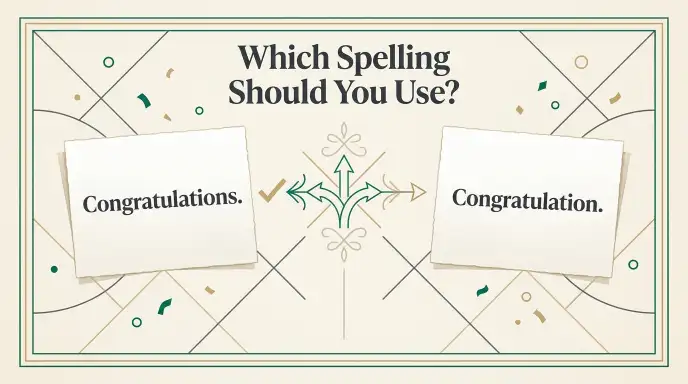
Which Spelling Should You Use?
For everyday messages
Use congratulations.
Congratulations on your graduation!
This is the most natural choice for texts, cards, social media comments, and conversations.
For professional emails
Use congratulations when acknowledging someone’s success.
Congratulations on your promotion. I wish you continued success in your new role.
It sounds polite and professional.
For formal writing
The singular congratulation can be used when discussing an individual expression of praise, but congratulations is still more common when directly addressing someone’s achievement.
For international English
Choose congratulations. It is widely understood and natural across English speaking regions.
Common Mistakes with Congratulations or Congratulation
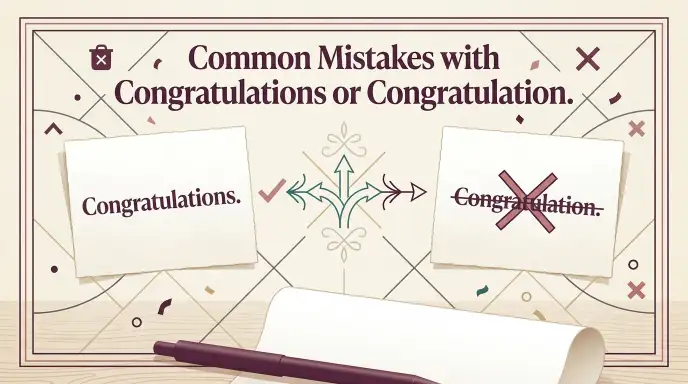
Mistake 1: Writing “Congratulation!”
Incorrect:
Congratulation on your graduation!
Correct:
Congratulations on your graduation!
The plural form is the standard expression.
Mistake 2: Removing the “s” because one person succeeded
A single person can still receive:
Congratulations!
The s does not mean that several people must be receiving the message.
Mistake 3: Using “congratulation” in a social media comment
You may see:
Congratulation!
This is understandable, but it does not sound natural to most English speakers.
Better:
Congratulations!
Mistake 4: Confusing congratulate with congratulations
Congratulate is a verb.
I want to congratulate you.
Congratulations is commonly used as an expression or noun.
Congratulations on your success!
Both words are correct, but they have different grammatical roles.
Congratulations or Congratulation in Everyday Examples

In emails
Congratulations on your promotion. I hope you enjoy your new position.
This works well in professional communication.
In text messages
Congratulations! You did it!
The short form is friendly and natural.
On social media
Congratulations on your graduation! Wishing you an amazing future.
This is a common way to celebrate someone’s milestone publicly.
In news writing
The organization sent congratulations to the team after its successful performance.
Here, the noun refers to an expression of praise.
In formal writing
The committee offered its congratulations to the award recipients.
This sounds appropriate in an official context.
For a wedding
Congratulations to you both on your wedding!
For a new baby
Congratulations on the arrival of your beautiful baby!
For an exam result
Congratulations on passing your exam!
For a new job
Congratulations on your new position!
Congratulations or Congratulation: Google Trends & Usage Data
Searches for congratulations or congratulation usually come from people checking which form is natural when writing a message or greeting.
English usage strongly favors congratulations as the direct expression of praise. The form appears naturally in phrases such as Congratulations on your success, Congratulations on your wedding, and Congratulations on your promotion.
The singular congratulation is much less common in everyday communication. It is more likely to appear when the word is being discussed as a noun or when referring to a particular expression of praise.
Search interest can also vary according to events such as graduation seasons, major sporting achievements, weddings, award ceremonies, and professional promotions. This means usage may rise around occasions when people commonly search for congratulatory phrases.
For practical writing, the distinction is simple:
Direct praise : Congratulations
Singular noun in a specific grammatical context : Congratulation
Congratulations vs Congratulation: Quick Comparison
| Word or Phrase | Meaning | Commonness | Example |
| congratulations | Expression of praise | Very common | Congratulations on your success! |
| congratulation | One expression of praise | Uncommon | He sent a congratulation. |
| congratulate | To praise someone for an achievement | Very common | I want to congratulate you. |
| Congratulations! | Direct expression of praise | Very common | Congratulations! You passed! |
| congratulations on | Praise connected to an achievement | Very common | Congratulations on your promotion. |
Frequently Asked Questions
Q1. Is it okay to say congratulations?
Yes, “congratulations” is completely correct and commonly used to celebrate someone’s success or achievement.
For example: “Congratulations on your new job!”
Q2. Is congratulation singular or plural?
“Congratulation” is singular, but it is rarely used in everyday English.
“Congratulations” is the standard plural form used when expressing good wishes.
Q3. Which is correct: “congrat” or “congrats”?
“Congrats” is the correct informal short form of “congratulations.”
“Congrat” is not normally used as a standalone word in standard English.
Q4. What is the meaning of congratulation?
“Congratulation” means an expression of praise or good wishes for someone’s achievement.
In everyday English, the plural “congratulations” is much more common.
Q5. Which is correct: “congratulation” or “congratulations”?
“Congratulations” is the natural and standard choice when you are praising someone.
“Congratulation” is grammatically possible but uncommon in modern everyday English.
Q6. What is the best congratulation?
A good congratulation is warm, specific, and sincere, such as “Congratulations on your amazing achievement!”
Adding the person’s achievement makes the message feel more personal.
Q7. How to write a good congratulation?
Mention the achievement, express genuine happiness, and add a positive wish for the future.
For example: “Congratulations on your graduation! Wishing you great success ahead.”
Q8. What is a better way to say congratulations?
You can say “Well done!”, “I’m so happy for you!”, “You did it!”, or “Many congratulations!”
The best choice depends on how formal or personal the situation is.
Q9. Is congratulations a good wish?
Yes, “congratulations” is a positive expression used to celebrate someone’s success or good news.
It is appropriate for occasions such as graduations, weddings, promotions, and awards.
Conclusion
Congratulations is the standard choice when you want to celebrate someone’s success, achievement, or special occasion. It is the form you should use in messages, emails, greeting cards, social media posts, conversations, and most other everyday situations. For example, Congratulations on your graduation! and Congratulations on your new job! both sound natural and correct.
Congratulation is not necessarily grammatically wrong. It is the singular noun form, but it is uncommon in ordinary communication. Most speakers naturally choose congratulations when expressing praise directly.
The easiest rule to remember is simple: use congratulations when celebrating someone. Use congratulate when you need the verb, as in “I want to congratulate you.” If you are unsure which form belongs in a greeting, choose Congratulations! It is clear, natural, widely understood, and appropriate for both British and American English.
📚 Every Word Matters!
Brauts or Brats? Correct Spelling, Meaning, & Real Examples
Spatter or Splatter? Meaning, Differences, & When to Use Each
Spoilt or Spoiled: Meaning, British vs American English & Examples

Hi, I’m Ava Collins, a writer and English language enthusiast behind CorrectlyWritten. I’m passionate about making grammar simple, clear, and easy to understand. I write about grammar rules, confusing words, spelling, and everyday English usage to help readers write more accurately and confidently.








3 thoughts on “Congratulations or Congratulation? Usage, Meaning & Examples ”