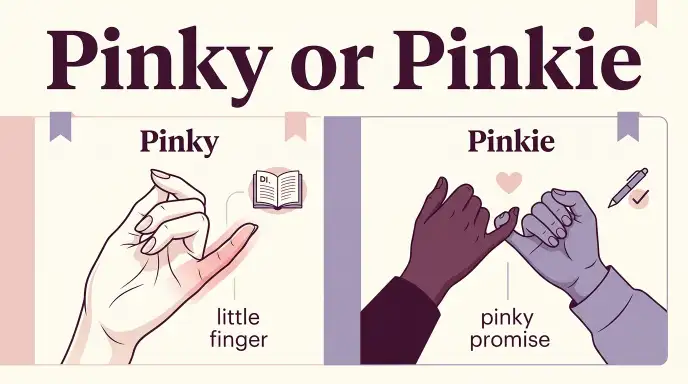
Pinky and pinkie are both correct spellings for the smallest finger of the hand, with pinkie especially common in British and Scottish usage and pinky widely used in American English.
These two spellings often confuse English learners because they sound exactly the same and have the same basic meaning. The word refers to the little finger, the fifth finger on either hand. You may see pinky finger, pinkie finger, pinky ring, or pinkie ring in everyday writing. Cambridge Dictionary lists pinkie and gives pinky as an alternative, while its American Dictionary also recognizes both forms.
The choice is therefore not simply about one spelling being right and the other wrong. Both are established English words, but their usage varies by region and personal preference. If you are writing for an American audience, pinky is a familiar choice. For British or Scottish English, pinkie is also well established. In international writing, either form is understandable, although choosing one spelling and using it consistently is best.
Pinky or Pinkie: Quick Answer
Pinky and pinkie are both correct.
They usually mean the smallest finger of the hand, also called the little finger. Cambridge Dictionary defines pinkie as a little finger and lists pinky as an alternative.
Examples:
- I hurt my pinky.
- I hurt my pinkie.
- She wore a ring on her pinky.
- She wore a ring on her pinkie.
Both spellings have the same pronunciation:
Pinky = pinkie
The main difference is regional preference rather than meaning.
Definition and Meaning of Pinky or Pinkie
What does pinky mean?
Pinky is an informal noun meaning the smallest finger of the hand.
For example:
I cut my pinky while cooking.
It can also appear in the phrase pinky finger.
He injured his right pinky finger.
The word is especially familiar in American English.
What does pinkie mean?
Pinkie has the same basic meaning. It refers to the smallest finger of the hand.
For example:
She hurt her pinkie during the game.
Cambridge Dictionary lists pinkie as a noun meaning a little finger and identifies pinky as another form.
Are pinky and pinkie pronounced the same?
Yes. In normal English pronunciation, both words are pronounced PINGkee.
The spelling changes, but the pronunciation and basic meaning remain the same.
Can pinky refer to something else?
Yes. Pinky can also be an adjective meaning slightly pink or pinkish in some contexts. The noun referring to the little finger is a separate usage. Historical sources record pinky as an adjective meaning “pinkish” from the late 18th century.
The context normally makes the intended meaning clear.
The Origin of Pinky or Pinkie
The history of pinkie is particularly interesting because the word is older than many people realize.
The noun pinkie, meaning the little finger, is recorded from around 1808 in Scottish English. Etymological sources connect it with Dutch pinkje, a diminutive form of pink, referring to something small or narrow.
This history helps explain why pinkie has the ie ending. The form developed as a diminutive word associated with something small.
The spelling pinky developed as a variant. English often develops alternative spellings for informal words, especially when pronunciation remains unchanged.
It is important not to assume that pinkie comes directly from the color pink. The history of the finger word is connected to older terms meaning something small or narrow, while the history of pink as a color has its own complicated development.
Today, both pinky and pinkie are established forms.
British English vs American English Spelling
There is no major difference in meaning between pinky and pinkie in British and American English. The main difference is usage preference.
Cambridge identifies pinkie as a US or Scottish English word and also lists pinky as an alternative. Its American Dictionary likewise gives pinkie with pinky as another form.
| Spelling | British English | American English | Meaning |
| pinky | Used | Very common | Smallest finger |
| pinkie | Used, especially familiar in some varieties | Used | Smallest finger |
| pinky finger | Correct | Very common | Smallest finger |
| pinkie finger | Correct | Correct | Smallest finger |
| pinky ring | Correct | Common | Ring worn on the little finger |
| pinkie ring | Correct | Correct | Ring worn on the little finger |
| little finger | Very common | Common | Formal or neutral name for the finger |
Both forms can be understood across Englishspeaking regions.
The choice mainly depends on regional habit, audience, and personal preference.
Which Spelling Should You Use?
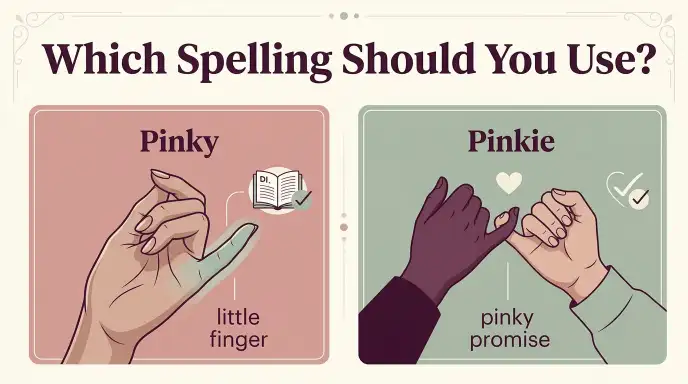
For American English
Pinky is a natural and widely recognized choice.
For example:
I hurt my pinky playing basketball.
You will also commonly see pinky finger and pinky promise.
For British English
Pinkie is a wellestablished form, although pinky is also understood.
For example:
She wore a small ring on her pinkie.
For Scottish English
Pinkie has a particularly strong historical connection with Scottish English. Etymological records place the early noun usage there in the early 19th century.
For international English
Either spelling is acceptable.
If your audience is broad, pinky may feel more familiar to many readers because of its strong presence in American English. However, pinkie is also standard enough to be understood easily.
The most important point is consistency. If you choose pinky, keep using pinky throughout the same article or document.
Common Mistakes with Pinky or Pinkie
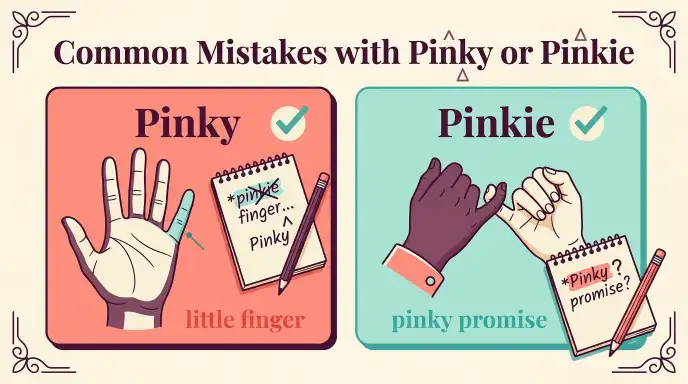
Mistake 1: Thinking one spelling is completely wrong
Incorrect assumption:
Pinkie is wrong because pinky is the common spelling.
Both forms are established. Pinkie is not simply a spelling mistake.
Mistake 2: Thinking pinky and pinkie have different meanings
In the context of the finger, they normally have the same meaning.
He injured his pinky.
He injured his pinkie.
Both sentences refer to the smallest finger.
Mistake 3: Writing pinky finger as two separate concepts
Pinky finger is a normal phrase for the smallest finger.
For example:
My pinky finger is sore.
You can also simply say:
My pinky is sore.
Mistake 4: Assuming pinkie is only British
Pinkie is used in several varieties of English. Cambridge specifically records it and also recognizes pinky as an alternative.
Mistake 5: Confusing the finger meaning with the color meaning
Pinky can sometimes mean slightly pink, while pinky or pinkie can refer to the little finger.
Context determines the meaning.
Pinky or Pinkie in Everyday Examples
In emails
I injured my pinky yesterday, so typing is a little uncomfortable.
For a more formal medical or professional context, little finger may sound more neutral.
In everyday conversation
I bumped my pinkie on the table.
This is a natural informal use.
On social media
My pinky is officially stronger than my other fingers after today’s workout!
The informal spelling works naturally in casual posts.
In news writing
The player suffered an injury to his left pinky during the match.
News writing may use pinky in American publications, while little finger can provide a more neutral alternative.
In formal writing
The patient reported pain in the little finger of the right hand.
In medical or highly formal writing, little finger or the anatomical term may be preferred over the informal pinky or pinkie.
For a ring
She bought a silver ring for her pinky.
Or:
She bought a silver ring for her pinkie.
Both are understandable and correct.
For a promise
They made a pinky promise.
This is a common informal expression, especially in American English.
Pinky or Pinkie: Google Trends & Usage Data
Search interest in pinky and pinkie can vary by country, writing style, and context. The two spellings refer to the same finger, so searches often reflect regional vocabulary rather than a difference in meaning.
Pinky is strongly associated with American English, while pinkie is also established in Scottish English and appears as an accepted alternative in American English dictionaries. Cambridge lists both forms for the smallest finger.
Searches may also increase around topics such as:
- Pinky promises
- Pinky rings
- Finger injuries
- Jewelry
- Children’s vocabulary
- Anatomy and health information
The word pinkie also has a longer documented history as the name for the little finger, with evidence dating to around 1808.
Because search behavior changes by country and topic, exact popularity can vary over time. For practical writing, the key usage pattern is more useful than a single search number:
American audience : pinky is very natural
British or Scottish audience : pinkie is well established
International audience : both are understood
Pinky vs Pinkie: Quick Comparison
| Feature | Pinky | Pinkie |
| Basic meaning | Smallest finger | Smallest finger |
| Pronunciation | PINGkee | PINGkee |
| American English | Very common | Common |
| British English | Used | Well established |
| Scottish English | Used | Historically established |
| Formality | Informal | Informal |
| Pinky finger | Yes | Pinkie finger |
| Pinky ring | Yes | Pinkie ring |
| Pinky promise | Very common | Also understandable |
| Correct spelling | Yes | Yes |
Frequently Asked Questions
Q1. Is it pinky finger or pinkie finger?
Both pinky finger and pinkie finger are correct. Pinky is more common in American English, while pinkie is also widely used, especially in British English.
Q2. Is it pinkie or pinky promise?
Both pinky promise and pinkie promise are used. Pinky promise is the more common form in modern English.
Q3. What does pinky mean for a girl?
For a girl, pinky can simply refer to the smallest finger. In some contexts, it may also be used as a cute nickname or affectionate term, depending on the person and situation.
Q4. What does “pinkie” mean?
Pinkie can mean the smallest finger of the hand. It can also be used as a variant spelling of pinky or as a nickname.
Q5. Which is correct, “pinkie” or “pinky”?
Both pinkie and pinky are correct spellings. Pinky is more common in American English, while pinkie is an established alternative.
Q6. Is pinky a girl name?
Pinky can be used as a girl’s name or nickname, although it is not usually a common formal given name in Englishspeaking countries.
Q7. What gender is Pinky?
Pinky can be used for any gender as a nickname, although it is often associated with girls in some cultures and contexts.
Q8. What is Pinky a nickname for?
Pinky can be a standalone nickname and does not have one fixed formal name that it always represents. It may be given because of someone’s personality, appearance, or personal association with the word.
Q9. What is Pinky in slang?
In informal use, pinky can refer to the smallest finger, especially in expressions such as pinky promise. Its meaning as slang can vary depending on the context.
Conclusion
Pinky and pinkie are both correct spellings for the smallest finger of the hand. Neither spelling should automatically be treated as a mistake. The main difference is regional preference and familiarity. Pinky is especially common in American English, while pinkie is a longestablished form with strong historical links to Scottish English. Cambridge recognizes pinkie and lists pinky as an alternative, confirming that both forms are accepted.
For American readers, pinky is a natural choice in everyday writing. For British, Scottish, or international readers, pinkie is also perfectly understandable. If you are writing formally, little finger is a more neutral alternative.
The simplest rule is this: pinky = pinkie when you mean the smallest finger. Choose the form that fits your audience, then use it consistently. Both spellings are correct, both have the same pronunciation, and both can appear in phrases such as pinky finger, pinkie finger, and pinky ring.
🔍 Find the Perfect Word:
Borders or Boarders? Meaning, Differences, Usage & Examples
Neither or Nither: Correct Spelling, Meaning, Usage & Examples

Hi, I’m Ava Collins, a writer and English language enthusiast behind CorrectlyWritten. I’m passionate about making grammar simple, clear, and easy to understand. I write about grammar rules, confusing words, spelling, and everyday English usage to help readers write more accurately and confidently.








2 thoughts on “Pinky or Pinkie? Correct Spelling, Meaning, & Real Examples ”