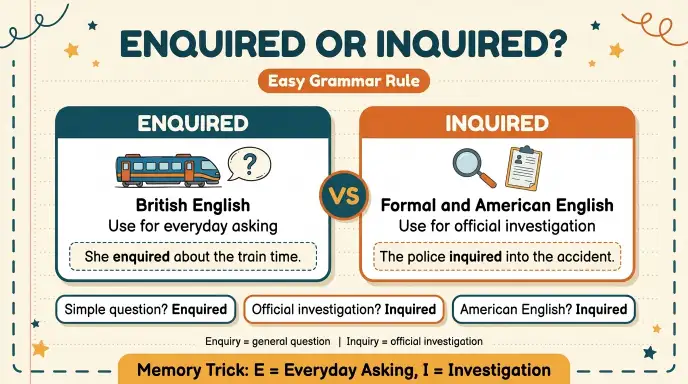
Enquired or inquired confuses many writers, because both spellings look right and both are real words. The short rule is simple. Enquired is the past tense of enquire for a general question, and inquired is the past tense of inquire for formal questions and official investigations.
Inquired is also the standard choice in American English for almost every use. So a traveller enquired about a train time, but a committee inquired into a serious matter. This guide covers the meanings, the noun pair enquiry and inquiry, the verb forms, and a simple three step test, plus prepositions, common mistakes, and real examples from shops, emails, and news reports.
Many learners mix the pair in emails, exams, and job letters. A wrong choice rarely blocks the meaning, but it can make careful readers doubt the writing. This page ends that doubt in a few minutes of easy reading, and you will also meet the fixed phrase public inquiry and the warm pattern enquire after.
Short Answer
Enquired is the past tense of enquire, the British choice for a general question like asking about a price or a train time. Inquired is the past tense of inquire, and it fits formal questions and official investigations. Inquired is also the normal spelling in American English for almost every use.
Enquired or Inquired: Quick Answer
Keep this quick guide beside you as you write.
- General question, British English: enquired. She enquired about the course fee.
- Formal question or investigation: inquired. The police inquired into the case.
- American English, almost all uses: inquired. He inquired about the hotel rooms.
- Matching nouns: enquiry goes with enquire, and inquiry goes with inquire.
The split is a style rule, not a hard law. Many dictionaries accept both spellings for plain asking. Still, the traditional split is the safest choice, and editors in Britain still follow it.
Meaning of Enquire and Inquire
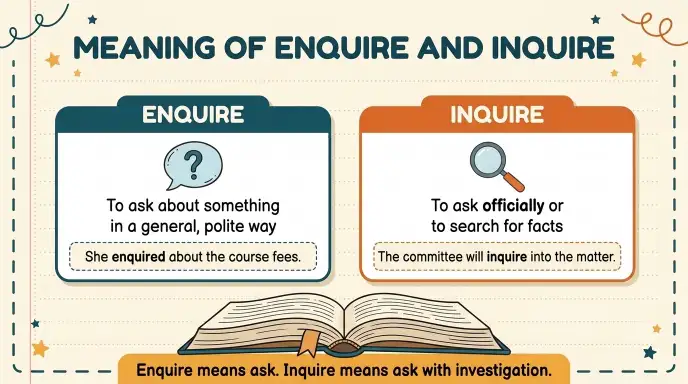
Both verbs mean to ask for information. The difference is the level of formality and the region.
Meaning of Enquire
Enquire means to ask a normal, everyday question. Customers, students, and travellers enquire in daily life. The tone is friendly and simple.
- I enquired about the price of the tickets.
- He enquired after her health.
Meaning of Inquire
Inquire also means to ask, but it carries a formal and careful feel. Official bodies, judges, and reporters inquire when they check facts in a serious way.
- The board inquired into the bank report.
- She inquired about the price at the desk.
That second example shows the overlap. In American English, inquire serves for simple questions too.
Verb Forms of Enquire and Inquire
Both verbs follow the same pattern. The past tense and the past participle have the same form.
| Verb | Past Tense | Past Participle | ing Form |
| Enquire | enquired | enquired | enquiring |
| Inquire | inquired | inquired | inquiring |
Watch the ing forms. The final e drops in both verbs, so the spellings are enquiring and inquiring. The middle part stays the same in every form: quire.
Where the Two Spellings Come From
Both verbs come from the Latin word inquirere, which means to seek after or to ask. The spelling with e came later, through French influence on English. Over time, British writers began to save enquire for everyday asking.
American English took a simpler path. It kept inquire as the main spelling for both everyday and formal asking. That is why the e form looks rare to American readers today.
Enquiry vs Inquiry: The Noun Pair
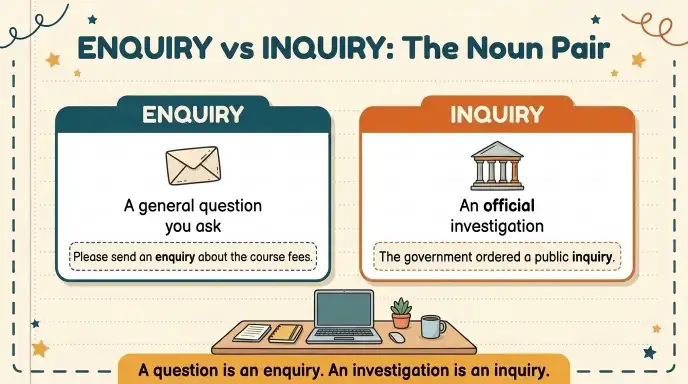
The nouns follow the same split as the verbs. Pick the noun that matches your verb, and your sentence will sound natural.
Enquiry for Everyday Questions
An enquiry is a simple question from a customer, a student, or a visitor. British shops and offices use this word every day.
- For sales enquiries, please call this number.
- She made an enquiry about the evening course.
Inquiry for Official Investigations
An inquiry is a formal and official check into a serious event. Governments set up inquiries after fires, crashes, and public scandals.
- The government ordered a public inquiry into the fire.
- The inquiry report came out last spring.
Note the fixed phrase. Standard style always writes public inquiry, never public enquiry, for an official investigation.
British English vs American English
| Point | British English | American English |
| Everyday asking | Enquire is common | Inquire is standard |
| Formal investigation | Inquire | Inquire |
| Noun for a question | Enquiry | Inquiry |
| Noun for an investigation | Inquiry | Inquiry |
| Example | She enquired about tickets | She inquired about tickets |
In short, British English uses both spellings with a split of duties. American English uses inquire and inquiry for nearly everything. The word enquire exists in American dictionaries, but readers rarely see it.
Which One Should You Use?
Answer three quick questions, in this order.
- Are you writing for American readers? Choose inquired and inquiry.
- Are you writing about a formal investigation or an official report? Choose inquire and inquiry.
- Are you writing a general question in British English? Enquire and enquiry are safe and natural.
Emails and Job Applications
In a British email, enquire sounds polite and normal: I am writing to enquire about the teaching post. In an American application, write inquire instead. Both sentences are polite, and only the region changes.
Customer Service
British firms deal with customer enquiries all day, from prices to delivery times. The word enquiry on a British contact page tells the reader that simple questions are welcome.
News and Police Reports
News style is formal, so reporters write inquire. You will read lines like this one: Police inquired into the cause of the crash. Committees and courts take inquire as well.
Academic and Research Writing
Careful study takes the formal form. Scholars inquire into a topic, and journals print inquiries. Follow your style guide, and stay with one spelling through the whole paper.
Helpful Prepositions With Enquire and Inquire
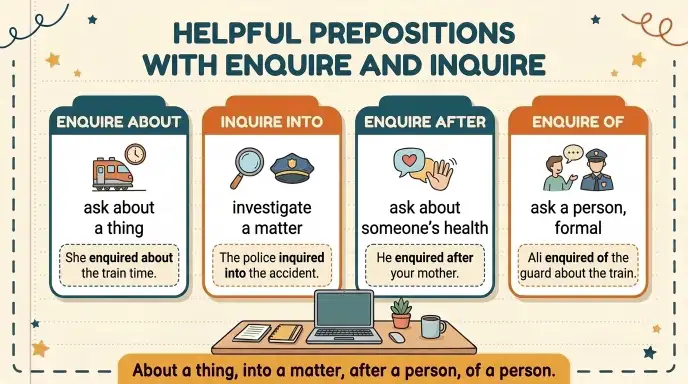
The small word after the verb changes the meaning. These four patterns cover most real sentences.
- enquire about: ask about a thing. She enquired about the bus times.
- inquire into: study or investigate a matter in a formal way. The panel inquired into the case.
- enquire after: ask about the health of a person. This is a warm British pattern, and it feels a little old fashioned. He enquired after your mother.
- enquire of: ask a person directly, in formal style. She enquired of the officer the way to the hall.
Common Mistakes With Enquired and Inquired
These four slips appear again and again in student work and office writing.
Using Enquired in American Formal Writing
American readers expect inquired in essays, reports, and job letters. The form enquired can look like a spelling slip to them. For American exams and formal posts, choose inquired every time.
Using Inquiry for a Simple Customer Question
In British business style, a simple question is an enquiry. A page that asks for customer inquiries sounds heavy and cold. It suggests investigations, not friendly questions about prices.
Mixing the Verb and Noun Forms
Keep the pairs together: enquire with enquiry, and inquire with inquiry. A mixed pair looks careless.
- Weak: She made an inquiry about the bus time.
- Better in British style: She made an enquiry about the bus time.
Small Spelling Slips
The slips inquiered and enqired are not real words. Both verbs hold the same middle part: quire. Write en quire and in quire in your mind, and the spelling stays safe.
Wrong vs Correct Examples
| Wrong | Correct | Why |
| I enquired about the job (US letter) | I inquired about the job | American standard spelling |
| A public enquiry into the crash | A public inquiry into the crash | Public inquiry is the fixed phrase |
| She inquiered about the fee | She enquired about the fee | The middle part is quire |
| Police are enquiring into the theft | Police are inquiring into the theft | Formal reports take inquire |
Everyday Examples of Enquired and Inquired
Real sentences make the rule easy to feel.
At a Shop or Station
- He enquired about the train times at the desk.
- I enquired about the price of the blue bag.
In an Email
- I am writing to enquire about your evening classes.
- American version: I am writing to inquire about the open position.
In News Reports
- The committee inquired into the hospital case.
- Police inquired into the cause of the crash last night.
A Memory Tip
Here is a tip, not a grammar rule: E for Everyday asking, I for Investigation. Say it once as you write. The first letter will pick the right word for you most of the time.
Quick Comparison Table
| Word | Use It For | Best Region | Example |
| enquired | General questions | British English | She enquired about the tickets |
| inquired | Formal questions and investigations | American and formal British | The police inquired into the case |
| enquiry | A simple question (noun) | British English | A customer enquiry |
| inquiry | An official investigation (noun) | Both regions | A public inquiry |
Key Takeaways
- Enquired is the past tense of enquire, the British choice for general questions.
- Inquired is the past tense of inquire, the formal and American choice.
- The traditional split still guides careful British writing today.
- Enquiry names a simple question, and inquiry names an official investigation.
- Public inquiry is a fixed phrase in standard style.
- American writers and learners should pick inquire and inquiry.
- Memory tip: E for Everyday asking, I for Investigation.
Frequently Asked Questions
1. Is enquired a correct word?
Yes, enquired is a fully correct word. It is the past tense of enquire, and British writers use it for general questions every day. It is not a spelling error, and American writers still prefer inquired, so pick the form that fits your readers and your region.
2. What is the difference between enquired and inquired?
The traditional difference is one of style. Enquired suits a general question, like asking about a price, and inquired suits a formal question or an official investigation. Modern usage overlaps, and dictionaries accept both for asking, but the old split remains the safest guide in careful writing.
3. Enquired or inquired in British English?
British English uses both forms. Choose enquired for everyday asking, as in she enquired about the tickets, and choose inquired for formal matters, as in the council inquired into the report. This split is the habit of British editors, newspapers, and exam boards.
4. Enquired or inquired in American English?
In American English, inquired is the standard choice for almost every sentence, simple or formal. The form enquired is rare, and many readers take it for a mistake. Learners who write for American readers, schools, or exams should use inquired and inquiry as their default pair.
5. Enquiry or inquiry, which noun should I use?
Use enquiry for a simple question in British English, like a customer enquiry about a price. Use inquiry for a formal investigation, like a public inquiry into a fire. American English uses inquiry for both jobs, so inquiry is the safe noun for American readers.
6. What is a public inquiry?
A public inquiry is an official investigation that a government sets up after a serious event, such as a fire, a train crash, or a public scandal. A chair leads the work, witnesses give evidence, and a report shares the findings. The phrase is fixed, so standard style always writes inquiry here.
7. Can I write “I enquired about the job”?
Yes, that sentence is correct and polite in British English. It suits letters and emails to British firms and schools. For an American company or an American exam, write I inquired about the job instead, since only the region changes the spelling there.
8. Is “inquired” used for simple questions too?
Yes, inquired works for simple questions as well, and this use is normal in American English, where a shopper can inquire about a price. British writers also accept it in formal writing. The traditional British habit saves enquired for such cases, but inquired never sounds wrong there.
9. Which spelling is best for exams and formal writing?
Match the spelling to the exam and the region. American tests expect inquire and inquiry, and British formal writing takes inquire for investigations and accepts enquire for general questions. In a mixed or unsure case, inquire is the safest single choice, since every style guide accepts it.
Conclusion
Enquired and inquired are both real words from the same root of asking. British English keeps a tidy split: enquire for an everyday question, and inquire for a formal investigation. American English keeps life simple and uses inquire for nearly everything.
Match the noun to the verb: enquiry with enquire, and inquiry with inquire. Remember the fixed phrase public inquiry for official work, and run the three step test when you feel stuck. Think of the tip as well: E for Everyday asking, I for Investigation.
That small choice also protects your tone. An enquiry feels open and friendly on a shop page, and an inquiry feels serious on a government page. Small words carry weight beyond their meaning, and careful readers feel that weight at once.
With this guide beside you, the pair will never slow your writing again. Pick the form that fits your reader, and your spelling will sound natural and sure. That is all this pair asks of you.
🔍 Find the Perfect Word:
Drunk or Drank: Correct Forms, Rules and Examples

Hi, I’m Ava Collins, a writer and English language enthusiast behind CorrectlyWritten. I’m passionate about making grammar simple, clear, and easy to understand. I write about grammar rules, confusing words, spelling, and everyday English usage to help readers write more accurately and confidently.



2 thoughts on “Enquired or Inquired: Correct Spelling, Meaning and Use”