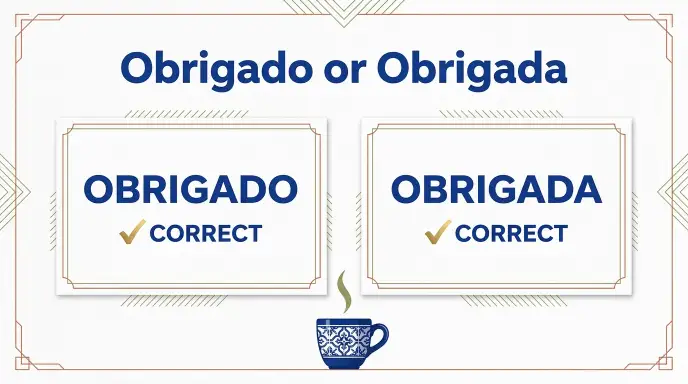
“Obrigado” and “obrigada” both mean “thank you” in Portuguese, but the correct form depends on the gender of the person saying it. A male speaker normally says obrigado, while a female speaker normally says obrigada. Cambridge Dictionary lists both forms and gives examples such as “Muito obrigado!” and “Muito obrigada!” for “Thank you very much.”
This difference can be confusing for English speakers because English does not normally change “thank you” based on the speaker’s gender. Portuguese works differently. The expression is connected to the adjective obrigado, meaning something like “obliged” or “grateful,” so its form can agree with the person speaking.
In this guide, you will learn exactly when to use obrigado or obrigada, if the rule changes in Brazil and Portugal, what muito obrigado means, how to pronounce each form, and what to say in everyday conversations.
Let’s start with the simple rule.
Obrigado or Obrigada: Quick Answer
Use “obrigado” if you are a man and “obrigada” if you are a woman when saying “thank you” in Portuguese. The difference is based on the speaker, not the person being thanked. Cambridge Dictionary provides both forms and examples for male and female speakers.
Examples:
- Man: Obrigado!
- Woman: Obrigada!
- Man: Muito obrigado!
- Woman: Muito obrigada!
So, if a woman is saying “thank you,” she would normally say obrigada, even when thanking another woman or a man.
If a man is speaking, he normally says obrigado, regardless of whom he is thanking.
Easy rule:
Male speaker : obrigado
Female speaker : obrigada
What Does Obrigado or Obrigada Mean?
Obrigado and obrigada are Portuguese expressions used to say “thank you.”
They can express gratitude after someone helps you, gives you something, compliments you, or does something kind for you. Cambridge Dictionary lists obrigado as an interjection meaning “thankful” or “obliged” and gives obrigada as the feminine form.
What does obrigado mean?
Obrigado is normally used by a male speaker.
For example:
Obrigado pela ajuda.
This means:
Thank you for the help.
What does obrigada mean?
Obrigada is normally used by a female speaker.
For example:
Obrigada pela ajuda.
This also means:
Thank you for the help.
The English translation is exactly the same. The difference appears in Portuguese because the expression changes form.
Does the person you thank affect the word?
No.
The form normally depends on the person saying thank you, not the person receiving the thanks.
For example:
- A man thanking a woman: Obrigado.
- A man thanking a man: Obrigado.
- A woman thanking a man: Obrigada.
- A woman thanking a woman: Obrigada.
This is one of the most important rules to remember.
Why Does Obrigado Change to Obrigada?
The difference comes from Portuguese grammatical agreement.
Historically, obrigado is related to the Portuguese adjective meaning “obliged” or “indebted.” Michaelis gives meanings including “obliged,” “grateful,” and “thank you,” while Priberam traces the word to the past participle of obrigar, meaning “to oblige.”
Because the expression developed from an adjective, its form can agree with the speaker.
The basic pattern is:
| Speaker | Form |
| Male | obrigado |
| Female | obrigada |
This is why you hear both forms in Portuguese.
A simple way to remember it
Think of the final letter:
Man : O : obrigado
Woman : A : obrigada
You do not need to change the word according to the gender of the person you are thanking.
Obrigado vs. Obrigada: Comparison
| Form | Who normally says it? | Meaning | Example |
| Obrigado | Male speaker | Thank you | Obrigado pela ajuda. |
| Obrigada | Female speaker | Thank you | Obrigada pela ajuda. |
| Muito obrigado | Male speaker | Thank you very much | Muito obrigado pela ajuda. |
| Muito obrigada | Female speaker | Thank you very much | Muito obrigada pela ajuda. |
The important point is that both forms are correct. Neither is a “more correct” version of the other.
British English vs. American English
There is no British:versus:American difference in the Portuguese forms obrigado and obrigada.
English speakers in the United States, United Kingdom, Canada, Australia, and other English:speaking countries can use the same Portuguese rule.
| English:speaking region | Male speaker | Female speaker | Meaning |
| United States | obrigado | obrigada | Thank you |
| United Kingdom | obrigado | obrigada | Thank you |
| Canada | obrigado | obrigada | Thank you |
| Australia | obrigado | obrigada | Thank you |
| International English | obrigado | obrigada | Thank you |
The important distinction is Portuguese grammar, not English regional spelling.
Cambridge’s Portuguese dictionary gives both obrigado and obrigada, with examples showing the forms used by male and female speakers.
Brazilian Portuguese vs. European Portuguese
The basic obrigado/obrigada distinction is used in both Brazilian Portuguese and European Portuguese.
You may hear differences in pronunciation, accent, vocabulary, and conversational style between Brazil and Portugal, but the basic gender agreement remains.
For example:
Brazilian Portuguese:
Obrigado!
European Portuguese:
Obrigada!
The speaker’s gender determines the form in both cases.
Priberam specifically notes that its Portuguese dictionary covers both European Portuguese and Brazilian Portuguese usage.
Which Version Should You Use?
The answer is simple.
If you are a man
Use:
Obrigado.
Example:
Obrigado pela informação.
If you are a woman
Use:
Obrigada.
Example:
Obrigada pela informação.
If you are learning Portuguese
Learn both forms together:
obrigado = male speaker
obrigada = female speaker
This prevents one of the most common mistakes English:speaking Portuguese learners make.
In formal situations
Both forms can be polite and appropriate.
For example:
Muito obrigado pela sua ajuda.
or
Muito obrigada pela sua ajuda.
You can use the appropriate form when speaking to a teacher, colleague, customer, official, or stranger.
In casual conversations
The same basic rule applies.
You can simply say:
Obrigado!
or:
Obrigada!
Common Mistakes

Mistake 1: A woman always saying obrigado
Incorrect for a female speaker:
Obrigado pela ajuda.
Standard form:
Obrigada pela ajuda.
Why?
A female speaker normally uses the feminine form obrigada.
Mistake 2: A man saying obrigada
Incorrect for a male speaker:
Obrigada pela ajuda.
Standard form:
Obrigado pela ajuda.
The male speaker normally uses obrigado.
Mistake 3: Choosing the word based on the listener
Some learners think they should say obrigada when thanking a woman.
That is not the rule.
For example, if a man thanks a woman:
Obrigado.
If a woman thanks a man:
Obrigada.
The form follows the speaker.
Mistake 4: Thinking one form is more polite
Neither obrigado nor obrigada is automatically more polite.
They are simply different grammatical forms used according to the speaker.
Memory tip
Remember:
The person saying “thank you” chooses the form.
Not the person receiving the thanks.
Everyday Examples
Example 1: Receiving a gift
Man:
Obrigado pelo presente!
Woman:
Obrigada pelo presente!
Both mean:
Thank you for the gift!
Example 2: Someone helps you
Man:
Muito obrigado pela ajuda.
Woman:
Muito obrigada pela ajuda.
Example 3: Someone gives you directions
Man:
Obrigado pela informação.
Woman:
Obrigada pela informação.
Example 4: In a restaurant
A waiter gives a woman her food.
Obrigada!
A man receives his food.
Obrigado!
Example 5: At work
A female employee receives an email with useful information:
Obrigada por enviar os documentos.
A male employee might write:
Obrigado por enviar os documentos.
Example 6: Social media
A woman may comment:
Obrigada por todo o apoio!
A man may write:
Obrigado por todo o apoio!
Example 7: After a compliment
Someone says:
Seu vestido é lindo!
A woman can reply:
Obrigada!
A man can reply:
Obrigado!
What Does Muito Obrigado or Muito Obrigada Mean?
Muito obrigado and muito obrigada mean “thank you very much.”
The word muito means “very” or “much,” while the form of obrigado/obrigada still depends on the speaker.
Examples:
- Male: Muito obrigado!
- Female: Muito obrigada!
Cambridge Dictionary gives these exact patterns in its Portuguese entry for obrigado.
You can use these expressions when you want to show stronger gratitude.
For example:
Muito obrigada pela sua ajuda.
means:
Thank you very much for your help.
Can You Say Obrigado to a Woman?
Yes, if the person saying it is a man.
For example, a man can say:
Obrigado!
to a woman who helped him.
The listener’s gender does not determine the form.
Likewise, a woman can say:
Obrigada!
to a man.
The speaker’s gender determines the usual form.
Can a Woman Say Obrigado?
In standard Portuguese usage, a female speaker normally says obrigada when using the traditional gender:agreement rule for “thank you.”
For example:
Obrigada por tudo.
This means:
Thank you for everything.
A male speaker would normally say:
Obrigado por tudo.
Some language discussions can involve variation in how speakers understand or use the expression, but for learners, female :obrigada is the clear standard rule to follow.
How Do You Pronounce Obrigado and Obrigada?
The pronunciation varies somewhat between Brazilian and European Portuguese.
In simplified English pronunciation, you might hear them roughly as:
obrigado: oh:bree:GAH:doo
obrigada: oh:bree:GAH:dah
The exact pronunciation depends on the Portuguese variety and the speaker’s accent.
The important difference for spelling is the final vowel:
- 😮 :obrigado
- :a : obrigada
If you are learning Portuguese, listening to native speakers is the best way to improve pronunciation.
Obrigado or Obrigada in Text Messages
The same rule applies in texting and online messages.
For example:
Male:
Obrigado 😊
Female:
Obrigada 😊
You can also use:
Muito obrigado!
or:
Muito obrigada!
The informal setting does not normally change the basic gender distinction.
Google Trends & Modern Usage
People search “obrigado or obrigada” because English uses one expression, “thank you,” while Portuguese commonly uses two gendered forms.
The question is therefore a natural language:learning search. People may encounter obrigado in Portuguese videos, travel conversations, songs, social media, or language lessons and then wonder why they sometimes see obrigada.
Dictionary evidence confirms that both forms are established. Cambridge lists obrigado and obrigada, while Priberam includes obrigado as an expression used to show gratitude.
There is no need to treat one spelling as a regional alternative to the other. The main difference is grammatical agreement with the speaker.
Search interest can also come from travelers preparing to visit Portuguese:speaking countries. Learning this one rule makes everyday conversations much easier.
Quick Comparison Table
| Version | Meaning | Correct? | Used by | Example |
| obrigado | Thank you | Yes | Male speaker | Obrigado pela ajuda. |
| obrigada | Thank you | Yes | Female speaker | Obrigada pela ajuda. |
| muito obrigado | Thank you very much | Yes | Male speaker | Muito obrigado! |
| muito obrigada | Thank you very much | Yes | Female speaker | Muito obrigada! |
| obrigados | Thank you, plural masculine/mixed context | Yes, in appropriate grammatical contexts | Plural speakers/context | Muito obrigados. |
| obrigadas | Thank you, plural feminine/context | Yes, in appropriate grammatical contexts | Female plural context | Muito obrigadas. |
Priberam also lists plural forms and identifies obrigado as an interjection used to express thanks.
Key Takeaways
- Obrigado and obrigada both mean “thank you.”
- A male speaker normally says obrigado.
- A female speaker normally says obrigada.
- The form depends on the speaker, not the person being thanked.
- Muito obrigado means “thank you very much” for a male speaker.
- Muito obrigada means “thank you very much” for a female speaker.
- The basic distinction applies in both Brazilian and European Portuguese.
- Remember: male :o, female :a.
FAQs
Q1. Can a woman say obrigado?
Yes, a woman can say obrigado in some contexts, especially when the word is used more broadly than the speaker’s gender. In Brazilian Portuguese, however, women commonly say obrigada.
Q2. Does a man say “obrigada” to a woman?
No, the speaker’s gender determines the usual form: a man says obrigado, while a woman says obrigada. The gender of the person being thanked does not change the word.
Q3. How does a girl say thank you in Portuguese?
A girl or woman usually says obrigada to mean “thank you” in Portuguese. A boy or man normally says obrigado.
Q4. Do Brazilians say “obrigado”?
Yes, obrigado is very commonly used in Brazil to say “thank you.” Women generally use obrigada, while men use obrigado.
Q5. Do Portuguese say “ciao”?
Yes, Portuguese speakers may understand and occasionally use ciao, especially in informal situations. However, adeus and tchau are more relevant Portuguese forms depending on the context.
Q6. How do you say “hi” in Portugal?
In Portugal, common ways to say “hi” include olá and informal greetings such as oi. Olá is the standard and widely understood option.
Q7. How to write “I love you” in Portugal?
In European Portuguese, “I love you” is written as Amo:te or Amo:te muito. Another common expression is Gosto muito de ti, depending on the context.
Q8. Do they say “oi” in Portugal?
Yes, people in Portugal can say oi, although olá is generally more common as a standard greeting. Usage can vary by region, age, and personal style.
Q9. Do Brazilians say “como vai”?
Yes, Brazilians understand and use como vai? to mean “how are you?” More casual alternatives include tudo bem? and como você está?.
Conclusion
When choosing between obrigado or obrigada, remember one simple rule: the speaker’s gender determines the form. A man normally says obrigado, while a woman normally says obrigada. Both mean “thank you,” and both are standard Portuguese expressions. Cambridge Dictionary confirms the use of both forms and gives separate examples for male and female speakers.
The difference can seem unusual to English speakers because English simply uses “thank you” without changing the expression according to the speaker. Portuguese, however, preserves the grammatical agreement found in the adjective from which the expression developed.
This rule works in everyday conversations, emails, messages, travel situations, business communication, and formal interactions. You do not need to change the word based on if you are thanking a man or a woman.
If you are a man, remember obrigado. If you are a woman, remember obrigada.
You May Also Like:
Mamma or Mama: Which Is Correct? Meaning, Spelling & Usage
Complements or Compliments: Which Word Is Correct?
Lendor or Lender: Which Spelling Is Correct? Meaning & Examples

Hi, I’m Ava Collins, a writer and English language enthusiast behind CorrectlyWritten. I’m passionate about making grammar simple, clear, and easy to understand. I write about grammar rules, confusing words, spelling, and everyday English usage to help readers write more accurately and confidently.








3 thoughts on “Obrigado or Obrigada: Which Is Correct? Meaning & Usage ”