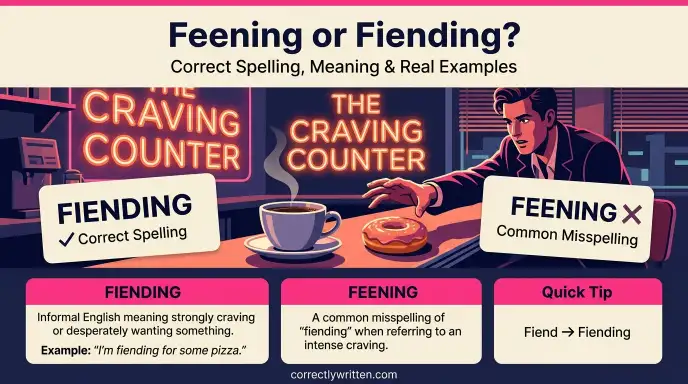
Feening or fiending? Use “fiending” in most writing, because it comes from the dictionary word “fiend.” “Feening” is a slang spelling that copies how people say the word aloud.
Both mean the same thing: craving something badly. You might say, “I am fiending for pizza.” Or, “I am feening for pizza.” People search this phrase because the two forms look so different, yet they sound the same. Song lyrics and social posts often use “feening,” while dictionaries lean on “fiend.” That mix leaves readers unsure.
This guide clears up the doubt. You will learn the meaning, the roots of the word, and how the two spellings differ in tone. You will also see British and American usage, common slips, real examples, and quick answers to common questions.
Read on, and you will know exactly which spelling fits your email, your caption, or your essay. The answer is short, and the reasons are easy to follow. Most readers finish in just a few minutes.
Feening or Fiending – Quick Answer
The Short Answer
Choose “fiending” for clear and safe writing. Choose “feening” for casual talk that copies speech. Both mean to want something very much.
Quick Examples
- Casual: I am feening for tacos tonight.
- Clear: She was fiending for coffee all morning.
- Formal: The team was craving a win.
- Incorrect: He was feigning for fries.
Feening and Fiending Meaning Explained
Clear Definition
To fiend or feen for something means to crave it strongly. It is a slang verb. The ing form shows the craving is happening right now.
Simple Meaning
Think of it as “wanting it badly.”
Context and Usage
You will hear the word in many everyday moments:
- Food: “I am feening for fries.”
- Drinks: “She is fiending for her morning coffee.”
- Sleep: “We are fiending for a long nap.”
- Entertainment: “Fans are feening for the next season.”
- Hobbies: “He is fiending to get back on the court.”
Other Meanings You May Hear
“Fiend” is also a noun. In older writing, it means an evil spirit or a cruel person. It can also describe a big fan, as in “coffee fiend” or “fitness fiend.” Long ago, people also used the word for someone tied to a harmful habit. Because of that history, be careful with the term in serious talks about health.
Where Feening and Fiending Come From
From Old English Enemy to Modern Craving
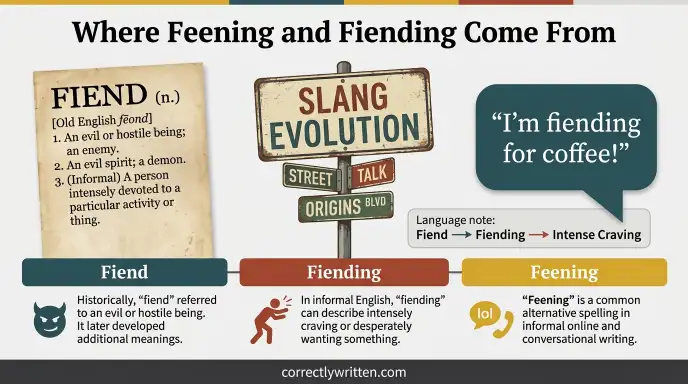
The story starts with the Old English word “feond.” It meant an enemy or a foe, and it grew from a root meaning “to hate.” Over time, it also came to mean a devil or evil spirit. By the late 1800s, people used “fiend” for a person with a strong habit or passion. Later, speakers turned the noun into a slang verb: to fiend for something.
Why Two Spellings Exist
The reason is sound. Say “fiend” out loud, and the last d often fades. It comes out close to “feen.” Slang is often written by ear, so people typed “feen,” “feenin’,” and “feening.” Many language writers link this spelling to Black American slang and hip hop. Social apps then spread it far and wide.
Feening or Fiending in British and American English
Regional Habits
No spelling rule splits the two countries here. Both write “fiend” the same way. The real difference is how often people use the slang. Americans use it more, while young speakers in the UK, Canada, and Australia have picked it up from music and social apps. Each region also has its own cousins. Americans may say “jonesing for,” and British speakers may say “gagging for.”
Side by Side Comparison
| Word Form | American English | British English | Note |
| fiend (noun) | fiend | fiend | Standard everywhere |
| fiending (verb) | Informal slang | Informal slang | Matches the root word |
| feening | Common in slang | Growing in slang | Matches the sound |
| feenin’ | Casual speech | Casual speech | Drops the g |
| Similar phrase | jonesing for | gagging for | Regional cousins |
Which Spelling Should You Use: Feening or Fiending?
For US Audiences
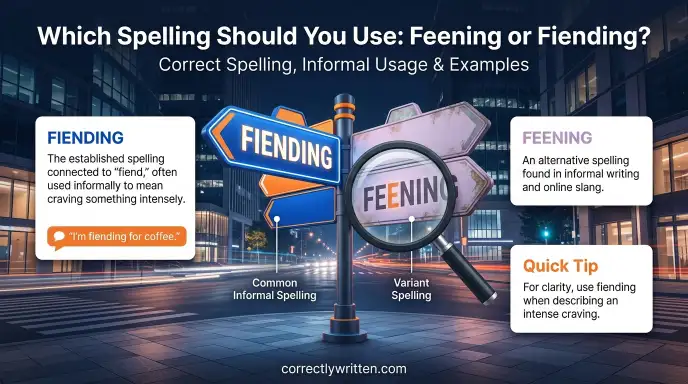
Texts, captions, and casual posts welcome “feening.” For blogs and articles, “fiending” looks cleaner. Readers can link it to the word “fiend.”
For UK and Commonwealth Audiences
The same advice works. Use “fiending” in writing and keep “feening” for quotes that copy speech. Some older readers may not know the slang at all.
For Global and Professional Audiences
Skip slang in business emails, school papers, and reports. Words like “craving” and “longing for” travel well across every country. Match your spelling to your readers, and your message will land.
Common Mistakes with Feening and Fiending
Frequent Errors and Fixes
| Mistake | Fix | Why |
| I am fiend for pizza. | I am fiending for pizza. | The verb needs ing. |
| He was feigning for fries. | He was feening for fries. | “Feign” means to pretend. |
| She fiened for candy. | She fiended for candy. | Add ed to the full word. |
| We are feening on snacks. | We are feening for snacks. | “For” is the usual partner. |
| They were feiending. | They were fiending. | Keep the letters in order. |
A Simple Memory Trick
Picture the letter i in “fiend” as “I need it now.” That small “i” sits right in the middle of the craving.
Feign, Fiend, and Friend: Sound Alike Words
“Feign” means to pretend, as in “feigning sleep.” It sounds close to “feening,” yet it has nothing to do with cravings.
Fiend and Friend Share a Twist
Both words keep the same “ie” pattern. Their roots are also linked to feelings. “Fiend” grew from an old word for hate, while “friend” grew from an old word for love.
Feening and Fiending in Everyday Examples
In Emails
- To a close coworker: “I am fiending for a coffee break. Want to join?”
- In a formal email: “I am looking forward to a short break.”
In News Writing
- “Fans are craving new music from the band.” (Formal news style)
- “Coffee fiends line up early each morning.” (Noun use)
On Social Media
- “Feening for a burger right now.”
- “Fiending for the weekend already.”
In Formal Writing
- “The children were longing for summer.”
- “She is a true tea fiend.” (Noun use, still friendly and clear)
Popularity Check: Google Trends and Usage Data
Popularity by Country
Google Trends lets you compare terms by country. Interest in “feening” tends to be strongest in the United States. It also shows up in Canada, the UK, and Australia. “Fiend” as a plain noun is steady in all of these places. Numbers change over time, so open the tool for the latest chart.
Popularity by Context
Context shapes the spelling. Social apps, music, and food posts lean on “feening.” Blogs and captions with a polished tone often choose “fiending.” News sites and schools mostly avoid the slang verb and pick “craving” instead.
Variations Side by Side
| Variation | Type | Tone | Example |
| fiend | Noun | Neutral | She is a coffee fiend. |
| fiending | Slang verb | Casual | He is fiending for snacks. |
| feening | Slang verb | Casual | We were feening for fries. |
| feenin’ | Speech spelling | Very casual | Feenin’ for a nap. |
| jonesing | Slang verb (US) | Casual | I am jonesing for pizza. |
| craving | Standard verb | Neutral | She is craving fries. |
| feigning | Different word | Neutral | He is feigning sleep. |
FAQs About Feening and Fiending
Q1. Is It Spelled “Feening” or “Fiending”?
Fiending is the standard spelling when you mean craving something intensely. Feening is an informal variant often used in slang.
Q2. What Does “Fiending” Mean?
Fiending means strongly craving or desperately wanting something. It can refer to food, attention, entertainment, or addictive substances.
Q3. Is “Feening” in the Dictionary?
“Feening” is used informally as a variant of “fiending.” However, fiending is the more widely recognized standard spelling.
Q4. Is It “Feigning” or “Feining”?
Feigning is the correct spelling. It means pretending or falsely presenting a feeling, condition, or behavior. Feining is a common misspelling.
Q5. What Does “I’m Feening” Mean?
“I’m feening” means “I’m craving something badly” or “I really want something.” For example, “I’m feening for pizza” means “I’m craving pizza.”
Q6. What Does “Feigning” Mean?
Feigning means pretending or acting as though something is true when it is not. For example, “He was feigning interest in the conversation.”
Q7. Does “Feigning” Mean Fake?
Yes, feigning can mean pretending or faking something. For example, “She was feigning happiness” means she was pretending to be happy.
Q8. What Does “Feining” Mean?
“Feining” is generally a misspelling of “feigning” or “fiending.” The correct spelling depends on the intended meaning.
Q9. What Is a Synonym for “Feigning”?
Synonyms for feigning include pretending, faking, acting, simulating, affecting, and dissembling.
Conclusion
Key Takeaways
Here is the plain answer to feening or fiending. Fiending is the safer spelling, because it comes from the dictionary word “fiend.” Feening is a slang spelling that copies how people speak. Both mean the same thing: to crave something very much.
The two forms differ in tone, not in meaning. Use “feening” in texts, captions, and casual chats, where readers know the slang. Use “fiending” when you want a clearer link to the root word. In school, business, and news writing, skip the slang and choose “craving” or “longing for.” That keeps your message clear for every reader.
Spelling does not change between British and American English here. Only the slang habits change, since the term is heard more often in the United States. Watch out for common slips such as “feigning,” which means pretending, and “fiend for” without the ing.
Remember the story behind the word. It began as an Old English term for an enemy and grew into a playful way to say you want something now. Keep your audience in mind, pick the form that fits, and your writing will stay clear, correct, and easy to read.
📌 Continue Your Journey:
Maxed or Maxxed: Correct Spelling, Meaning Everyday Explained
Rewound vs Rewinded: Correct Past Tense, Meaning & Examples
Momma or Mamma: Meaning, Spelling Differences ,Everyday Uses

Hi, I’m Ava Collins, a writer and English language enthusiast behind CorrectlyWritten. I’m passionate about making grammar simple, clear, and easy to understand. I write about grammar rules, confusing words, spelling, and everyday English usage to help readers write more accurately and confidently.








1 thought on “Feening or Fiending: Correct Spelling, Meaning & Usage Explained ”