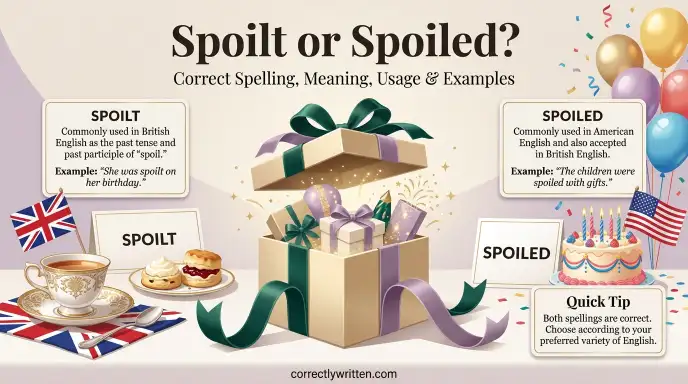
Spoilt and spoiled are both correct English spellings. Spoilt is especially common in British English, while spoiled is more common in American English. Both words can describe someone who receives too much special treatment, food that has gone bad, or something that has been ruined.
People often search for spoilt or spoiled because English uses two accepted forms of the past tense of spoil. The choice can depend on the type of English you use and the audience you are writing for. This difference can be confusing, especially for students, ESL learners, and writers who read both British and American content.
In this guide, you will learn the meaning of both words, their origins, regional differences, and correct usage. You will also find clear examples, common mistakes, practical writing advice, and answers to frequently asked questions.
Spoilt or Spoiled: Quick Answer
Both spoilt and spoiled are correct. They are the past tense and past participle forms of the verb spoil. British English often uses spoilt, while American English generally prefers spoiled. Both forms have the same basic meaning.
Examples:
- The child was spoiled by his grandparents.
- She was spoilt with beautiful birthday gifts.
- The hot weather spoiled our picnic.
You can use either spelling when the context is clear. For formal writing, choose the form that matches your audience and writing style.
What Does Spoilt or Spoiled Mean?
The words spoilt and spoiled come from the verb spoil. They have the same basic meanings, but their use depends on the context.
1. Spoilt or Spoiled as an Adjective for People
When someone is called spoilt or spoiled, it often means that they receive too many gifts, privileges, or favors. The word may suggest that the person expects special treatment or has become demanding.
Examples:
- The spoiled child refuses to share his toys.
- She is a spoilt daughter who gets everything she wants.
- His grandparents have spoiled him with expensive presents.
The word can sound negative when it describes selfish behavior. However, people also use it in a friendly or playful way.
2. Spoilt or Spoiled Food
Both forms can describe food that is no longer fresh or suitable for eating.
Examples:
- The milk has spoiled in the refrigerator.
- The fruit was spoilt by the extreme heat.
- We had to throw away the spoiled meat.
In British English, people often use gone off to describe food that is no longer fresh.
Example:
The milk has gone off.
3. Spoilt or Spoiled Plans
The verb spoil can also mean to ruin something or make an experience less enjoyable.
Examples:
- The rain spoiled our picnic.
- The loud music spoiled the movie.
- The unexpected news spoiled the surprise.
In these examples, spoiled and spoilt describe something that was damaged or ruined.
4. Spoilt or Spoiled With Kindness
The words can have a positive meaning when someone receives special care, attention, or affection.
Examples:
- My parents spoiled me on my birthday.
- We were spoilt with delicious food at the wedding.
- The hotel staff spoiled us with excellent service.
Here, the words express appreciation rather than criticism.
The Origin of Spoilt and Spoiled
Both spoilt and spoiled come from the English verb spoil.
The word spoil entered English through Anglo French and is related to the Latin word spolium, which referred to the goods or valuables taken from an enemy. Over time, the verb developed several meanings.
It came to describe the act of damaging something, ruining food, or treating someone with excessive generosity.
Why Are There Two Forms?
English has several verbs with more than one accepted past tense form. Spoil is one of them.
- Spoiled follows the regular pattern of adding ed.
- Spoilt is an alternative form that developed through older English usage.
Both forms became established in different varieties of English. Neither spelling is a modern mistake.
Today, regional language habits influence which form people prefer.
British English vs American English
British and American English use both forms, but their preferences can differ. The table below explains the most common patterns.
Regional Usage Comparison
| Feature | British English | American English |
| Common form | Spoilt and spoiled | Spoiled |
| Alternative form | Spoiled is also correct | Spoilt is understood but less common |
| Describing a child | A spoilt child | A spoiled child |
| Describing food | The food has spoiled | The food has spoiled |
| Describing a ruined event | The rain spoiled the day | The rain spoiled the day |
British English Usage
Spoilt is a familiar choice in British English, especially when describing a person who receives too many privileges or gifts.
Example:
He is a spoilt child.
However, spoiled is also correct in British English and appears in many types of writing.
American English Usage
American English generally prefers spoiled in everyday speech and writing.
Example:
She was spoiled by her parents.
The form spoilt is understandable to American readers, but it is less common in ordinary American usage.
Does the Meaning Change?
No. The basic meaning stays the same. The main difference is the spelling preference associated with different varieties of English.
Which Version Should You Use?
The best choice depends on your audience and the style of writing you are following.
United States
Use spoiled in most American writing.
- The child was spoiled by his parents.
- The food has spoiled.
- The surprise was spoiled.
This form is familiar to American readers.
United Kingdom
You can use either spoilt or spoiled. Spoilt is a natural choice in many British contexts, particularly when describing a person.
Example:
The children were spoilt by their grandparents.
Canada
Both forms are used in Canadian English. Spoiled is a common choice, while spoilt is also recognized.
Follow the spelling preferences of your school, workplace, or publication.
Australia
Australian English accepts both forms. Your choice may depend on the context and your personal writing style.
Consistency is important when writing for a broad audience.
International Writing
For an international audience, spoiled is a familiar and widely understood choice. Spoilt is also correct and works well in British influenced writing.
Academic Writing
Follow the spelling conventions required by your school, university, or publisher. Avoid switching between forms without a reason.
Business Writing
Choose the form that matches your organization’s preferred variety of English. Use clear language and consider the tone of your message.
Common Mistakes With Spoilt and Spoiled
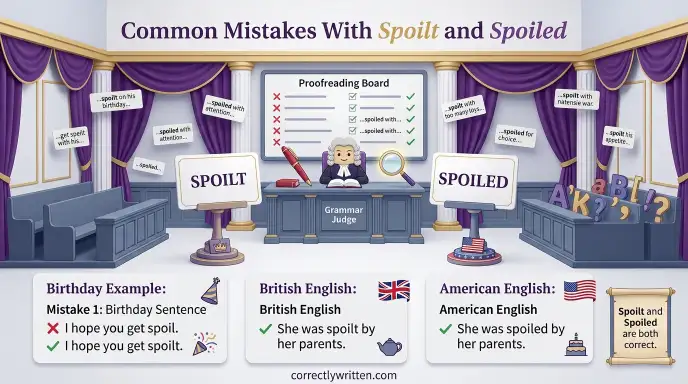
Understanding the difference between these forms can help you avoid mistakes in everyday writing.
Mistake 1: Thinking That Spoilt Is Wrong
Incorrect assumption:
Spoilt is not a real English word.
Correct explanation:
Spoilt is an accepted form of the verb spoil.
Why it matters: Both spellings are correct. The choice often depends on regional preference.
Memory tip: Remember that spoilt is a traditional alternative to spoiled.
Mistake 2: Using Spoiled as a Noun
Incorrect:
He is a spoiled.
Correct:
He is a spoiled child.
Explanation: In this sentence, spoiled is an adjective. It describes the noun child.
You can also say:
He is spoiled.
Here, the adjective comes after the verb is.
Mistake 3: Using the Wrong Verb Form
Incorrect:
The rain has spoiling our plans.
Correct:
The rain has spoiled our plans.
Explanation: After has or have, you need the past participle spoiled or spoilt.
Mistake 4: Assuming Spoiled Always Has a Negative Meaning
Incorrect assumption:
Spoiled always means badly behaved.
Correct understanding:
Spoiled can also describe someone who receives loving care or special treatment.
Examples:
- My family spoiled me on my birthday.
- The spoiled child refused to listen.
The context determines the meaning.
Mistake 5: Mixing Spelling Styles Without a Reason
Example:
The child was spoilt, but the food was spoiled.
Explanation: This sentence is not grammatically wrong. However, writers who prefer a consistent regional style may choose one form throughout their work.
Memory tip: Select a spelling style and use it consistently.
Spoilt or Spoiled in Everyday Examples
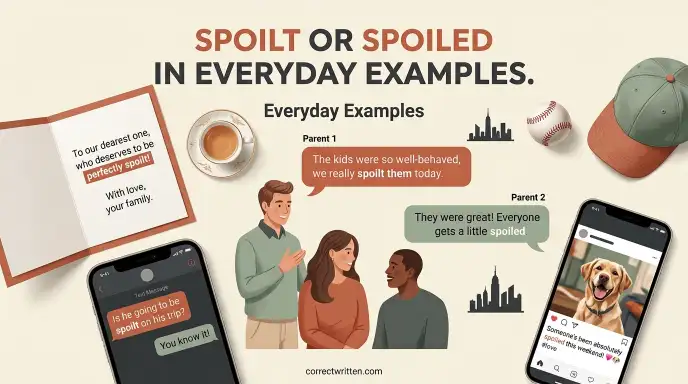
Here are practical examples of both forms in different situations.
Emails
Thank you for spoiling us with such a thoughtful gift.
We were truly spoilt during our stay at your hotel.
Both sentences express appreciation.
Business Writing
The delay spoiled an otherwise successful event.
The goods were spoiled during transportation.
In professional communication, choose the spelling that matches your organization’s style.
News Headlines
Heavy Rain Spoils Weekend Events
Local Families Spoiled by Generous Community Donations
Headlines often use short and direct language. The preferred spelling depends on the publication.
Blog Writing
Five Ways to Avoid Spoiled Food
How to Tell If Your Child Is Becoming Spoilt
Blog writers should choose words that feel natural to their intended readers.
Social Media
My friends spoiled me on my birthday!
We were so spoilt during our vacation.
Both forms work well in informal posts.
Academic Writing
Excessive rewards may cause children to become spoiled.
The researchers examined how spoiled food contributes to household waste.
Use precise language and follow your institution’s writing guidelines.
Daily Conversation
You have spoiled me with all these gifts!
The kids are getting spoilt by their grandparents.
I think the heat has spoiled the fruit.
These examples show how the words can express affection, criticism, or damage.
Google Trends and Modern Usage
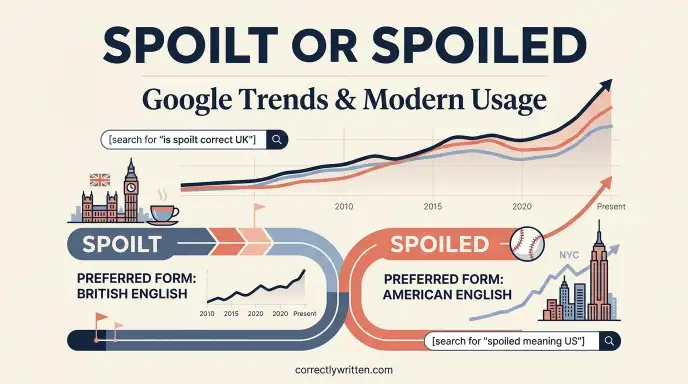
People search for spoilt or spoiled because English has two accepted forms of the past tense of spoil. The difference is especially noticeable when readers encounter British and American content.
General language patterns show that:
- Spoiled is especially familiar to American English speakers.
- Spoilt is strongly associated with British English.
- Both forms appear in international writing.
- Readers may be unsure which spelling to use when writing for another country.
Search interest does not always show how frequently a word is used in everyday writing. A person may search for a spelling comparison because they encountered an unfamiliar form, not because the word is rare.
For practical writing, choose a consistent style that suits your audience. Both forms are valid.
Quick Comparison Table
Spoilt vs Spoiled
| Version | Meaning | Correct? | Region | Example |
| Spoilt | Past tense or past participle of spoil | Yes | Common in British English | She was spoilt by her family. |
| Spoiled | Past tense or past participle of spoil | Yes | Common in American English | She was spoiled by her family. |
| Spoil | Base form of the verb | Yes | All major varieties | Do not spoil the surprise. |
Key Takeaways
- Spoilt and spoiled are both correct English forms.
- Spoilt is especially common in British English.
- Spoiled is generally preferred in American English.
- Both words can describe people, food, and ruined experiences.
- The meaning depends on the context.
- British writers can use either spelling.
- American writers usually prefer spoiled.
- Consistency is important in formal writing.
Frequently Asked Questions
Q1. Is a Person “Spoilt” or “Spoiled”?
Both spoilt and spoiled are correct. Spoiled is more common in American English, while spoilt is widely used in British English.
Q2. Is It “Spoiled” or “Spoilt” on Your Birthday?
Both forms are correct. You can say, “I hope you get spoiled on your birthday” or “I hope you get spoilt on your birthday.”
Q3. What Is a Spoilt Person?
A spoilt person is someone who is given too much attention, kindness, or too many gifts and may expect special treatment from others.
Q4. Is It “Hope You Get Spoilt” or “Hope You Get Spoiled”?
Both are grammatically correct. Use “spoiled” in American English and “spoilt” in British English.
Q5. What Does “Spoilt” Mean?
Spoilt means treated with excessive care, attention, or gifts. It can also describe food that has gone bad, such as “spoilt milk.”
Q6. Is Being Spoilt a Bad Thing?
Not always. Being spoilt can mean receiving love, care, or thoughtful gifts. However, it can have a negative meaning when someone becomes demanding or entitled.
Q7. Is “Spoiled” an Insult?
It depends on the context. Calling someone spoiled can be affectionate, but it may also be an insult if it suggests that the person is selfish or entitled.
Q8. What Is a Spoiled Girl Called?
A spoiled girl may be called a spoiled girl, pampered girl, or brat, depending on the context. “Brat” is more negative and suggests bad behavior.
Q9. What Does “Spoil a Girl” Mean?
To spoil a girl means to treat her with extra love, care, attention, gifts, or special experiences. It can be romantic, friendly, or simply affectionate.
Conclusion: Spoilt or Spoiled?
Spoilt and spoiled are both correct forms of the verb spoil. They can describe someone who receives excessive attention, food that has gone bad, or an experience that has been ruined. The main difference is regional preference, not meaning.
British English often uses spoilt, especially when describing a person who receives too much special treatment. American English generally favors spoiled. However, both forms are accepted in British, Canadian, Australian, and international writing.
If you are writing for an American audience, spoiled is usually the natural choice. For a British audience, spoilt can fit the local style, although spoiled is also correct. In academic and professional writing, follow the spelling rules of your institution or organization.
The most important point is to understand the context. Someone can be spoiled by gifts, spoiled by kindness, or spoiled by bad weather. The meaning changes with the sentence.
Remember: Both spellings are correct, so choose the form that suits your readers and use it consistently.
For more helpful spelling and word meaning guides, explore correctlywritten.com.

Hi, I’m Ava Collins, a writer and English language enthusiast behind CorrectlyWritten. I’m passionate about making grammar simple, clear, and easy to understand. I write about grammar rules, confusing words, spelling, and everyday English usage to help readers write more accurately and confidently.








2 thoughts on “Spoilt or Spoiled: Meaning, British vs American English & Examples”