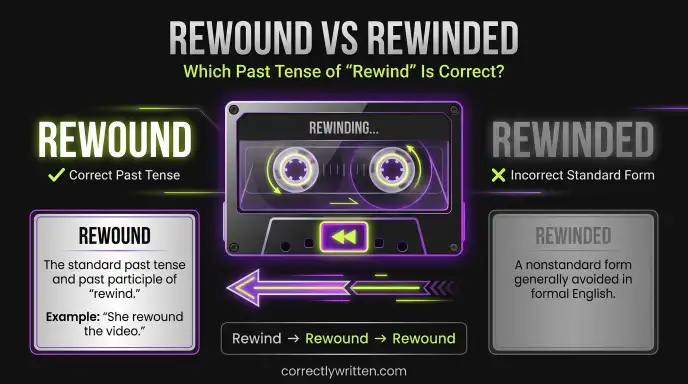
Have you ever wondered if the past tense of rewind is rewound or rewinded? The correct past tense and past participle of rewind is rewound. Although some people use rewinded, it is not the standard form in modern English.
The verb rewind means to move something backward, such as a video, audio recording, tape, or story. It can also mean reviewing an earlier event or returning to a previous point in time.
In this guide, you will learn the difference between rewound and rewinded, understand how to use rewind correctly, and explore clear examples from everyday English.
Quick Answer: Rewound vs Rewinded
The correct past tense of rewind is rewound, not rewinded.
- Present tense: Rewind
- Past tense: Rewound
- Past participle: Rewound
- Incorrect form: Rewinded
Example
- Correct: I rewound the video to watch that scene again.
- Incorrect: I rewinded the video to watch that scene again.
The word rewound is used in standard English for both the simple past tense and the past participle.
Rewound or Rewinded: Which Form Is Correct?
Rewound is the standard and correct past form of rewind. It is an irregular verb form, so it does not follow the usual pattern of adding ed.
Many English verbs form their past tense by adding ed:
- Walk : Walked
- Open : Opened
- Watch : Watched
- Clean : Cleaned
However, some verbs have irregular past forms:
- Find : Found
- Write : Wrote
- Take : Took
- Wind : Wound
- Rewind : Rewound
Because rewind is formed from the verb wind, it follows the same irregular pattern.
Correct Forms of Rewind
| Verb Form | Word | Example |
| Base form | Rewind | Please rewind the recording. |
| Third-person singular | Rewinds | She rewinds the tape. |
| Present participle | Rewinding | He is rewinding the video. |
| Simple past | Rewound | We rewound the film. |
| Past participle | Rewound | She has rewound the tape. |
What Does Rewind Mean?
Rewind is a verb that means to move a recording, tape, video, or audio track backward to an earlier point.
In the past, people commonly used the word rewind when they wanted to move a cassette tape or videotape back. Today, the word is still used for digital videos, podcasts, voice recordings, and online media.
Simple Meaning
To rewind means:
- To go backward in a recording
- To return to an earlier part of a video or audio file
- To review something that happened earlier
- To mentally revisit a past event
Examples
- Please rewind the video.
- I had to rewind the podcast because I missed an important point.
- Can you rewind the movie by two minutes?
- She likes to rewind old family memories in her mind.
The meaning depends on the context. It can refer to a physical recording, a digital file, or a figurative return to the past.
The Origin of Rewound
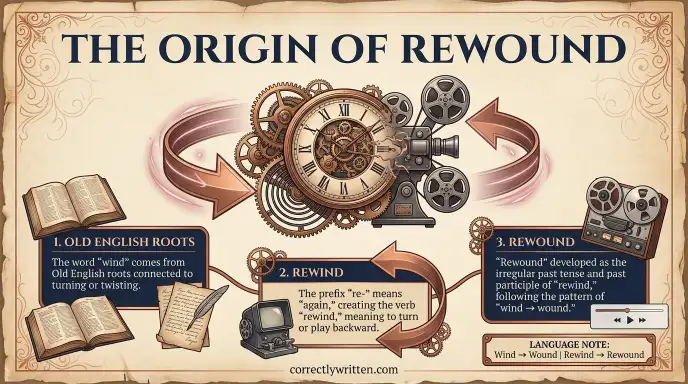
The word rewind comes from the verb wind, which means to turn, twist, or wrap something around an object.
The prefix re means “again” or “back.” Therefore, rewind originally referred to winding something back to its earlier position.
The verb wind has an irregular past tense:
Wind : Wound
When the prefix re is added, the same pattern remains:
Rewind : Rewound
This is why rewound is correct instead of rewinded.
The spelling can be confusing because many English verbs form their past tense with ed. However, rewind follows the irregular pattern of wind.
Why Is Rewound Correct Instead of Rewinded?
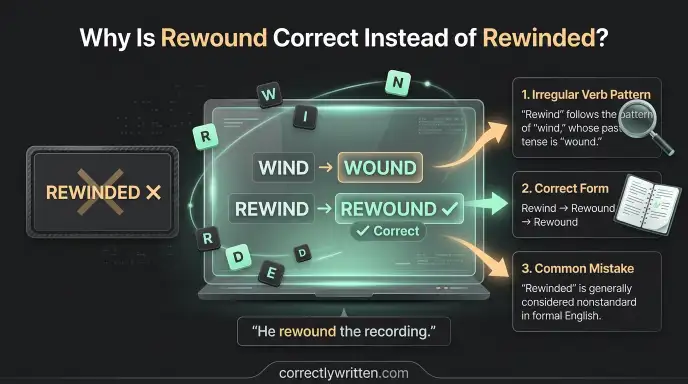
The main reason is that rewind is an irregular verb.
Regular verbs usually form their past tense by adding ed. Irregular verbs, however, change their spelling or use a different form.
For example:
- Begin : Began
- Break : Broke
- Choose : Chose
- Speak : Spoke
- Wind : Wound
- Rewind : Rewound
The form rewinded may seem logical, but it is not the accepted standard form for ordinary English writing and speech.
A Helpful Comparison
| Base Verb | Correct Past Form | Incorrect Form |
| Wind | Wound | Winded |
| Rewind | Rewound | Rewinded |
Note that winded can be a correct word in another context. For example, I felt winded after running. However, it is not the ordinary past tense of wind when the verb means “to turn or wrap.”
Rewound in American and British English
Both American English and British English use rewound as the standard past tense and past participle of rewind.
There is no major spelling difference between the two varieties in this case.
| English Variety | Past Tense | Past Participle |
| American English | Rewound | Rewound |
| British English | Rewound | Rewound |
| Canadian English | Rewound | Rewound |
if you are writing for an American, British, Canadian, or international audience, rewound is the appropriate choice.
How to Use Rewound in a Sentence
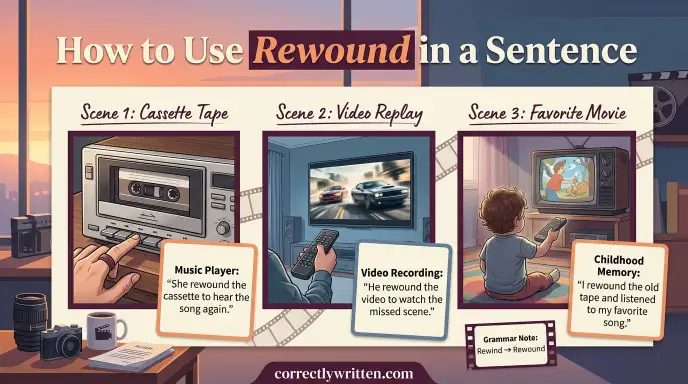
The word rewound can be used when talking about an action that happened in the past. It can also appear after helping verbs such as has, have, and had.
Rewound as a Simple Past Verb
Use rewound when an action happened in the past.
Examples:
- I rewound the video to hear the speaker again.
- She rewound the cassette before returning it.
- We rewound the movie to watch the final scene.
- He rewound the audio clip several times.
- They rewound the recording after missing the announcement.
Rewound as a Past Participle
Use rewound with has, have, or had.
Examples:
- I have rewound the video twice.
- She has rewound the recording.
- They had rewound the tape before the machine stopped.
- He has already rewound the podcast.
- We had rewound the film to check the details.
Rewound in a Figurative Sense
You can also use rewound when describing memories or past events.
Examples:
- Her mind rewound the events of that difficult day.
- He mentally rewound the conversation.
- The documentary rewound the story to explain what happened earlier.
- She wished she could rewind time and make a different decision.
In these examples, rewound does not describe a physical recording. It describes returning to an earlier moment or reviewing something from the past.
Common Mistakes With Rewind
Many learners use rewinded because they believe that every verb forms its past tense with ed. This is a common mistake with irregular verbs.
Mistake 1: Using Rewinded as the Past Tense
Incorrect:
I rewinded the video last night.
Correct:
I rewound the video last night.
Mistake 2: Using Rewinded After Have or Has
Incorrect:
She has rewinded the recording.
Correct:
She has rewound the recording.
Mistake 3: Confusing Rewind With Winded
The words rewound and winded have different meanings.
- Rewound: Moved something backward or returned to an earlier point.
- Winded: Made someone short of breath or exhausted.
Examples:
- I rewound the video.
- The long walk left me winded.
Mistake 4: Using the Wrong Present Form
The present participle of rewind is rewinding, not rewindding.
Correct:
- He is rewinding the film.
- She was rewinding the tape.
The final consonant is not doubled.
Rewound or Rewinded in Everyday Examples
Here are some practical examples to help you understand the correct usage.
Conversations
- “Can you rewind that part?”
- “I rewound it, but I still could not hear the words.”
- “I have already rewound the clip.”
- “Please rewind the message.”
Emails
- “I rewound the training video and reviewed the instructions again.”
- “The recording has been rewound to the beginning.”
- “I rewound the presentation to check the speaker’s explanation.”
School and Education
- The student rewound the online lecture to review the difficult topic.
- I have rewound the lesson several times to understand the formula.
- The teacher rewound the video and explained the example again.
Entertainment
- She rewound the movie to watch the opening scene.
- He rewound the song to listen to his favorite line.
- We rewound the television recording after missing an important moment.
Technology
- The user rewound the audio file.
- I have rewound the video to the previous section.
- The application automatically rewound the recording.
Creative Writing
- His thoughts rewound to the day they first met.
- The story rewound to reveal an important detail.
- She wished she could rewind the last few minutes.
Rewound vs. Rewinded: Quick Comparison
| Feature | Rewound | Rewinded |
| Spelling | Correct | Nonstandard and generally incorrect |
| Verb type | Irregular verb form | Incorrect regularized form |
| Past tense | Yes | No, in standard English |
| Past participle | Yes | No, in standard English |
| Example | I rewound the video. | I rewinded the video. |
Rewind in Different Verb Tenses
Understanding the different forms of rewind can help you avoid grammatical mistakes.
| Tense | Example |
| Simple present | I rewind the video. |
| Present continuous | I am rewinding the video. |
| Simple past | I rewound the video. |
| Present perfect | I have rewound the video. |
| Past perfect | I had rewound the video. |
| Future | I will rewind the video. |
These examples show that rewound is used for both the simple past and perfect tenses.
Is Rewinded Ever Used?
You may occasionally see or hear rewinded, especially in informal speech, online writing, or learner generated content. People sometimes create rewinded by applying the regular ed pattern to rewind.
However, rewound is the established standard form. In professional writing, academic work, website content, emails, and formal communication, you should use rewound.
The occasional appearance of rewinded does not make it the preferred form.
Recommended Usage
Use:
The video was rewound to the beginning.
Avoid:
The video was rewinded to the beginning.
Frequently Asked Questions
Q1. Is “Rewinded” Grammatically Correct?
No, “rewinded” is generally incorrect in standard English. The correct past tense and past participle of rewind is “rewound.”
Q2. Is It “Rewinded” or “Rewound”?
Rewound is the correct form. For example: “She rewound the video to watch the scene again.”
Q3. What Is the Meaning of “Rewound”?
Rewound means played, turned, or moved backward to an earlier point. It is the past tense of rewind.
Q4. What Is “Rewinded”?
“Rewinded” is a common but generally incorrect form of rewound. Use rewound in formal and standard English writing.
Q5. Is “Rewinded” a Word?
“Rewinded” may appear in informal speech or writing, but it is not the standard past tense of rewind. The correct word is rewound.
Q6. Is It “Winded” or “Rewound”?
Winded and rewound have different meanings. “Winded” can mean out of breath, while “rewound” means moved or played backward.
Q7. Is It “Rewind” or “Rewound”?
Use rewind for the present tense or base form and rewound for the past tense. Example: “Please rewind the video.” “I rewound the video.”
Q8. What Is Another Word for “Rewind”?
Depending on the context, synonyms for rewind include reverse, replay, go back, review, and return to an earlier point.
Q9. What Does “Rewind” Mean in Slang?
In slang, rewind can mean asking someone to repeat something or go back to a previous moment. For example, “Rewind that!” means “Say or show that again.”
Key Takeaways
- Rewound is the correct past tense of rewind.
- Rewound is also the correct past participle.
- Rewinded is not the standard form in modern English.
- Rewind is an irregular verb because it follows the pattern of wind.
- Use rewound in formal writing, academic work, emails, and everyday communication.
- The word can describe physical recordings or figurative memories.
Conclusion
The correct past tense and past participle of rewind is rewound. The form rewinded may seem logical because many English verbs take the ed ending, but rewind is an irregular verb. It follows the same pattern as wind, whose past form is wound.
Use rewind for the present tense, rewinding for the present participle, and rewound for both the simple past and past participle.
For example, you can say, “I rewound the video,” or “She has rewound the recording.” These forms are correct in both British and American English.
Whenever you are unsure, remember this simple rule:
Rewind : Rewound, not Rewinded.
🔍 Find the Perfect Word:
Momma or Mamma: Meaning, Spelling Differences ,Everyday Uses
Snowboarding vs Skiing: Key Difference, Skills, Beginner Tips
Ditto or Diddo? Correct Spelling, Meaning, Usage & Real Examples

Hi, I’m Ava Collins, a writer and English language enthusiast behind CorrectlyWritten. I’m passionate about making grammar simple, clear, and easy to understand. I write about grammar rules, confusing words, spelling, and everyday English usage to help readers write more accurately and confidently.








2 thoughts on “Rewound vs Rewinded: Correct Past Tense, Meaning & Examples ”