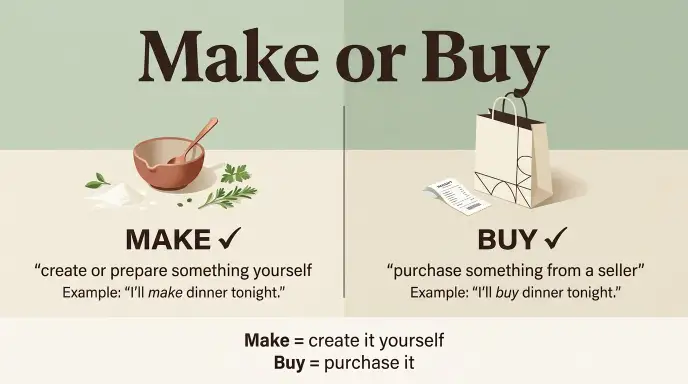
Make or buy is a business decision about if a company should produce something itself or purchase it from an outside supplier.
For example, a company may need packaging for its products. It can make the packaging in:house or buy it from another company. The better choice depends on cost, quality, time, skills, resources, and business goals.
The phrase is common in business, accounting, manufacturing, supply chain management, and procurement. It is also called a make:or:buy decision.
The basic question is simple:
Should we make it ourselves, or should we buy it from someone else?
A good decision looks at more than the purchase price. A company must also consider labor, equipment, storage, quality control, delivery time, supplier reliability, and long:term effects.
This guide explains what make or buy means, how the decision works, its advantages and disadvantages, and practical examples.
Make or Buy: Quick Answer
Make or buy means deciding if to produce a product, part, or service internally or purchase it from an outside supplier.
A company may choose to make something when it has the skills, equipment, capacity, and resources to produce it efficiently.
It may choose to buy when an outside supplier can provide it at a lower cost, better quality, or faster speed.
The decision should consider both financial and non:financial factors.
What Does Make or Buy Mean?
The phrase make or buy describes a choice between two options:
- Make: Produce the item or service internally.
- Buy: Purchase the item or service from an external supplier.
The phrase is especially common in business discussions.
For example:
The company is reviewing its make:or:buy decision for product packaging.
This means the company is deciding if to produce the packaging itself or purchase it from another business.
What is a make:or:buy decision?
A make:or:buy decision is the process of comparing the benefits and costs of making something internally with the benefits and costs of buying it externally.
Businesses use this process when they want to control costs, improve efficiency, protect quality, or use their resources more effectively.
Make or buy in simple words
In simple terms:
Make = Do it yourself.
Buy = Get it from another company.
The choice is not always about finding the cheapest option. A company also needs to consider quality, reliability, capacity, and strategy.
Why Do Businesses Use Make:or:Buy Decisions?
Businesses make these decisions because resources are limited.
A company may have talented employees but limited production space. Another company may have excellent equipment but expensive labor.
The make:or:buy approach helps managers compare their options before making a decision.
Common reasons include:
- Reducing costs
- Improving product quality
- Saving time
- Increasing production capacity
- Accessing specialist skills
- Reducing business risk
- Improving supply reliability
- Focusing on core activities
- Avoiding unnecessary equipment costs
A good decision balances these factors instead of looking at only one number.
Make or Buy: How Does the Decision Work?
A basic make:or:buy analysis follows a few simple steps.
1. Identify what needs to be produced or purchased
First, the business identifies the exact product, component, or service.
For example, a manufacturer may need 10,000 plastic components each month.
2. Calculate the cost of making it
The company estimates the relevant costs of internal production.
These may include:
- Direct materials
- Direct labor
- Variable production costs
- Additional equipment
- Maintenance
- Utilities
- Quality control
3. Calculate the cost of buying it
The company then gets supplier prices.
The purchase cost may include:
- Supplier price
- Shipping
- Insurance
- Inspection
- Import costs
- Storage
- Other purchasing expenses
4. Compare the two options
The company compares the relevant costs and benefits.
But cost should not be the only consideration.
5. Consider non:financial factors
Managers should also ask:
- Is the supplier reliable?
- Can we maintain the required quality?
- Do we have enough production capacity?
- Can we meet the deadline?
- Will buying create supply:chain risks?
- Is the product strategically important?
6. Choose the better option
After reviewing the information, the company chooses the option that best supports its financial and business goals.
Make or Buy Example
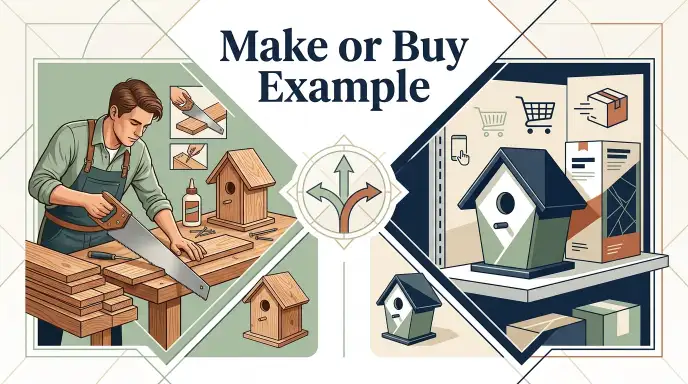
Imagine a company needs 5,000 parts.
The company can make the parts internally for $8 per unit.
An outside supplier offers the same parts for $7 per unit.
At first, buying appears cheaper.
The company should not stop there.
It should ask if the $8 internal cost includes costs that will continue even if production stops.
For example, some factory rent or permanent employee salaries may remain unchanged.
This is why a proper make:or:buy analysis focuses on relevant costs, not simply every cost shown in the accounting records.
Simple calculation
If the relevant internal cost is $8 per unit:
5,000 × $8 = $40,000
If the supplier price is $7 per unit:
5,000 × $7 = $35,000
The apparent difference is:
$40,000 − $35,000 = $5,000
So buying could save $5,000 if the costs are truly comparable.
However, quality, delivery, supplier reliability, and other factors still need to be considered.
Make or Buy Formula
A simple cost comparison can be written as:
Total Make Cost = Relevant Fixed Costs + Variable Costs
Total Buy Cost = Purchase Price + Additional Buying Costs
Then compare the two totals.
If:
Make Cost < Buy Cost
making may be financially attractive.
If:
Buy Cost < Make Cost
buying may be financially attractive.
However, the lowest cost does not automatically mean the best business decision.
Make or Buy Decision: Advantages of Making
Producing something internally can offer several benefits.
Better control
A company has more direct control over production.
It can monitor:
- Quality
- Production schedules
- Materials
- Manufacturing methods
Greater customization
Internal production can make it easier to change a product or component to meet specific requirements.
Protection of knowledge
If a product depends on valuable technical knowledge, making it internally may help protect that knowledge.
Less supplier dependence
The company does not have to rely completely on an external supplier.
This can be useful when supply interruptions would seriously affect operations.
Better use of existing resources
If the company already has unused equipment and employees, internal production may make good use of those resources.
Make or Buy Decision: Disadvantages of Making
Making something internally also has risks.
Higher production costs
Internal production may be more expensive than buying from a specialized supplier.
Equipment investment
The company may need to purchase machinery or technology.
More management work
Internal production requires employees, planning, maintenance, quality control, and supervision.
Limited capacity
A company may not have enough space, equipment, or workers to produce everything it needs.
Greater operational responsibility
The company becomes responsible for solving production problems itself.
Make or Buy Decision: Advantages of Buying
Buying from an outside supplier can also offer important benefits.
Lower costs
Specialized suppliers may produce large quantities at lower costs.
Faster production
An experienced supplier may already have the equipment and processes needed.
Access to expertise
A supplier may have specialist knowledge that the company does not have internally.
Flexible capacity
Buying can help a business meet increased demand without investing heavily in new equipment.
Focus on core activities
Outsourcing non:core work allows a company to focus on what it does best.
Make or Buy Decision: Disadvantages of Buying
Buying is not always the better option.
Supplier dependence
The business becomes dependent on another company.
Quality problems
The supplier may not maintain the required quality level.
Delivery risks
Late shipments can interrupt production or customer deliveries.
Less control
The company has less direct control over the supplier’s production process.
Price changes
A supplier may increase prices in the future.
Confidentiality concerns
Outsourcing certain activities can create risks if the work involves sensitive designs or business information.
Make vs. Buy: Quick Comparison
| Factor | Make | Buy |
| Production control | High | Lower |
| Supplier dependence | Low | Higher |
| Initial investment | May be high | Usually lower |
| Customization | Often easier | Depends on supplier |
| Specialist expertise | Must exist internally | Can be purchased |
| Production capacity | Limited by internal resources | Supplier capacity helps |
| Quality control | Direct | Shared with supplier |
| Flexibility | Can be high | Depends on contract |
| Supply risk | Lower supplier risk | Higher supplier dependence |
| Management effort | Usually higher | Usually lower |
Financial Factors in a Make or Buy Decision
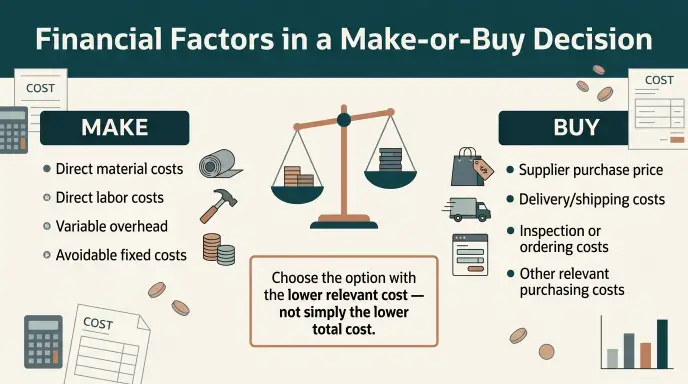
Cost is one of the most important factors.
However, businesses should use relevant costs.
Variable costs
Variable costs change with production volume.
Examples include:
- Materials
- Direct labor
- Packaging
- Production supplies
These costs are usually important in the comparison.
Avoidable fixed costs
Some fixed costs may disappear if the company stops making the product.
For example, a machine may be leased only for producing a specific component.
If the company stops production, that lease may end.
This cost is relevant.
Unavoidable fixed costs
Some costs continue even if production stops.
For example, general factory rent may remain the same.
Such costs may not affect the short:term make:or:buy decision.
Opportunity cost
Opportunity cost is also important.
Suppose making a component uses a machine that could instead produce another product.
The profit that could have been earned from the other product becomes an opportunity cost of making the component.
This can change the final decision.
Non:Financial Factors to Consider
Money is only one part of the decision.
Quality
Will the supplier meet the company’s quality standards?
Reliability
Can the supplier deliver consistently?
Delivery time
Will buying make it easier or harder to meet customer deadlines?
Capacity
Does the company have enough resources to make the item?
Employee skills
Does the company have the necessary technical knowledge?
Customer expectations
Would customers care if the product was made internally or outsourced?
Strategic importance
Is the item important to the company’s competitive advantage?
Confidential information
Could outsourcing expose valuable designs, processes, or data?
These questions can be just as important as the cost difference.
When Should a Company Make Instead of Buy?
A company may prefer to make when:
- It already has suitable equipment.
- Internal production is cost:effective.
- Quality is strategically important.
- The component is highly customized.
- The company wants strong production control.
- Supplier reliability is poor.
- The knowledge involved is confidential.
- The company has enough production capacity.
For example, a technology company may choose to develop an important internal software system instead of purchasing a standard solution if that system gives it a major competitive advantage.
When Should a Company Buy Instead of Make?
A company may prefer to buy when:
- A supplier offers a lower relevant cost.
- The supplier has specialized expertise.
- Internal production requires expensive equipment.
- The company lacks production capacity.
- The item is not part of its core business.
- The supplier can deliver faster.
- Demand changes frequently.
- Outsourcing reduces operational complexity.
For example, a small business may buy packaging from a specialist supplier instead of purchasing printing equipment and hiring additional workers.
Make or Buy in Everyday Business Examples
Example 1: Restaurant
A restaurant needs fresh bread every morning.
It can bake the bread itself or buy it from a bakery.
If the restaurant has skilled bakers and enough kitchen space, making may work well.
If kitchen space is limited, buying may be more practical.
Example 2: Clothing company
A clothing company can manufacture buttons itself or purchase them from a specialist supplier.
Because buttons are not its core product, buying may make more sense.
Example 3: Software company
A company needs customer:support software.
It can build its own system or purchase an existing platform.
If building the software would take years, buying may be the more practical choice.
Example 4: Manufacturer
A manufacturer needs a specialized metal component.
It can produce the component internally or order it from a specialist manufacturer.
The decision may depend on machinery costs, production volume, quality, and supplier reliability.
Make or Buy vs. Outsourcing
Make or buy and outsourcing are closely related, but they are not exactly the same.
A make:or:buy decision compares internal production with external purchasing.
Outsourcing is the broader practice of giving work to an outside company.
For example:
The company made a make:or:buy analysis before outsourcing its packaging production.
In this sentence, the make:or:buy analysis is the decision process, while outsourcing is the resulting business arrangement.
Make or Buy vs. Do It Yourself
In everyday language, make or buy can simply mean deciding if to create something yourself or purchase it.
For example:
We need to decide if to make or buy the birthday cake.
This does not always involve accounting or business.
The phrase can be used for personal decisions too.
However, make:or:buy decision is especially common in business and management contexts.
Common Mistakes With “Make or Buy”
Mistake 1: Looking only at the purchase price
A supplier’s price is not the only cost.
Better approach: Include relevant purchasing costs such as shipping, handling, and other direct expenses.
Mistake 2: Including every internal cost
Not every accounting cost changes when production stops.
Better approach: Identify which internal costs are actually avoidable.
Mistake 3: Ignoring opportunity cost
Using internal resources may prevent the company from using them elsewhere.
Better approach: Consider the value of the next:best use of those resources.
Mistake 4: Ignoring quality
A cheaper supplier may provide lower:quality products.
Better approach: Compare quality standards as well as price.
Mistake 5: Ignoring supplier risk
A supplier may have delivery problems or production disruptions.
Better approach: Evaluate reliability before choosing to buy.
Make or Buy: Key Questions to Ask
Before making a decision, a company can ask:
- What will it cost to make the item?
- What will it cost to buy it?
- Which costs will actually change?
- Do we have enough production capacity?
- Can we maintain the required quality?
- Is the supplier reliable?
- How quickly can each option deliver?
- Does the decision affect our competitive advantage?
- Are there confidentiality concerns?
- What happens if demand changes?
These questions create a more complete picture than a simple price comparison.
Make or Buy: Key Takeaways
- Make or buy means choosing between internal production and external purchasing.
- A make:or:buy decision is common in business and accounting.
- Making gives a company more direct control.
- Buying can provide lower costs, specialist expertise, or faster production.
- Relevant costs are more useful than simply comparing total accounting costs.
- Opportunity cost can affect the decision.
- Quality, capacity, delivery, and supplier reliability also matter.
- The cheapest option is not always the best option.
- Businesses should consider both financial and non:financial factors.
- The best choice depends on the company’s specific situation.
FAQs
Q1. What is a make vs buy analysis?
A make vs buy analysis helps a business decide if to produce a product in:house or buy it from a supplier. It compares costs, quality, time, and resources.
Q2. What are the 5 steps in decision analysis?
The five steps are to define the problem, identify options, gather information, compare choices, and select the best decision. These steps help you make a clear and informed choice.
Q3. What is a buy decision?
A buy decision is the choice to purchase a product or service instead of making it yourself. It usually depends on price, quality, need, and available alternatives.
Q4. What are the 7 types of decision:making?
The seven types include directive, analytical, conceptual, behavioral, autocratic, consultative, and collaborative decision:making. Each type uses a different approach to making choices.
Q5. How do I make a purchase decision?
Start by identifying what you need and setting a budget. Then compare products, check reviews, and choose the option that offers the best value.
Q6. What is the first step of the buying decision:making process?
The first step is recognizing a need or problem. You identify what you need before searching for products or comparing prices.
Q7. How to make buying decisions?
To make better buying decisions, compare prices, quality, features, and reviews. Choose a product that meets your needs and fits your budget.
Q8. What are the 7 steps of the decision:making process?
The seven steps are to identify the problem, gather information, identify alternatives, evaluate options, choose a solution, take action, and review the results. This process helps improve decision:making.
Conclusion
Make or buy is a simple phrase for an important business decision: should a company produce something itself or purchase it from another supplier?
The right answer depends on more than price. A company should examine relevant costs, available capacity, equipment, employee skills, quality, delivery time, supplier reliability, opportunity cost, and strategic value.
Making can provide greater control and customization. Buying can reduce production responsibilities and provide access to specialist suppliers. Neither option is automatically better.
For a sound decision, businesses should compare both choices carefully and consider what will change if they switch from making to buying or from buying to making.
In simple terms, the question is:
“Can we make it better or more efficiently ourselves, or is it smarter to buy it from someone else?”
That is the central idea behind a make:or:buy decision.
Words Worth Knowing!
Love or Infatuation: What’s the Difference? Meaning,& Examples

Hi, I’m Ava Collins, a writer and English language enthusiast behind CorrectlyWritten. I’m passionate about making grammar simple, clear, and easy to understand. I write about grammar rules, confusing words, spelling, and everyday English usage to help readers write more accurately and confidently.








1 thought on “Make or Buy: Meaning, Decision,Key Differences & Examples”