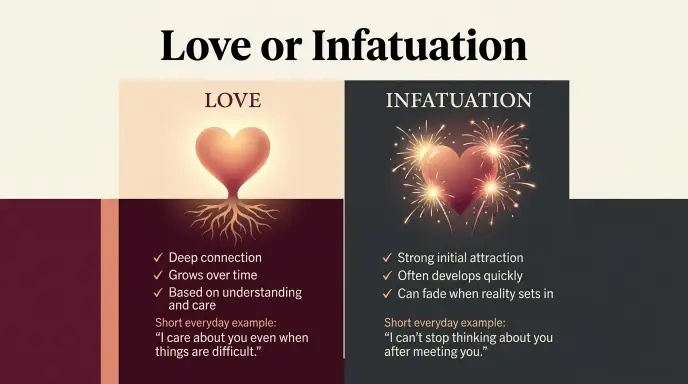
Love and infatuation can feel very similar at first, but they are not the same experience. Infatuation is often marked by intense attraction, excitement, idealization, and a strong focus on another person. Love can include those feelings, but deeper romantic love is more likely to involve intimacy, care, trust, and commitment.
This difference can be difficult to recognize when emotions are intense. A new crush may make you think about someone constantly, imagine a future together, or overlook their flaws. Those feelings can be powerful, but intensity alone does not prove that you are in love.
Psychological theories also distinguish different forms of romantic feeling. Sternberg’s triangular theory, for example, describes love through combinations of passion, intimacy, and commitment. Research on passionate and companionate love likewise distinguishes intense romantic feelings from the steadier affection and attachment that can develop in established relationships.
So, love or infatuation? The answer often becomes clearer when you look beyond excitement and ask if you genuinely know, care about, respect, and understand the other person.
Love or Infatuation: Quick Answer
Infatuation is usually intense attraction or fascination with someone, while love is a deeper emotional connection that can involve care, intimacy, trust, and commitment.
Infatuation often develops quickly and may involve idealizing the other person. Love generally becomes more grounded as you get to know someone realistically.
| Love | Infatuation |
| Can develop gradually | Can develop very quickly |
| Includes genuine care | Often centers on attraction |
| Accepts imperfections | May idealize the person |
| Can involve trust and intimacy | Often involves fantasy |
| Can include commitment | May exist without commitment |
| Becomes more grounded with time | May fade when reality appears |
This does not mean every new attraction is unhealthy or that infatuation can never develop into love. In some relationships, intense early attraction can become a deeper connection as two people build intimacy and commitment.
What Does Love Mean?
Love is a broad emotional experience that can involve affection, care, attachment, intimacy, trust, and commitment.
Romantic love can be passionate and exciting, but it can also become more stable and emotionally grounded over time. Research on romantic relationships distinguishes passionate love from companionate love, with companionate love involving affection, tenderness, attachment, and shared life experiences.
Love is not limited to one emotion. It can include:
- Emotional closeness
- Care for another person’s well:being
- Trust
- Respect
- Affection
- Intimacy
- Shared experiences
- Commitment
- Acceptance of imperfections
A person can love someone without feeling intense excitement every moment.
That is one reason love and infatuation should not be judged only by emotional intensity.
Love can become more realistic over time
When you love someone deeply, you generally become more familiar with their strengths and weaknesses.
You may still feel attraction, excitement, and affection, but you are also able to see the person as a complete human being rather than an idealized image.
What Does Infatuation Mean?
Infatuation is an intense but often short:lived feeling of attraction, fascination, or admiration toward another person.
An infatuated person may think about someone frequently, feel unusually excited around them, or imagine an ideal relationship before knowing the person very well.
Infatuation often focuses heavily on the emotional experience of attraction.
For example, you might think:
“This person is absolutely perfect for me.”
But you may not have enough real:life experience with them to know if that is true.
Psychological literature has connected infatuation with passionate forms of romantic feeling. Sternberg’s theory specifically describes infatuated love as passion without intimacy or commitment.
Infatuation can feel extremely real
The fact that infatuation may be temporary does not mean the feelings are fake.
The excitement is real.
The attraction is real.
The emotional reaction is real.
What may be uncertain is if those feelings are based on a realistic understanding of the person.
Love vs. Infatuation: Main Differences
The biggest difference between love and infatuation is usually depth and realism.
1. Time
Infatuation can happen quickly.
You may become fascinated with someone after a few conversations, a first meeting, or even limited interaction.
Love often has more time to develop because genuine intimacy requires learning about another person’s personality, values, behavior, and needs.
2. Knowledge
Infatuation can happen when you know relatively little about someone.
You may fill the missing information with assumptions or fantasies.
Love becomes more grounded when you know the person as they actually are.
3. Idealization
Infatuation often encourages idealization.
You may notice someone’s best qualities while minimizing everything that does not fit your image of them.
Love does not require believing that someone is perfect.
You can recognize flaws and still care deeply about the person.
4. Emotional intensity
Infatuation can produce extremely strong emotions.
You may feel excited, nervous, distracted, or preoccupied.
Love can also be passionate, but deeper love does not depend entirely on emotional highs.
5. Commitment
Infatuation does not necessarily involve commitment.
You can be intensely attracted to someone without wanting or being ready for a long:term relationship.
Commitment is one of the components that distinguishes some forms of love in Sternberg’s triangular theory.
6. Care
Infatuation can focus strongly on how the other person makes you feel.
Love is more likely to include genuine concern for the other person’s well:being.
This distinction is important because healthy love involves another person’s needs, feelings, and individuality rather than only your own emotional reaction.
Love or Infatuation: Comparison Table
| Feature | Love | Infatuation |
| Development | Often develops with time | Can appear quickly |
| Attraction | May be strong | Usually very strong |
| Emotional intensity | Can vary | Often extremely intense |
| Knowledge of person | Usually deeper | May be limited |
| Idealization | Usually less idealized | Often idealized |
| Acceptance | Recognizes imperfections | May overlook flaws |
| Intimacy | Often present | May be limited |
| Commitment | Can be present | Not necessarily present |
| Stability | Often more grounded | May fluctuate |
| Long:term potential | Can support a lasting bond | May fade or develop further |
Signs It May Be Infatuation
No single sign can prove that a feeling is infatuation. However, several patterns can suggest that attraction is being driven more by idealization than by a well:developed relationship.
You think about the person constantly
You may find it difficult to focus on other things because your thoughts repeatedly return to the person.
Constant thoughts can happen during attraction and early romance, so this sign alone does not distinguish infatuation from love.
You idealize them
You may see the person as almost perfect.
Their positive qualities seem extremely important, while their flaws barely register.
You imagine the future quickly
You may start imagining marriage, a lifelong relationship, or an entire future together before you have built enough real:life experience together.
Their attention strongly affects your mood
A message, compliment, or sign of interest may make you feel extremely happy.
A delayed response or lack of attention may cause disproportionate worry or disappointment.
You focus more on fantasy than reality
You may spend more time imagining what the relationship could become than evaluating what the relationship actually is.
Research on limerence, a related but distinct concept, describes intense preoccupation, idealization, and concern about if attraction is reciprocated.
Signs It May Be Love
Again, no checklist can diagnose love. Relationships differ, and people experience romantic feelings differently.
However, deeper love often involves qualities such as:
Signs It May Be Love
Love often feels deeper than a strong attraction. You care about the person, respect who they are, and want to know them better.
You feel emotionally connected
There is a sense of closeness and understanding that goes beyond physical attraction.
You are willing to build something together
Love can involve choosing to invest time, effort, communication, and commitment into a relationship.
Psychological discussions of healthy relationships emphasize qualities such as acceptance, respect, attention to a partner’s needs, and allowing the other person to remain an individual rather than trying to control them.
Can Infatuation Turn Into Love?
Yes, infatuation can develop into love, but it does not automatically do so.
An intense initial attraction may give two people the motivation to spend more time together. As they learn about each other, build trust, develop intimacy, and decide if they want a committed relationship, the connection may become deeper.
Sternberg’s theory is useful here because it treats love as combinations of passion, intimacy, and commitment rather than as one single feeling.
For example:
Infatuation:
“I can’t stop thinking about this person.”
Developing love:
“I know this person well, including their imperfections, and I still care deeply about them.”
The second statement reflects a more grounded connection.
Can You Love Someone and Still Feel Infatuated?
Yes.
Love and infatuation are not always mutually exclusive.
A person can have a deep emotional bond with someone while also experiencing intense attraction and excitement.
Long:term romantic relationships can contain passion as well as intimacy and commitment. Research has found that passionate romantic feelings can persist in some long:term relationships rather than automatically disappearing.
The important question is not simply:
“How strongly do I feel?”
It is also:
“How well do I know this person, and what kind of connection are we actually building?”
Love vs. Infatuation vs. Limerence
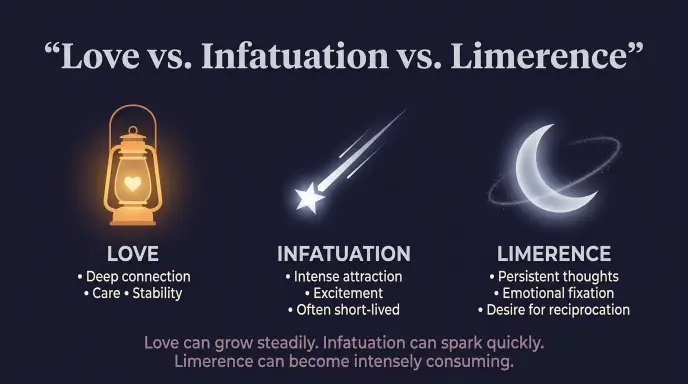
These terms are related, but they should not be treated as exact synonyms.
Love
Love can involve affection, intimacy, care, attachment, and commitment.
Infatuation
Infatuation generally describes intense attraction or fascination, often before a deep relationship has developed.
Limerence
Limerence is a more specific concept involving intense preoccupation with another person and uncertainty about if the feelings are reciprocated. Psychology Today describes it as distinct from love and notes that it can involve obsessive thinking and idealization.
| Term | Main focus |
| Love | Care, intimacy, attachment, and possibly commitment |
| Infatuation | Intense attraction and fascination |
| Limerence | Obsessive preoccupation and desire for reciprocation |
These concepts can overlap, but they are not interchangeable.
How Do You Know If It Is Love or Infatuation?
Ask yourself a few practical questions.
Do I know the real person?
If you know mostly what you imagine about someone rather than how they actually behave, your feelings may be based partly on idealization.
Do I accept their imperfections?
Love does not require pretending that someone has no flaws.
Do I care about their well:being?
Consider if your concern extends beyond getting attention, affection, or validation from them.
Would I still value them without the excitement?
Infatuation can depend heavily on novelty and emotional intensity.
A deeper relationship can remain meaningful even when the initial excitement becomes calmer.
Am I attracted to the person or to my idea of them?
This is one of the most useful questions.
You may be attracted to who someone actually is, or you may be attracted to the version of them that exists in your imagination.
Everyday Examples of Love and Infatuation
Example 1: A new crush
You meet someone and immediately feel an overwhelming attraction.
You think about them all day and imagine that they are perfect.
This may be infatuation because the emotional intensity is high while your knowledge of the person is still limited.
Example 2: A long:term relationship
You have been with someone for years. You know their strengths, weaknesses, habits, fears, and goals.
This may reflect deeper love.
Example 3: Idealizing someone
You barely know someone but believe they are your perfect match.
You have created an image of them without seeing how they behave in different situations.
This can be a sign of infatuation.
Example 4: Accepting imperfections
You know your partner has weaknesses, but you understand them realistically and still choose to care for and respect them.
This is more consistent with grounded love.
Example 5: Uncertainty
You constantly check if someone has viewed your message or liked your post. Their attention creates a strong emotional high, while silence causes anxiety.
This kind of preoccupation can resemble features described in discussions of limerence.
Common Misconceptions About Love and Infatuation
“If the feelings are intense, it must be love.”
Not necessarily.
Intensity can occur during attraction, infatuation, passionate love, and limerence.
Strong feelings alone cannot tell you exactly what kind of connection you have.
“Infatuation is fake.”
Not necessarily.
Infatuation describes a type of intense feeling. The emotion itself can be genuine even if the relationship does not become long:lasting.
“Love is never exciting.”
This is also incorrect.
Healthy romantic love can include passion, attraction, excitement, and desire.
The difference is that deeper love does not have to depend entirely on those feelings.
“Real love means ignoring someone’s flaws.”
No.
Love can involve accepting that someone is imperfect while still recognizing harmful behavior and maintaining appropriate boundaries.
“Infatuation always becomes love.”
Not every attraction develops into a lasting relationship.
Sometimes the intensity fades as people get to know each other.
Google Trends & Modern Usage
The search phrase “love or infatuation” reflects a common informational intent: people want to understand if intense romantic feelings represent genuine love or a temporary attraction.
Related searches often focus on the difference between love and infatuation, signs of infatuation, how to know if you are in love, and if infatuation can become love.
Modern psychological discussions also use related concepts such as passionate love, companionate love, and limerence. Research has distinguished passionate love from companionate love, while contemporary psychology resources describe limerence as a separate experience involving intense preoccupation and uncertainty about reciprocation.
Because relationship experiences vary greatly, it is better to avoid claiming that a specific feeling always proves someone is in love or infatuated.
Instead, the most useful distinction is based on patterns such as time, knowledge, idealization, intimacy, care, and commitment.
Quick Comparison: Love or Infatuation?
| Question | Love | Infatuation |
| Do you know the person well? | Usually yes | Not necessarily |
| Do you see their flaws? | Yes | Often minimized |
| Is attraction important? | Often | Usually central |
| Is intimacy present? | Often | May be limited |
| Is commitment involved? | May be | Not necessarily |
| Is the feeling realistic? | More grounded | Can involve fantasy |
| Can it last? | Yes | May fade or develop |
| Is intensity required? | No | Often high |
| Do you care about their well:being? | Typically yes | May focus more on personal feelings |
| Can both occur together? | Yes | Yes |
Key Takeaways
- Love and infatuation are not the same thing.
- Infatuation often involves intense attraction, excitement, and idealization.
- Love can involve care, intimacy, trust, affection, and commitment.
- Infatuation can happen before you know someone deeply.
- Love tends to become more grounded as you understand the person realistically.
- Strong feelings do not automatically prove that you are in love.
- Infatuation can develop into love, but it does not always do so.
- Love and infatuation can sometimes exist at the same time.
- Limerence is a related but distinct concept involving intense preoccupation and uncertainty about reciprocation.
- One useful question is: “Am I attached to the real person, or to the image I have created of them?”
FAQs
Q1. How do I know if it is love or infatuation?
Love usually develops through trust, understanding, respect, and genuine care over time. Infatuation tends to feel intense and exciting but may focus more on attraction or idealizing someone.
Q2. What are the 7 stages of love?
A commonly described sequence is attraction, infatuation, dating, commitment, deep love, intimacy, and lasting partnership. These stages are not universal and relationships can develop differently.
Q3. What is the 3 6 9 rule in relationships?
The 3:6:9 rule is an informal dating guideline suggesting that relationships may become clearer around three, six, and nine months. It is not a scientifically established rule.
Q4. What is the difference between love and infatuation?
Love is generally deeper and more stable, involving trust, commitment, and acceptance. Infatuation is often intense and fast:moving, driven by excitement, attraction, and idealization.
Q5. How long is infatuation before love?
There is no fixed timeline because every relationship develops differently. Infatuation can last weeks or months and may gradually develop into deeper love.
Q6. What do men crave the most in a relationship?
Many men value respect, emotional connection, appreciation, trust, and affection in relationships. Individual needs differ, so communication is more reliable than assumptions.
Q7. What is the highest form of intimacy for a man?
For many people, the deepest form of intimacy is emotional vulnerability and feeling completely safe with a partner. Physical closeness can be meaningful too.
Q8. Where do men love to be touched most?
Preferences vary, but many people enjoy affectionate touches such as holding hands, hugging, touching the shoulders, or gentle back contact. Communication and personal boundaries matter most.
Q9. Where to kiss a man to drive him wild ?
There is no universal “best” place because preferences differ. Kisses on the lips, neck, or cheek may feel intimate, but mutual comfort and consent are important.
Conclusion
Love or infatuation? The difference is usually clearer when you look beyond how intense your emotions feel.
Infatuation can be exciting, powerful, and completely genuine. It often appears when attraction is new and can involve idealizing another person or imagining a relationship before you know them deeply. That does not make the feeling meaningless. It simply means the emotional experience may be developing faster than your understanding of the person.
Love can include the same excitement and attraction, but it can also grow into something more grounded. You learn who the other person really is, recognize their imperfections, care about their well:being, respect their individuality, and build emotional intimacy and trust.
Psychological models describe love in different ways, but one influential approach separates passion, intimacy, and commitment. These components help explain why romantic feelings can change and deepen over time.
The simplest way to remember the distinction is this:
Infatuation may focus on how strongly you feel about someone. Love is more likely to include how deeply you know, care for, and connect with them.
So if you are wondering if your feelings are love or infatuation, do not judge them only by their intensity. Give yourself time to see the person clearly. Reality, consistency, intimacy, and genuine care often reveal more than butterflies ever can.
Words Worth Knowing:
Aesthetician or Esthetician: Meaning, Spelling, Usage

Hi, I’m Ava Collins, a writer and English language enthusiast behind CorrectlyWritten. I’m passionate about making grammar simple, clear, and easy to understand. I write about grammar rules, confusing words, spelling, and everyday English usage to help readers write more accurately and confidently.








2 thoughts on “Love or Infatuation: What’s the Difference? Meaning,& Examples”