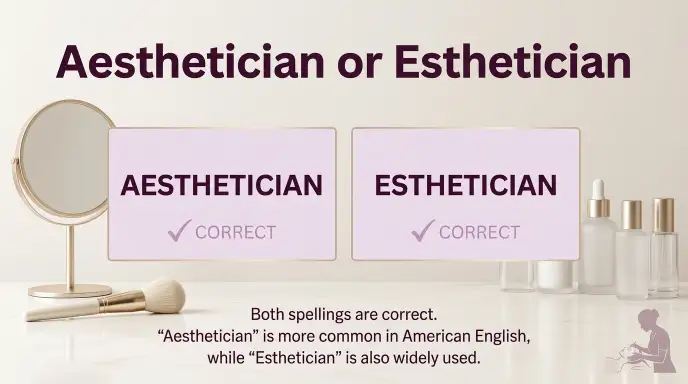
If you are wondering if aesthetician or esthetician is correct, the good news is that both spellings are correct. The main difference is regional usage. Aesthetician is mainly used in British English, while esthetician is the usual spelling in American English.
Both words describe a trained professional who works with skincare, beauty treatments, and improving the appearance and health of the skin. The difference is not in the basic meaning. It is mainly in the spelling used in different varieties of English.
This can be confusing because you may see aesthetician on British websites, in UK:based beauty salons, or in British writing. At the same time, American websites, salons, and professional profiles commonly use esthetician.
If you are writing an article, creating a business profile, or choosing a professional title, it is helpful to know which spelling fits your audience. Using the right regional form can make your writing look more natural and consistent.
In this guide, we will explain aesthetician vs esthetician, their meanings, spelling differences, British and American usage, common mistakes, and examples.
Aesthetician or Esthetician :Quick Answer
Both Spellings Are Correct
Aesthetician and esthetician are both correct spellings.
The main difference is where they are commonly used:
- Aesthetician : mainly British English
- Esthetician : mainly American English
Both words refer to a professional who provides skincare and beauty:related treatments.
For example:
She works as an aesthetician in London.
She works as an esthetician in New York.
The meaning of both sentences is essentially the same. The spelling changes because British and American English sometimes use different forms of the same word.
If your audience is mainly from the UK, aesthetician is the better choice. If your audience is mainly from the United States, esthetician is usually the better choice.
Aesthetician vs Esthetician at a Glance
| Word | Common Usage | Meaning |
| Aesthetician | British English | A skincare and beauty professional |
| Esthetician | American English | A skincare and beauty professional |
| Aesthetician | UK | Preferred form |
| Esthetician | US | Preferred form |
So, if you are asking “aesthetician or esthetician, which is correct?”, the simple answer is: both are correct, but your choice should match your variety of English.
Definition and Meaning of Aesthetician
What Does Aesthetician Mean?
An aesthetician is a trained professional who works with skincare and beauty treatments. Their work may focus on improving the appearance and health of a person’s skin.
The word is especially common in British English.
For example:
I booked an appointment with an aesthetician for a facial.
The aesthetician recommended a new skincare routine.
She wants to become a professional aesthetician.
An aesthetician may provide services such as facials, skin treatments, exfoliation, and other beauty services. The exact services can vary depending on the professional’s training and local rules.
The important point is that aesthetician is a professional noun. It describes a person, not a treatment or a skincare product.
Simple Meaning of Aesthetician
In simple words:
Aesthetician = a skincare and beauty professional.
The word is often used when talking about someone who specializes in the appearance and care of the skin.
For example:
My aesthetician helped me choose a skincare routine.
Here, aesthetician means the professional who provides skincare advice or treatment.
Definition and Meaning of Esthetician
What Does Esthetician Mean?
An esthetician has essentially the same meaning as aesthetician.
The main difference is spelling and regional usage.
Esthetician is the form commonly used in American English.
For example:
I made an appointment with an esthetician.
The esthetician recommended a gentle cleanser.
She is a licensed esthetician.
In American writing, esthetician is usually the more natural choice.
Simple Meaning of Esthetician
In simple words:
Esthetician = a skincare and beauty professional.
The word can be used for someone who works with skincare and beauty treatments.
For example:
The esthetician gave me advice about my skin.
The meaning is almost identical to the British:English word aesthetician.
Aesthetician vs Esthetician: What Is the Difference?
The Main Difference Is Spelling
The biggest difference between aesthetician and esthetician is their regional spelling.
British English generally keeps the a in the beginning:
aesthetician
American English commonly drops the a:
esthetician
This difference is also seen in related words.
For example:
- British English: aesthetic
- American English: esthetic
And:
- British English: aesthetician
- American English: esthetician
The words have the same basic meaning. The spelling simply changes depending on the variety of English.
Is There a Difference in Meaning?
No major difference in meaning exists between the two spellings when they are used for the skincare profession.
For example:
She is an aesthetician.
and
She is an esthetician.
Both sentences describe a skincare and beauty professional.
The important thing is consistency. If your website uses American English, esthetician will usually fit better. If it uses British English, aesthetician is the better choice.
Why Do Both Spellings Exist?
English has many regional spelling differences. British and American English developed different preferences for certain words over time.
The pair aesthetic/aesthetician and esthetic/esthetician follows this pattern.
This is why you may find both spellings in reliable English writing.
You should not assume that esthetician is a misspelling of aesthetician, or that aesthetician is wrong because American English uses the shorter form.
Both forms have a place in English.
Aesthetician or Esthetician :Which One Should You Use?
Choose Based on Your Audience
The easiest rule is to choose the spelling that matches your target audience.
Use aesthetician when your writing follows British English.
Use esthetician when your writing follows American English.
For example:
British English:
She is a qualified aesthetician.
American English:
She is a qualified esthetician.
If you are writing for a worldwide audience, you can mention both spellings and explain the regional difference. This helps readers understand why they may see two different forms.
For a grammar or spelling website, using both forms naturally is also useful because people may search for either aesthetician or esthetician.
British English vs American English Spelling
Aesthetician in British English
In British English, aesthetician is the more common spelling. It keeps the “a” in the word and follows the traditional spelling of aesthetic.
British English examples include:
- She is a qualified aesthetician.
- I booked an appointment with an aesthetician.
- The aesthetician recommended a new skincare routine.
- The salon employs several experienced aestheticians.
If your website, business, or article follows British English, aesthetician is the natural choice.
The same spelling can also appear in international writing, especially when the writer wants to keep the traditional aesthetic form.
Esthetician in American English
In American English, esthetician is commonly used.
It removes the “a” from the beginning of aesthetician.
American English examples include:
- She is a licensed esthetician.
- I visited an esthetician for a facial.
- The esthetician recommended a moisturizer.
- She wants to become an esthetician.
This spelling is especially familiar in American skincare, beauty, spa, and professional settings.
British vs American Comparison
| Feature | British English | American English |
| Preferred spelling | Aesthetician | Esthetician |
| Spelling pattern | Keeps “ae” | Uses “e” |
| Related word | Aesthetic | Esthetic |
| Meaning | Skincare and beauty professional | Skincare and beauty professional |
| Main difference | Regional preference | Regional preference |
The important thing to remember is that the spelling does not create a different profession. Both words can describe the same type of skincare professional.
Why Are There Two Spellings?
The “Aesthetic” and “Esthetic” Pattern
The two spellings exist because English has developed different spelling preferences in different regions.
The longer form is:
aesthetic : aesthetician
The shorter American form is:
esthetic : esthetician
This is why the two words look different even though their meanings are closely related.
The difference can be seen in other words as well. American English sometimes simplifies certain spellings that contain ae, while British English often keeps the traditional form.
For example:
- aesthetic : esthetic
- aesthetics : esthetics
- aesthetician : esthetician
However, American English does not always remove ae. The word aesthetic itself remains very common in American English. Therefore, it is not correct to assume that every American writer must use the shorter spelling.
Is One Spelling Older?
The form aesthetician is the traditional spelling and is closely connected with the word aesthetic.
Over time, esthetician developed as a variant, especially in American usage.
Today, both forms are established enough to be understood as correct. The important difference for most writers is simply regional preference and consistency.
Which Spelling Should You Use?
For British English
Choose aesthetician if your content is written for readers in the UK.
For example:
Our experienced aesthetician provides professional skincare treatments.
This spelling will look natural to a British audience.
For American English
Choose esthetician if your content is written for readers in the United States.
For example:
Our licensed esthetician provides professional skincare treatments.
This is the spelling most American readers will expect in a beauty or skincare context.
For International Audiences
If your website has readers from many countries, you can use both spellings when explaining the difference.
For example:
An aesthetician, also spelled esthetician in American English, is a skincare and beauty professional.
This approach is useful because it immediately answers the spelling question while helping readers understand both forms.
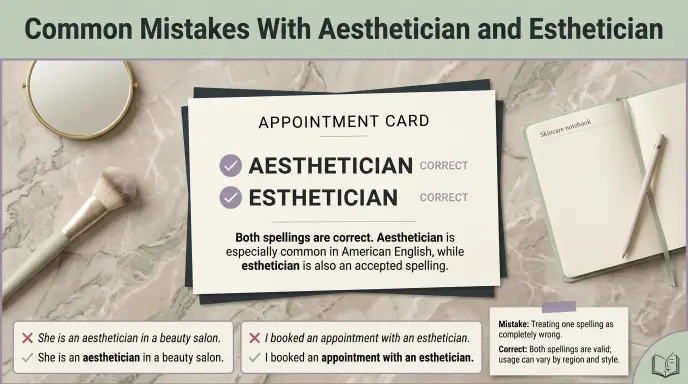
Common Mistakes With Aesthetician and Esthetician
Mistake 1: Saying Esthetician Is Wrong
One of the most common mistakes is thinking that esthetician is simply a misspelling of aesthetician.
That is not correct.
Esthetician is an accepted spelling, especially in American English.
Correct:
She works as an esthetician.
Also correct:
She works as an aesthetician.
The best choice depends on the English variety being used.
Mistake 2: Saying Aesthetician Is Wrong in American English
It is also incorrect to say that aesthetician can never be used in American English.
American English can use both forms, although esthetician is commonly preferred in the skincare profession.
So, do not treat the difference as a strict “right versus wrong” spelling issue.
It is better to think of it as a regional spelling preference.
Mistake 3: Mixing Both Spellings in the Same Article
Another common mistake is switching between the two spellings without a reason.
For example:
Our esthetician provides skincare advice. The aesthetician can also recommend products.
If both sentences refer to the same professional and the article is following American English, it is better to stay consistent:
Our esthetician provides skincare advice. The esthetician can also recommend products.
Consistency makes your writing look more professional.
Mistake 4: Thinking They Describe Different Jobs
The spelling does not automatically tell you that the two people have different jobs.
For example, it is not correct to assume:
An aesthetician works in a clinic, while an esthetician works in a spa.
The spelling alone does not create this distinction.
Both terms can refer to professionals who provide skincare and beauty services.
Mistake 5: Confusing Aesthetician With Aesthetic
Aesthetician is a person.
Aesthetic is a word that can describe beauty, appearance, style, or artistic taste.
For example:
The room has a modern aesthetic.
But:
She is a professional aesthetician.
These words are related, but they are not interchangeable.
Aesthetician or Esthetician in Everyday Examples
Examples With Aesthetician
Here are some natural examples using aesthetician:
- I booked an appointment with an aesthetician.
- The aesthetician examined my skin.
- She works as a professional aesthetician.
- My aesthetician recommended a gentle cleanser.
- The salon has an experienced aesthetician.
- She wants to study skincare and become an aesthetician.
- I visited an aesthetician for a facial treatment.
These examples are suitable for British English or content that prefers the traditional spelling.
Examples With Esthetician
Here are natural examples using esthetician:
- I booked an appointment with an esthetician.
- The esthetician recommended a new moisturizer.
- She is a licensed esthetician.
- My esthetician suggested a simple skincare routine.
- The spa hired an experienced esthetician.
- She is studying to become an esthetician.
- I visited an esthetician for a professional facial.
These examples fit naturally with American English.
Aesthetician or Esthetician in Professional Writing
Use the Right Form for Your Audience
Professional writing should follow a consistent style.
If your business operates in the UK, you may write:
Our qualified aestheticians provide personalized skincare treatments.
If your business operates in the United States, you may write:
Our licensed estheticians provide personalized skincare treatments.
If you are writing a global article, you can introduce both forms:
Aesthetician and esthetician are two accepted spellings for a skincare and beauty professional.
This makes the content clear for readers from different English:speaking regions.
Use Your Official Professional Title
If you are a skincare professional, your official title may depend on your employer, training program, certification, or local licensing system..
When writing a resume, profile, business page, or professional biography, consistency is more important than trying to change an accepted spelling simply because another version is more common in a different country.
Aesthetician vs Esthetician :Simple Comparison
A Quick Way to Remember the Difference
The easiest way to remember the spelling is:
British English :Aesthetician
American English : Esthetician
Think of the related words:
British: aesthetic : aesthetician
American: esthetic : esthetician
Both spellings refer to a skincare and beauty professional.
So if you see aesthetician in British content and esthetician in American content, there is no need to assume that one is a spelling mistake.
The difference is mainly a matter of regional English and spelling preference.
Aesthetician or Esthetician :Usage and Search Intent
Why People Search for Both Spellings
People often search for aesthetician or esthetician because both forms appear online and in professional settings. This can make it hard to know which spelling is correct.
The simple answer is that both spellings are correct. The main difference is regional preference. Esthetician is commonly used in American English, while aesthetician is mainly used in British English.
People may also see both spellings on spa websites, beauty school pages, job listings, and professional profiles.
Common Search Questions
People commonly search questions such as:
- Is aesthetician or esthetician correct?
- Is esthetician an American spelling?
- Is aesthetician British English?
- Are aesthetician and esthetician the same?
- How do you spell esthetician?
- Should I write aesthetician on my resume?
- Which spelling should I use in the US?
These searches all point to the same basic issue: regional spelling and word choice.
Aesthetician or Esthetician :Google Trends and Usage Data
What Usage Patterns Show
Search behavior for these words can vary by country. American users are more likely to search for esthetician, while British users are more likely to use aesthetician.
This matches major English usage guides, which identify esthetician as the US form and aesthetician as the mainly UK form.
The exact level of search interest can change over time. For this reason, it is better not to treat one fixed search number as permanent.
Regional Search Behavior
Regional language can strongly affect which spelling people search for.
| Region | Common Form |
| United States | Esthetician |
| United Kingdom | Aesthetician |
| Other English:speaking regions | Both may appear |
| International websites | Aesthetician and esthetician |
For an American audience, esthetician is usually the natural choice. For a British audience, aesthetician is usually the better choice.
If your website targets readers from many countries, using both forms naturally can help readers understand the difference.
Aesthetician vs Esthetician Comparison Table
Side:by:Side Comparison
| Feature | Aesthetician | Esthetician |
| Correct spelling | Yes | Yes |
| Main regional use | British English | American English |
| Meaning | Skincare and beauty professional | Skincare and beauty professional |
| US usage | Used, but less typical | Common |
| UK usage | Common | Less typical |
| Refers to a different job? | No | No |
| Best for US audience | Usually not the first choice | Yes |
| Best for UK audience | Yes | Usually not the first choice |
The two words generally describe the same type of professional. The key difference is the spelling used in different varieties of English.
Frequently Asked Questions About Aesthetician and Esthetician
Q1. What is the difference between an aesthetician and an esthetician?
Both refer to professionals who provide skincare and beauty treatments, but esthetician is more common in American English. Aesthetician is more common in British English and can also have a broader meaning.
Q2. What is the main difference between aesthetics and esthetics?
Aesthetics and esthetics have the same basic meaning: the study or appreciation of beauty and appearance. The main difference is spelling, with aesthetics more common in British English and esthetics in American English.
Q3. What are the highest paid estheticians?
The highest-paid estheticians often work in medical aesthetics, advanced skincare, luxury spas, or specialized cosmetic treatments. Their earnings can vary significantly based on location, experience, skills, and clientele.
Q4. What is another name for an aesthetician?
An aesthetician may also be called a skincare specialist, skin therapist, beauty therapist, or esthetician. The exact title can vary depending on the country and type of services provided.
Q5. Is aesthetician a profession?
Yes, aesthetician is a recognized profession involving skincare, beauty treatments, and related services. Many aestheticians complete professional training and may need a license depending on their location.
Q6. What is a fancy word for a cosmetologist?
A more specialized or polished term for a cosmetologist can be beauty professional or beauty specialist. However, cosmetologist remains the standard professional title.
Q7. What is a person who loves makeup called?
A person who loves makeup can be called a makeup enthusiast or beauty enthusiast. Informally, makeup lover is also commonly used.
Q8. What is the highest paid cosmetology job?
Some of the highest-paying cosmetology careers include celebrity hairstylists, makeup artists, salon owners, and specialized beauty professionals. Income depends heavily on expertise, reputation, location, and clientele.
Q9. What is the strongest word to describe beauty?
Words such as breathtaking, magnificent, exquisite, stunning, and ravishing can describe exceptional beauty. The best choice depends on whether you want a formal, poetic, or emotional tone.
How to Choose the Right Spelling
Use Esthetician for American English
Choose esthetician when your content is written mainly for readers in the United States.
For example:
She works as a licensed esthetician in New York.
Use Aesthetician for British English
Choose aesthetician when your content follows British English.
For example:
She works as an aesthetician at a beauty clinic in London.
Stay Consistent
The most important rule is consistency.
Do not switch between aesthetician and esthetician without a reason. If your article follows American English, use esthetician throughout most of the article. If it follows British English, use aesthetician.
For content, you can mention both spellings naturally. This helps readers who search for either version while keeping the main spelling consistent.
Aesthetician or Esthetician :Final Answer
Both Spellings Are Correct
Aesthetician and esthetician are both correct.
The main difference is regional:
- Aesthetician : mainly British English
- Esthetician : commonly American English
Neither spelling is automatically more professional or more correct.
If you write for American readers, esthetician is usually the better choice. If you write for British readers, choose aesthetician.
The best approach is simple: know your audience, choose the spelling they expect, and use it consistently.
Conclusion
The question “aesthetician or esthetician?” has a simple answer: both spellings are correct.
Aesthetician is mainly associated with British English, while esthetician is commonly used in American English. Both words can describe a trained skincare and beauty professional.
The difference is not usually about the person’s skills, training, or job. It is mainly about spelling preference and regional English.
If you are writing for people in the United States, esthetician is a strong choice. If you are writing for a British audience, aesthetician is the natural choice.
For websites and professional writing, consistency is important. Choose the form that matches your audience, your local standards, or your official professional title.
So, when you see aesthetician or esthetician, remember that neither spelling is wrong. They are two accepted forms of the same word.
Explore More Spelling Guides!
Obrigado or Obrigada: Which Is Correct? Meaning & Usage

Hi, I’m Ava Collins, a writer and English language enthusiast behind CorrectlyWritten. I’m passionate about making grammar simple, clear, and easy to understand. I write about grammar rules, confusing words, spelling, and everyday English usage to help readers write more accurately and confidently.








2 thoughts on “Aesthetician or Esthetician: Meaning, Spelling, Usage ”