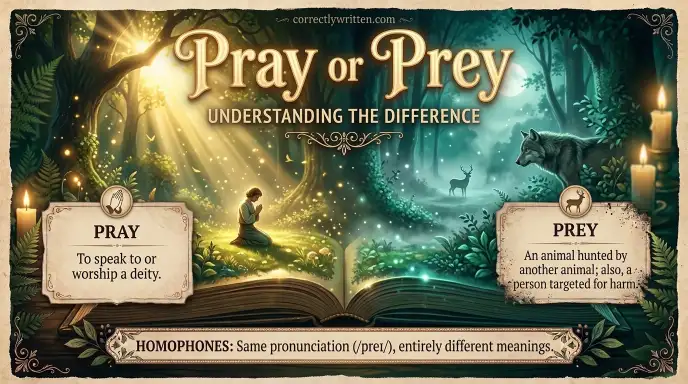
Pray and prey are both correct English words, but they have completely different meanings and uses. Pray is a verb that means to speak to God or another deity, express a hope, or make a sincere request.
Prey is usually a noun referring to an animal hunted by another animal for food, although it can also be a verb meaning to hunt, exploit, or take advantage of someone or something. Because these words sound alike in many English accents, writers sometimes confuse them in sentences, messages, and online posts.
For example, “I pray for your safety” expresses a hope or religious request, while “The rabbit became prey to the fox” describes an animal being hunted. The difference is important because using the wrong word can change a sentence’s meaning entirely. In this guide, you will learn the definitions, origins, grammatical roles, common mistakes, and everyday examples of pray and prey, making it easier to choose the right word whenever you write.
Pray or Prey: Quick Answer
Both pray and prey are correct spellings. The right choice depends on the meaning of your sentence.
- Pray: To speak to God, express a hope, or make a sincere request.
- Prey: An animal hunted by another animal, or someone who is targeted or exploited.
Examples:
Pray: “I pray for my family’s happiness.”
Prey: “The owl searched for its prey.”
Prey as a verb: “Scammers prey on people who trust them.”
Remember the simple distinction: pray relates to prayer and hope, while prey relates to hunting and exploitation.
Definition and Meaning of Pray and Prey
What Does Pray Mean?
Pray is a verb that commonly means to address God or a deity in worship, express gratitude, ask for help, or seek guidance.
It can also mean to hope earnestly for something or make a sincere request.
Examples:
- “We pray for peace around the world.”
- “She prays every morning.”
- “I pray that everything goes well.”
- “They prayed for the safety of their friends.”
The word does not always refer to religious worship. In everyday English, people may also use pray to express a strong hope.
For example, “I pray that the weather improves” expresses a sincere wish for better weather.
What Does Prey Mean?
Prey is commonly used as a noun to describe an animal hunted and eaten by another animal.
Examples:
- “The mouse became prey to the cat.”
- “The eagle spotted its prey from above.”
- “Small fish often serve as prey for larger fish.”
The word can also describe a person or group targeted by someone who intends to harm, deceive, or exploit them.
For example, “The fraudster targeted older people as prey.”
As a verb, prey means to hunt, exploit, or take advantage of someone or something.
Examples:
- “Lions prey on zebras.”
- “Some scammers prey on vulnerable people.”
- “The disease preys on the body’s weakened defenses.”
The intended meaning depends on the context.
What Is the Difference in Simple English?
In simple English, pray means to ask God for help or express a sincere hope.
Prey means an animal that is hunted, or a person or group that is targeted for harm or exploitation.
For example:
- “I pray for my friends.” This expresses a wish or prayer.
- “The lion hunts its prey.” This describes hunting.
Although the words sound alike, their meanings are different.
The Origin of Pray and Prey
The Origin of Pray
The word pray entered English through Old French prier, meaning to ask or request, and ultimately comes from Latin precari, meaning to pray or entreat.
Over time, its meaning became strongly associated with religious worship, supplication, and asking for divine help. Today, it can also express a sincere wish or hope.
The Origin of Prey
The word prey came into English through Old French preie, referring to booty or something seized, and ultimately traces back to Latin praeda, meaning booty or plunder.
Its meaning developed to include an animal hunted by another animal. It is also used figuratively for people who are targeted, deceived, or exploited.
Although pray and prey have different histories and meanings, their similar pronunciation explains why they are sometimes confused in writing.
Pray vs Prey: The Main Difference

The main difference between pray and prey is their meaning and grammatical use.
Pray is a verb associated with worship, requests, and sincere hopes.
Example: “We pray for a better future.”
Prey can be a noun referring to an animal that is hunted.
Example: “The hawk caught its prey.”
It can also be a verb meaning to hunt or exploit.
Example: “Dishonest businesses may prey on inexperienced customers.”
A useful way to remember the distinction is to connect pray with prayer and prey with predators.
British English vs American English Usage
There is no significant spelling difference between British and American English for these words. Both varieties use pray and prey with the same meanings.
British English:
- “She prays for her family.”
- “The fox hunts its prey.”
- “Criminals sometimes prey on vulnerable people.”
American English:
- “She prays for her family.”
- “The fox hunts its prey.”
- “Criminals sometimes prey on vulnerable people.”
The spelling remains the same across both varieties. The words may be pronounced slightly differently depending on accent, but the distinction in meaning does not change.
Which Word Should You Use?
Choose pray when you are describing a prayer, religious worship, or a sincere hope.
Use it when you want to:
- Ask God for help or guidance
- Express gratitude through prayer
- Wish for someone’s safety or happiness
- Express a sincere hope that something happens
Examples:
“I pray for your recovery.”
“We pray that the journey is safe.”
Choose prey when you are discussing animals being hunted or people being targeted or exploited.
Use it when you want to:
- Describe an animal hunted for food
- Explain a predatorprey relationship
- Describe someone being manipulated or exploited
- Use the phrase “prey on” to describe taking advantage of someone
Examples:
“The snake waited patiently for its prey.”
“Scammers prey on people who are unfamiliar with online fraud.”
Before choosing the word, ask yourself: Am I talking about prayer or about hunting and exploitation?
Common Mistakes with Pray and Prey
Mistake 1: Using Prey When You Mean Pray
Incorrect: “I prey for your success.”
Correct: “I pray for your success.”
The sentence expresses a sincere hope, so pray is the appropriate word.
Mistake 2: Using Pray When You Mean Prey
Incorrect: “The lion chased its pray.”
Correct: “The lion chased its prey.”
The sentence describes an animal being hunted, so prey is correct.
Mistake 3: Confusing Prey with Pray in Figurative Expressions
Incorrect: “Fraudsters pray on vulnerable people.”
Correct: “Fraudsters prey on vulnerable people.”
The expression prey on means to exploit or take advantage of someone.
Mistake 4: Assuming Prey Is Only a Noun
Prey can function as both a noun and a verb.
As a noun: “The rabbit became the fox’s prey.”
As a verb: “Foxes prey on rabbits.”
Mistake 5: Thinking Pray Always Refers to Religion
Although pray often describes religious activity, it can also express an earnest hope.
Example: “I pray that you arrive safely.”
In this sentence, the speaker expresses a sincere wish.
Pray and Prey in Everyday Examples

Pray
- “I pray for my family’s health.”
- “She prays before going to bed.”
- “We pray that everyone stays safe.”
- “He prayed for strength during a difficult time.”
- “I pray that tomorrow brings good news.”
- “They gathered to pray for peace.”
Prey as a Noun
- “The eagle searched for prey.”
- “The rabbit became prey to the fox.”
- “The spider waited for its prey.”
- “Small insects provide prey for many birds.”
- “The predator watched its prey carefully.”
Examples of Prey as a Verb
- “Owls prey on mice.”
- “Some criminals prey on lonely individuals.”
- “The hawk preys on smaller birds.”
- “Fraudsters prey on people who trust them.”
- “Certain parasites prey on weakened organisms.”
These examples demonstrate how the words work in everyday English and why their meanings should not be confused.
Pray vs Prey: Quick Comparison
Pray
Meaning: To speak to God, worship, make a request, or express a sincere hope.
Part of speech: Verb.
Example: “I pray for your happiness.”
Prey
Meaning: An animal hunted by another animal, or a person targeted for harm or exploitation.
Part of speech: Noun and verb.
Example as a noun: “The owl caught its prey.”
Example as a verb: “Scammers prey on vulnerable people.”
Best choice: Use pray for prayers and hopes. Use prey for hunting, targeting, and exploitation.
Pray or Prey: Google Trends and Usage
People may search for pray or prey because the two words sound alike in many English accents but have different meanings. This makes them a common source of confusion in writing.
The word pray appears frequently in religious contexts, personal messages, and expressions of hope. Prey is commonly used in discussions of wildlife, food chains, predator behavior, crime, and exploitation.
Search interest can vary over time and by region. Exact search volumes or popularity rankings should not be assumed without checking current Google Trends data.
For clear writing, focus on the meaning of the sentence. If you are expressing a prayer or hope, choose pray. If you are referring to an animal being hunted or someone being exploited, choose prey.
Frequently Asked Questions
Q1. Is the saying “pray tell” or “prey tell”?
“Pray tell” is the correct expression. It is an oldfashioned or playful way to ask someone to explain something or share information. For example, “Pray tell, what happened at the meeting?” The word prey refers to an animal hunted by another animal and does not fit this expression.
Q2. Which is correct: “pray on” or “prey on”?
Both expressions can be correct, but they have different meanings. Prey on means to exploit, harm, or hunt someone or something, as in “Scammers prey on vulnerable people.” Pray on can refer to praying while focused on something, but the more usual expression for directing a prayer toward someone or something is pray for or pray to.
Q3. Is it “pray to God” or “prey”?
“Pray to God” is correct when referring to worship, asking for help, or expressing faith. Pray means to communicate with a deity through prayer, while prey refers to an animal hunted by another animal or, figuratively, someone who is exploited.
Q4. What does “prey” mean?
Prey refers to an animal that is hunted and eaten by another animal. It can also describe a person who is targeted or taken advantage of by someone else. For example, “Rabbits are prey for many predators.”
Q5. What is a prey example?
A common example of prey is a mouse hunted by an owl. In this relationship, the owl is the predator, and the mouse is the prey. In a figurative sense, a person tricked by a scammer may also be described as prey.
Q6. What is another word for prey?
Depending on the context, another word for prey is quarry, especially when referring to an animal being hunted. Other related words include victim, target, and game, although each has a slightly different meaning.
Q7. What is the opposite of prey?
The opposite of prey is usually predator in the context of animals. A predator hunts other animals for food, while prey is hunted. For example, a lion is a predator, and a zebra may be its prey.
Q8. What are 5 synonym words?
Five synonyms or related words for prey, depending on the context, are:
- Quarry: an animal or person being pursued or hunted.
- Target: someone or something selected for an attack or action.
- Victim: someone harmed or exploited.
- Game: wild animals hunted for sport or food.
- Mark: a person targeted for a trick, scam, or deception.
These words are not interchangeable in every sentence, so choose the one that best matches the intended meaning.
Conclusion
Pray and prey are both correct English words, but they serve different purposes. Pray is a verb used for religious worship, requests, and sincere hopes. Prey can be a noun describing an animal hunted by another animal, or a verb meaning to hunt or take advantage of someone.
The easiest way to remember the difference is to connect pray with prayer and prey with predators. For example, “I pray for your safety” expresses a hope, while “The lion hunts its prey” describes a hunting relationship. Similarly, the phrase prey on means to exploit or target someone, so it is the correct expression when discussing fraud or manipulation.
Both words are spelled the same way in British and American English. By paying attention to the meaning of your sentence, you can choose the right word and avoid a common English writing mistake.
💡 Unlock Better Writing:
Ornery or Onery: Correct Spelling, Meaning & Usage

Hi, I’m Ava Collins, a writer and English language enthusiast behind CorrectlyWritten. I’m passionate about making grammar simple, clear, and easy to understand. I write about grammar rules, confusing words, spelling, and everyday English usage to help readers write more accurately and confidently.








2 thoughts on “Pray or Prey:Meaning, Differences & Correct Usage ”