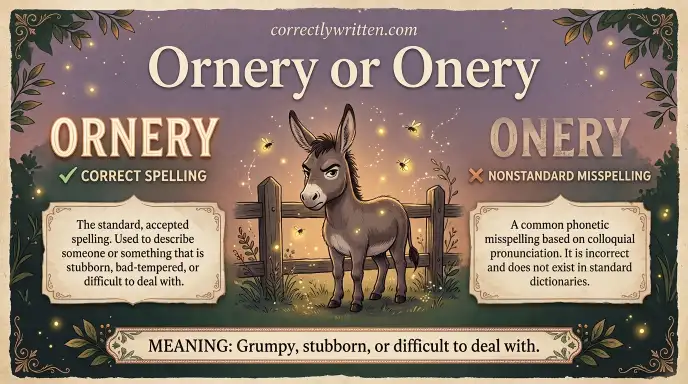
Ornery is the correct spelling, while onery is a common misspelling. The word ornery describes someone who is badtempered, irritable, stubborn, or difficult to deal with. It appears most often in American English, especially in casual conversations and informal writing.
People sometimes write onery because they do not clearly hear the first r when they pronounce the word. However, standard English always uses the spelling ornery. You might use this word to describe a grumpy neighbor, a stubborn animal, or a person who seems annoyed for no clear reason.
Although ornery often describes someone with a difficult personality, people sometimes use it humorously or affectionately. This guide explains the correct spelling, meaning, pronunciation, origin, common mistakes, and everyday examples. It also answers frequently asked questions to help you use the word confidently.
Onery or Ornery: Quick Answer
Ornery is the correct spelling in standard English.
Onery is a common misspelling. It does not serve as the standard written form of the word.
- Ornery: Correct spelling. It means badtempered, irritable, stubborn, or difficult.
- Onery: Incorrect spelling of ornery.
- Pronunciation: Usually sounds like ORnuhree in American English.
- Usage: Common in American English, especially in informal speech and writing.
Example: My ornery cat refused to leave the chair.
Remember to include the r after the first letter: ornery.
Definition and Meaning of Ornery
Ornery is an adjective. It describes someone or something that behaves in a difficult, irritable, or stubborn way.
People often use the word for someone who complains frequently, gets annoyed easily, or refuses to cooperate.
For example:
- The ornery man argued with everyone.
- Our ornery dog growled when anyone approached its food.
- She felt ornery after a sleepless night.
- My grandfather can be ornery, but he has a kind heart.
The word does not always suggest serious anger. Sometimes, it describes a person who is simply grumpy, cranky, or hard to please.
Writers can also use ornery to describe animals, moods, or behavior. The meaning depends on the situation.
Why Is Ornery the Correct Spelling?
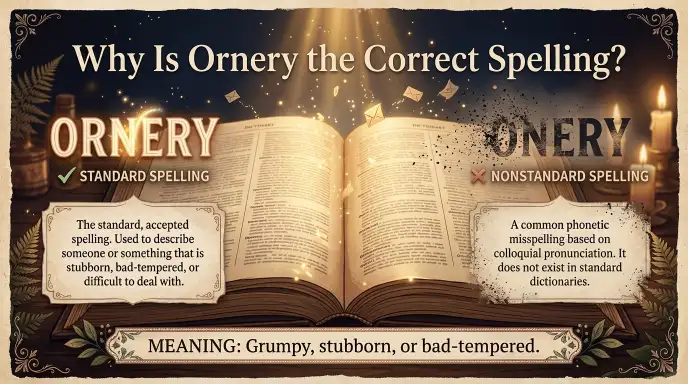
The standard spelling contains six letters: ORNERY.
The spelling onery leaves out the r after the first letter. This omission creates a misspelling.
Compare the two forms:
- ORNERY ✓ Correct
- ONERY ✗ Incorrect
English spelling does not always match pronunciation perfectly. In some American accents, the first r may sound less noticeable. This can lead people to leave it out when writing the word.
However, standard dictionaries use ornery. If you want to write the word correctly in an essay, email, article, or social media post, choose ornery.
Pronunciation of Ornery
In American English, people commonly pronounce ornery as ORnuhree. Some speakers use slightly different pronunciations depending on their region and accent.
The word has three syllables:
OR – nuh – ree
The first syllable carries the main stress.
Because some speakers pronounce the word quickly, the spelling may seem confusing. A person might hear something close to “onery” and assume that the word has no r after the first letter.
The written spelling remains ornery, regardless of how a speaker pronounces it.
Example: The ornery child refused to put away his toys.
Origin of the Word Ornery
The word ornery developed in American English. It comes from an older pronunciation and spelling of ordinary.
Over time, the word developed a different meaning. Instead of describing something usual or common, ornery came to describe someone who was disagreeable, badtempered, or difficult.
Today, the word has a distinctly informal American feel. It often appears in conversations, stories, and descriptions of strong personalities.
People sometimes use it with affection or humor. For example, a family member might call a stubborn relative “ornery” without intending to insult them seriously.
The word’s tone depends on the context, the speaker, and the relationship between the people involved.
Synonyms of Ornery
Several words have a meaning similar to ornery. However, each word carries a slightly different tone.
Grumpy: Describes someone who feels annoyed or unhappy.
Example: He felt grumpy before breakfast.
Cranky: Describes someone who becomes irritated easily, often because of tiredness or discomfort.
Example: The baby grew cranky after missing a nap.
Irritable: Describes someone who gets annoyed easily.
Example: She felt irritable after a stressful day.
Stubborn: Describes someone who refuses to change their opinion or behavior.
Example: The stubborn child refused to apologize.
Cantankerous: Describes someone who often argues or behaves unpleasantly.
Example: The cantankerous neighbor complained about the noise.
Badtempered: Describes someone who often shows anger or irritation.
Example: The badtempered customer shouted at the waiter.
These words can help you choose a more precise description. Ornery often combines stubbornness with a difficult or irritable attitude.
Antonyms of Ornery
Antonyms express the opposite meaning of a word. The best opposite of ornery depends on the context.
- Agreeable: Pleasant and easy to get along with.
- Friendly: Kind and welcoming toward others.
- Gentle: Calm, mild, and considerate.
- Pleasant: Enjoyable or easy to deal with.
- Cooperative: Willing to work with others.
- Goodnatured: Naturally kind and cheerful.
Examples:
- The ornery dog became friendly after it got used to us.
- Her agreeable attitude helped everyone work together.
- He seemed ornery in the morning but pleasant later in the day.
These contrasts make the meaning of ornery easier to understand.
Ornery in American and British English
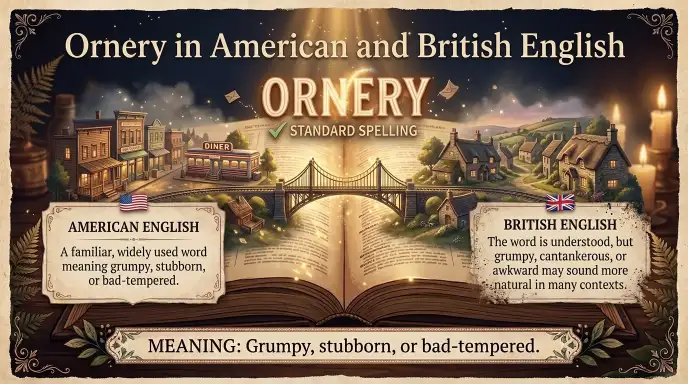
Ornery is especially common in American English. American speakers often use it in everyday conversation to describe a stubborn person, a grumpy mood, or a difficult animal.
Examples:
- That ornery horse refuses to follow the trail.
- My ornery uncle argues about everything.
- The child became ornery after a long day.
British English speakers may understand the word, but they often choose alternatives such as grumpy, badtempered, or cantankerous.
For example:
- American English: He is an ornery old man.
- British English alternative: He is a grumpy old man.
These are general usage patterns, not strict rules. British writers can use ornery, especially when discussing American speech or culture.
The spelling remains ornery in both varieties.
Common Mistakes with Ornery
Writers often make a few mistakes when they use this word.
Mistake 1: Writing Onery Instead of Ornery
Incorrect: My onery neighbor complained again.
Correct: My ornery neighbor complained again.
Always include the r after the first o.
Mistake 2: Confusing Ornery with Ordinary
Ornery and ordinary look and sound somewhat similar, but their meanings differ.
- Ornery: Badtempered, stubborn, or difficult.
- Ordinary: Normal, usual, or not special.
Examples:
- The ornery dog barked at every visitor.
- It was an ordinary day at school.
Do not use these words interchangeably.
Mistake 3: Using Ornery as a Noun
Ornery is an adjective, not a standard noun.
Incorrect: He is an ornery.
Correct: He is ornery.
You can also write, “He is an ornery person.”
Mistake 4: Assuming Ornery Always Means Angry
Ornery can describe anger or irritation, but it can also suggest stubbornness or an uncooperative attitude.
For example, an ornery animal might refuse to move even when it does not appear angry.
Mistake 5: Using Ornery in Every Formal Context
Ornery is a valid word, but it often sounds informal or conversational. In formal writing, a more precise term such as irritable, uncooperative, or badtempered may suit the context better.
Ornery in Everyday Examples
These examples show how to use ornery naturally in different situations.
About People
- My ornery uncle always challenges everyone’s opinions.
- The ornery customer refused to listen to the cashier.
- Our teacher seemed ornery after a difficult meeting.
- He has an ornery personality, but his friends understand him.
- The ornery old man complained about the weather.
About Animals
- The ornery mule refused to move.
- Our ornery cat scratched the sofa again.
- The farmer struggled to guide the ornery horse.
- That ornery rooster chases anyone who enters the yard.
Examples About Moods and Behavior
- I felt ornery after sleeping only four hours.
- His ornery behavior made the meeting difficult.
- She gave an ornery reply and left the room.
- The child became ornery when his parents said no.
Examples in Casual Conversation
- “Don’t mind him. He’s just being ornery today.”
- “That was an ornery thing to say.”
- “Our old dog gets ornery when he’s tired.”
- “She can be ornery, but she always helps her friends.”
These examples show that ornery can describe a personality, a temporary mood, or difficult behavior.
How to Remember the Correct Spelling
The easiest way to remember the spelling is to focus on the missing letter in onery.
Correct: ORNERY
Incorrect: ONERY
Say the word slowly as you write it: ORNERY.
You can also remember this simple rule:
Ornery has an R after the first O.
Before publishing an article or submitting schoolwork, check that you have written ornery rather than onery. This quick check can prevent a common spelling mistake.
Frequently Asked Questions
Q1. What does onery mean?
Onery is a nonstandard spelling of ornery, an informal American English word describing someone who is badtempered, stubborn, irritable, or difficult to deal with. For example, “The ornery old man refused to change his mind.”
Q2. Is it ornery or awnry?
Ornery is the correct standard spelling. Awnry is an informal phonetic spelling sometimes used to represent how people pronounce the word in certain American accents, but it is not the standard written form.
Q3. When someone is being onry?
When someone is being ornery, they are acting grumpy, stubborn, argumentative, or difficult. For example, “He was feeling ornery this morning and complained about everything.” The standard spelling is ornery, even when it sounds like onry.
Q4. What is another word for ornery?
Depending on the context, synonyms for ornery include grumpy, cranky, irritable, cantankerous, stubborn, and difficult. Cantankerous suggests a habit of being argumentative, while grumpy usually means being in a bad mood.
Q5. What does “ornery” mean in slang?
In informal American English, ornery describes someone who is badtempered, troublesome, or stubborn. It can sometimes be used playfully or affectionately for a person who is mischievous or difficult but still liked. The exact meaning depends on the tone and situation.
Q6. What is the opposite of ornery?
Opposites of ornery include pleasant, agreeable, friendly, cooperative, and goodnatured. For example, an ornery person may argue over small things, while an agreeable person is generally easy to get along with.
Q7. Is ornery an insult?
Ornery can be an insult if it is used to criticize someone’s bad temper or difficult behavior. However, it can also be teasing or affectionate, especially when describing a stubborn friend or family member. The speaker’s tone and relationship with the person help determine how it sounds.
Q8. Can ornery mean lazy?
Not usually. Ornery primarily means badtempered, stubborn, or difficult to deal with, rather than lazy. If someone avoids work or makes little effort, words such as lazy, idle, or sluggish are more accurate.
Final Thoughts
Ornery is the correct spelling, while onery is a common spelling mistake. The word describes someone or something that is grumpy, stubborn, irritable, or difficult to deal with. It is especially common in American English and often appears in casual conversations.
Remember the extra r after the first o. Write ornery when you describe a difficult person, a stubborn animal, or an irritable mood. Avoid onery in standard writing.
Once you learn the spelling and meaning, you can use the word confidently in conversations, stories, and articles.
Discover the Right Words 🔤:
Programme or Program: Correct Spelling, Meaning & Usage

Hi, I’m Ava Collins, a writer and English language enthusiast behind CorrectlyWritten. I’m passionate about making grammar simple, clear, and easy to understand. I write about grammar rules, confusing words, spelling, and everyday English usage to help readers write more accurately and confidently.








2 thoughts on “Ornery or Onery: Correct Spelling, Meaning & Usage ”