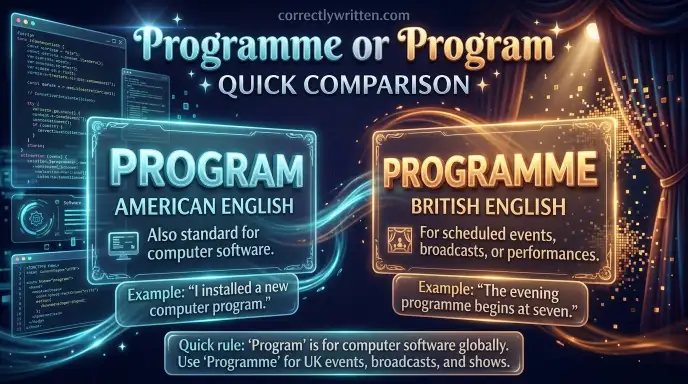
Both programme and program are correct spellings, but the right choice depends on the type of English and the context. In British English, programme is generally used for planned activities, television shows, events, and organized courses, while program is commonly used for computer software.
In American English, program is the standard spelling for nearly all meanings, including events, television shows, educational plans, and computer applications. This difference often confuses writers who read English content from different countries or work with international audiences. For example, a British newspaper might advertise a television programme, while an American website would describe the same kind of show as a television program.
However, a British technology company would still refer to a computer program. Understanding these regional conventions helps you choose the right spelling for articles, assignments, business documents, and digital content. This guide explains the meanings, origins, regional differences, common mistakes, and everyday uses of programme and program so you can write confidently.
Programme or Program: Quick Answer
Both spellings are correct, but their use depends on regional spelling conventions and meaning.
- British English: Programme for most non computing meanings; program for computer software.
- American English: Program for almost all meanings, including events, broadcasts, and software.
- Australian English: Program is commonly used, although programme may appear in some contexts.
- Canadian English: Program is generally preferred, especially in official and institutional usage.
Examples:
British English: “We watched a television programme last night.”
American English: “We watched a television program last night.”
British and American English: “The developer created a computer program.”
The key is to follow the spelling convention of your intended audience and remain consistent throughout your writing.
Definition and Meaning of Programme and Program
What Does Programme Mean?
In British English, programme is a noun that commonly refers to a planned series of activities, an organized event, a television or radio broadcast, or a structured course of study.
Examples include:
- “The school introduced a new reading programme.”
- “The television programme begins at eight.”
- “She joined a training programme at work.”
- “The event programme lists the speakers and their presentation times.”
In these examples, programme describes something planned or organized.
The spelling is especially common in British publications, educational materials, and event information.
What Does Program Mean?
Program has the same general meanings as programme in American English. It can refer to a schedule of activities, a television show, an educational course, or an organized initiative.
Examples:
- “The school launched a new reading program.”
- “My favorite television program starts at nine.”
- “He enrolled in a professional training program.”
- “The city introduced a recycling program.”
The word also has an important computing meaning in both British and American English.
A computer program is a set of instructions that tells a computer how to perform specific tasks.
Example: “The programmer wrote a program to organize the data.”
In British English, program is the usual spelling for this computing meaning, too.
What Is the Difference in Simple English?
The difference is mainly regional.
In British English, writers usually choose programme for television shows, organized activities, and courses, but program for computer software.
In American English, program is used for all these meanings.
The words often mean the same thing; the spelling changes according to the English variety being used.
The Origin of Programme and Program
The word program entered English through French, ultimately tracing back to Greek roots associated with a public notice or written announcement. Over time, its meaning expanded to include a planned list of activities, a broadcast, an organized course, and computer instructions.
The spelling programme developed under French influence and became established in British English for many non computing meanings. The shorter spelling program became standard in American English.
As computing developed, program became the established spelling for computer software in both British and American English. This distinction remains important today.
Although the spellings differ in some contexts, they share the same historical background and often carry the same meaning.
Programme vs Program: The Main Difference
The main difference is how the spellings are used in different English varieties.
Programme is commonly used in British English for planned activities, television broadcasts, educational courses, and organized events.
Example: “The university offers a summer programme for international students.”
Program is used in American English for those same meanings. It is also the standard spelling for computer software in both British and American English.
Example: “The university offers a summer program for international students.”
Computing example: “The engineer tested the computer program.”
For this reason, neither spelling is universally correct for every situation. The best choice depends on your audience, the meaning, and the spelling convention you follow.
British English vs American English Spelling
The distinction becomes clearer when the two varieties are compared.
British English
British English commonly uses programme for:
- Television and radio broadcasts
- Educational courses
- Training initiatives
- Government and community projects
- Planned events and activities
Examples:
“The documentary programme explores wildlife.”
“She joined a language learning programme.”
For computer software, British English uses program.
Example: “The computer program needs an update.”
American English
American English generally uses program for all these meanings.
Examples:
“The television program explores wildlife.”
“She joined a language learning program.”
“The computer program needs an update.”
American English does not normally use programme in these contexts.
What About Other English Speaking Countries?
Usage varies by country and institution. Australian English commonly uses program, while programme can still appear in certain established names or specific contexts. Canadian English generally favors program, including in many official and educational settings.
If you are writing for an international audience, program is widely understood. However, if your publication follows British English, use programme for non computing meanings and program for computing.
Which Spelling Should You Use?
Choose the spelling that matches your audience and the meaning of the word.
Use programme when:
- Writing in British English about television or radio shows
- Describing a British educational course
- Referring to a planned event or organized initiative in British English
- Following a publication’s British spelling style
Use program when:
- Writing in American English
- Referring to computer software in British or American English
- Writing for an audience or organization that follows American, Canadian, or Australian conventions
- Following a style guide that prefers the shorter spelling
For example, a British university might advertise a summer programme, while an American university would advertise a summer program. Both could describe their software as a computer program.
The most important rule is consistency. Avoid switching between regional spellings without a clear reason.
Common Mistakes with Programme and Program
Mistake 1: Assuming Programme Is Always British and Program Is Always American
This is an oversimplification. British English uses program for computing, while American English uses program for almost all meanings.
Correct British usage: “The television programme was interesting.”
Correct British computing usage: “The computer program crashed.”
Mistake 2: Writing Programme for Computer Software in British English
In standard British usage, program is the usual spelling for computer software.
Less suitable: “The programmer updated the computer programme.”
Preferred: “The programmer updated the computer program.”
Mistake 3: Mixing Spellings in the Same Article
Switching between programme and program without a reason can make writing look inconsistent.
If you are writing in British English about educational courses, use programme consistently for that meaning. Use program when referring to computer software.
Mistake 4: Thinking One Spelling Is Incorrect Everywhere
Both forms are accepted in the appropriate contexts. Programme is not simply a misspelling of program, and program is not incorrect in British English.
The meaning, audience, and regional convention determine the preferred form.
Mistake 5: Ignoring an Organization’s Official Spelling
Universities, broadcasters, government agencies, and companies may use a spelling in their official programme or program names. Preserve the official spelling when referring to a named initiative or title.
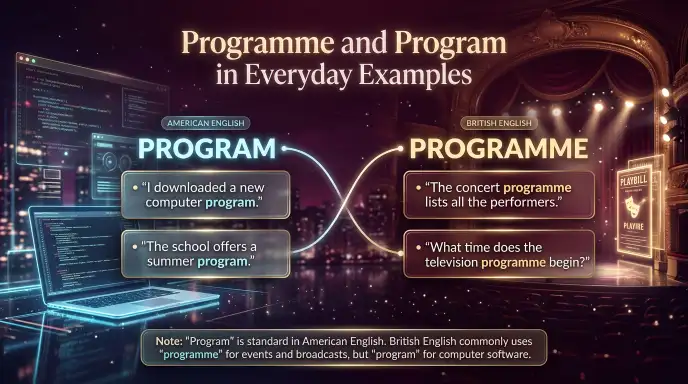
Programme and Program in Everyday Examples
Education and Training
British English: “The college offers a professional development programme.”
American English: “The college offers a professional development program.”
Both sentences describe an organized learning opportunity.
Television and Radio
British English: “The television programme features interviews with local artists.”
American English: “The television program features interviews with local artists.”
The spelling changes, but the meaning remains the same.
Events and Activities
British English: “The event programme includes a welcome speech and three workshops.”
American English: “The event program includes a welcome speech and three workshops.”
Both refer to a schedule or list of activities.
Computing and Technology
British English: “The technician installed a new computer program.”
American English: “The technician installed a new computer program.”
The spelling is the same because program is standard for computer software in both varieties.
Government and Community Projects
British English: “The council introduced a recycling programme.”
American English: “The city introduced a recycling program.”
Both describe an organized public initiative.
Programme vs Program: Quick Comparison
Programme
Meaning: A planned set of activities, an educational course, a broadcast, or an organized initiative.
Spelling status: Standard in British English for many non computing meanings.
Example: “The training programme lasts six weeks.”
Program
Meaning: A planned set of activities, a broadcast, an organized initiative, or computer software.
Spelling status: Standard in American English for general use and in both British and American English for computing.
Example: “The training program lasts six weeks.”
Best choice: Use programme for many non computing meanings in British English. Use program in American English and for computer software in both varieties.
Programme or Program: Google Trends and Usage

People often search for programme or program because both spellings are established in English, but their use differs by region and context.
British publications commonly use programme for broadcasts, courses, and organized activities. American publications generally use program for those same meanings. In technology, program is the standard spelling in both varieties.
Search interest may vary by country, topic, and time. Exact search volumes or regional popularity rankings should not be assumed without checking current trend data.
For writers, the practical lesson is to identify the intended audience before choosing a spelling. A British focused article about television may use programme, while an American focused article would use program. In a technical article about software, use program regardless of if the audience is British or American.
Frequently Asked Questions
Q1. What is the difference between a program and a programme?
Program is the standard spelling in American English for computer software, scheduled activities, and broadcasts. Programme is commonly used in British English for events, television shows, and organized activities. However, British English generally uses program for computer software.
Q2. What is programme meaning?
A programme is a planned series of activities, events, or performances. It can also refer to a television or radio show, or a printed guide to an event. For example, “The school organized a programme for its annual celebration.”
Q3. What is a program example?
A program can refer to different things depending on the context. Examples include a computer program that edits photos, a television program that presents the news, or a fitness program designed to improve health. In American English, program is used for all these meanings.
Q4. Is it correct to say programme?
Yes, programme is correct in British English and is also used in several other varieties of English. It is commonly used for organized events, television shows, and planned activities. For computer software, British English generally uses program.
Q5. How do you say programme?
Programme is pronounced PROH gram in many British English accents. It has two syllables, with the stress on the first syllable. The word is pronounced the same as program; the difference is in spelling, not pronunciation.
Q6. What is the difference between programs and programs?
Programs and programs are spelled identically, so there is no spelling difference between them. If you intended to compare programs and programmes, programs is the usual American spelling, while programmes is commonly used in British English for events and broadcasts.
Q7. What are two types of programs?
Two common types of computer programs are system software and application software. System software helps operate and manage a computer, while application software helps users perform specific tasks, such as writing documents or editing photos.
Q8. What is this program?
The meaning of program depends on the context. It could refer to computer software, a television show, a scheduled event, or a planned series of activities. If you share where you saw the word or provide the sentence, I can explain its exact meaning.
Conclusion
Programme and program are both correct spellings, but their use depends on regional conventions and context. British English generally uses programme for television and radio broadcasts, educational courses, planned events, and organized initiatives. American English uses program for these meanings. In computing, program is the standard spelling in both varieties.
The easiest way to remember the difference is to consider your audience first. If you are writing for British readers, use programme for non computing meanings and program for software. If you are writing for American readers, use program across these contexts. Other English speaking countries may follow their own conventions, so an organization’s style guide can be helpful.
Above all, consistency makes your writing clearer and more professional. Neither spelling is automatically wrong in every context. By choosing the form that matches your meaning and audience, you can use programme and program accurately in articles, assignments, business documents, and everyday communication.
📚 Every Word Matters:
Slimy or Slimey: Correct Spelling, Meaning & Usage

Hi, I’m Ava Collins, a writer and English language enthusiast behind CorrectlyWritten. I’m passionate about making grammar simple, clear, and easy to understand. I write about grammar rules, confusing words, spelling, and everyday English usage to help readers write more accurately and confidently.








3 thoughts on “Programme or Program: Correct Spelling, Meaning & Usage ”