
Slimy is the correct standard spelling, while slimey is a common misspelling. The word slimy is an adjective used to describe something covered with slime, slippery, or unpleasantly wet and sticky.
It can also describe a person or behavior that seems dishonest, sneaky, or morally unpleasant. Many people write slimey because the base word slime ends in the letter e, making it seem natural to keep that letter when adding :y. However, standard English drops the final e in this word, giving us slimy.
You might use it to describe a slimy rock beside a pond, a slimy substance on a surface, or a slimy character in a story. Understanding the difference between slimey and slimy helps you avoid spelling mistakes in everyday conversations, school assignments, creative writing, and professional content. This guide explains the correct spelling, meaning, origin, grammar, regional usage, common errors, and practical examples.
Slimey or Slimy: Quick Answer
Slimy is the correct standard spelling.
Slimey is a nonstandard spelling and should generally be avoided in edited English.
- Correct: “The rocks were slimy after the rain.”
- Incorrect: “The rocks were slimey after the rain.”
- Correct: “The frog slipped on a slimy leaf.”
- Incorrect: “The frog slipped on a slimey leaf.”
The spelling rule is simple:
Slime + y = slimy
The final e is dropped before adding :y.
Definition and Meaning of Slimy and Slimey
What Does Slimy Mean?
Slimy is an adjective that describes something covered in slime or having a slippery, sticky, wet texture.
For example, a rock covered in algae near a pond may feel slimy. A wet, slippery substance on the floor might also be described as slimy.
Examples:
- “The stones felt slimy under my feet.”
- “A slimy layer covered the inside of the container.”
- “The snail left a slimy trail across the garden.”
- “The fish slipped out of his slimy hands.”
The word can describe both the physical texture of something and an unpleasant feeling associated with it.
What Does Slimy Mean When Describing a Person?
The word slimy can also have a figurative meaning. When used to describe a person, it often suggests that the person is dishonest, manipulative, insincere, or unpleasant.
Examples:
- “The story’s villain was a slimy character.”
- “He made a slimy excuse to avoid responsibility.”
- “Her coworkers considered the salesman’s behavior slimy.”
This usage is informal and usually expresses strong disapproval. It does not describe a person’s physical texture; instead, it criticizes their character or behavior.
What Does Slimey Mean?
Slimey is a spelling variant that people sometimes use because it appears to follow the spelling of slime. However, it is not the standard form in modern English.
For example:
Nonstandard: “The wall felt slimey.”
Standard: “The wall felt slimy.”
If you are writing an article, assignment, story, or professional message, choose slimy.
The Origin of Slimy
The word slimy comes from slime, a noun referring to a soft, slippery, sticky substance. The noun has historical roots in Old English and related Germanic words.
English commonly forms adjectives by adding the suffix :y, which can mean “having,” “covered with,” or “characterized by” something.
In this case:
slime + y = slimy
The final e is removed before the suffix is added. The resulting adjective describes something that has slime or resembles it.
The same spelling pattern occurs in other words, such as:
- Grease : greasy
- Noise : noisy
- Ice : icy
These examples help illustrate why slimy, rather than slimey, is the standard spelling.
Slimey vs Slimy: The Main Difference
The main difference is spelling rather than meaning.
Slimy is the accepted standard adjective. It can describe a slippery substance, a surface covered with slime, or someone whose behavior seems dishonest or unpleasant.
Example: “The slimy path was difficult to walk on.”
Slimey is a nonstandard spelling that may appear in informal writing, online posts, or spelling errors.
Example: “The slimy path was difficult to walk on.”
For clear and correct English, use slimy in all ordinary writing contexts.
British English vs American English Spelling
There is no standard British:American spelling difference for this word.
Both British and American English use slimy as the correct spelling.
British English: “The stones beside the river were slimy.”
American English: “The stones beside the river were slimy.”
The spelling remains the same in both varieties. Although slimey may occasionally appear in informal writing, it is not the preferred standard spelling in either region.
If you are writing for a British, American, or international audience, slimy is the appropriate choice.
Which Spelling Should You Use?
Use slimy whenever you need the standard adjective.
It is suitable for:
- School and university assignments
- Blog posts and articles
- Professional emails
- Creative writing and storytelling
- Product or surface descriptions
- Everyday conversations and social media posts
Examples:
“The slimy surface made the steps dangerous.”
“A slimy substance was stuck to the bottom of the jar.”
“The detective suspected that the slimy businessman was hiding something.”
Avoid slimey in edited writing because it is not the standard spelling.
Common Mistakes with Slimey and Slimy
Mistake 1: Keeping the Final E
Incorrect: “The floor became slimey.”
Correct: “The floor became slimy.”
The final e in slime is dropped before adding :y.
Mistake 2: Assuming Slimey Is Correct Because Slime Ends in E
The spelling slimey may look logical, but English spelling does not always preserve the final e when a suffix is added.
The standard adjective is slimy.
Mistake 3: Confusing Slimy with Slim
These words have different meanings.
Slimy describes something slippery, sticky, or figuratively dishonest.
Example: “The slimy rock was covered in algae.”
Slim describes something thin or having a small amount of body fat. It can also mean small or limited in quantity.
Example: “She carried a slim notebook.”
Mistake 4: Using Slimy Only for Physical Substances
Although slimy often describes wet, slippery textures, it can also describe unpleasant behavior.
Example: “The character used a slimy trick to deceive his friends.”
The figurative meaning is common in informal conversation and fiction.
Mistake 5: Treating Slimey as a British or American Variant
Neither British nor American English uses slimey as the standard spelling. The correct form is slimy in both varieties.
Slimy in Everyday Examples
About Nature
- “The rocks near the waterfall were slimy.”
- “A snail left a slimy trail across the garden path.”
- “The fish had a slimy coating on its skin.”
- “The pond’s edges became slimy with algae.”
- “She avoided stepping on the slimy leaves.”
Objects and Substances
- “The container had a slimy layer inside.”
- “The soap made the surface feel slimy.”
- “The old pipe was covered with a slimy substance.”
- “He wiped the slimy residue off the table.”
- “The wet steps felt slimy beneath her shoes.”
People and Behavior
- “The villain was a slimy character who tricked everyone.”
- “His slimy comments made the conversation uncomfortable.”
- “She refused to trust the slimy salesman.”
- “The politician was portrayed as a slimy opportunist in the novel.”
- “His slimy behavior damaged his reputation.”
These examples show how slimy can describe a physical texture or express a negative judgment about someone’s behavior.
Slimy vs Slime: Understanding the Difference
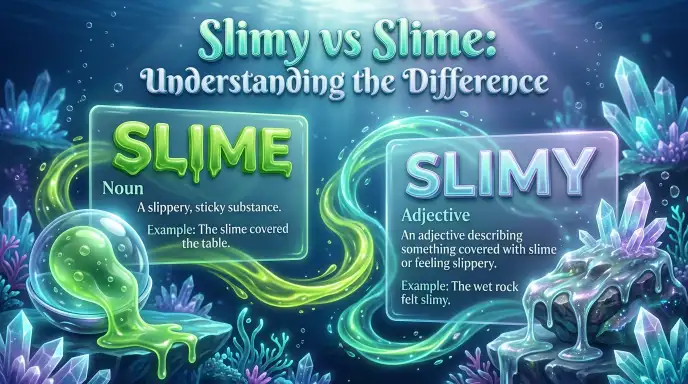
Slime is a noun. It refers to a slippery, sticky substance.
Example: “The children found slime in the container.”
Slimy is an adjective. It describes something that has slime or feels slippery and sticky.
Example: “The container felt slimy.”
The two words are related, but they have different grammatical functions. Use slime when naming the substance and slimy when describing something.
Slimey or Slimy: Easy Way to Remember
Remember this simple spelling pattern:
Slime + y = slimy
Drop the final e before adding :y.
You can also compare it with these familiar words:
- Grease becomes greasy.
- Noise becomes noisy.
- Ice becomes icy.
- Slime becomes slimy.
Thinking of these related spelling patterns can help you remember the correct form.
Whenever you need an adjective describing something slippery, sticky, or unpleasantly dishonest, write slimy, not slimey.
Slimey or Slimy: Quick Comparison
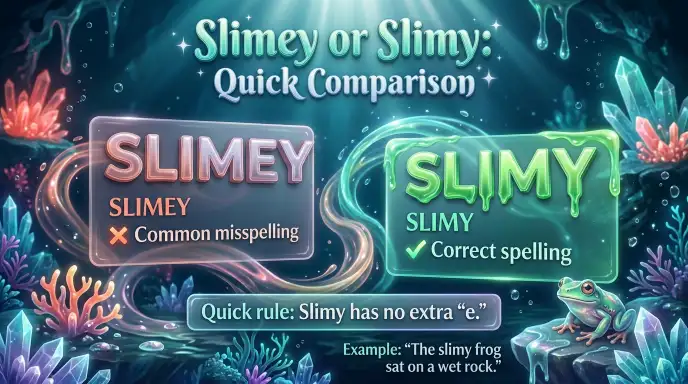
Slimy
Meaning: Covered in slime, slippery, sticky, or figuratively dishonest and unpleasant.
Spelling status: Correct standard spelling.
Example: “The slimy rock was difficult to hold.”
Slimey
Meaning: Intended to describe the same qualities as slimy.
Spelling status: Nonstandard spelling.
Example: “The slimey rock was difficult to hold.” This spelling should be corrected to slimy.
Best choice: Use slimy in standard English writing.
Slimey or Slimy: Google Trends and Usage
People may search for slimey or slimy because the base word slime ends in e, making the alternative spelling seem plausible.
However, slimy is the standard spelling used in edited English. It appears in descriptions of nature, household surfaces, substances, fictional characters, and unpleasant behavior.
Search interest can change over time and by region. Without checking current Google Trends data, it would be inaccurate to provide exact search volumes or claim a specific popularity gap.
For everyday communication and published writing, the practical rule is clear: use slimy. It is the recognized standard form in both British and American English.
Frequently Asked Questions
Q1. Is it spelled slimy or slimey?
Slimy is the correct standard spelling. It describes something slippery, sticky, or covered with slime. Slimey is a common misspelling and should generally be avoided in formal writing.
Q2. What does slimey mean?
Slimey is usually a misspelling of slimy, which means slippery, sticky, or covered with a soft, unpleasant substance. It can also describe a person who behaves dishonestly or in a disgusting, untrustworthy way.
Q3. What is a word for a slimy person?
Words such as sleazy, creepy, shady, and dishonest can describe a person considered slimy in a figurative sense. The best choice depends on the behavior: sleazy suggests unpleasant or immoral conduct, while shady suggests dishonesty or suspicious activity.
Q4. How do you say “slimy”?
Slimy is pronounced SLY:mee. It has two syllables, with the stress on the first syllable. The first part rhymes with “fly,” and the second sounds like “me.”
Q5. What is the word “slimy”?
Slimy is an adjective that describes something covered in slime or having a slippery, sticky texture. It can also be used figuratively to describe someone whose behavior seems dishonest, unpleasant, or morally questionable. For example, “The wet rock felt slimy.”
Q6. What is a better word for slimy?
A suitable alternative depends on what you mean. For a physical texture, use slippery, gooey, sticky, or mucous:covered. For a person’s behavior, consider sleazy, deceitful, manipulative, or untrustworthy.
Q7. How to say wet without saying wet?
You can use damp, moist, soaked, drenched, soggy, or waterlogged, depending on the situation. Damp means slightly wet, soaked means thoroughly wet, and soggy describes something unpleasantly wet and soft.
Q8. What type of word is “slimy”?
Slimy is an adjective because it describes a noun. For example, in “The slimy surface was difficult to hold,” the word slimy describes the surface. Its related noun is slime, and its comparative and superlative forms are slimier and slimiest.
Conclusion
Slimy is the correct standard spelling, while slimey is a nonstandard variant. The word slimy describes something covered with a slippery, sticky substance, but it can also be used figuratively to criticize dishonest or unpleasant behavior. It is a useful adjective in everyday conversation, descriptive writing, storytelling, and articles.
The spelling rule is easy to remember: when forming the adjective from slime, drop the final e and add :y to create slimy. This pattern is similar to grease becoming greasy and noise becoming noisy. British and American English use the same spelling, so there is no need to choose a regional variation.
For schoolwork, professional writing, blog posts, and everyday communication, choose slimy. Remembering this simple pattern will help you avoid the common mistake of writing slimey.
🌟 Make Every Word Count:
Kerb or Curb: Correct Spelling, Meaning & Usage

Hi, I’m Ava Collins, a writer and English language enthusiast behind CorrectlyWritten. I’m passionate about making grammar simple, clear, and easy to understand. I write about grammar rules, confusing words, spelling, and everyday English usage to help readers write more accurately and confidently.








3 thoughts on “Slimy or Slimey: Correct Spelling, Meaning & Usage ”