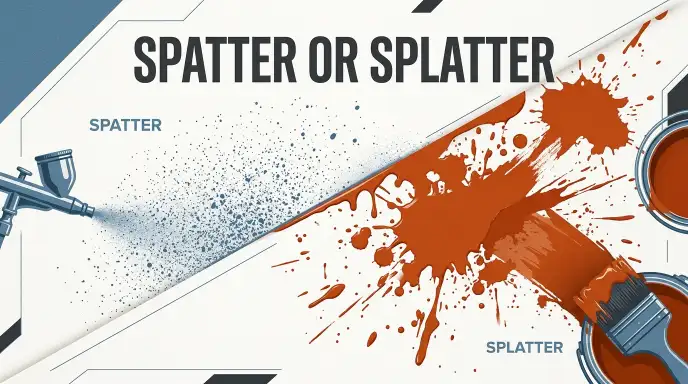
Spatter and splatter are both correct English words, but they are not always used in exactly the same way. Spatter usually refers to small drops or spots of liquid scattered over a surface, while splatter often suggests a larger, messier, or more noticeable spread of liquid or material. The two words overlap, so context matters.
People often confuse these words because both can describe liquid being scattered by movement, impact, or force. They can also work as nouns and verbs, which makes their usage seem even more similar.
This guide explains the difference between spatter and splatter in simple terms. You will learn their meanings, origins, common contexts, examples, regional usage, frequent mistakes, and the easiest way to choose the right word.
Spatter or Splatter: Quick Answer
Spatter and splatter are both correct words.
- Spatter usually means small drops scattered in different directions.
- Splatter often suggests a messier or heavier scattering of liquid or soft material.
- Both words can be used as nouns and verbs.
- They can describe water, paint, mud, blood, grease, or other liquids.
- In many everyday sentences, either word may work, but splatter often creates a stronger image of mess or force.
Examples:
- Mud spattered across my shoes.
- Paint splattered all over the wall.
- The windshield was covered with spatters of rain.
The difference is often one of degree and emphasis rather than a strict grammatical rule.
What Does Spatter Mean?
Spatter means to scatter small drops or particles of a liquid or substance over an area.
It can be used as both a verb and a noun.
Spatter as a Verb
As a verb, spatter describes the action of scattering small drops.
Examples:
- Rain spattered against the window.
- Mud spattered my trousers.
- The artist spattered paint across the canvas.
- Grease spattered onto the stove.
The focus is usually on small drops being scattered.
Spatter as a Noun
As a noun, spatter refers to the drops or marks produced by the scattering.
Examples:
- There were spatters of paint on the floor.
- The car had mud spatter along the sides.
- Small spatters of water covered the mirror.
The word can describe both the individual drops and the resulting marks.
Common Contexts for Spatter
You may see spatter used with:
- Rain
- Mud
- Paint
- Water
- Grease
- Oil
- Blood
- Dirt
For example:
The passing car caused mud to spatter onto the sidewalk.
What Does Splatter Mean?
Splatter also means to scatter liquid or another substance, often in a messy or forceful way.
Like spatter, it can work as both a verb and a noun.
Splatter as a Verb
As a verb, splatter describes liquid or another substance being thrown or scattered in drops.
Examples:
- The paint splattered across the wall.
- Water splattered onto the floor.
- Mud splattered all over the car.
- Sauce splattered onto my shirt.
Splatter often gives the reader a stronger sense of mess or sudden movement.
Splatter as a Noun
As a noun, splatter refers to the scattered drops or the messy marks they create.
Examples:
- There was paint splatter on the table.
- The floor was covered in mud splatter.
- I noticed splatter on the kitchen wall.
The noun can describe the visible result of a liquid or substance being scattered.
Common Contexts for Splatter
Splatter is often used when the result is messy, dramatic, or visually noticeable.
Common examples include:
- Paint
- Mud
- Water
- Food
- Grease
- Sauce
- Blood
For example:
The children splattered paint across the old wall.
The Difference Between Spatter and Splatter
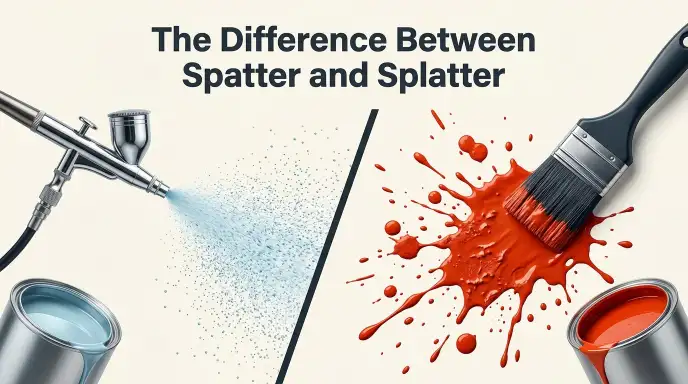
The main difference is the feeling or image created by each word.
Spatter often suggests relatively small drops scattered across a surface. Splatter can suggest a more forceful, messy, or extensive scattering.
Spatter
Think of small scattered drops.
Rain spattered against the window.
The image is of individual drops hitting the glass.
Splatter
Think of a mess created by scattered liquid or material.
The paint splattered across the wall.
The image is more energetic and messy.
Do They Overlap?
Yes. The meanings overlap considerably.
For example, both of these sentences can describe paint spreading across a surface:
The paint spattered across the canvas.
The paint splattered across the canvas.
The second sentence may sound more dramatic or messy, but both are understandable.
Spatter vs Splatter: Quick Comparison
| Word | Basic Meaning | Typical Feeling | Example |
| Spatter | Small drops scattered over an area | Light or scattered | Rain spattered the window. |
| Splatter | Liquid or material scattered in a messy way | Messy or forceful | Paint splattered the wall. |
| Spattered | Scattered in small drops | Less dramatic | Mud spattered my shoes. |
| Splattered | Scattered with a stronger messy effect | More dramatic | Mud splattered the car. |
The Origin of Spatter and Splatter
The words spatter and splatter have a long history in English and are closely related in meaning.
Spatter has been used in English for centuries to describe the scattering of drops or small particles. Its development is connected with words that imitate the sound or action of liquid striking a surface.
Splatter developed later as an expressive variation. The added l gives the word a slightly stronger sound and often a stronger sense of messy movement.
English contains many words that have developed through sound symbolism. These words can give readers an impression of an action simply through their sound.
For example:
- Splash suggests a larger movement of water.
- Spatter suggests scattered drops.
- Splatter often suggests a messier scattering.
These associations are useful for understanding the words, but they do not create strict rules. Actual usage depends on the sentence and context.
How Spatter and Splatter Are Used in Different Contexts
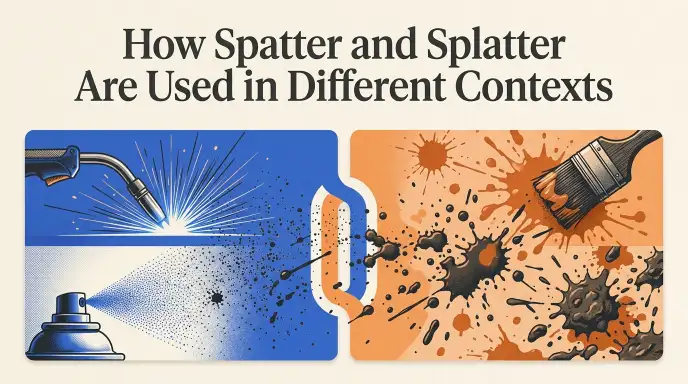
The best word can change depending on what is being described.
Rain
Spatter often works naturally when describing small raindrops hitting a surface.
Rain spattered against the glass.
Splatter can also work when the rain creates a more forceful or messy effect.
Heavy rain splattered mud across the road.
Paint
Both words are common with paint.
The artist spattered paint across the canvas.
The artist splattered paint across the canvas.
Splattered may suggest a more energetic painting technique.
Mud
Both words can describe mud being thrown onto something.
The tires spattered mud onto the car.
The tires splattered mud across the car.
The second example sounds messier and more dramatic.
Food and Cooking
Splatter is especially common when hot food or cooking oil jumps from a pan.
Hot oil splattered onto the stove.
You can also use spatter:
Hot oil spattered across the counter.
Both are possible, although splatter often creates a stronger image.
Water
Both words can describe water droplets.
Water spattered onto the floor.
Water splattered onto the floor.
The surrounding context determines which one sounds more natural.
Common Mistakes With Spatter and Splatter
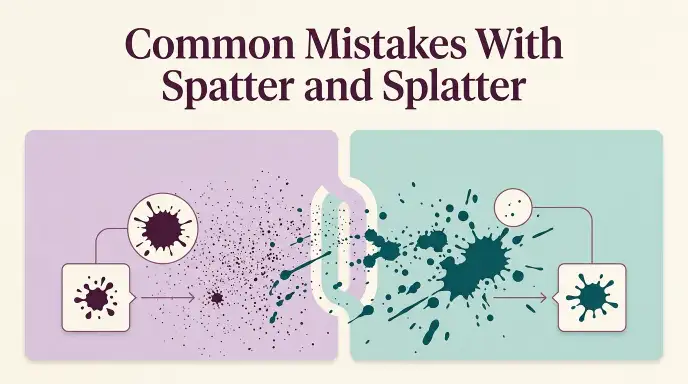
These words are easy to confuse because their meanings overlap.
Mistake 1: Thinking One Word Is Wrong
Incorrect assumption:
Splatter is just an incorrect spelling of spatter.
Correct understanding:
Spatter and splatter are both established English words.
They can have similar meanings, but splatter often suggests a messier or more forceful action.
Mistake 2: Assuming Spatter Always Means Less Liquid
There is no strict rule that says spatter must involve a tiny amount of liquid.
Example:
Mud spattered across the vehicle.
The word describes scattered drops or marks. The exact amount depends on the situation.
Mistake 3: Assuming Splatter Always Means Something Violent
Splatter can describe completely ordinary situations.
Examples:
- Paint splattered across the canvas.
- Sauce splattered onto the counter.
- Water splattered onto the floor.
The word does not automatically imply violence.
Mistake 4: Using the Words Without Considering Context
A sentence may be grammatically correct but sound less natural with one word.
For example:
Hot oil splattered from the pan.
This sounds natural because splatter emphasizes the sudden mess.
For gentle scattered drops, spatter may fit better:
Light rain spattered against the window.
Memory Tip
Think:
Spatter = scattered drops.
Splatter = scattered drops with a stronger messy effect.
This is a useful guide, although the two words can overlap.
Spatter or Splatter in Everyday Examples
Emails
Please be careful when using the printer because ink may spatter onto the desk.
The kitchen floor needs cleaning because cooking oil splattered across it.
Business Writing
Paint spattered onto the equipment during the renovation.
The machine caused oil to splatter across the work area.
In technical or professional writing, choose the word that describes the physical action most clearly.
News Writing
Heavy rain spattered windows across the city.
Mud splattered several vehicles after the storm.
News writing often favors simple and direct wording.
Blogs
Use a lid to prevent hot oil from splattering around the stove.
A fine spray of paint spattered across the canvas.
Both words can work well in descriptive articles.
Social Media
Somehow, I got paint splattered all over my shoes!
Rain spattered against the window all afternoon.
Informal writing gives you more freedom to choose the word that best matches the image you want to create.
Academic Writing
Droplets spattered across the surface during the experiment.
The sample caused liquid to splatter onto the surrounding area.
Academic writing should focus on precision rather than dramatic language.
Daily Conversation
My shoes are covered in mud spatter.
The sauce splattered all over the stove.
Rain was spattering against the window.
These are natural everyday uses of both words.
Which Word Should You Use?
There is no single word that works in every sentence.
Use spatter when you want to emphasize small drops scattered over a surface.
Use splatter when you want to emphasize a messy, sudden, or forceful scattering.
Choose Spatter When:
- You are describing small scattered drops.
- The action is relatively light.
- You want a neutral description.
- You are describing rain or fine droplets.
- You are focusing on individual marks or spots.
Example:
Rain spattered against the window.
Choose Splatter When:
- The action creates a noticeable mess.
- Liquid moves suddenly or forcefully.
- You are describing paint, sauce, mud, or grease.
- You want a stronger visual effect.
Example:
Grease splattered across the stove.
When Either Word Works
Sometimes both choices are natural.
Paint spattered across the canvas.
Paint splattered across the canvas.
The first can sound more focused on scattered drops. The second can sound more energetic or messy.
Modern Usage and Search Confusion
People often search spatter or splatter because dictionaries define the words in closely related ways.
The confusion also comes from everyday speech. A speaker may use one word in a situation where another speaker would choose the other.
Modern English does not always maintain a sharp boundary between the two words. Their meanings overlap, especially when describing paint, water, mud, grease, and other liquids.
For clear writing, focus on the image you want to create:
- Small scattered drops: spatter
- Messier or stronger scattering: splatter
This simple distinction works well for most everyday situations.
Quick Comparison Table
| Word | Part of Speech | Meaning | Typical Context | Example |
| Spatter | Verb | To scatter small drops | Rain, paint, water, mud | Rain spattered the window. |
| Spatter | Noun | Scattered drops or marks | Paint, water, mud | There was paint spatter on the floor. |
| Splatter | Verb | To scatter liquid or material messily | Paint, grease, sauce, mud | Oil splattered onto the stove. |
| Splatter | Noun | Scattered liquid or messy marks | Paint, food, mud | The wall had paint splatter on it. |
Key Takeaways
- Spatter and splatter are both correct English words.
- Spatter often refers to small scattered drops.
- Splatter often suggests a messier or more forceful effect.
- Both words can be verbs and nouns.
- Both can describe paint, water, mud, grease, and other substances.
- Their meanings overlap in many sentences.
- Use spatter for a lighter scattered effect.
- Use splatter when you want to emphasize mess or force.
Frequently Asked Questions
Q1. Is it called blood spatter or splatter?
Blood spatter is the standard term for droplets of blood scattered through the air or onto a surface. “Blood splatter” is also used, but spatter is more common in forensic contexts.
Q2. What is the meaning of spatter?
Spatter means small drops or particles scattered over a surface or through the air. It is commonly used for blood, paint, water, and molten metal.
Q3. What is a paint splatter?
Paint splatter refers to drops or spots of paint scattered onto a surface, often accidentally or as an artistic effect. “Paint spatter” is also correct.
Q4. Is it weld spatter or splatter?
Weld spatter is the standard technical term. It describes small droplets of molten metal that escape from the weld pool during welding.
Q5. Which is correct, spatter or splatter?
Both spatter and splatter are correct, but they have slightly different uses. Spatter usually suggests smaller scattered drops, while splatter often suggests larger or messier drops.
Q6. What is the splatter from welding called?
The technical term is weld spatter. It refers to molten metal droplets that are expelled during the welding process and stick to nearby surfaces.
Q7. Why do welders drink milk after welding?
Some welders drink milk because of the traditional belief that it helps remove or neutralize substances inhaled during welding. However, milk is not a substitute for proper ventilation or respiratory protection.
Q8. What are F1, F2, F3, and F4 in welding?
F1 to F4 are welding positions used to describe different positions for fillet welds. They indicate how the weld is positioned and performed.
Q9. Why does spatter happen in MIG welding?
MIG welding spatter can result from incorrect voltage, wire feed speed, shielding gas, or welding technique. Proper settings and a clean workpiece can help reduce it.
Conclusion: Spatter or Splatter?
Spatter and splatter are both correct English words, and their meanings are very close. The main difference is the image each word tends to create.
Spatter often suggests small drops scattered over a surface. It works naturally with rain, water, paint, mud, and other substances. Splatter can suggest a stronger, messier, or more noticeable spread. It is especially natural when describing paint, grease, sauce, mud, or liquid that suddenly moves across a surface.
The two words can overlap, so you do not need to treat them as completely separate terms. In many sentences, either one can make sense. Your choice should depend on the amount of force, the level of mess, and the effect you want your sentence to create.
Remember: spatter suggests scattered drops, while splatter often suggests a stronger and messier spread.
🌟 Make Every Word Count:
Spoilt or Spoiled: Meaning, British vs American English & Examples
Feening or Fiending: Correct Spelling, Meaning & Usage Explained
Maxed or Maxxed? Correct Spelling, Meaning,& Everyday Examples

Hi, I’m Ava Collins, a writer and English language enthusiast behind CorrectlyWritten. I’m passionate about making grammar simple, clear, and easy to understand. I write about grammar rules, confusing words, spelling, and everyday English usage to help readers write more accurately and confidently.








2 thoughts on “Spatter or Splatter? Meaning, Differences, & When to Use Each ”