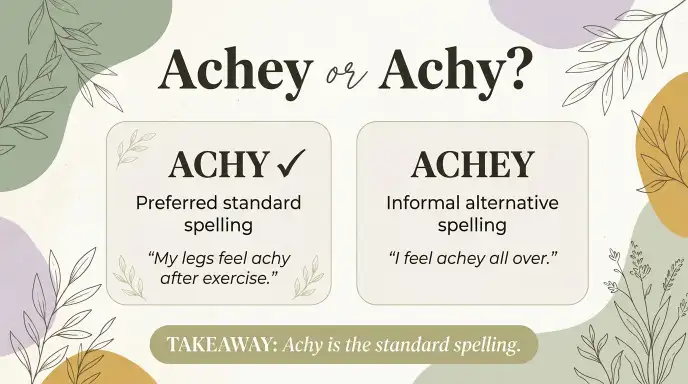
Achy is the standard spelling, while achey is an informal and nonstandard variant that appears occasionally in casual writing. The word achy describes a feeling of mild, continuous pain or soreness in a part of the body.
For example, you might have achy legs after a long walk, an achy back after sitting for hours, or an achy feeling when you are coming down with an illness. The confusion between achey and achy happens because the base word is ache, which ends in the letter e. However, when the suffix y is added, the standard spelling becomes achy, not achey.
This spelling follows the established form used in standard English dictionaries and general writing. Knowing the difference helps you avoid spelling errors in messages, healthrelated descriptions, personal writing, and everyday communication. In this guide, you will learn the meaning, formation, usage, common mistakes, and practical examples of achy and achey.
Achey or Achy: Quick Answer
Achy is the standard spelling.
Achey is sometimes used informally, but it is generally considered a nonstandard spelling.
Use achy when describing a dull, persistent pain or soreness.
Correct: “My shoulders feel achy after exercising.”
Nonstandard: “My shoulders feel achey after exercising.”
The simple rule is:
Achy = standard spelling
Achey = informal, nonstandard variant
Definition and Meaning of Achy and Achey
What Does Achy Mean?
Achy is an adjective that describes a dull, continuing pain or a feeling of soreness in the body.
The pain may not be sharp or severe. Instead, it often feels like a steady discomfort that remains for some time.
Examples include:
- “My back feels achy after a long day.”
- “She woke up with achy muscles.”
- “His legs were achy after the hike.”
- “I have an achy feeling throughout my body.”
The word is commonly used in everyday conversation because it describes discomfort in a simple, natural way.
What Does Achey Mean?
Achey is an alternative spelling sometimes used in informal messages, online posts, and casual writing.
It is formed by keeping the final e in ache before adding y. However, achy is the standard spelling in general English.
For example:
Nonstandard: “I feel achey today.”
Standard: “I feel achy today.”
If you are writing an article, school assignment, professional email, or other edited text, choose achy.
What Does Achy Mean in Simple English?
In simple English, achy means feeling a dull pain or soreness.
For example, if your legs hurt a little after running, you might say:
“My legs feel achy.”
The word describes the feeling rather than identifying a specific injury or medical condition.
The Origin of Achy and Achey
The word achy is formed from the noun and verb ache, which refers to a continuous or prolonged pain, and the suffix y, which can mean “having” or “characterized by.”
The final e in ache is dropped before adding y in the standard spelling:
ache + y = achy
This produces an adjective meaning “characterized by an ache” or “feeling sore.”
The spelling achey appears to preserve the original e from ache, but it is not the standard form used in general edited English.
The same basic spelling principle can be seen in other words formed by adding y, although the exact spelling rules depend on the word.
Achey vs Achy: The Main Difference
The main difference is spelling, not meaning.
Achy is the accepted standard spelling for describing soreness or dull pain.
Example: “My feet are achy after walking all day.”
Achey is an informal, nonstandard variant that some people use because it resembles the original word ache.
Example: “My feet feel achey.”
In standard writing, use achy. It is the clearer and more reliable choice for articles, educational content, professional communication, and formal assignments.
British English vs American English Spelling
There is no widely established BritishAmerican spelling difference for this word.
Both British and American English generally use achy as the standard spelling.
British English: “My legs feel achy after the walk.”
American English: “My legs feel achy after the walk.”
The spelling remains the same in both varieties.
Although achey may appear in informal writing on either side of the Atlantic, it is not the usual standard spelling in either variety.
Which Spelling Should You Use?
Use achy in standard English writing.
It is appropriate for:
- School and university assignments
- Articles and blog posts
- Emails and professional communication
- Personal writing
- Everyday descriptions of soreness
- Healthrelated general information
For example:
“My back feels achy after working at my desk.”
“The runner experienced achy muscles the following morning.”
If you encounter achey in a social media post or informal message, you can usually understand what the writer means. However, when choosing the spelling yourself, achy is the recommended form.
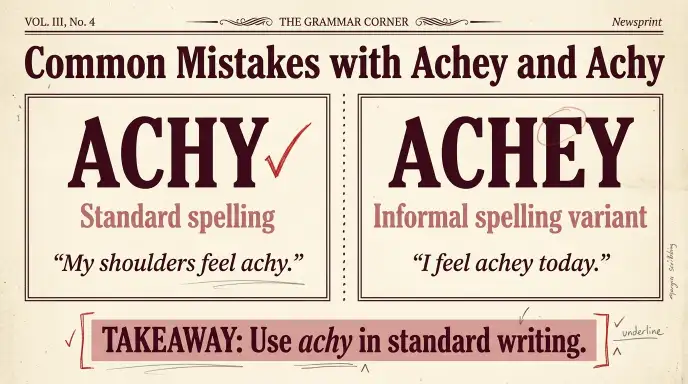
Common Mistakes with Achey and Achy
Mistake 1: Keeping the Final E
Nonstandard: “My shoulders are achey.”
Standard: “My shoulders are achy.”
The standard adjective drops the final e from ache before adding y.
Mistake 2: Assuming Achey Is the More Correct Form
Because ache contains an e, some writers assume that achey must preserve it.
However, standard spelling uses achy.
Mistake 3: Confusing Achy with Aching
Both words are correct, but they have different forms.
Achy: “My legs feel achy.”
Aching: “My legs are aching.”
Achy is an adjective, while aching is commonly used as a verb form or participial adjective.
Mistake 4: Using Achy to Describe Every Kind of Pain
Achy usually suggests dull, persistent soreness. It is not necessarily the best word for sharp, sudden, or intense pain.
For example, “a sharp pain in my foot” communicates something different from “an achy foot.”
Achy in Everyday Examples
After Exercise
“My arms feel achy after lifting weights.”
“Her legs were achy after the long run.”
After a Long Day
“My back is achy from sitting at my desk.”
“He had an achy neck after working on his laptop.”
During an Illness
“I feel tired and achy today.”
“She woke up with an achy body and a headache.”
After Travelling
“My shoulders became achy during the long flight.”
“His legs felt achy after walking around the city.”
In Casual Conversation
“I’m feeling a little achy this morning.”
“Are your muscles still achy after yesterday’s workout?”
These examples show how naturally achy fits into everyday English.
Achy vs Aching: What Is the Difference?
Although achy and aching are related, they are not always used in exactly the same way.
Achy describes a state or feeling of soreness.
Example: “My back feels achy.”
Aching often emphasizes the ongoing pain or sensation.
Example: “My back is aching.”
Both are correct, and the best choice depends on the sentence. You can use either to describe discomfort, but achy is especially common in casual descriptions of general soreness.
Achey or Achy: Easy Way to Remember
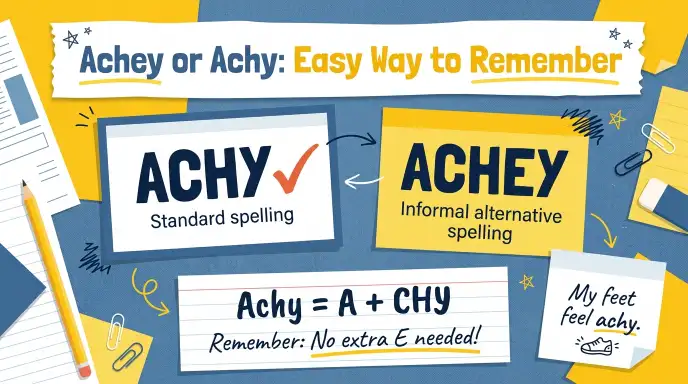
Remember this spelling pattern:
Ache + y = achy
Drop the final e before adding y.
You can also remember the word as:
Achy = a standard adjective for soreness
For example:
“My muscles feel achy.”
When writing about soreness or dull pain, choose achy instead of achey.
Achey or Achy: Quick Comparison
Achy
Meaning: Feeling a dull, continuing pain or soreness.
Spelling status: Standard.
Example: “My shoulders feel achy.”
Achey
Meaning: Intended to describe the same feeling of soreness.
Spelling status: Informal, nonstandard variant.
Example: “My shoulders feel achey.”
Best choice: Use achy in standard English writing.
Achey or Achy: Google Trends and Usage
Both spellings may appear in online searches, casual messages, and usergenerated content. However, achy is the standard form to use in edited English.
People may search for achey or achy because the base word ache retains its final e, making achey look logical at first glance. The standard spelling follows a different pattern: the final e is dropped before adding y.
Search popularity can vary by region and over time, so no exact popularity ranking should be assumed without checking current trend data.
For everyday writing, the useful distinction remains clear: achy is the recommended standard spelling, while achey is a nonstandard variant.
Frequently Asked Questions
Q1. How do you spell achey or achy?
Achy is the standard and correct spelling. Achey is a less common variant, but achy is preferred in standard English writing. It describes a dull, continuous pain.
Q2. What is the meaning of achey?
Achey is usually intended to mean achy, which describes a feeling of dull, persistent pain. For example, “My legs feel achy after a long walk.”
Q3. How do you spell “achy all over”?
The standard spelling is “achy all over.” It describes a feeling of pain or soreness throughout the body. For example, “I feel achy all over after exercising.”
Q4. What is the meaning of aches?
Aches refers to ongoing or repeated dull pains. It can describe discomfort in different parts of the body, as in “muscle aches,” “headaches,” or “body aches.”
Q5. What is an achy pain?
An achy pain is a dull, lingering discomfort rather than a sharp or sudden pain. It may occur in muscles, joints, or other parts of the body.
Q6. How do you say “aches”?
Aches is pronounced “ayks” (rhyming with “cakes”). The ch sounds like the k in “kite,” not the “ch” in “chair.”
Q7. Is it “body ache” or “aches”?
Both are correct, but they are used differently. Body ache can refer to a single general feeling of bodily pain, while body aches commonly describes pain or soreness affecting the body, especially in the phrase “I have body aches.”
Q8. How do you say body aches?
Say “body aches” as “BAHdee ayks” in American English. It refers to pain or soreness in the body, often affecting several muscles or areas at once. For example, “I have body aches and feel tired.”
Conclusion
Achy is the standard spelling, while achey is an informal, nonstandard variant. Both forms are used to communicate the idea of soreness or dull, continuing pain, but achy is the better choice for standard English writing. It is commonly used to describe tired muscles, sore legs, an uncomfortable back, or a general feeling of body soreness.
The spelling becomes easier to remember when you look at how the word is formed. The base word is ache, but when the suffix y is added, the final e is dropped. This gives us achy, the standard adjective. British and American English generally use the same spelling, so there is no need to choose between regional forms.
For articles, assignments, emails, and everyday communication, write achy. Once you remember the pattern ache + y = achy, you can avoid this common spelling confusion.
🔠 Master Spelling:
Forward or Forwards? Meaning, Correct Usage & Differences

Hi, I’m Ava Collins, a writer and English language enthusiast behind CorrectlyWritten. I’m passionate about making grammar simple, clear, and easy to understand. I write about grammar rules, confusing words, spelling, and everyday English usage to help readers write more accurately and confidently.








1 thought on “Achey or Achy? Correct Spelling, Meaning & Usage ”