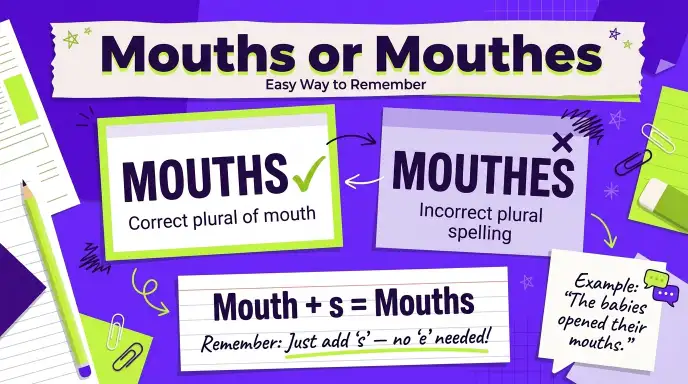
Mouths is the correct standard spelling, while mouthes is a common spelling mistake. The word mouths is the plural form of mouth, referring to more than one person’s or animal’s mouth.
It can also be used as the third person singular form of the verb mouth, meaning to say something without speaking clearly or to move the lips as if speaking. Many writers become confused when forming the plural because English words ending in certain sounds take es, such as boxes and wishes. However, mouth follows a different pattern and simply takes s to become mouths.
Understanding this rule helps you spell the word correctly in everyday conversations, school assignments, articles, emails, and professional writing. In this guide, you will learn the difference between mouthes and mouths, explore their meanings and origins, review British and American English usage, and see practical examples that make the correct spelling easy to remember.
Mouthes or Mouths: Quick Answer
Mouths is the correct spelling in standard English.
Mouthes is generally considered a misspelling and should be avoided in formal and edited writing.
- Singular noun: mouth
- Plural noun: mouths
- Verb: mouth
- Verb with he, she, or it: mouths
Examples:
- Correct: “The children opened their mouths.”
- Incorrect: “The children opened their mouthes.”
- Correct: “She mouths the words silently.”
- Incorrect: “She mouthes the words silently.”
Remember that the correct plural and verb form is mouths, not mouthes.
Definition and Meaning of Mouths and Mouthes
What Does Mouths Mean?
Mouths has two common grammatical uses.
First, it is the plural form of the noun mouth. A mouth is the opening in the face used for eating, drinking, speaking, and breathing.
Examples:
- “The baby opened both eyes and moved his mouth.”
- “The dentist examined the patients’ mouths.”
- “The animals opened their mouths to eat.”
Second, mouths is the third person singular form of the verb mouth. As a verb, mouth can mean to form words with the lips without speaking aloud or to express words in a particular way.
Examples:
- “She mouths the lyrics while listening to the song.”
- “He mouths the word ‘hello’ from across the room.”
- “The actor mouths the dialogue silently.”
The intended meaning depends on how the word is used in a sentence.
What Does Mouthes Mean?
Mouthes is not the standard spelling of the plural noun or the third person singular verb form of mouth.
People may write mouthes because they assume that words ending in certain consonant sounds need es to form their plurals. However, the standard spelling is mouths.
For example:
Incorrect: “The birds opened their mouthes.”
Correct: “The birds opened their mouths.”
Incorrect: “He mouthes the words.”
Correct: “He mouths the words.”
In standard English, use mouths in both cases.
What Is the Meaning of Mouth in Simple English?
In simple English, a mouth is the opening in your face that you use to eat, drink, and speak.
The plural mouths means more than one mouth.
For example, if several children are eating, you could say, “The children have food in their mouths.”
The Origin of Mouths and Mouthes
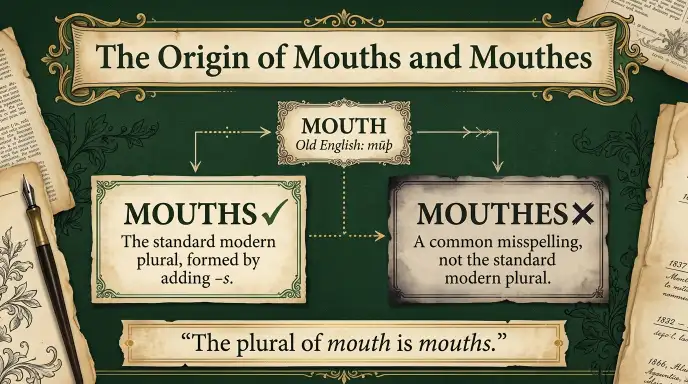
The word mouth comes from Old English mūþ, which referred to the opening used for eating and speaking. It is related to similar words in other Germanic languages.
Over time, English developed a regular way to form many plural nouns by adding s or es. The word mouth follows the pattern of adding s.
The formation is straightforward:
mouth + s = mouths
The same spelling is used when mouth functions as a verb with a third person singular subject:
mouth + s = mouths
The spelling mouthes results from applying an unnecessary es ending. Although the extra letters may seem logical to some writers, they are not part of the standard spelling.
Mouths in British English vs American English
There is no spelling difference between British and American English for this word.
Both varieties use mouths as the standard plural of mouth and as the third person singular form of the verb.
British English: “The children covered their mouths when they laughed.”
American English: “The children covered their mouths when they laughed.”
The spelling remains the same in both examples.
You should therefore use mouths regardless of if you are writing for a British, American, or international audience. Mouthes is not the standard spelling in either variety.
Which Spelling Should You Use?
Use mouths whenever you need the plural of mouth or the verb form used with he, she, or it.
Choose mouths in:
- School and university assignments
- Blog posts and articles
- Emails and workplace communication
- Stories and creative writing
- Social media captions
- Educational materials
Examples:
“The dentist checked the children’s mouths.”
“The speaker mouths the words while the music plays.”
“The hungry puppies opened their mouths.”
Avoid mouthes in formal writing because it is not the accepted standard spelling.
Common Mistakes with Mouthes and Mouths
Mistake 1: Adding an Unnecessary E
Incorrect: “The children washed their mouthes.”
Correct: “The children washed their mouths.”
The word mouth forms its plural by adding s, not es.
Mistake 2: Confusing Mouths with Similar Plural Words
Some nouns form their plurals with es, including boxes, buses, and wishes. This does not mean every noun ending in a similar sound follows the same pattern.
For mouth, the correct form is mouths.
Mistake 3: Writing Mouthes as a Verb
Incorrect: “She mouthes the lyrics.”
Correct: “She mouths the lyrics.”
When the subject is he, she, or it, the verb form is mouths.
Mistake 4: Using Mouth Instead of Mouths
Incorrect: “The babies opened their mouth.”
Correct: “The babies opened their mouths.”
When referring to several mouths, use the plural noun mouths.
Mistake 5: Forgetting the Subject Verb Agreement
Incorrect: “He mouth the words silently.”
Correct: “He mouths the words silently.”
With a singular third person subject such as he, she, or it, the verb takes s.
Mouths in Everyday Examples
Examples as a Plural Noun
- “The children covered their mouths while laughing.”
- “The dentist examined the patients’ mouths.”
- “The puppies opened their mouths to bark.”
- “The babies had milk around their mouths.”
- “The fish opened their mouths near the surface of the water.”
- “The audience watched as the performers opened their mouths to sing.”
Examples as a Verb
- “She mouths the lyrics instead of singing aloud.”
- “He mouths the word ‘sorry’ from across the room.”
- “The actor mouths each line during rehearsal.”
- “The child mouths the words while learning to read.”
- “She mouths a silent thank you to her friend.”
These examples show that mouths can be a plural noun or a verb, depending on its position and function in the sentence.
Mouths vs Mouth: Understanding the Difference
Mouth is the singular noun and the base form of the verb.
Example: “Open your mouth.”
Mouths is the plural noun when referring to more than one mouth.
Example: “The babies opened their mouths.”
Mouths is also the verb form used with he, she, or it in the present simple tense.
Example: “He mouths the words silently.”
The key is to identify the grammatical role of the word. If you mean more than one mouth, use mouths. If you are describing an action performed by one person or thing in the present simple tense, mouths may also be correct.
Mouthes or Mouths: Easy Way to Remember
A simple way to remember the correct spelling is to start with the singular word:
Mouth + s = Mouths
You do not need to add another e.
Compare these forms:
- One mouth : two mouths
- A mouth : several mouths
- She mouths the words.
- He mouths a silent response.
Whenever you are tempted to write mouthes, remember that the standard spelling is mouths.
Mouthes or Mouths: Quick Comparison
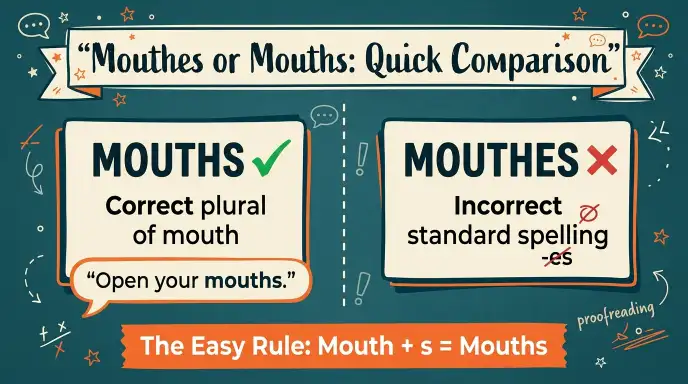
Mouth
Meaning: The opening in the face used for eating, drinking, and speaking; also the base form of a verb.
Example: “Please open your mouth.”
Mouths
Meaning: The plural of mouth or the third person singular form of the verb mouth.
Example: “The children opened their mouths.”
Mouthes
Meaning: An intended plural or verb form of mouth, but not the standard spelling.
Example: “The children opened their mouthes.” This spelling is incorrect in standard English.
Best choice: Use mouths for both the plural noun and the third person singular verb form.
Frequently Asked Questions
Q1. How do you say mouth in plural?
The plural of mouth is mouths. For example, “The children opened their mouths to sing.” The word mouthes is not the standard plural spelling.
Q2. Is it mouth or mouthe?
Mouth is the correct spelling. It refers to the opening in the face used for eating, speaking, and breathing. Mouthe is not the standard spelling of this noun.
Q3. Is it mouths or mouthes?
Mouths is the correct plural form of mouth. English usually forms the plural of nouns ending in th by adding s in this case. For example, “The fish opened their mouths.”
Q4. What is the meaning of mouth?
A mouth is the opening in the face through which a person or animal eats, drinks, and makes sounds. It includes structures such as the lips, teeth, tongue, and gums. The word can also refer to the opening of a river, cave, or container.
Q5. What are the types of mouths?
Mouths vary in shape, size, and structure among humans and animals. In humans, descriptions may include wide, narrow, full lipped, or thin lipped mouths. In animals, mouth structures differ according to their species and feeding habits.
Q6. What is another word for “mouth”?
Synonyms for mouth depend on the context. Words such as oral cavity and opening may fit formal or descriptive writing. For a river, mouth refers to the point where it enters another body of water.
Q7. What is slang for mouth?
Common informal or slang terms for mouth include gob, trap, and pie hole. These expressions can sound rude or humorous, depending on the situation. For example, “Keep your trap shut” is an impolite way to tell someone to stop talking.
Q8. What is the mouth also called?
The mouth is also called the oral cavity in anatomical and medical contexts. This term refers to the space inside the mouth, including areas around the teeth and tongue. In everyday conversation, people generally use the word mouth.
Conclusion
Mouths is the correct spelling, while mouthes is a nonstandard form that should generally be avoided. The word mouths can refer to more than one mouth or describe an action, such as silently forming words with the lips. Its meaning depends on the sentence in which it appears.
The spelling rule is simple: add s to mouth to form mouths. There is no need to insert an extra e. This spelling is used in both British and American English, making it suitable for school assignments, professional writing, blog articles, and everyday communication.
To avoid this common mistake, remember the simple pattern mouth + s = mouths. When you are writing about several mouths or describing someone silently forming words, mouths is the form to choose.
📖 Explore Words:
Achey or Achy? Correct Spelling, Meaning & Usage

Hi, I’m Ava Collins, a writer and English language enthusiast behind CorrectlyWritten. I’m passionate about making grammar simple, clear, and easy to understand. I write about grammar rules, confusing words, spelling, and everyday English usage to help readers write more accurately and confidently.








2 thoughts on “Mouths or Mouthes: Correct Spelling, Meaning & Usage ”