Forward and forwards are both correct words in English. The main difference lies in how people use them and which variety of English they follow. American English often prefers forward, while British English commonly uses both forward and forwards. Both words can describe movement toward a position ahead, progress, or a direction.
For example, you can say “Move forward” or “Move forwards.” Both sentences are correct. However, some expressions use one form more naturally than the other. If you have ever wondered if to write “looking forward” or “looking forwards,” the answer depends on the expression.
This guide explains the meanings, grammar rules, regional differences, common mistakes, and everyday uses of both words. You will also find clear examples and answers to frequently asked questions.
Forward or Forwards: Quick Answer
Forward and forwards are both correct. Your choice depends on the sentence, the expression, and your preferred style of English.
- Forward: Common in American and British English. It can work as an adverb, adjective, or verb.
- Forwards: Usually works as an adverb. British English uses it more often than American English.
- American English: Generally favors forward.
- British English: Commonly accepts both forward and forwards.
Examples:
- Please move forward.
- Please move forwards.
- We need to plan forward.
- The car moved forwards slowly.
Both forms can describe movement toward the front. However, fixed expressions often favor forward, as in “I look forward to hearing from you.”
Definition and Meaning of Forward
The word forward has several meanings. It can describe movement toward the front, progress, or something that comes next. It can also describe a person who acts confidently or speaks too directly.
Forward as an Adverb
As an adverb, forward describes movement toward the front or ahead.
Examples:
- She stepped forward to answer the question.
- The driver moved the car forward.
- We must keep moving forward.
In these sentences, forward explains the direction of movement.
Forward as an Adjective
As an adjective, forward describes something that faces ahead or relates to the future.
Examples:
- The forward section of the ship needs repairs.
- We made a forward plan for the next year.
- The team played a forward pass.
The exact meaning depends on the context.
Forward as a Verb
As a verb, forward means to send something to another person or place.
Examples:
- Please forward the email to your manager.
- I will forward your message to the team.
- Could you forward the documents today?
In these sentences, forward means to send something onward.
Definition and Meaning of Forwards
Forwards is mainly an adverb. It describes movement toward the front, ahead, or in the direction someone faces.
Examples:
- The child took two steps forwards.
- The bus moved forwards slowly.
- She leaned forwards to hear better.
- The crowd moved forwards toward the entrance.
Forwards usually has the same basic meaning as forward when it describes movement.
However, you cannot replace forward with forwards in every sentence. For example, the verb forward means to send something onward. You would say, “Please forward the email,” not “Please forwards the email.”
The word forwards does not work as the standard base form of that verb.
Forward vs Forwards: Main Differences
The main difference involves grammar and regional preference.
Forward
- Works as an adverb, adjective, and verb.
- Appears frequently in American English.
- Commonly appears in fixed expressions.
- Works in phrases such as “look forward to” and “move forward.”
Forwards
- Usually works as an adverb.
- Appears frequently in British English.
- Often describes physical movement toward the front.
- Can replace forward in many movement related sentences.
For example, both “He moved forward” and “He moved forwards” are correct. However, “Please forward the email” requires forward because it functions as a verb.
Forward or Forwards in American and British English
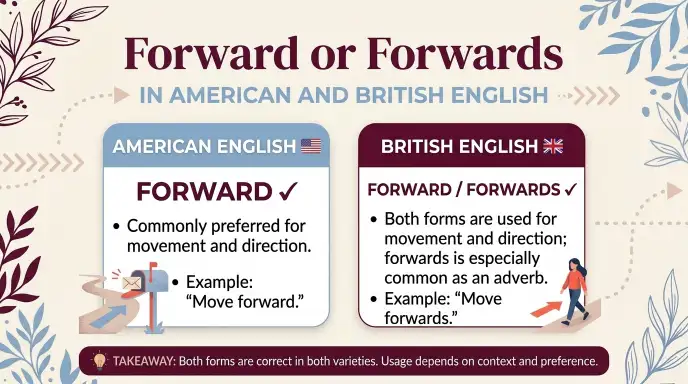
Both forms appear in British and American English, but their frequency differs.
American English
American English often prefers forward, especially in everyday writing and formal expressions.
Examples:
- Move forward carefully.
- We need to move forward with the project.
- I look forward to your reply.
- Please forward the email to me.
American writers usually choose forward even when they describe physical movement.
British English
British English commonly uses both forward and forwards.
Examples:
- He stepped forwards.
- The car rolled forwards.
- We must move forward with the plan.
- I look forward to hearing from you.
British speakers may prefer forwards when they describe movement. However, forward remains common and correct.
Important: These are general usage patterns, not strict rules. Both forms appear in both varieties of English.
Is It Looking Forward or Looking Forwards?
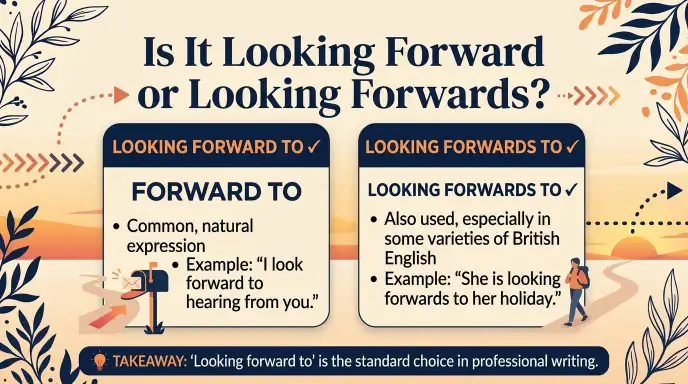
The phrase “looking forward to” is the standard expression in both American and British English.
Examples:
- I look forward to meeting you.
- We look forward to your response.
- She is looking forward to her holiday.
- I look forward to hearing from you.
In this expression, forward describes an attitude toward a future event. Writers should keep the standard phrase “look forward to.”
Remember the grammar rule that follows it: use a noun or a verb ending in ing after “look forward to.”
Correct:
- I look forward to meeting you.
- I look forward to your visit.
Incorrect:
- I look forward to meet you.
The word to in this expression acts as a preposition, so it takes a noun or an ing form.
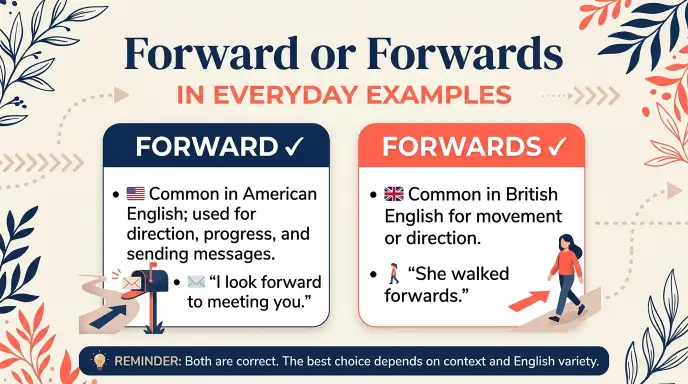
Forward or Forwards in Everyday Examples
Both words appear in conversations, work, travel, and formal writing.
Everyday Conversation
- Please take one step forward.
- He leaned forwards to see the screen.
- Move forward so everyone has room.
- She walked forwards toward the door.
Business and Workplace Writing
- We need to move forward with the proposal.
- Please forward the report to the director.
- I look forward to working with you.
- The team discussed the steps forward.
Emails and Formal Messages
- I look forward to your response.
- Please forward the attachment to the correct department.
- We look forward to meeting you.
- I will forward your request to the relevant team.
Sports and Physical Movement
- The player moved forward to receive the ball.
- The runner leaned forwards near the finish line.
- The team passed the ball forward.
- The child fell forwards onto the grass.
These examples show how context determines which form fits best.
Common Mistakes with Forward and Forwards
Writers sometimes treat forward and forwards as interchangeable in every situation. Although they often share a meaning, their grammatical roles differ.
Mistake 1: Using Forwards as a Verb
Incorrect: Please forwards the email.
Correct: Please forward the email.
Use forward as the base verb when you ask someone to send something onward.
Mistake 2: Changing a Fixed Expression
Less standard: I look forwards to hearing from you.
Preferred: I look forward to hearing from you.
Use “look forward to” in formal and professional writing.
Mistake 3: Assuming Forwards Is Always Wrong
Incorrect claim: “Forwards” is never correct.
Correct explanation: Forwards is a valid adverb, especially in British English.
For example, “The car moved forwards” is correct.
Mistake 4: Assuming Forward Is Only American
Incorrect claim: British English uses only forwards.
Correct explanation: British English accepts both forward and forwards. The preferred form often depends on the sentence and the writer.
Mistake 5: Mixing Styles Without a Reason
A writer may use both forms correctly, but consistent style helps readers. If you follow American English, forward is usually the simplest choice. If you follow British English, you can use either form where grammar allows.
Can Forward and Forwards Be Used Interchangeably?
Sometimes, but not always.
When both words describe physical movement, you can often use either one.
- She stepped forward.
- She stepped forwards.
Both sentences are correct.
However, grammar can prevent the substitution. Consider these examples:
- Please forward the message.
- I look forward to your reply.
- The forward section needs cleaning.
You cannot replace forward with forwards in these sentences without changing or breaking the grammar.
Simple rule: Use forwards mainly for movement. Use forward for movement, fixed expressions, adjectives, and the verb meaning “send onward.”
How to Choose the Right Word
Use these simple guidelines when you write.
- Choose forward for professional emails and formal expressions.
- Use forward in “look forward to.”
- Use forward when you mean “send onward,” as in “forward an email.”
- Use forwards when describing movement, especially if you follow British English.
- When in doubt, forward is a safe choice in both American and British English.
The best choice depends on grammar and context, not just nationality.
Frequently Asked Questions
Q1. Is it going forward or going forwards?
Both going forward and going forwards are correct. Going forward is more common in American English and often means from now on, while going forwards is more common in British English when referring to future progress or movement.
Q2. Is “forwards” a word?
Yes, forwards is a correct English word. It is an adverb that describes movement or direction toward the front or ahead. It is commonly used in British English.
Q3. Is it looking forward or looking forwards?
Looking forward is the standard expression, especially in phrases such as “I look forward to hearing from you.” Looking forwards can also be correct when describing physical direction, particularly in British English.
Q4. What is meant by forwards?
Forwards means toward the front, ahead, or in the direction of progress. For example, “The child took two steps forwards.”
Q5. Which is correct, forward or forwards?
Both forward and forwards are correct. Forward is more common in American English, while forwards is frequently used in British English. In expressions such as “move forward,” either form may be acceptable depending on the variety of English.
Q6. How do you use forward?
Use forward to describe movement ahead, progress, or a future point in time. For example, “She moved forward,” “We need to plan forward,” and “Going forward, we will meet every Monday.”
Q7. What does “forward” mean?
Forward can mean toward the front, ahead in progress, or onward into the future. It can also describe sending something to another person, as in “Please forward the email.”
Q8. What is another word for “forward”?
Depending on the context, synonyms for forward include ahead, onward, onward facing, progressive, and forth. When referring to sending a message, alternatives include send on or pass along.
Final Thoughts
Forward and forwards are both correct English words. They often share the same meaning when they describe movement, but they do not serve every grammatical role in the same way.
American English generally favors forward, while British English commonly uses both forms. Forward also works as an adjective and a verb, as in “the forward section” and “forward the email.” Forwards mainly works as an adverb.
For most everyday and professional writing, forward is a reliable choice. Use “look forward to” in emails and formal messages, and remember to follow it with a noun or an ing verb.
💡 Unlock Better Writing!
Suite or Suit? Correct Spelling, Meaning & Usage
Across or Accross? Correct Spelling, Meaning & Usage
Branzini or Branzino? Meaning, Spelling, Usage & Differences

Hi, I’m Ava Collins, a writer and English language enthusiast behind CorrectlyWritten. I’m passionate about making grammar simple, clear, and easy to understand. I write about grammar rules, confusing words, spelling, and everyday English usage to help readers write more accurately and confidently.








2 thoughts on “Forward or Forwards? Meaning, Correct Usage & Differences”