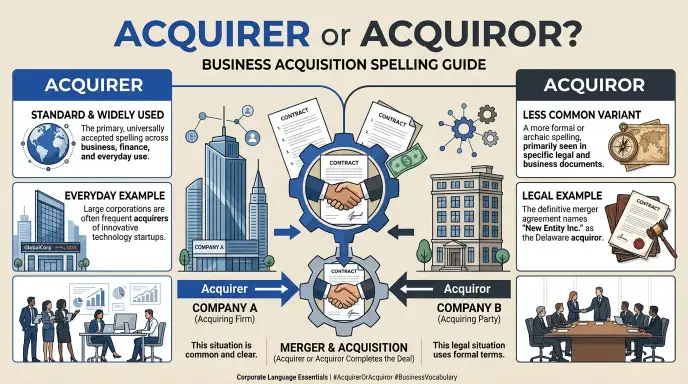
Acquirer and acquiror are both correct English words for a person or company that acquires something. The main difference is usage. Acquirer is the more common and widely recognized form in general English.
Acquiror is also correct and appears often in legal, financial, corporate, and business documents. Both words come from the verb acquire, which means to obtain, purchase, or gain something. For example, a company that purchases another company can be called the acquirer or acquiror.
In banking, an acquiring institution may also be called an acquirer, especially when it processes payments for merchants. The choice between these forms usually depends on context and writing style rather than meaning. If you are writing for a general audience, acquirer is usually the more familiar choice.
In a legal or corporate agreement, acquiror may appear because it is a traditional term used in transaction documents. This guide explains the meaning, spelling, origin, usage, differences, and examples of acquirer and acquiror.
Acquirer or Acquiror: Quick Answer
these are both correct.
Acquirer is the more common form in general English. It refers to a person or organization that acquires, buys, or obtains something.
Acquiror has the same basic meaning but is more common in legal, corporate, and financial contexts.
Examples:
The acquirer purchased the company.
The acquiror agreed to the terms of the transaction.
The choice depends mainly on context. In everyday and general business writing, acquirer is usually the more familiar form.
What Does Acquirer Mean?
Acquirer is a noun derived from the verb acquire.
It refers to someone or something that acquires another thing.
To acquire means to obtain, gain, purchase, or take ownership of something.
For example:
The company became the acquirer of the smaller business.
Here, the company is the organization that obtained ownership of another business.
The word can describe:
- a company buying another company
- a person obtaining an asset
- an organization purchasing property
- a financial institution handling transactions
- an entity gaining control of another business
The exact meaning depends on the context.
What Does Acquiror Mean?
Acquiror is an alternative noun form of acquirer.
It refers to a person, company, or organization that acquires something.
For example:
The acquiror will purchase all outstanding shares.
The meaning is essentially the same as:
The acquirer will purchase all outstanding shares.
The main difference is stylistic and contextual.
Acquiror appears particularly often in legal and corporate transaction documents.
Acquirer vs Acquiror: The Main Difference
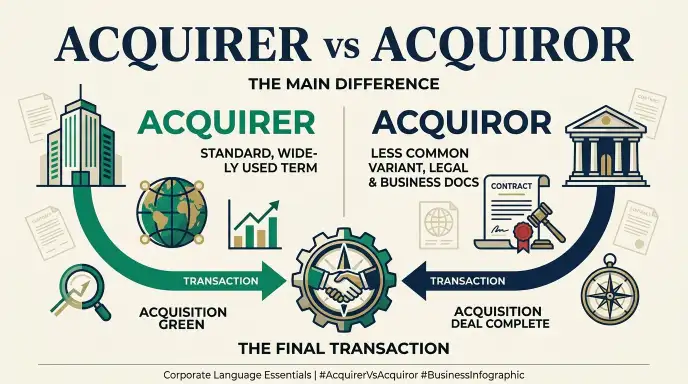
The two words have the same basic meaning.
Both refer to an entity that acquires something.
The main difference is usage.
Acquirer
- More common in general English
- Common in business writing
- Common in finance
- Common in payment terminology
- Familiar to a broad audience
Acquiror
- Common in legal documents
- Used in corporate transactions
- Appears in merger and acquisition documents
- Often used in formal agreements
- Less common in everyday English
Neither form is inherently incorrect.
Why Are There Two Spellings?
The difference comes from English word formation.
The verb is acquire.
The person or entity performing the action can be described with a noun ending in er, giving acquirer.
English also uses the or ending in many words, especially words influenced by Latin or legal terminology.
This gives acquiror.
Both forms developed as nouns describing an entity that acquires something.
The result is two accepted forms with essentially the same meaning.
The Origin of Acquirer
Acquirer comes from the verb acquire.
The verb traces back through French to Latin roots connected with obtaining or gaining something.
The suffix er is commonly used in English to identify a person or entity that performs an action.
For example:
- teach : teacher
- buy: buyer
- acquire : acquirer
In this pattern, an acquirer is the entity that acquires something.
The Origin of Acquiror
Acquiror also comes from acquire.
The ending or is common in words that describe someone performing an action.
Examples include:
- actor
- creditor
- administrator
- investor
Legal and corporate language has preserved many or forms.
As a result, acquiror became established in transaction and legal terminology.
British English vs American English
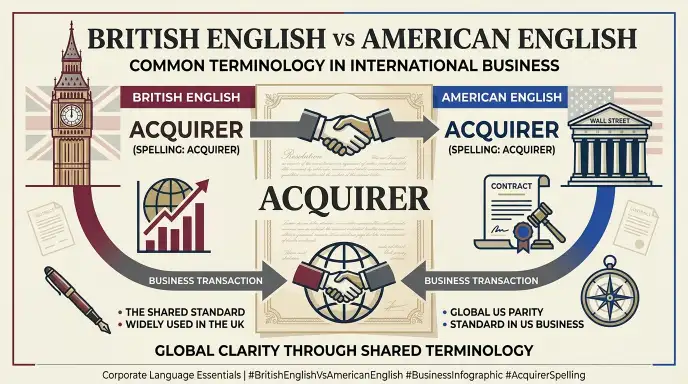
Both acquirer and acquiror can be found in Englishlanguage writing.
There is no simple BritishversusAmerican spelling rule that makes one form correct and the other incorrect.
However, usage can vary by field.
Acquirer is widely understood in general English and business communication.
Acquiror is especially familiar in formal legal and corporate contexts.
The terminology used by a company, law firm, financial institution, or contract may determine which form appears most often.
Which Word Should You Use?
Choose acquirer when you are writing for a general audience.
It is clear, familiar, and widely understood.
For example:
The acquirer plans to expand the company after the purchase.
Choose acquiror when you are following the terminology of a legal agreement, corporate transaction, or specialized document.
For example:
The acquiror shall assume all obligations under the agreement.
If there is no specific reason to use the legalstyle form, acquirer is usually the simpler choice.
Acquirer in Business and Finance

Acquirer is a common term in business and finance.
In a merger or acquisition, the acquirer is the company or entity that obtains another company or its assets.
For example:
The acquirer purchased a majority stake in the company.
The company being purchased is often called the target.
This creates a useful distinction:
Acquirer = the entity buying or obtaining
Target = the entity being acquired
The term can also appear in payment processing.
In card payment systems, an acquirer may refer to a financial institution that works with merchants to process card transactions.
Acquiror in Legal Documents
Acquiror is particularly common in formal legal language.
You may see it in:
- merger agreements
- acquisition agreements
- share purchase agreements
- corporate transaction documents
- securities documents
- legal filings
For example:
The Acquiror agrees to purchase the shares described in this agreement.
Legal documents often define a party using a specific term and then use that term throughout the agreement.
This is why acquiror may appear frequently in formal transaction documents even though acquirer is more familiar to general readers.
Common Mistakes With Acquirer or Acquiror
The most common mistake is assuming that one form is always correct and the other is always wrong.
That is not the case.
Mistake 1: Treating Acquiror as Incorrect
Acquiror is a legitimate English word.
It is especially established in legal and corporate contexts.
Mistake 2: Treating Acquirer as Informal or Wrong
Acquirer is also fully correct.
It is widely used in general business and financial writing.
Mistake 3: Using Acquire as a Noun
Incorrect:
The acquire will purchase the company.
Correct:
The acquirer will purchase the company.
The verb is acquire.
The noun for the entity performing the action is acquirer or acquiror.
Mistake 4: Confusing Acquirer With Target
The acquirer is the entity obtaining another company or asset.
The target is the company or business being acquired.
These terms describe different sides of a transaction.
Acquirer in Everyday Examples
Although acquirer is mainly a business term, it can be used in several contexts.
Examples:
- The acquirer purchased the software company.
- The acquirer plans to keep the existing management team.
- The bank acted as the payment acquirer.
- The company became the largest acquirer in the sector.
- The acquirer received approval for the transaction.
These examples all describe an entity that obtains something.
Acquiror in Legal and Corporate Examples
Examples of acquiror include:
- The acquiror will purchase all outstanding shares.
- The acquiror must satisfy the conditions of the agreement.
- The acquiror agreed to pay the specified purchase price.
- The acquiror will assume certain liabilities after closing.
- The agreement identifies the buyer as the acquiror.
This form is especially natural in formal transaction language.
Acquirer or Acquiror in Formal Writing
Both forms are suitable for formal writing.
However, consistency matters.
If a contract defines one party as the Acquiror, that exact term should normally be used throughout the document.
For general business writing, acquirer may be easier for readers to understand.
For example:
The acquirer completed the purchase in June.
This is clear and natural.
In a legal agreement, you might instead see:
The Acquiror shall complete the purchase on the closing date.
The second version has a more formal legal style.
Acquirer vs Buyer
Acquirer and buyer can sometimes refer to the same party, but they are not always interchangeable.
Buyer is a broad everyday term.
Acquirer is more specialized.
For example:
The buyer purchased a house.
This is natural everyday English.
The acquirer purchased the company.
This sounds more appropriate in corporate or financial writing.
In mergers and acquisitions, acquirer is often preferred because it identifies the entity obtaining control of another business.
Acquirer vs Acquiring Company
An acquiring company is a company that obtains another business.
An acquirer can refer to the same company in a shorter form.
For example:
The acquiring company announced the transaction.
can become:
The acquirer announced the transaction.
Both can be correct.
The shorter form is common in specialized business writing.
Google Trends and Modern Usage
Acquirer and acquiror are both established terms, but their usage differs by context.
Acquirer has broad use across business, finance, banking, and general corporate writing.
Acquiror is strongly associated with legal and transaction language.
Exact search interest can change by country, industry, and time period. For that reason, specific Google Trends numbers should be checked for the chosen region and date range rather than treated as universal usage statistics.
For most general readers, acquirer is the more familiar form.
Quick Comparison: Acquirer vs Acquiror
Acquirer
Meaning: A person or entity that acquires something
Common contexts: Business, finance, banking, general writing
Style: More familiar and widely used
Example: The acquirer purchased the company.
Acquiror
Meaning: A person or entity that acquires something
Common contexts: Legal, corporate, merger and acquisition documents
Style: More formal and specialized
Example: The acquiror agreed to the terms of the transaction.
Key Takeaways
- Acquirer is correct.
- Acquiror is also correct.
- Both mean an entity that acquires something.
- Acquirer is more common in general English.
- Acquiror is especially common in legal and corporate documents.
- Neither spelling is simply a mistake.
- In a legal agreement, follow the terminology defined in the document.
- For general readers, acquirer is usually clearer.
- Acquirer and buyer can overlap, but acquirer is more specialized.
- The company being acquired is often called the target.
Frequently Asked Questions
Q1. Is acquiror a word?
Yes. Acquiror is a word, especially used in legal and business contexts. It refers to a person or company that acquires something, although acquirer is more common.
Q2. What is the difference between “acquiror” and “acquirer”?
Both acquiror and acquirer refer to someone or something that acquires another business, asset, or property. Acquirer is the more common form, while acquiror is often found in legal and financial writing.
Q3. What is the meaning of acquirer?
An acquirer is a person or organization that obtains or purchases something. In business, it often refers to a company that acquires another company or its assets.
Q4. How do you spell acquirer?
The correct spelling is acquirer: ACQUIRER. It comes from the verb acquire, meaning to obtain or gain something.
Q5. What is another word for “acquirer”?
Depending on the context, alternatives for acquirer include buyer, purchaser, purchaser company, buyer company, and recipient. In business contexts, buyer is often the simplest choice.
Q6. How do I spell acquiring?
The correct spelling is acquiring: ACQUIRING. The final e in acquire is dropped before adding ing.
Q7. Do you spell acquisition?
Yes. The correct spelling is acquisition: ACQUISITION. It means the act or process of acquiring something.
Q8. Is “acquire” or “aquire” the correct spelling?
Acquire is the correct spelling. Aquire is a misspelling because it leaves out the c after the initial a.
Conclusion
Acquirer and acquiror are both correct forms with essentially the same meaning. Each describes a person, company, or organization that acquires something. The main difference is where the words are commonly used.
Acquirer is the more familiar form in general English. It is common in business, finance, banking, and corporate communication. Acquiror is more specialized and appears frequently in legal agreements and formal transaction documents.
If you are writing for a general audience, acquirer is usually the clearer choice. If you are working with a legal agreement, use the terminology established in that document and keep it consistent.
The important point is that acquiror is not a spelling mistake. It is a legitimate alternative to acquirer. Both forms describe the entity that obtains something, while the company being acquired is often called the target.
🌟 Make Every Word Count!
Spiralling or Spiraling? Correct Spelling, Meaning, & Examples

Hi, I’m Ava Collins, a writer and English language enthusiast behind CorrectlyWritten. I’m passionate about making grammar simple, clear, and easy to understand. I write about grammar rules, confusing words, spelling, and everyday English usage to help readers write more accurately and confidently.








2 thoughts on “Acquirer or Acquiror? Correct Spelling, Meaning, Differences ”