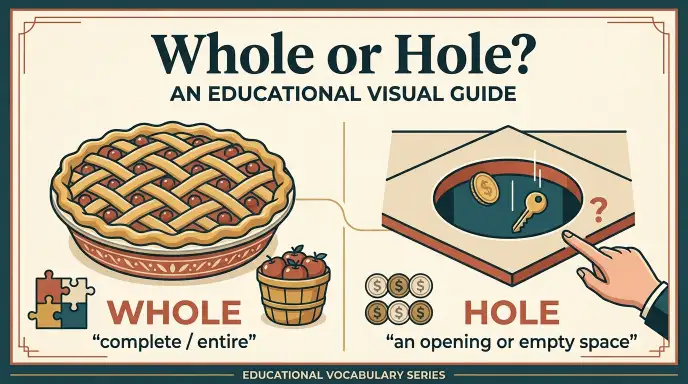
Whole and hole are both correct English words, but they have completely different meanings and uses. Whole means complete, entire, or not divided into parts, while hole means an opening, gap, or empty space in something.
The two words sound exactly the same in standard English, which makes them common sources of spelling mistakes. This is especially true when writing quickly because hearing the word does not tell you which spelling to use.
Understanding the difference between whole and hole can help you avoid errors in emails, school assignments, social media posts, and everyday writing. In this guide, you will learn the meanings, origins, correct usage, common mistakes, and practical examples of both words. You will also see simple ways to remember which spelling fits your sentence.
Whole or Hole: Quick Answer
Whole means complete or entire.
- I ate the whole cake.
- She spent the whole day studying.
- He told me the whole story.
Hole means an opening, gap, or hollow space.
- There is a hole in my shirt.
- The ball fell into a hole.
- We found a hole in the fence.
The easiest way to remember the difference is:
Whole = complete
Hole = opening or gap
Both words are pronounced the same, but their meanings and spellings are different.
Definition and Meaning of Whole
What Does Whole Mean?
Whole is an adjective, noun, and sometimes a pronoun. It generally describes something that is complete, entire, or undivided.
For example:
- She ate the whole pizza.
- I read the whole book.
- The whole family came to dinner.
In each example, whole refers to something complete rather than only part of it.
Simple Meaning of Whole
The simplest meaning of whole is complete or entire.
If something includes all its parts, you can describe it as whole.
For example:
- a whole apple = an entire apple
- the whole team = every member of the team
- the whole story = the complete story
How Is Whole Used?
Whole is commonly used before nouns.
Examples:
- the whole house
- the whole week
- the whole family
- the whole country
- the whole problem
It can also refer to something considered as one complete unit.
Definition and Meaning of Hole
What Does Hole Mean?
Hole is a noun that means an opening, gap, or hollow space in something.
For example:
- There is a hole in the wall.
- My shoe has a hole in it.
- The dog dug a hole in the garden.
A hole can be large or small and can occur naturally or be created intentionally.
Simple Meaning of Hole
The simplest meaning of hole is an opening or empty space.
For example:
- a hole in a wall
- a hole in a sock
- a hole in the ground
- a hole in a fence
How Is Hole Used?
Hole is usually used as a noun.
Examples:
- The workers repaired the hole.
- There is a small hole in the box.
- Water is coming through the hole.
The word can also appear in expressions such as dig a hole, fall into a hole, and make a hole.
The Origin of Whole and Hole

The words whole and hole have different histories even though they are pronounced alike today.
Whole comes from Old English hāl, meaning healthy, sound, complete, or uninjured. Over time, its spelling changed and eventually developed into the modern form whole. The w is now silent.
Hole comes from Old English hol, referring to an opening, hollow place, or cavity.
Their similar pronunciation developed over the history of English, but their meanings remained different. This is why they are classified as homophones, words that sound alike but have different meanings and spellings.
Whole vs Hole: The Main Difference
The main difference is simple:
Whole = complete or entire
Hole = an opening or empty space
Consider these two sentences:
- I ate the whole sandwich.
- There is a hole in the sandwich wrapper.
In the first sentence, whole means the entire sandwich. In the second, hole refers to an opening.
The context usually makes the correct spelling clear.
British English vs American English Spelling
There is no major BritishAmerican spelling difference between whole and hole.
Both British and American English use:
whole for something complete or entire
hole for an opening or gap
Examples:
British English:
- She stayed home for the whole weekend.
- There is a hole in the roof.
American English:
- She stayed home for the whole weekend.
- There is a hole in the roof.
The spelling remains the same in both varieties of English.
Whole or Hole: Quick Comparison
| Word | Meaning | Example |
| Whole | Complete or entire | I ate the whole apple. |
| Hole | An opening or gap | There is a hole in the wall. |
Which Spelling Should You Use?
Use whole when you mean complete, entire, or all of something.
- I watched the whole movie.
- She worked the whole day.
- He knows the whole story.
Use hole when you mean an opening, gap, or hollow space.
- There is a hole in my pocket.
- The mouse ran into a hole.
- They dug a hole in the ground.
Neither spelling is more correct than the other. The correct choice depends entirely on the meaning of your sentence.
Common Mistakes with Whole and Hole
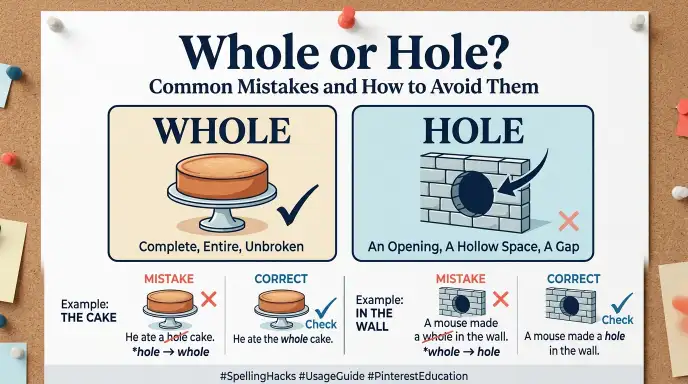
Because whole and hole sound identical, writers sometimes choose the wrong spelling.
Mistake 1: Using Hole for Complete
Incorrect:
I spent the hole day at home.
Correct:
I spent the whole day at home.
Here, whole means the entire day.
Mistake 2: Using Whole for an Opening
Incorrect:
There is a whole in my shirt.
Correct:
There is a hole in my shirt.
Here, hole means an opening in the shirt.
Mistake 3: Confusing Them in Fast Writing
Incorrect:
She told me the hole story.
Correct:
She told me the whole story.
A useful trick is to replace whole with entire. If the sentence still makes sense, whole is probably correct.
For example:
She told me the entire story.
Therefore:
She told me the whole story.
Whole and Hole in Everyday Examples
Both words appear frequently in everyday English.
Emails
- Thank you for explaining the whole situation.
- Please check the hole in the document cover.
School Writing
- The whole class participated in the activity.
- The experiment created a small hole in the material.
Social Media
- I watched the whole video.
- My favorite jeans have a hole in the knee.
News Writing
- The whole community joined the event.
- Workers repaired a large hole in the road.
Formal Writing
- The report provides a whole picture of the issue.
- Engineers discovered a hole in the structure.
Whole or Hole: Easy Ways to Remember
A simple memory trick can make these words much easier to distinguish.
Whole = Whole Thing
Think of whole as meaning all of something.
- whole cake
- whole book
- whole day
- whole family
Hole = Opening
Think of hole as a physical opening or gap.
- hole in a wall
- hole in a shirt
- hole in the ground
- hole in a fence
You can also remember the spelling:
Whole : complete
Hole : opening
If you can replace the word with entire, choose whole. If you can replace it with opening or gap, choose hole.
Whole or Hole: Usage and Meaning Comparison
| Feature | Whole | Hole |
| Part of speech | Adjective, noun, pronoun | Noun |
| Main meaning | Complete or entire | Opening or gap |
| Pronunciation | Same as hole | Same as whole |
| Spelling | Whole | Hole |
| Example | The whole team arrived. | There is a hole in the wall. |
| Common phrase | The whole story | A hole in the ground |
Whole or Hole: Google Trends & Usage Data
Both whole and hole are established English words and appear frequently in written and spoken language. Their search patterns are influenced by their very different meanings.
Whole is commonly associated with phrases such as:
- whole world
- whole time
- whole thing
- whole life
- whole family
Hole is commonly associated with phrases such as:
- hole in the wall
- hole in the ground
- hole in the roof
- hole in my shirt
- black hole
Because the two words have different meanings, search interest for them often reflects different topics rather than a simple spelling competition.
Frequently Asked Questions
Q1. What is the difference between whole and full?
Whole means complete or entire, while full usually means containing as much as possible or having no empty space. For example, “the whole cake” means the entire cake, while “a full glass” has no space left.
Q2. What does “whole” mean?
Whole means complete, entire, or not divided into parts. For example, “She ate the whole apple” means she ate the entire apple.
Q3. How do we spell hole?
The correct spelling is hole: HOLE. It refers to an opening, hollow space, or gap in something.
Q4. Is it a hole or an hole?
The correct phrase is “a hole.” Use a because hole begins with a consonant sound: “There is a hole in the wall.”
Q5. Is it hole or whole?
Both hole and whole are correct words, but they have different meanings. Hole means an opening or hollow space, while whole means complete or entire.
Q6. What is a hole?
A hole is an opening or hollow space in something. It can be natural or created intentionally, such as a hole in the ground or a hole in a piece of paper.
Q7. What is a hole called?
A hole can also be called an opening, gap, cavity, or hollow, depending on its size, shape, and context.
Q8. What does one hole mean?
One hole simply means a single opening or hollow space. For example, “The shirt has one hole” means there is one opening or damaged spot in the shirt.
Conclusion
Whole and hole are both correct English words, but they cannot be used interchangeably. Whole means complete, entire, or including all parts, while hole means an opening, gap, or hollow space. The two words are easy to confuse because they are homophones and have the same pronunciation. However, their meanings are completely different.
Use whole when you are talking about something complete, such as a whole book, whole day, whole family, or whole story. Use hole when you are talking about an opening or empty space, such as a hole in a wall, hole in a shirt, or hole in the ground. A simple memory trick is to connect whole with entire and hole with opening. Once you understand this distinction, choosing the correct spelling becomes much easier in everyday, academic, professional, and formal writing.
✨ Discover the Difference:
Acquirer or Acquiror? Correct Spelling, Meaning, Differences
Spiralling or Spiraling? Correct Spelling, Meaning, & Examples

Hi, I’m Ava Collins, a writer and English language enthusiast behind CorrectlyWritten. I’m passionate about making grammar simple, clear, and easy to understand. I write about grammar rules, confusing words, spelling, and everyday English usage to help readers write more accurately and confidently.








2 thoughts on “Whole or Hole? Correct Spelling, Meaning, Usage & Examples ”