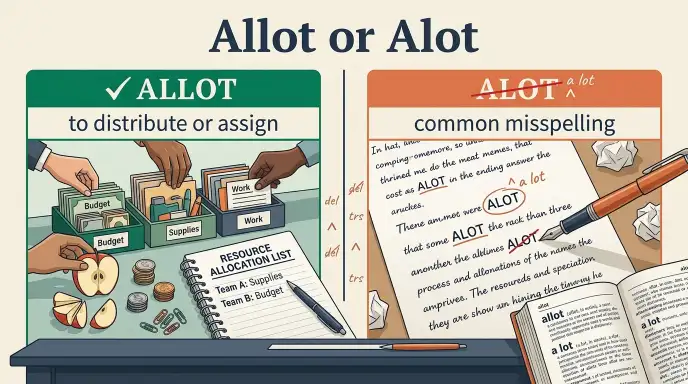
Allot is the correct English word when you mean to assign, distribute, or give a specific amount of something. Alot is not a standard English word and is considered a spelling mistake.
However, a lot is correct when you mean a large amount, a large number, or very often. The three forms can look confusing because they sound similar in everyday speech, but they have different uses. For example, a teacher may allot each student a project, while a student may have a lot of homework.
The form alot should not be used in standard English writing. Understanding the difference between allot, a lot, and alot can help you avoid a common mistake in emails, essays, schoolwork, professional writing, and everyday communication. This guide explains their meanings, origins, grammar, common mistakes, and practical examples so you can choose the right form with confidence.
Allot or Alot: Quick Answer
Allot is a correct word and means to assign, give, or distribute something.
A lot is also correct and means a large amount, a large number, or frequently.
Alot is incorrect in standard English.
Examples:
- The manager will allot tasks to the team.
- We have a lot of work today.
- ❌ We have alot of work today.
The easiest way to remember the difference is simple: allot is a verb, while a lot is usually a phrase that describes quantity or frequency.
Definition and Meaning of Allot
Allot is a verb that means to give or assign something to a particular person, group, purpose, or activity.
It often suggests that something is being divided or distributed according to a plan.
Simple Meaning of Allot
Allot = to assign or distribute something.
Examples:
- The teacher allotted ten minutes for the activity.
- Each employee was allotted a specific amount of time.
- The committee will allot funds to different projects.
- We need to allot enough space for the new equipment.
The word is commonly followed by an object and sometimes the person or group receiving it.
For example:
The school allotted extra time to the students.
Here, “allotted” means that the school assigned or provided extra time.
Definition and Meaning of A Lot
A lot is a phrase used to talk about a large quantity, number, or frequency.
It can be used in several common ways.
A Lot Meaning “A Large Amount”
Use a lot with uncountable nouns.
Examples:
- I have a lot of work.
- She drinks a lot of water.
- There is a lot of traffic today.
A Lot Meaning “Many”
Use a lot of with plural countable nouns.
Examples:
- There are a lot of students in the classroom.
- We received a lot of emails.
- She has a lot of books.
A Lot Meaning “Very Often”
A lot can also describe frequency.
Examples:
- I travel a lot for work.
- They talk a lot.
- She exercises a lot.
Why Is Alot Incorrect?
Alot is generally considered a misspelling of a lot.
In standard English, the two words should remain separate when they express quantity or frequency.
Correct:
- I have a lot of questions.
- He talks a lot.
- We learned a lot today.
Incorrect:
- I have alot of questions.
- He talks alot.
- We learned alot today.
The confusion is understandable because many English expressions eventually become single words. However, a lot has not become a standard single word in modern English.
Allot vs A Lot: The Main Difference
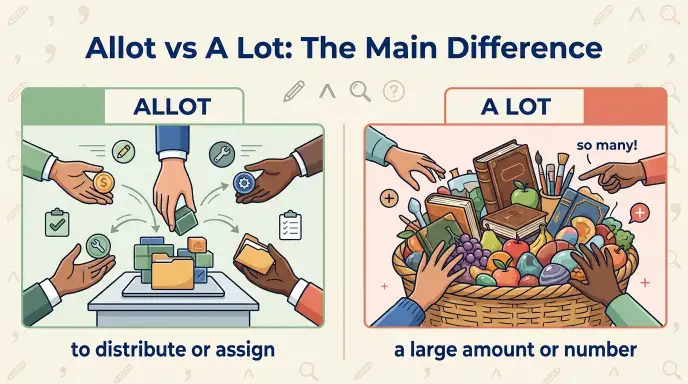
The key difference is grammatical and semantic.
Allot is an action. It means to assign or distribute something.
A lot describes quantity or frequency.
Compare these examples:
The teacher will allot five minutes to each student.
Here, allot means assign.
The students have a lot of homework.
Here, a lot means a large amount.
The words may sound similar, but they cannot normally replace each other.
The Origin of Allot
Allot entered English through French and ultimately comes from a word associated with a share or portion.
Its meaning developed around the idea of assigning or distributing a particular share.
Today, allot is commonly used when something such as time, money, space, resources, or responsibilities is assigned for a specific purpose.
Examples include:
- allot time
- allot money
- allot space
- allot resources
- allot responsibilities
The Origin of A Lot
The phrase a lot developed from the older noun lot, which could refer to a portion, share, or assigned piece.
Over time, a lot became widely used to express a large quantity or number.
Today, it is one of the most common expressions for quantity in informal and everyday English.
For example:
She has a lot of friends.
Here, a lot means a large number.
British English vs American English
Allot and a lot are standard in both British and American English.
There is no spelling difference between the two varieties.
British English:
- I have a lot of work.
- The teacher will allot time for each task.
American English:
- I have a lot of work.
- The teacher will allot time for each task.
The incorrect form alot should be avoided in both varieties of standard English.
Which Form Should You Use?
Choose the form based on the meaning.
Use allot when you mean:
- assign
- distribute
- give a share
- set aside for a purpose
Example:
The manager will allot each employee a different task.
Use a lot when you mean:
- a large amount
- a large number
- frequently
Example:
The manager receives a lot of emails.
Avoid alot in standard writing.
Common Mistakes With Allot or Alot
The most common mistake is writing alot instead of a lot.
Mistake 1: Using Alot for Quantity
Incorrect:
I have alot of homework.
Correct:
I have a lot of homework.
Mistake 2: Confusing Allot With A Lot
Incorrect:
I allot of work to finish.
Correct:
I have a lot of work to finish.
Here, the writer needs the quantity phrase a lot, not the verb allot.
Mistake 3: Using A Lot When Allot Is Needed
Incorrect:
The company will a lot funds to the project.
Correct:
The company will allot funds to the project.
Here, allot is a verb because the company is assigning or distributing funds.
Allot in Everyday Examples
Here are natural examples of allot:
- The teacher will allot twenty minutes for the test.
- The company allotted money for employee training.
- Each team was allotted two hours.
- We should allot enough space for storage.
- The manager allotted tasks to each member.
- The government allotted funds for the project.
In each example, something is assigned, divided, or provided for a specific purpose.
A Lot in Everyday Examples
Here are common examples of a lot:
- I have a lot of work today.
- She knows a lot about history.
- We spent a lot of time there.
- They have a lot of questions.
- He travels a lot.
- I learned a lot from the experience.
Notice that a lot can appear before a noun or after a verb.
Allot, A Lot, and Alot Compared
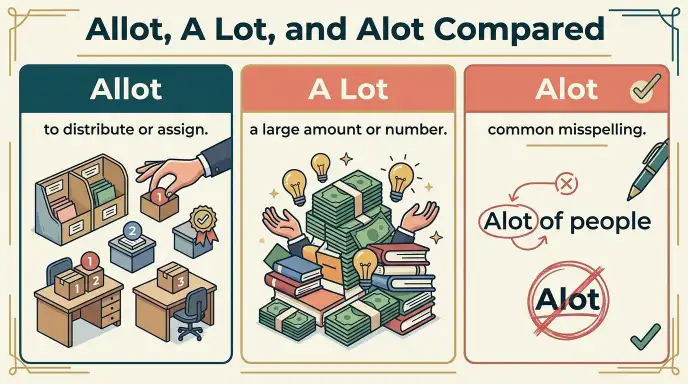
Allot
Meaning: assign or distribute
Part of speech: verb
Example:
The teacher will allot five minutes to each group.
A lot
Meaning: a large amount, many, or frequently
Part of speech: phrase
Example:
She has a lot of books.
Alot
Meaning: no standard meaning in modern English
Status: incorrect spelling in standard English
Example:
Alot of people ❌
Correct form:
A lot of people ✅
Allot or A Lot in Formal Writing
In formal writing, using the correct form is important because allot and a lot serve different grammatical purposes.
Use allot when discussing the assignment or distribution of something.
Example:
The organization will allot additional resources to the research team.
Use a lot when describing a large quantity or frequency.
Example:
The organization receives a lot of applications each year.
Avoid alot in academic papers, business writing, professional emails, reports, and other formal contexts.
Is “A Lot” Formal?
A lot is grammatically correct, but it can sound informal in some formal contexts.
For academic or professional writing, you can sometimes choose more precise alternatives such as:
- many
- numerous
- substantial
- considerable
- frequently
For example:
Informal:
A lot of people attended the event.
More formal:
Many people attended the event.
However, a lot is not grammatically wrong simply because it is common in everyday English.
Google Trends and Modern Usage
The forms allot, a lot, and alot do not have the same grammatical status.
Allot is an established English verb and appears in contexts involving assignment, distribution, time, money, space, and resources.
A lot is extremely common in everyday English and is widely used to express quantity or frequency.
Alot is generally treated as a spelling error rather than a standard alternative spelling.
Search interest can vary over time and by region, so exact Google Trends numbers should be checked for a specific location and date range rather than assumed.
Quick Comparison: Allot or Alot
ALLot
Correct: Yes
Meaning: To assign or distribute
Word type: Verb
Example: We will allot enough time for the meeting.
A lot
Correct: Yes
Meaning: A large amount, many, or frequently
Word type: Phrase
Example: We have a lot of work today.
Alot
Correct: No
Meaning: Not a standard English word
Word type: Incorrect form
Example: I have alot of work. ❌
Key Takeaways
- Allot is a correct English verb.
- Allot means to assign, distribute, or give a share.
- A lot means a large amount, a large number, or frequently.
- Alot is not a standard spelling.
- Use a lot of before nouns when describing quantity.
- Use allot when something is being assigned or distributed.
- Both allot and a lot are used in British and American English.
- Avoid alot in formal and informal standard English.
Frequently Asked Questions
Q1. What is the full meaning of allot?
Allot means to give or distribute a specific amount of something to a person, group, or purpose. For example, “The teacher allotted each student ten minutes.”
Q2. Is allot the same as a lot?
No. Allot is a verb meaning to distribute or assign something, while a lot means a large amount or quantity.
Q3. When can I use a lot?
Use a lot when you mean “many,” “much,” or “a large amount.” For example, “She reads a lot.”
Q4. Does “allot” mean “allow”?
No. Allot means to assign or distribute something, while allow means to give permission.
Q5. Is it alot or allot?
Allot is a correct English word meaning to assign or distribute. Alot is generally considered a misspelling of a lot.
Q6. What does “lot” mean?
Lot can have several meanings, including a large amount, a piece of land, or a group of items. The meaning depends on the context.
Q7. What is LOT used for?
Lot is used in different contexts. It can refer to a large quantity, a parcel of land, a group of things, or a person’s share.
Q8. What is called a lot?
A lot can refer to a large number or amount of something. For example, “There are a lot of books” means there are many books.
Q9. What is another word for “lot”?
Depending on the context, synonyms for lot include many, much, plenty, quantity, amount, group, and portion.
Conclusion
Allot and a lot are both correct, but they have completely different uses. Allot is a verb that means to assign, distribute, or give a particular share of something. A lot is a phrase used to describe a large amount, a large number, or something that happens frequently. The form alot is not a standard English spelling and should be avoided.
A simple way to remember the difference is to focus on the action. If something is being assigned or distributed, use allot. If you are talking about quantity or frequency, use a lot. For example, “The teacher will allot ten minutes for the test” is correct, while “I have a lot of homework” uses the phrase correctly. Keeping the meanings separate will help you avoid one of the most common spelling mistakes in everyday English.
📖 Explore More Knowledge!
Choked or Chocked? Correct Spelling, Meaning, Uses & Examples

Hi, I’m Ava Collins, a writer and English language enthusiast behind CorrectlyWritten. I’m passionate about making grammar simple, clear, and easy to understand. I write about grammar rules, confusing words, spelling, and everyday English usage to help readers write more accurately and confidently.








2 thoughts on “Allot or Alot? Correct Spelling, Meaning, Usage & Examples ”