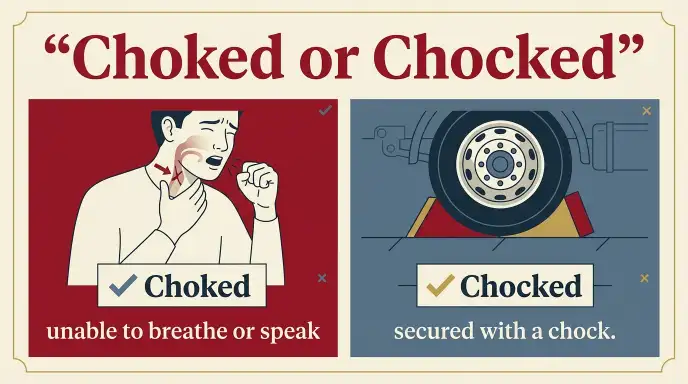
Choked is the correct spelling when you mean having difficulty breathing because something blocks the throat, or struggling to speak because of strong emotion, while chocked is a different word used mainly in technical contexts.
These two words are easy to confuse because they differ by only one letter, but they come from different words and have different meanings. Choked is the past tense and past participle of choke, a common verb used for situations involving breathing, swallowing, emotion, or restricted flow. For example, you can say, “He choked on his food” or “She choked back tears.
” Chocked, on the other hand, comes from chock, which means to secure or support something with a wedge or block called a chock. It is mainly found in technical, mechanical, construction, transportation, and industrial contexts. Understanding this difference helps you avoid a common spelling mistake and choose the right word based on meaning. If you are talking about food, breathing, tears, words, or strong emotion, choked is almost certainly the word you need.
Chocked or Choked: Quick Answer
Choked is correct when you mean the past tense of choke.
Examples:
- He choked on a piece of food.
- She choked back her tears.
- I almost choked while drinking water.
- He choked with emotion.
Chocked is also a real word, but it has a different meaning. It comes from chock, meaning to secure something with a wedge, block, or support.
Example:
- The mechanic chocked the wheels before working underneath the vehicle.
So the simple rule is:
Choke : Choked
Chock : Chocked
Definition and Meaning of Chocked or Choked
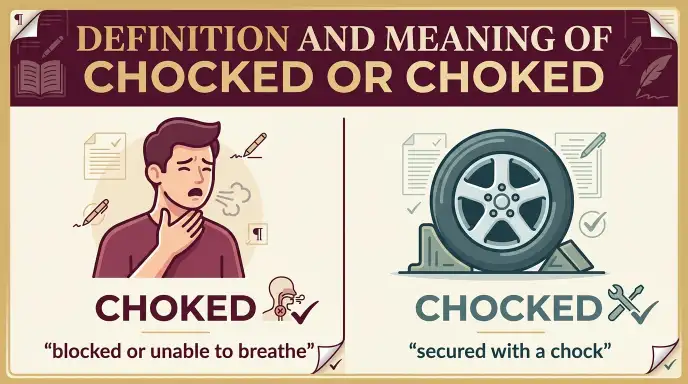
What does choked mean?
Choked is the past tense and past participle of choke.
The verb choke can mean to have difficulty breathing because something blocks the throat.
The child choked on a piece of food.
It can also describe stopping yourself from crying or speaking.
She choked back her tears.
Another meaning involves strong emotion.
He choked with emotion while giving his speech.
The word can also describe something being restricted or blocked.
The narrow pipe was choked with dirt.
What does chocked mean?
Chocked is the past tense and past participle of chock.
To chock something means to place a block, wedge, or other support against it to prevent movement.
The workers chocked the wheels before repairing the truck.
This word is more common in technical and industrial writing than in everyday conversation.
Choked and chocked have different roots
The difference becomes easier when you remember their base words:
Choke : choked
Chock : chocked
Although they look similar, they describe different actions.
The Origin of Chocked or Choked
The word choke has a long history in English and is connected with older Germanic words associated with the throat and breathing. Over time, choke developed several related meanings involving obstruction, suffocation, restricted movement, and suppressed emotion.
The word chock has a different history. It refers to a block or wedge used to prevent an object from moving. The verb chock developed from this noun.
This explains why the past tense forms are different:
choke + d = choked
chock + ed = chocked
The extra c in chocked is not simply an alternative spelling of choked. It reflects the different base word chock.
British English vs American English Spelling
There is no major British American spelling difference between choked and chocked. Both forms are spelled the same in British and American English.
The important difference is meaning.
| Word | British English | American English | Main Meaning |
| choke | Yes | Yes | Have difficulty breathing or block/restrict something |
| choked | Yes | Yes | Past tense of choke |
| chock | Yes | Yes | Secure something with a block or wedge |
| chocked | Yes | Yes | Past tense of chock |
| choked on food | Common | Common | Food blocks the throat |
| chocked the wheels | Common in technical use | Common in technical use | Secured wheels to prevent movement |
Examples:
British English:
He choked on his lunch.
American English:
He choked on his lunch.
The spelling remains the same in both varieties.
Which Spelling Should You Use?
Use choked for breathing problems
If something blocks your throat or makes breathing difficult, use choked.
She choked on a piece of bread.
Use choked for strong emotion
Use choked when someone struggles to speak because of emotion.
He was choked with emotion.
Use choked for suppressed crying
She choked back her tears.
Use chocked for securing something
Use chocked when something has been secured with a block or wedge.
The driver chocked the wheels before leaving the vehicle.
For everyday English
Most people will use choked far more often than chocked because choke has many everyday meanings.
If you are talking about food, breathing, crying, emotion, or speech, choked is usually the correct choice.
Common Mistakes with Chocked or Choked
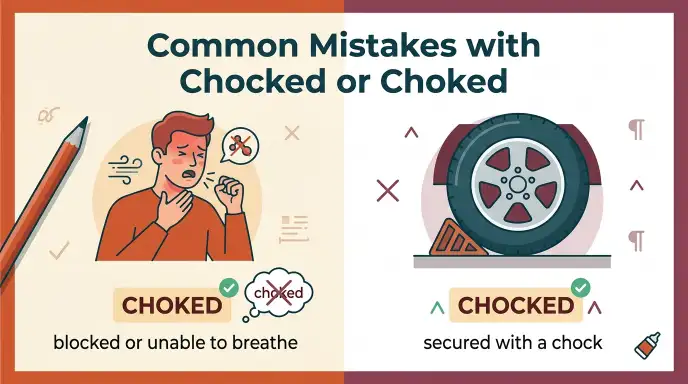
Mistake 1: Writing “chocked on food”
Incorrect:
He chocked on his food.
Correct:
He choked on his food.
The verb is choke, so the past tense is choked.
Mistake 2: Writing “choked the wheels”
Incorrect when you mean securing the wheels:
He choked the wheels.
Correct:
He chocked the wheels.
The verb chock means to secure something with a block or wedge.
Mistake 3: Treating chocked as a spelling variant of choked
These words are not interchangeable.
Choked relates to choke.
Chocked relates to chock.
Mistake 4: Using chocked for emotional situations
Incorrect:
She chocked back her tears.
Correct:
She choked back her tears.
The expression is choke back tears.
Mistake 5: Adding an extra c to every form of choke
The correct forms are:
choke : choked : choking
Not:
chock : chocked
unless you actually mean the separate verb chock.
Chocked or Choked in Everyday Examples
In emails
I was so surprised that I almost choked on my coffee.
Here, choked refers to difficulty breathing or swallowing.
In everyday conversation
I choked when I tried to swallow the food too quickly.
In emotional situations
She choked back tears while talking about her family.
In news writing
The player choked during the final moments of the competition.
Here, choked can describe failing under pressure in informal usage.
In formal writing
The pipe became choked with sediment.
Here, choked means blocked or restricted.
In mechanical writing
The technician chocked the vehicle’s wheels before beginning the repair.
Here, chocked comes from chock.
In construction or transportation
The aircraft wheels were chocked before maintenance began.
The word refers to preventing movement with wheel chocks.
Chocked or Choked: Google Trends & Usage Data
Searches for chocked or choked usually come from people checking which spelling belongs in a sentence. The confusion is understandable because the words differ by only one letter.
The everyday word is choked, because choke has several common meanings. People may use it when talking about food, breathing, emotion, crying, blocked pipes, restricted flow, or performance under pressure.
Chocked has a narrower meaning. It is connected to chock, a technical term for a block or wedge used to prevent movement. As a result, searches for chocked are more likely to appear in mechanical, industrial, transportation, construction, or equipment related contexts.
Search popularity can change depending on country and topic, so exact search volumes are not fixed. The practical distinction remains straightforward:
Food, breathing, emotion, or restriction : choked
Securing something with a block or wedge : chocked
Choked vs Chocked: Quick Comparison
| Feature | Choked | Chocked |
| Base word | choke | chock |
| Main meaning | Block breathing or restrict something | Secure something with a block or wedge |
| Common in everyday English | Yes | Less common |
| Food example | Choked on food | Not normally used |
| Emotional use | Choked back tears | Not normally used |
| Wheel example | Not normally used | Chocked the wheels |
| Technical use | Yes | Yes |
| Correct spelling | Yes | Yes, in the right context |
Frequently Asked Questions
Q1. Is it spelled chocked or choked?
Both chocked and choked are correct words, but they have different meanings. Choked is the past tense of choke, while chocked is the past tense of chock, meaning to secure something with a wedge or block.
Q2. What does “chocked” mean?
Chocked means secured or stopped from moving by placing a wedge, block, or other support against something. For example, The wheels were chocked before the vehicle was lifted.
Q3. What does it mean to be choked up?
To be choked up means to have difficulty speaking because of strong emotions, such as sadness, excitement, or gratitude. For example, She was choked up while giving her speech.
Q4. Which is correct: “choked” or “choked”?
Choked is correct, but the question repeats the same spelling. If you meant choked versus chocked, they are both correct words with different meanings.
Q5. What does “I am choked” mean?
I am choked can mean that someone is unable to breathe properly because something is blocking their throat. In some varieties of English, it can also mean being extremely upset or emotionally overwhelmed.
Q6. Which is correct: “chocked” or “chalked”?
Both chocked and chalked are correct words, but they have different meanings. Chocked means secured with a wedge or block, while chalked means marked or written with chalk.
Q7. Is it “chock full” or “choked full”?
The standard expression is chock full, meaning completely or extremely full. Choked full is not the standard expression.
Q8. What is slang for chalk?
There is no single universal slang word for chalk. Informal terms can vary by context, community, or activity, so the intended meaning matters.
Q9. What does “chaulk” mean?
Chaulk is generally a misspelling of chalk. The standard spelling is chalk, which refers to a soft, powdery substance used for writing, marking, or other purposes.
Conclusion
Choked and chocked are both correct English words, but they should not be used interchangeably. Choked is the past tense of choke and is the word you need when talking about difficulty breathing, swallowing, strong emotion, suppressed tears, blocked passages, or similar situations. For example, He choked on his food and She choked back tears are both correct.
Chocked is the past tense of chock. It has a more specific meaning and usually appears in technical or practical situations where something is secured with a block or wedge. For example, The mechanic chocked the wheels is correct.
The easiest way to remember the difference is to look at the base word. If the action is choke, use choked. If the action is chock, use chocked. For most everyday situations involving food, breathing, emotion, or tears, choked will be the form you need. When talking about securing wheels or equipment, choose chocked.
💡 Unlock Better words!
Pinky or Pinkie? Correct Spelling, Meaning, & Real Examples
Borders or Boarders? Meaning, Differences, Usage & Examples
Neither or Nither: Correct Spelling, Meaning, Usage & Examples

Hi, I’m Ava Collins, a writer and English language enthusiast behind CorrectlyWritten. I’m passionate about making grammar simple, clear, and easy to understand. I write about grammar rules, confusing words, spelling, and everyday English usage to help readers write more accurately and confidently.








1 thought on “Choked or Chocked? Correct Spelling, Meaning, Uses & Examples ”