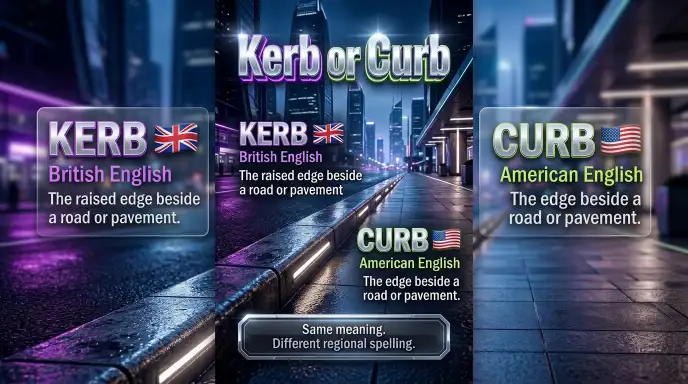
Kerb and curb are both correct spellings, but their use depends on the meaning and variety of English. British English uses kerb for the raised edge between a road and a pavement.
American English uses curb for the same feature. However, curb has another important use. It can act as a verb that means to control, limit, or restrain something. For example, a government may try to curb pollution, or a person may curb their spending. British English also uses curb as a verb.
This difference often confuses students, writers, and English learners. The good news is that the rule is simple once you understand the context. This guide explains the meaning, spelling, pronunciation, British and American differences, common mistakes, and everyday examples of kerb and curb.
Kerb or Curb: Quick Answer
Kerb and curb are both correct, but they do not always mean the same thing.
- Kerb: The British English spelling for the raised edge beside a road or pavement.
- Curb: The American English spelling for that same roadside edge.
- Curb as a verb: To control, limit, or restrain something in both British and American English.
Examples:
- British English: The driver parked beside the kerb.
- American English: The driver parked beside the curb.
- Both varieties: The new rules aim to curb pollution.
Easy rule: Use kerb for the roadside edge in British English. Use curb for the roadside edge in American English and for the verb meaning “control” in both varieties.
Definition and Meaning of Kerb
Kerb is a noun in British English. It refers to the raised edge that separates a road from a pavement, footpath, or other roadside area.
A kerb often helps define the boundary between the road and the pavement. It can also help direct rainwater toward roadside drains.
Kerb in a Sentence
- The driver stopped beside the kerb.
- Please do not park on the kerb.
- The workers repaired the broken kerb.
- She stepped down from the kerb to cross the road.
- Rainwater flowed along the kerb.
In each example, kerb refers to the physical edge beside the road.
British writers commonly use kerb in road safety instructions, driving discussions, and everyday conversation.
Definition and Meaning of Curb
Curb has two common meanings. It can refer to the raised edge beside a road, especially in American English. It can also act as a verb that means to control or limit something.
Curb as a Noun
In American English, a curb separates the road from the pavement or sidewalk.
Examples:
- The car stopped beside the curb.
- He sat on the curb outside the shop.
- The workers replaced the damaged curb.
- Keep your vehicle away from the curb.
American writers use curb for this roadside feature.
Curb as a Verb
As a verb, curb means to control, reduce, or restrain something. Both British and American English use this meaning.
Examples:
- The government introduced new rules to curb pollution.
- She tried to curb her spending.
- The company took steps to curb unnecessary costs.
- He struggled to curb his anger.
In these sentences, curb does not refer to a roadside edge. It describes an effort to control something.
Kerb vs Curb: Main Differences
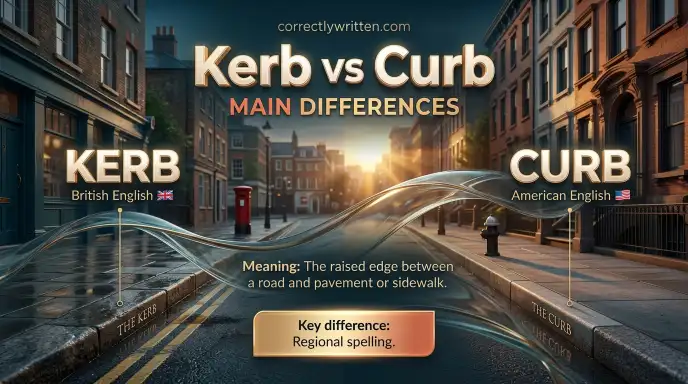
The main difference concerns regional spelling and grammatical meaning.
Kerb
- Usually a noun.
- Refers to the raised edge beside a road.
- Common in British English.
- Used in British road and driving contexts.
Curb
- A noun for the roadside edge in American English.
- A verb meaning to control, limit, or restrain.
- Used in both British and American English as a verb.
- Common in phrases such as “curb spending” and “curb pollution.”
The distinction matters because British English does not use kerb as a replacement for the verb curb.
For example:
- Correct: The car stopped beside the kerb. (British English)
- Correct: The car stopped beside the curb. (American English)
- Correct: The rules aim to curb pollution. (British and American English)
- Incorrect: The rules aim to kerb pollution.
Kerb or Curb in British and American English
British and American English often use different spellings for the same word. Kerb and curb provide a clear example.
British English: Kerb
British English uses kerb when referring to the raised edge beside a road.
Examples:
- The driver parked near the kerb.
- Please step onto the pavement from the kerb.
- The council repaired the damaged kerb.
However, British English uses curb as a verb.
Examples:
- The policy aims to curb spending.
- The new measures may curb traffic congestion.
American English: Curb
American English uses curb for both the roadside edge and the verb.
Examples:
- The driver parked near the curb.
- The city repaired the damaged curb.
- The government hopes to curb inflation.
Which Spelling Should You Use?
Choose the spelling that matches your audience.
- Writing for British readers: Use kerb for the roadside edge and curb for the verb.
- Writing for American readers: Use curb for both meanings.
- Writing for an international audience: Follow one variety consistently and make the context clear.
Remember that curb is not wrong in British English. It is the standard spelling of the verb in both varieties.
The Origin of Kerb and Curb
The words kerb and curb have a shared history. English developed different spellings for the roadside noun over time.
The spelling curb has older roots in English and was associated with a restraining strap or restraint. The word later developed other meanings, including the idea of controlling or limiting something.
The roadside meaning also became established in English. Over time, British English adopted the spelling kerb for the physical edge beside a road, while American English retained curb.
Today, the spelling difference mainly reflects regional usage. The verb curb, meaning to control or restrain, remains standard in both varieties.
Common Mistakes with Kerb and Curb
Writers often confuse these words because they sound alike. However, a few simple rules can help you choose the correct form.
Mistake 1: Using Curb for a British Roadside Edge
If you follow standard British spelling, use kerb for the raised road edge.
Less suitable for standard British usage: The car stopped beside the curb.
Preferred British spelling: The car stopped beside the kerb.
American English uses curb in the same sentence.
Mistake 2: Using Kerb as a Verb
Incorrect: The new policy will kerb pollution.
Correct: The new policy will curb pollution.
Use curb when you mean to control or reduce something.
Mistake 3: Assuming Curb Is Only American
This is incorrect. British English also uses curb as a verb.
Correct British English: The company wants to curb unnecessary spending.
Mistake 4: Mixing Regional Spellings
A writer may use British spelling in one paragraph and American spelling in another. This can make an article look inconsistent.
Choose a style and follow it throughout the piece. For British readers, write kerb for the road edge. For American readers, write curb.
Kerb and Curb in Everyday Examples

These examples show how each word works in natural sentences.
Examples with Kerb
- The taxi stopped beside the kerb.
- He sat on the kerb while waiting for his friend.
- The driver accidentally hit the kerb.
- Workers repaired the damaged kerb outside the school.
- She stepped onto the pavement from the kerb.
These examples follow British English spelling.
Examples with Curb as a Noun
- The car stopped beside the curb.
- The children sat on the curb outside their house.
- The driver hit the curb while parking.
- The city replaced the broken curb.
- Please keep the bicycle away from the curb.
These examples use the American spelling for the roadside edge.
Examples with Curb as a Verb
- The government wants to curb rising costs.
- She tried to curb her excitement.
- The company introduced rules to curb waste.
- New measures may curb dangerous driving.
- He took a deep breath to curb his anger.
These sentences work in both British and American English.
Kerb vs Curb: Easy Way to Remember
Use this simple memory trick:
British roadside edge = kerb
American roadside edge = curb
Control or limit something = curb
You can remember the difference through three short examples:
- British English: The car stopped beside the kerb.
- American English: The car stopped beside the curb.
- Both varieties: The rules aim to curb pollution.
The key is to check the meaning before choosing the spelling.
Frequently Asked Questions
Q1. Is kerb the same as curb?
Yes, kerb and curb refer to the same thing when describing the raised edge between a road and a pavement. Kerb is the standard British English spelling, while curb is the standard American English spelling. In American English, curb can also mean to control or limit something.
Q2. Why do British people spell it kerb?
British English uses kerb to distinguish the raised edge of a pavement from the verb curb, which means to control or restrain something. The spelling developed through historical usage and became the standard British form for the roadside structure.
Q3. What does “kerb” mean?
A kerb is the raised stone or concrete edge separating a road from a pavement, footpath, or similar area. For example, “She sat on the kerb while waiting for her friend.” In American English, the same structure is called a curb.
Q4. Do Australians say curb or kerb?
Australians generally use kerb for the raised edge beside a road, following British English spelling conventions. However, curb is used as a verb meaning to control or limit something, as in “curb spending.”
Q5. How do Aussies say “sorry”?
Australians pronounce sorry with an accent that often sounds like “SORee,” although the exact vowel varies by speaker and region. The word is used much as it is elsewhere in English to express an apology, sympathy, or regret.
Q6. How do British people say curb?
British people generally pronounce curb and kerb the same way: /kɜːb/, which sounds roughly like “kurb.” The spelling depends on the meaning and context, not the pronunciation. British English usually spells the roadside edge kerb.
Q7. How do British people say “burger”?
British people pronounce burger with a hard g, generally sounding like “BURguh” in nonrhotic British accents. The final r is usually not pronounced unless the next word begins with a vowel sound. Pronunciation varies across the UK.
Q8. Do Americans say kerb or curb?
Americans use curb for the raised edge beside a road or pavement. Kerb is not the standard American spelling. For example, an American would typically write, “The car pulled up to the curb.”
Final Thoughts
Kerb and curb are both correct spellings, but the right choice depends on the meaning and the variety of English.
British English uses kerb for the raised edge beside a road. American English uses curb for the same feature. However, both varietie use curb as a verb that means to control, limit, or restrain something.
For example, a British driver may park beside the kerb, while a city council may introduce rules to curb pollution. Understanding this distinction helps you avoid spelling mistakes and write more clearly.
🔍 Find the Perfect Word:
Mouths or Mouthes: Correct Spelling, Meaning & Usage

Hi, I’m Ava Collins, a writer and English language enthusiast behind CorrectlyWritten. I’m passionate about making grammar simple, clear, and easy to understand. I write about grammar rules, confusing words, spelling, and everyday English usage to help readers write more accurately and confidently.








2 thoughts on “Kerb or Curb: Correct Spelling, Meaning & Usage ”